What makes PEEK machining safe for medical devices?
Publication Date
author
In regulated healthcare manufacturing, safety is never assumed—it is proven through material purity, dimensional control, and validated process stability. That is why peek machining for medical devices requires more than tight tolerances. It must protect biocompatibility, preserve surface integrity, and reduce contamination risk while supporting repeatable production. In practice, safe machining decisions depend on the application scenario, because implantable parts, sterilizable instruments, and diagnostic assemblies each face different technical thresholds.
Why application context changes the safety standard for PEEK components
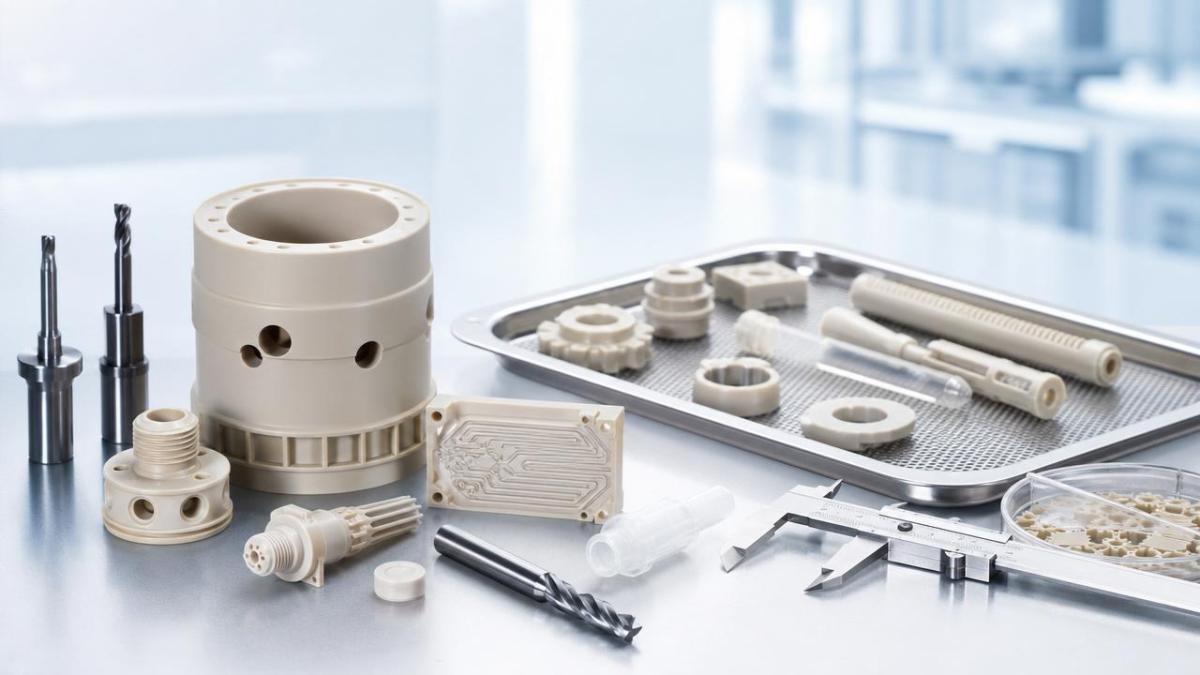
PEEK is valued in healthcare because it combines chemical resistance, high strength, and sterilization compatibility. Yet those advantages can be weakened by poor machining strategy.
For peek machining for medical devices, safety depends on where the part will be used, how long it will contact the body, and which cleaning or sterilization cycle follows machining.
A temporary surgical guide has different acceptance criteria than a long-term implant trial component. A housing inside a diagnostic device faces another risk profile entirely.
This is why engineering teams should judge safety through scenario-based controls rather than a generic “precision machining” claim. Context defines what must be verified.
Scenario 1: Implant-adjacent parts demand maximum control of heat, burrs, and residue
The highest-risk scenario involves parts that contact tissue, blood, or implant systems during use or validation. Here, thermal damage is a major hidden issue.
PEEK can tolerate high service temperatures, but local machining heat still matters. Excessive heat may smear the surface, alter edge quality, or trap contaminants.
Safe peek machining for medical devices in this scenario needs sharp tooling, controlled chip evacuation, and stable cutting parameters. Tool wear must be monitored before visible defects appear.
Deburring is equally critical. Microscopic burrs may break loose during assembly or cleaning. That creates a particle risk that can undermine qualification.
Core judgment points in implant-adjacent use
- Whether cutting heat changes the surface appearance or creates smearing
- Whether edges remain burr-free after machining and cleaning
- Whether coolant, lubricant, or handling residue can be fully removed
- Whether lot traceability covers raw material and machining steps
Scenario 2: Reusable surgical instruments require dimensional stability after repeated sterilization
Some PEEK parts are not implanted, yet they still face strict safety requirements. Reusable surgical devices are a common example.
In this setting, peek machining for medical devices must account for repeated autoclave or chemical sterilization exposure. A part may machine well initially, then drift later.
Stress introduced during machining can influence dimensional retention over time. Thin walls, slots, and asymmetric geometries are especially sensitive.
Surface finish also matters. Rougher features may hold residue and make validated cleaning harder. A safer process balances productivity with stable geometry and cleanable surfaces.
What to verify in sterilizable tool components
- Dimensional repeatability before and after sterilization cycles
- Surface finish in crevices, grooves, and joint areas
- Residual stress risk from aggressive machining passes
- Part deformation during fixturing or post-process handling
Scenario 3: Diagnostic and analytical devices prioritize cleanliness and assembly fit
PEEK is often selected for medical analyzers, fluidic systems, and imaging-related assemblies. Here, patient contact may be limited, but safety still depends on process discipline.
For this scenario, peek machining for medical devices is judged by particle control, sealing performance, and dimensional fit with sensors, valves, or precision mating parts.
A tiny dimensional error can affect flow paths or leak performance. A small chip left in an internal channel can compromise test reliability.
This makes process validation broader than geometry alone. Cleaning effectiveness, inspection access, and packaging protection become part of the safety discussion.
How safety needs differ across common medical PEEK machining scenarios
Practical process controls that make PEEK machining safer
Across all scenarios, safer peek machining for medical devices comes from disciplined process control rather than one single machine setting.
Recommended control measures
- Use medical-grade traceable PEEK stock with documented lot history.
- Define cutting windows that limit heat buildup and edge deformation.
- Separate medical PEEK workflows from contaminated mixed-material production where possible.
- Validate cleaning methods for chips, residue, and handling contamination.
- Inspect critical features using methods matched to surface and geometry risk.
- Control packaging to prevent recontamination after final cleaning.
Documentation is also part of safety. Process sheets, revision control, tool life records, and inspection results support repeatability and compliance expectations.
Common mistakes that make PEEK machining unsafe in medical use
Several issues are often missed when evaluating peek machining for medical devices. These gaps usually appear after validation trouble, not before.
- Assuming dimensional accuracy alone proves medical safety
- Ignoring microscopic burrs because macroscopic edges look acceptable
- Using machining aids without proving residue removal
- Overlooking stress release in thin or complex geometries
- Skipping post-sterilization checks for reusable applications
- Failing to link packaging cleanliness to final part safety
A data-driven review helps avoid these errors. In precision manufacturing, claims should be supported by measurable evidence, not generic quality language.
How to evaluate the right machining approach before production release
A useful evaluation path begins with the real use case. Define contact level, sterilization method, dimensional risk, and cleanliness threshold first.
Then match the process plan to that scenario. For peek machining for medical devices, that means reviewing tooling, workholding, cleaning, inspection, and packaging together.
Action steps for a safer release decision
- Map the component to its exact medical application scenario.
- List failure modes tied to heat, particles, stress, and residue.
- Request evidence for cleaning validation and critical feature inspection.
- Review sterilization or environmental exposure effects when relevant.
- Confirm traceability from raw material through final packaging.
Safe peek machining for medical devices is achieved when the machining route fits the application, the risks are measurable, and the controls are verifiable. In a regulated environment, that is what turns precision into dependable safety.
Search News
Hot Articles
- Carbon Fiber StructuresHow to Specify Aerospace Carbon Fiber Assemblies for Lightweight, Load-Bearing PartsJul 11, 2026
- Machine VisionXiaomi, Alibaba DAMO Academy Drive Open-Source Robotics Model Ecosystem, Lowering Algorithm Development Barriers for Overseas SMEs Adopting Chinese Robotics SolutionsMar 30, 2026
- Cobots & ArmsShanxi 'AI+' Conference Showcases Embodied Intelligence with Multinational Buyer Engagement: Key Industry ImplicationsMar 30, 2026
Popular Tags
Recommended News
 Jul 11, 2026How to Specify Aerospace Carbon Fiber Assemblies for Lightweight, Load-Bearing PartsAerospace carbon fiber assemblies: learn how to specify laminate design, load data, joining methods, and inspection controls for lighter, reliable load-bearing aerospace parts.Elena Rostova (UAV Systems Researcher)
 Mar 30, 2026Xiaomi, Alibaba DAMO Academy Drive Open-Source Robotics Model Ecosystem, Lowering Algorithm Development Barriers for Overseas SMEs Adopting Chinese Robotics SolutionsXiaomi & Alibaba DAMO Academy's open-source robotics models lower algorithm barriers for global SMEs. Boost efficiency in manufacturing, logistics & smart retail with ROS 2 compatible solutions.TSV Data Lab
 Mar 30, 2026Shanxi 'AI+' Conference Showcases Embodied Intelligence with Multinational Buyer Engagement: Key Industry ImplicationsShanxi 'AI+' Conference highlights embodied intelligence with Tesla, Ubtech & Jiantao showcasing multimodal robotics. 40+ global buyers validated tech on-site, creating new B2B channels for industrial automation & AI solutions.Chen Wei (Automation Lead Engineer)
 Mar 30, 2026Zhongguancun Unveils 6G Integrated Sensing-Computing-Intelligence Platform to Empower Embodied Robots for Global Industrial ApplicationsZhongguancun's new 6G platform revolutionizes industrial robotics with <10ms latency, empowering global automotive, logistics & port automation. Discover how this tech boosts China's smart manufacturing exports.TSV Data Lab
 Mar 30, 2026Mech-Mind Tianjin Embodied Intelligence R&D and Production Base Goes Live, Cutting Delivery Time by 20%–30% for Global Customized AMR+Vision SolutionsMech-Mind's Tianjin AMR+Vision production base cuts delivery time by 20%-30% for欧美 & Latin American markets. Discover how this PLd-certified facility accelerates customized robotics solutions for smart manufacturing and logistics.Chen Wei (Automation Lead Engineer)
 Mar 30, 2026Boao Forum Reveals 'Co-evolution of Big and Small Brains' Trend in Humanoid Robots, China's Embodied Intelligence Accelerates Adaptation to Overseas Manufacturing Service ScenariosDiscover how China's humanoid robots, featuring 'Co-evolution of Big and Small Brains,' are revolutionizing global manufacturing. Learn about Embodied Tian Gong 3.0's ISO compliance and overseas deployment at Boao Forum 2026.Chen Wei (Automation Lead Engineer)
 Mar 30, 2026China Railway Industrial Secures Patent for Embodied Robotics in Material Handling, Boosting High-Precision Delivery Capabilities for Overseas Infrastructure and Manufacturing ProjectsChina Railway Industrial's new patent for embodied robotics in material handling boosts high-precision delivery for global infrastructure & manufacturing. Discover how this innovation enhances logistics accuracy in automotive, rail transit & EPC projects.Chen Wei (Automation Lead Engineer)
 Oct 06, 2026Navigation Fault Tolerance Standards for AMRs: What Safety Teams Must VerifyNavigation fault tolerance standards: learn what AMR safety teams must verify, from localization loss and sensor faults to stopping distance, safe restart, and site-specific validation.Chen Wei (Automation Lead Engineer)
 Oct 05, 2026Calculating Edge Computing Total Cost of Ownership Across Distributed SitesEdge computing ownership cost explained: calculate deployment, energy, connectivity, security, remote support, and refresh costs across distributed sites.TSV Data Lab
 Oct 04, 2026CAD/CAM Benchmarking in the GCC: What Manufacturers Should Ask a ConsultantCAD CAM benchmark consultant GCC guide: learn the key questions manufacturers should ask to validate post-processors, workflows, machine performance, and production risk.Victor Lin (Chief Software Architect)
 Oct 03, 2026Selecting Automotive Radar Sensor Modules for ADAS Range, Resolution, and IntegrationAutomotive radar sensor module selection guide for ADAS: compare range, resolution, field of view, latency, and integration to build safer, reliable vehicle systems.TSV Data Lab
 Oct 02, 2026How to Qualify Machined Parts Suppliers for Hard Tech ProgramsHard tech supply chain machined parts demand rigorous supplier qualification. Learn how to assess capability, traceability, quality controls, and delivery resilience.Dr. Marcus Vance
 Oct 01, 2026How to Select an Outdoor Security Radar Sensor for Perimeter Detection?Outdoor security radar sensor selection guide: compare range, accuracy, false-alarm control, integration, and field testing for reliable perimeter detection.TSV Data Lab
 Sep 30, 2026How to Evaluate Solid-State LiDAR Hardware for Outdoor Autonomous VehiclesSolid state LiDAR hardware evaluation guide for outdoor autonomous vehicles—compare range, point-cloud quality, environmental resilience, integration, and safety.TSV Data Lab
 Sep 29, 2026ISO 9283 Repeatability: How to Evaluate Cobot Positioning PerformanceISO 9283 cobot repeatability explained: learn how payload, reach, approach direction, and test conditions affect positioning performance and cell capability.Chen Wei (Automation Lead Engineer)
 Oct 06, 2026Are Collaborative Robots Safe Enough to Operate Without Fencing?Are collaborative robots safe enough to work without fencing? Explore risk assessment, safeguarding options, and practical guidance for safer, productive cobot cells.Chen Wei (Automation Lead Engineer)
 Oct 05, 2026What Causes Machine Vision Systems to Miss Small Defects?What causes machine vision systems to miss small defects? Discover how lighting, optics, motion, and AI thresholds affect detection—and prevent costly escapes.TSV Data Lab
 Oct 04, 2026How Should You Compare 5-Axis CNC Machine Accuracy Claims?How do I compare 5-axis CNC machine accuracy claims? Learn how to assess standards, thermal stability, TCP accuracy, and real-world test evidence.Dr. Marcus Vance
 Oct 03, 2026Is Edge Computing Necessary for Real-Time Quality Inspection?Is industrial edge computing necessary for real-time quality inspection? Explore how latency, data volume, reliability, and control integration shape the right architecture.TSV Data Lab
 Oct 02, 2026What Documents Prove a Precision Machining Supplier Can Hold Tolerance?What documents prove a precision machining supplier can hold tolerance? Explore certificates, FAI reports, calibration, SPC, and traceability evidence to qualify suppliers with confidence.Dr. Marcus Vance
 Oct 01, 2026Can a Machining Supplier Meet Aerospace Fatigue Testing Requirements?Can a machining supplier meet aerospace fatigue testing requirements? Learn the traceability, process control, and test evidence needed for reliable aerospace parts.Dr. Marcus Vance
 Sep 30, 2026Which Industrial Robot Specifications Matter for High-Precision Assembly?Which industrial robot specifications matter most for high-precision assembly? Explore repeatability, accuracy, stiffness, vibration, calibration, and force control for reliable yields.Chen Wei (Automation Lead Engineer)
 Sep 29, 2026How Do You Verify Servo Motor Torque Under Continuous Load?How do I verify servo motor torque under continuous load? Learn RMS torque checks, torque-speed limits, thermal derating, and real-machine testing.Chen Wei (Automation Lead Engineer)
 Oct 02, 2026ZD330 Software Configuration: Verifying Cut-List Import Before PurchaseZD330 software and machine configuration: verify cut-list imports, data mapping, labels, and workflow before purchase to reduce errors and choose with confidence.Victor Lin (Chief Software Architect)