ZD330 Software Configuration: Verifying Cut-List Import Before Purchase
Publication Date
author
Why Cut-List Import Should Be Treated as a Purchase-Test Item
A beam saw can appear suitable on a specification sheet while still creating avoidable work at the programming stage. The critical question is not merely whether its software can “import files,” but whether it can interpret the shop’s actual cut-list structure accurately, consistently, and with enough control for production use.
For technical evaluators, cut-list import is where machine capability, data quality, material handling, optimization rules, labeling, and operator workflow meet. A weak import process may force staff to rebuild jobs manually, correct dimensions line by line, or separate a single order into multiple files before cutting begins. Those tasks can introduce errors before the saw has made its first cut.
Testing import before purchase is especially important when a factory receives panel data from multiple sources: cabinet-design software, ERP systems, spreadsheets, production planning tools, or customer-supplied lists. The same nominal field—such as length, width, grain direction, or material code—may be represented differently in each source. A successful demonstration should prove that the proposed system can handle the company’s real data, rather than a clean sample file prepared by the supplier.
Import Capability Is More Than File Compatibility
Many evaluation discussions stop at file extensions: CSV, XLSX, TXT, XML, DXF, or a proprietary export format. That is a useful starting point, but it does not establish whether the imported job will produce the intended cutting plan.
A cut list contains operational meaning. A field may identify the finished part size, while another describes the source board size. One column may state a material name used by the planning department, while the machine database may require a stock code, thickness assignment, or program-specific material record. If the software treats a header row as production data, reverses length and width, ignores a quantity field, or applies grain restrictions incorrectly, the file may import without an error message and still generate an unsuitable program.
Technical teams should separate import evaluation into three layers:
- File reading: Can the software open the file and recognize delimiters, text encoding, decimal symbols, and column headers?
- Data mapping: Can source fields be reliably assigned to part dimensions, quantities, materials, edge or grain information, labels, and job references?
- Production interpretation: Does the resulting optimization, cutting sequence, label output, and exception handling match the shop’s intended workflow?
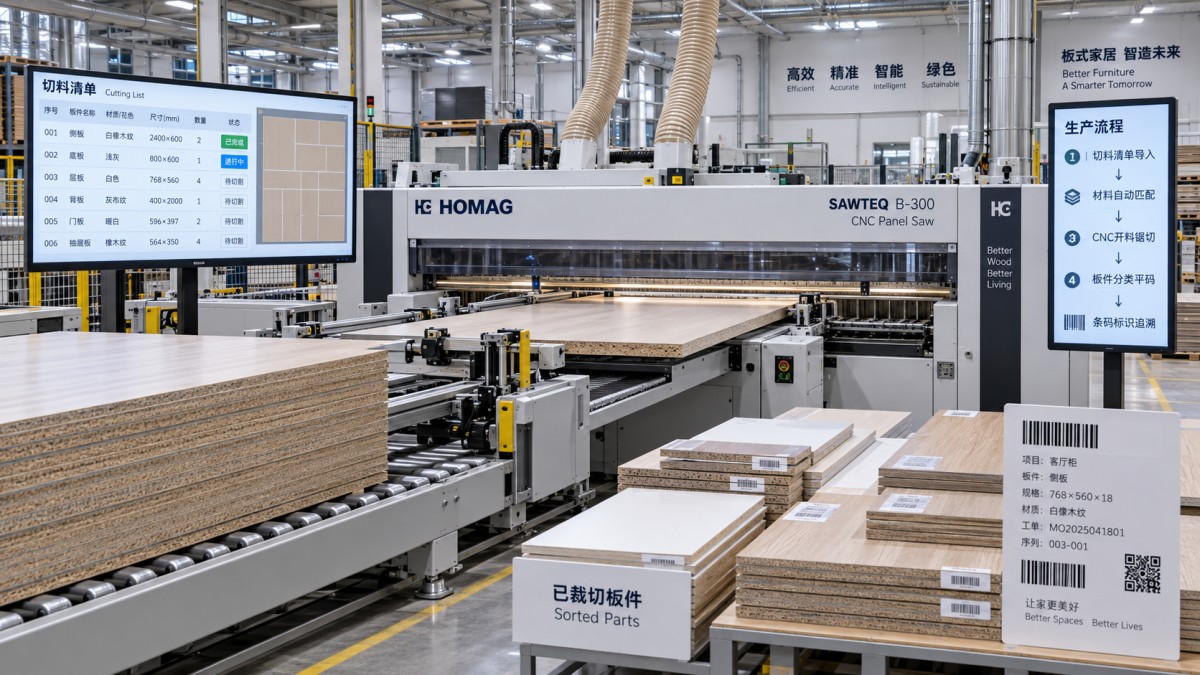
A supplier demonstration that proves only the first layer is incomplete. The meaningful test is a traceable path from the original list to the physical part, including the information an operator needs at loading, cutting, sorting, and downstream assembly.
Build a Test Pack From Real Production Conditions
The most useful pre-purchase test pack is drawn from recent work, with customer names and sensitive pricing removed where necessary. It should not contain only straightforward rectangular parts in one material. A representative pack exposes the conditions that make data exchange difficult in day-to-day production.
Include at least several types of jobs: a routine batch with repeated components, a mixed-material order, a job with rotated parts or directional grain, and a file containing unusual but legitimate entries such as blanks, notes, revision identifiers, or parts requiring manual review. If the facility processes coated board, plywood, MDF, particleboard, or other panel types, the test files should reflect the material naming conventions already used internally.
It is equally useful to include imperfect inputs. For example, one controlled test may contain a missing thickness value, a material code absent from the machine database, a non-numeric quantity, or a part larger than the available panel. The purpose is not to make the system fail. It is to determine whether it stops the job clearly, flags the affected records, or silently substitutes assumptions. Silent substitution is often harder to detect than a rejected file.
Keep the original files unchanged and create a review sheet showing expected part count, dimensions, material assignments, grain requirements, and intended output. This becomes the acceptance reference during the demonstration and later during factory acceptance or site commissioning.
Questions That Reveal Whether Mapping Is Maintainable
Import settings may work during an initial demonstration yet become fragile when a customer changes a spreadsheet template or an internal software update alters a field name. Evaluators should establish who can maintain mappings and how changes are controlled.
Ask whether a trained production engineer can create or edit an import template without changing machine-control logic. Clarify whether mappings are stored per customer, material family, job type, or machine. Determine whether the system preserves the source file, import log, error report, and edited job version. These records matter when a discrepancy is found after cutting has started.
There should also be a clear answer on units and numeric conventions. A source system may export millimetres with a decimal point, while a regional spreadsheet setup may use a decimal comma. Fractional values, leading zeros, spaces in material names, and quotation marks within descriptions can all affect parsing. A competent test includes these issues instead of assuming that a visually correct spreadsheet will be interpreted correctly by production software.
Check dimensional meaning, not only numerical values
Length and width fields can be numerically correct but operationally wrong. On a beam saw, orientation may affect grain direction, label placement, feeding sequence, optimization, and whether a part can be rotated. A 600 × 300 mm part and a 300 × 600 mm part are not always interchangeable.
For each selected test part, compare the source record with the imported screen, cutting pattern, printed label, and finished component. Verify finished dimensions versus trim allowance, kerf treatment, and any machining allowance that is expected to be added elsewhere in the process. The software’s rule for these values should be explicit. A planning system that adds trim while the saw program also adds trim can produce oversized parts; the opposite arrangement can leave insufficient stock for finishing operations.
Evaluate the Connection Between Software Rules and Machine Hardware
Software is not a separate procurement item when it governs how work reaches the saw. Optimization settings must reflect physical conditions such as saw kerf, clamp limits, pusher travel, minimum strip width, loading direction, scoring requirements, waste handling, and supported board sizes. A mathematically efficient pattern may not be executable if it conflicts with machine constraints or material-handling limits.
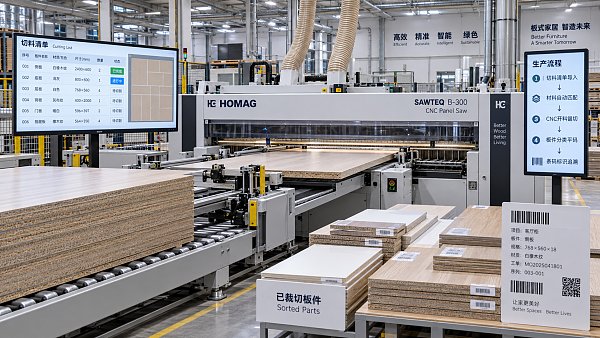
This is why the evaluation of ZD330 software and machine configuration should focus on the relationship between imported job data and the actual cutting process. A relevant product reference can help evaluators frame the machine-side questions, but the supplier should still demonstrate how the proposed configuration handles the facility’s own panels, file formats, material database, and production rules.
Ask for a visible explanation of what happens when imported data requires an unsupported operation. Examples include a panel exceeding the configured cutting envelope, a thickness not assigned to a material record, an invalid rotation instruction, or a part that cannot be cut within clamp and trim restrictions. A useful system should provide an understandable exception message and preserve enough context for the planner to correct the source data or adjust the job deliberately.
Optimization should also be reviewed in operational terms. Yield is relevant, but it is not the only criterion. A pattern that creates many small remnants can increase sorting effort and make offcuts difficult to reuse. A sequence with excessive handling steps may slow production even when board utilization appears attractive. Technical evaluators should decide which rules are fixed, which are adjustable, and which can be overridden for a particular order with appropriate authorization.
Run a Traceability Test From Import to Label
Where cut parts move to edge banding, drilling, CNC nesting, assembly, or packing, labels often carry the link between the saw and the next process. Import verification should examine whether each part’s identity survives the entire workflow.
A practical test follows a small set of parts through these checkpoints:
- Source file record and original job revision;
- Imported part record, including quantity and material assignment;
- Optimization result and designated source board;
- Machine program and actual cutting sequence;
- Printed label content, barcode or identifier where used;
- Physical part measurement and downstream routing information.
The label does not need to contain every source field. It should contain enough information to prevent ambiguous identification in the receiving process. A shop producing repeated cabinet parts, for example, may need order reference, cabinet or batch identifier, part name, dimensions, material, edge status, and revision control. The appropriate label layout depends on the downstream process, but the imported data should populate it reliably.
Barcode verification should be physical, not assumed. If labels are part of the workflow, print them during the test, apply them to representative panel surfaces, and scan them using the equipment and lighting conditions found on the shop floor. Readability can be affected by print contrast, label material, dust, handling, and placement near cut edges. This is an operational validation rather than a claim that a particular code format will work in every environment.
Do Not Separate Import Validation From Change Control
Cut lists change. A customer may alter dimensions after a nesting plan is generated, an estimator may substitute a material, or a production planner may reissue a job after discovering a shortage. The evaluation should establish whether revised files overwrite previous jobs, create a new revision, or require manual deletion of an earlier program.
Unclear revision control creates a familiar risk: the correct file is imported, but the operator runs an earlier version already stored at the machine. Useful controls may include unique job identifiers, revision status, timestamps, restricted approval rights, and a visible warning when an imported job duplicates or supersedes an existing one. The right combination depends on how the factory schedules work, but the responsibility for releasing the final cut program should be defined before commissioning.
Data access also deserves attention when job files move across office and shop-floor networks. ISO/IEC 27001:2022 provides a framework for managing information-security risks, although certification is not a substitute for reviewing the actual interfaces, user permissions, backup methods, and vendor remote-access arrangements involved in a specific installation. Source: ISO, ISO/IEC 27001:2022 Information security management systems — Requirements.
Safety and Acceptance Responsibilities
Imported information can affect production decisions, but it should not bypass machine safeguards or substitute for safe operating procedures. A cutting program should be reviewed within the machine’s permitted operating range, and operators need clear procedures for exceptions, interrupted jobs, scrap removal, blade changes, and fault recovery.
For machinery risk assessment, ISO 12100:2010 describes principles for hazard identification, risk estimation, and risk reduction. Electrical equipment associated with machinery is addressed by IEC 60204-1:2016. These documents do not validate a particular saw or software package; they provide reference frameworks for the manufacturer’s technical documentation, the buyer’s site risk assessment, and the integration of controls into the intended work environment. Sources: ISO, ISO 12100:2010 Safety of machinery — General principles for design — Risk assessment and risk reduction; IEC, IEC 60204-1:2016 Safety of machinery — Electrical equipment of machines.
Acceptance criteria should state what counts as a pass. “The file imported” is not enough. A stronger criterion might require all test records to be accounted for, dimensions and quantities to match the approved source, material and grain logic to be correctly applied, unsupported records to be clearly reported, labels to correspond with physical parts, and revision handling to be demonstrated.
The decision should then rest on evidence from the factory’s own files and workflow. If the supplier needs to modify an export template, map materials, or configure operational rules, those actions should be documented as deliverables rather than left as informal assumptions after the machine order is placed.
Search News
Hot Articles
- Carbon Fiber StructuresHow to Specify Aerospace Carbon Fiber Assemblies for Lightweight, Load-Bearing PartsJul 11, 2026
- Machine VisionXiaomi, Alibaba DAMO Academy Drive Open-Source Robotics Model Ecosystem, Lowering Algorithm Development Barriers for Overseas SMEs Adopting Chinese Robotics SolutionsMar 30, 2026
- Cobots & ArmsShanxi 'AI+' Conference Showcases Embodied Intelligence with Multinational Buyer Engagement: Key Industry ImplicationsMar 30, 2026
Popular Tags
Recommended News
 Jul 11, 2026How to Specify Aerospace Carbon Fiber Assemblies for Lightweight, Load-Bearing PartsAerospace carbon fiber assemblies: learn how to specify laminate design, load data, joining methods, and inspection controls for lighter, reliable load-bearing aerospace parts.Elena Rostova (UAV Systems Researcher)
 Mar 30, 2026Xiaomi, Alibaba DAMO Academy Drive Open-Source Robotics Model Ecosystem, Lowering Algorithm Development Barriers for Overseas SMEs Adopting Chinese Robotics SolutionsXiaomi & Alibaba DAMO Academy's open-source robotics models lower algorithm barriers for global SMEs. Boost efficiency in manufacturing, logistics & smart retail with ROS 2 compatible solutions.TSV Data Lab
 Mar 30, 2026Shanxi 'AI+' Conference Showcases Embodied Intelligence with Multinational Buyer Engagement: Key Industry ImplicationsShanxi 'AI+' Conference highlights embodied intelligence with Tesla, Ubtech & Jiantao showcasing multimodal robotics. 40+ global buyers validated tech on-site, creating new B2B channels for industrial automation & AI solutions.Chen Wei (Automation Lead Engineer)
 Mar 30, 2026Zhongguancun Unveils 6G Integrated Sensing-Computing-Intelligence Platform to Empower Embodied Robots for Global Industrial ApplicationsZhongguancun's new 6G platform revolutionizes industrial robotics with <10ms latency, empowering global automotive, logistics & port automation. Discover how this tech boosts China's smart manufacturing exports.TSV Data Lab
 Mar 30, 2026Mech-Mind Tianjin Embodied Intelligence R&D and Production Base Goes Live, Cutting Delivery Time by 20%–30% for Global Customized AMR+Vision SolutionsMech-Mind's Tianjin AMR+Vision production base cuts delivery time by 20%-30% for欧美 & Latin American markets. Discover how this PLd-certified facility accelerates customized robotics solutions for smart manufacturing and logistics.Chen Wei (Automation Lead Engineer)
 Mar 30, 2026Boao Forum Reveals 'Co-evolution of Big and Small Brains' Trend in Humanoid Robots, China's Embodied Intelligence Accelerates Adaptation to Overseas Manufacturing Service ScenariosDiscover how China's humanoid robots, featuring 'Co-evolution of Big and Small Brains,' are revolutionizing global manufacturing. Learn about Embodied Tian Gong 3.0's ISO compliance and overseas deployment at Boao Forum 2026.Chen Wei (Automation Lead Engineer)
 Mar 30, 2026China Railway Industrial Secures Patent for Embodied Robotics in Material Handling, Boosting High-Precision Delivery Capabilities for Overseas Infrastructure and Manufacturing ProjectsChina Railway Industrial's new patent for embodied robotics in material handling boosts high-precision delivery for global infrastructure & manufacturing. Discover how this innovation enhances logistics accuracy in automotive, rail transit & EPC projects.Chen Wei (Automation Lead Engineer)
 Oct 02, 2026How to Qualify Machined Parts Suppliers for Hard Tech ProgramsHard tech supply chain machined parts demand rigorous supplier qualification. Learn how to assess capability, traceability, quality controls, and delivery resilience.Dr. Marcus Vance
 Oct 01, 2026How to Select an Outdoor Security Radar Sensor for Perimeter Detection?Outdoor security radar sensor selection guide: compare range, accuracy, false-alarm control, integration, and field testing for reliable perimeter detection.TSV Data Lab
 Sep 30, 2026How to Evaluate Solid-State LiDAR Hardware for Outdoor Autonomous VehiclesSolid state LiDAR hardware evaluation guide for outdoor autonomous vehicles—compare range, point-cloud quality, environmental resilience, integration, and safety.TSV Data Lab
 Sep 29, 2026ISO 9283 Repeatability: How to Evaluate Cobot Positioning PerformanceISO 9283 cobot repeatability explained: learn how payload, reach, approach direction, and test conditions affect positioning performance and cell capability.Chen Wei (Automation Lead Engineer)
 Oct 01, 2026Can a Machining Supplier Meet Aerospace Fatigue Testing Requirements?Can a machining supplier meet aerospace fatigue testing requirements? Learn the traceability, process control, and test evidence needed for reliable aerospace parts.Dr. Marcus Vance
 Sep 30, 2026Which Industrial Robot Specifications Matter for High-Precision Assembly?Which industrial robot specifications matter most for high-precision assembly? Explore repeatability, accuracy, stiffness, vibration, calibration, and force control for reliable yields.Chen Wei (Automation Lead Engineer)
 Sep 29, 2026How Do You Verify Servo Motor Torque Under Continuous Load?How do I verify servo motor torque under continuous load? Learn RMS torque checks, torque-speed limits, thermal derating, and real-machine testing.Chen Wei (Automation Lead Engineer)
 Oct 02, 2026ZD330 Software Configuration: Verifying Cut-List Import Before PurchaseZD330 software and machine configuration: verify cut-list imports, data mapping, labels, and workflow before purchase to reduce errors and choose with confidence.Victor Lin (Chief Software Architect)
 Sep 28, 2026Spindle Runout Measurement in Germany: DIN Standards, Methods, and Acceptance LimitsSpindle runout measurement Germany: explore DIN standards, proven methods, acceptance limits, and audit-ready practices for reliable machining quality.Dr. Marcus Vance
 Sep 27, 2026How to Select Wall-Mount Edge Devices for Space-Constrained Factory NetworksWall mount edge devices for space-constrained factories: evaluate workload, thermal design, power resilience, cable access, and network reliability for smarter deployments.TSV Data Lab
 Sep 26, 2026Machining Tolerance Analysis: How to Set Limits That Meet Function and Cost TargetsMachining tolerance analysis: learn how to set functional limits, control tolerance stacks, reduce inspection risk, and balance precision with production cost.Dr. Marcus Vance
 Sep 25, 2026How to Evaluate an Industrial Infrastructure Data Platform for Multi-Site OperationsIndustrial infrastructure data platform evaluation guide for multi-site operations: compare data quality, edge resilience, interoperability, governance, and scalable proof-of-value criteria.Victor Lin (Chief Software Architect)
 Sep 24, 2026How to Select Machine Vision Optics for Accurate Inspection at Different Working DistancesMachine vision optics selection guide for accurate inspection at every working distance. Compare FOV, pixel scale, DOF, distortion, lighting, and telecentric options.TSV Data Lab
 Sep 23, 2026How to Evaluate a Machine Vision System Integrator for High-Speed Inspection LinesChoose a machine vision system integrator with proven expertise in high-speed inspection, reliable reject timing, robust optics, and measurable acceptance criteria.TSV Data Lab
 Oct 01, 2026What is included in a robotic system integration project cost?Robotic system integration project cost explained: compare equipment, engineering, safety, testing, installation, and lifecycle factors for smarter automation investments.Chen Wei (Automation Lead Engineer)
 Sep 30, 2026How much does warehouse automation cost for a growing distribution center?How much does warehouse automation cost? Explore equipment, integration, facility upgrades, lifecycle expenses, and ROI factors for a growing distribution center.Chen Wei (Automation Lead Engineer)
 Sep 29, 2026How MES and OEE work together to identify production lossesMES and OEE work together to uncover hidden production losses, connect downtime, speed, and quality data, and drive smarter shop-floor improvements.Victor Lin (Chief Software Architect)