Is Edge Computing Necessary for Real-Time Quality Inspection?
Publication Date
author
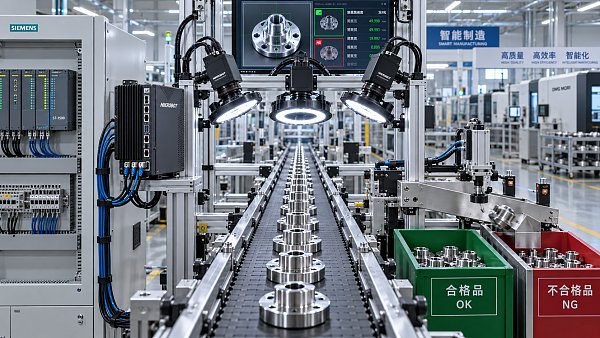
Edge computing is not inherently necessary for real-time quality inspection. It becomes necessary when the inspection decision must be made faster, more reliably, or closer to the production process than a centralized system can support. A factory inspecting slow-moving, low-volume parts may gain little from local inference. A line rejecting defects at high speed, handling multi-camera images, or operating where network interruptions cannot pause quality control may require it as part of the inspection architecture.
The practical question is not whether edge AI is more advanced than cloud or server-based inspection. It is whether the time between image capture and a usable quality decision fits inside the process window. That window includes acquisition, data transfer, preprocessing, inference, decision logic, PLC communication, actuator response, and evidence storage. If any part of that chain exceeds the available time, inspection becomes retrospective rather than corrective.
Start with the defect-response window, not the computing platform
“Real time” has no universal meaning in industrial inspection. In one application, an operator may have several minutes to review a weld image before the next manufacturing stage begins. In another, a defective cap, component, label, or machined part must be rejected while it is still within reach of a diverter or robot. These are fundamentally different engineering problems.
A useful assessment begins by defining the maximum permissible decision time:
- Detection point: Where is the part, surface, or assembly captured?
- Intervention point: Where can the process still stop, reject, rework, or mark the item?
- Transport time: How long does the product take to move between those points?
- Process consequence: What happens if the decision arrives late: scrap, mixed lots, untraceable product, safety exposure, or merely delayed reporting?
If a product travels from camera to reject station in 300 milliseconds, the complete inspection loop must comfortably fit within that period, with margin for normal operating variation. It is not sufficient for an AI model to infer an image in 100 milliseconds if camera buffering, network transmission, database calls, and control-system handoff consume the remaining time.
This is where industrial edge computing can matter. By placing acquisition, inference, and immediate control decisions near the machine or cell, it removes or reduces network-dependent delay from the critical path. The edge device does not make the model more accurate by itself. It makes the path from observation to action more deterministic.
Latency is only one part of the decision
It is common to reduce the architecture discussion to “cloud latency versus edge latency.” That framing is incomplete. A quality system can fail its real-time requirement even on a low-latency network when its design creates unnecessary dependencies.
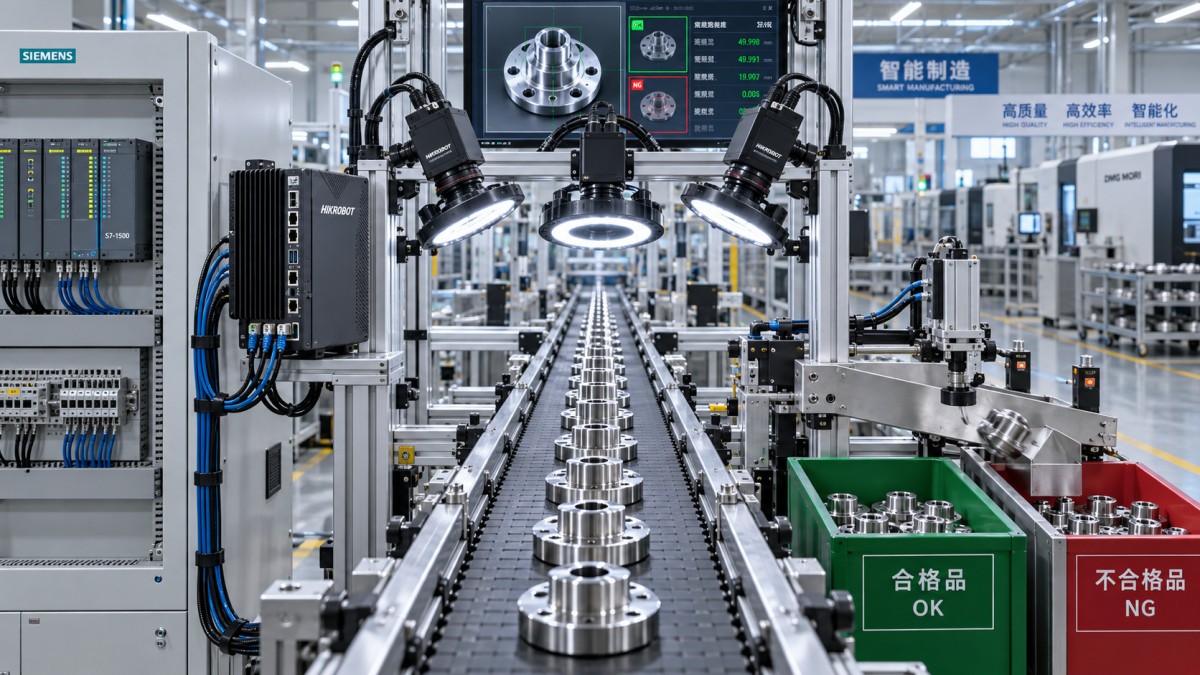
Consider a vision inspection station using several high-resolution cameras. Raw image streams may be large, particularly where the task requires fine surface-defect detection, optical character verification, dimensional measurement, or multi-angle inspection. Sending every image to a central server may be workable on a well-engineered local network. Sending all raw imagery to a remote environment introduces dependence on bandwidth, congestion, routing, security controls, and service availability.
The issue is not simply average delay. Production quality decisions depend on worst-case behavior. A system that responds quickly most of the time but occasionally stalls can cause missed rejects, uncontrolled accumulation of products, or line stoppages. For time-critical inspection, predictable response is often more valuable than a favorable average benchmark.
Industrial edge computing is therefore most justified where the inspection loop cannot tolerate a communication round trip outside the cell. This may include high-speed packaging, continuous web inspection, automated assembly, sorting operations, and processes in which a defect must trigger an immediate machine-state change.
When centralized processing is sufficient
Not every visual inspection task needs compute hardware at every line. A centralized on-premises server can be an effective choice when camera traffic remains within the plant network, the required response time is measured in seconds rather than fractions of a second, and the server has enough reserved capacity for concurrent workloads.
This model is often appropriate for batch inspection, final quality review, offline metrology analysis, low-frequency inspection events, or applications where production can hold a part until the result returns. Centralization can also simplify model governance: software updates, version control, cybersecurity patching, user management, and data retention may be easier to administer from a common infrastructure layer.
Cloud resources have a different role. They are valuable for long-term image retention, cross-site analytics, model development, model training, remote engineering review, and fleet-level performance monitoring. Those activities usually benefit from aggregation rather than proximity. They do not necessarily belong in the millisecond-sensitive decision path.
For this reason, the most defensible architecture is frequently hybrid rather than ideological. The edge handles acquisition, inference, pass/fail decisions, alarms, and local buffering. A central server or cloud environment receives selected images, metadata, model performance records, audit trails, and exceptions for broader analysis. This avoids treating every camera frame as enterprise data while preserving the evidence needed for traceability and continuous improvement.
High image volume is a stronger edge trigger than many buyers expect
Inspection systems are often specified around camera resolution and AI model accuracy, while the cost of moving and retaining visual data receives less attention. Yet data volume can change the architecture decision quickly.
A single image may be manageable. Several cameras capturing multiple images per part at production speed create a continuous data stream. Add depth sensors, line-scan cameras, thermal imaging, or multiple lighting conditions, and the system may generate much more data than the central environment needs for immediate decisions.
Edge processing allows the station to turn raw imagery into a smaller operational record: pass/fail status, defect class, confidence score, measurement result, timestamp, machine state, part identifier, and a retained image only where policy requires it. This is not merely a bandwidth optimization. It can improve data discipline by separating what must be acted upon immediately from what must be retained for quality evidence.
That distinction matters in regulated or high-traceability environments. A manufacturer may need to retain proof of inspection, link results to serial or batch numbers, and demonstrate that a released product met defined acceptance criteria. Local processing does not remove these obligations. It must preserve reliable synchronization, record integrity, and a clear association between the decision, the part, and the approved inspection configuration.
Edge devices do not solve weak inspection fundamentals
The most costly misconception is that moving AI to the edge will fix an unreliable inspection process. It will not. A fast wrong decision is still a quality failure.
Before selecting an edge platform, the inspection method must be stable. Lighting should control reflections, shadows, and ambient variation. Optics must provide enough resolution and depth of field for the smallest relevant feature. Part presentation must be repeatable enough that the model is not forced to distinguish defects from normal positional variation. Triggering must be synchronized with motion. The reject mechanism must be capable of acting on the decision at line speed.
Model performance also has to be evaluated against the actual quality risk. A model may appear effective in a curated image set while failing under material changes, supplier variation, tool wear, contamination, new packaging graphics, seasonal lighting changes, or rare defect types. Edge deployment adds its own operational demands: device thermal conditions, power quality, storage endurance, hardware lifecycle, software updates, and recovery behavior after an outage.
For critical inspection, acceptance criteria should not rely only on an AI confidence value. The production logic needs explicit treatment of uncertain outcomes. Depending on the process, a low-confidence result may route a part for manual review, stop the line, hold a batch, or trigger a secondary inspection. Allowing ambiguous items to pass merely to protect throughput can undermine the reason for automation.
Network reliability determines whether edge is optional or essential
A central system can be technically fast but operationally fragile if the inspection station becomes unable to make decisions during a network failure. The relevant question is not whether a site network is generally reliable. It is what the line must do when connectivity is degraded, a server is unavailable, a switch fails, or a security event isolates part of the network.
Where uninterrupted quality control is required, the local station should have a defined degraded-mode behavior. It may continue inspection using the last approved model, buffer results until the connection returns, send local alarms, and prevent uncontrolled product release. The design should also define what happens when the edge device itself fails: whether the line stops, switches to manual inspection, applies a conservative reject rule, or diverts output to hold.
This is why the phrase Is industrial edge computing necessary for real-time quality inspection? cannot be answered only with an inference-speed comparison. The requirement is frequently driven by resilience. A remote decision service may be adequate for analytics. It is less appropriate as the only control point when a lost connection would leave a process without an enforceable quality gate.
Integration with controls is often the real constraint
Inspection output must reach the equipment that can act on it. In many installations, that means a PLC, motion controller, robot controller, or industrial gateway. The interface must preserve timing and part identity. A correct result assigned to the wrong item is operationally equivalent to an incorrect result.
Part tracking becomes particularly important where multiple products are in flight between inspection and rejection. The architecture needs a reliable method to associate each image and classification result with the relevant physical unit. Encoder positions, timestamps, conveyor tracking, carrier IDs, and PLC-managed queues may all be involved. An edge system can reduce the number of handoffs, but it cannot compensate for incomplete product tracking logic.
Compatibility should be verified early. The proposed hardware may support the AI framework but lack the required industrial I/O, protocol support, environmental rating, or serviceability. Conversely, an industrial PC may connect well to plant controls but be undersized for the selected vision workload. Procurement specifications should address the complete system boundary: cameras, illumination, compute, storage, power, enclosure, network, control interfaces, and maintenance access.
Assess edge value through the cost of a late or unavailable decision
The capital cost of an edge device is visible. The cost of delayed inspection is often hidden across scrap, rework, downtime, labor, customer claims, investigation effort, and loss of traceability. That does not mean every line should receive local AI hardware. It means the investment should be compared with the actual consequence of failing to make a decision in time.
A disciplined evaluation asks whether edge deployment changes a measurable operating outcome. Can it prevent defects from progressing to a value-added stage? Can it avoid sending high-volume images across constrained infrastructure? Can it keep inspection active through a network interruption? Can it reduce false rejects by allowing richer local analysis within the available cycle time? Can it create a complete, auditable decision record without forcing the production line to wait for a remote service?
If the answer is no, a centralized design may be simpler and more economical. If the answer is yes, edge computing is not a technology upgrade for its own sake; it is part of the quality-control mechanism.
A practical architecture decision
Edge computing is justified when local execution is required to meet the physical and operational constraints of inspection. It is especially relevant where response windows are short, imaging data is heavy, production cannot depend on uninterrupted external connectivity, or a quality decision must directly control equipment.
It is less compelling when inspection is slow, centralized plant infrastructure can meet the timing requirement with adequate margin, images are modest in volume, and delayed results do not create product or process risk. In those conditions, centralized processing can deliver easier administration without sacrificing quality performance.
The strongest approach is to define the inspection decision as an engineering chain rather than an AI feature: capture the right evidence, process it within the available time, preserve part identity, execute the correct response, and retain records that can support traceability. Edge computing belongs in that chain only when it removes a real constraint. When it does, its value is not hype—it is the ability to turn inspection from after-the-fact detection into dependable process control.
Search News
Hot Articles
- Carbon Fiber StructuresHow to Specify Aerospace Carbon Fiber Assemblies for Lightweight, Load-Bearing PartsJul 11, 2026
- Machine VisionXiaomi, Alibaba DAMO Academy Drive Open-Source Robotics Model Ecosystem, Lowering Algorithm Development Barriers for Overseas SMEs Adopting Chinese Robotics SolutionsMar 30, 2026
- Cobots & ArmsShanxi 'AI+' Conference Showcases Embodied Intelligence with Multinational Buyer Engagement: Key Industry ImplicationsMar 30, 2026
Popular Tags
Recommended News
 Jul 11, 2026How to Specify Aerospace Carbon Fiber Assemblies for Lightweight, Load-Bearing PartsAerospace carbon fiber assemblies: learn how to specify laminate design, load data, joining methods, and inspection controls for lighter, reliable load-bearing aerospace parts.Elena Rostova (UAV Systems Researcher)
 Mar 30, 2026Xiaomi, Alibaba DAMO Academy Drive Open-Source Robotics Model Ecosystem, Lowering Algorithm Development Barriers for Overseas SMEs Adopting Chinese Robotics SolutionsXiaomi & Alibaba DAMO Academy's open-source robotics models lower algorithm barriers for global SMEs. Boost efficiency in manufacturing, logistics & smart retail with ROS 2 compatible solutions.TSV Data Lab
 Mar 30, 2026Shanxi 'AI+' Conference Showcases Embodied Intelligence with Multinational Buyer Engagement: Key Industry ImplicationsShanxi 'AI+' Conference highlights embodied intelligence with Tesla, Ubtech & Jiantao showcasing multimodal robotics. 40+ global buyers validated tech on-site, creating new B2B channels for industrial automation & AI solutions.Chen Wei (Automation Lead Engineer)
 Mar 30, 2026Zhongguancun Unveils 6G Integrated Sensing-Computing-Intelligence Platform to Empower Embodied Robots for Global Industrial ApplicationsZhongguancun's new 6G platform revolutionizes industrial robotics with <10ms latency, empowering global automotive, logistics & port automation. Discover how this tech boosts China's smart manufacturing exports.TSV Data Lab
 Mar 30, 2026Mech-Mind Tianjin Embodied Intelligence R&D and Production Base Goes Live, Cutting Delivery Time by 20%–30% for Global Customized AMR+Vision SolutionsMech-Mind's Tianjin AMR+Vision production base cuts delivery time by 20%-30% for欧美 & Latin American markets. Discover how this PLd-certified facility accelerates customized robotics solutions for smart manufacturing and logistics.Chen Wei (Automation Lead Engineer)
 Mar 30, 2026Boao Forum Reveals 'Co-evolution of Big and Small Brains' Trend in Humanoid Robots, China's Embodied Intelligence Accelerates Adaptation to Overseas Manufacturing Service ScenariosDiscover how China's humanoid robots, featuring 'Co-evolution of Big and Small Brains,' are revolutionizing global manufacturing. Learn about Embodied Tian Gong 3.0's ISO compliance and overseas deployment at Boao Forum 2026.Chen Wei (Automation Lead Engineer)
 Mar 30, 2026China Railway Industrial Secures Patent for Embodied Robotics in Material Handling, Boosting High-Precision Delivery Capabilities for Overseas Infrastructure and Manufacturing ProjectsChina Railway Industrial's new patent for embodied robotics in material handling boosts high-precision delivery for global infrastructure & manufacturing. Discover how this innovation enhances logistics accuracy in automotive, rail transit & EPC projects.Chen Wei (Automation Lead Engineer)
 Oct 03, 2026Selecting Automotive Radar Sensor Modules for ADAS Range, Resolution, and IntegrationAutomotive radar sensor module selection guide for ADAS: compare range, resolution, field of view, latency, and integration to build safer, reliable vehicle systems.TSV Data Lab
 Oct 02, 2026How to Qualify Machined Parts Suppliers for Hard Tech ProgramsHard tech supply chain machined parts demand rigorous supplier qualification. Learn how to assess capability, traceability, quality controls, and delivery resilience.Dr. Marcus Vance
 Oct 01, 2026How to Select an Outdoor Security Radar Sensor for Perimeter Detection?Outdoor security radar sensor selection guide: compare range, accuracy, false-alarm control, integration, and field testing for reliable perimeter detection.TSV Data Lab
 Sep 30, 2026How to Evaluate Solid-State LiDAR Hardware for Outdoor Autonomous VehiclesSolid state LiDAR hardware evaluation guide for outdoor autonomous vehicles—compare range, point-cloud quality, environmental resilience, integration, and safety.TSV Data Lab
 Sep 29, 2026ISO 9283 Repeatability: How to Evaluate Cobot Positioning PerformanceISO 9283 cobot repeatability explained: learn how payload, reach, approach direction, and test conditions affect positioning performance and cell capability.Chen Wei (Automation Lead Engineer)
 Oct 03, 2026Is Edge Computing Necessary for Real-Time Quality Inspection?Is industrial edge computing necessary for real-time quality inspection? Explore how latency, data volume, reliability, and control integration shape the right architecture.TSV Data Lab
 Oct 02, 2026What Documents Prove a Precision Machining Supplier Can Hold Tolerance?What documents prove a precision machining supplier can hold tolerance? Explore certificates, FAI reports, calibration, SPC, and traceability evidence to qualify suppliers with confidence.Dr. Marcus Vance
 Oct 01, 2026Can a Machining Supplier Meet Aerospace Fatigue Testing Requirements?Can a machining supplier meet aerospace fatigue testing requirements? Learn the traceability, process control, and test evidence needed for reliable aerospace parts.Dr. Marcus Vance
 Sep 30, 2026Which Industrial Robot Specifications Matter for High-Precision Assembly?Which industrial robot specifications matter most for high-precision assembly? Explore repeatability, accuracy, stiffness, vibration, calibration, and force control for reliable yields.Chen Wei (Automation Lead Engineer)
 Sep 29, 2026How Do You Verify Servo Motor Torque Under Continuous Load?How do I verify servo motor torque under continuous load? Learn RMS torque checks, torque-speed limits, thermal derating, and real-machine testing.Chen Wei (Automation Lead Engineer)
 Oct 02, 2026ZD330 Software Configuration: Verifying Cut-List Import Before PurchaseZD330 software and machine configuration: verify cut-list imports, data mapping, labels, and workflow before purchase to reduce errors and choose with confidence.Victor Lin (Chief Software Architect)
 Sep 28, 2026Spindle Runout Measurement in Germany: DIN Standards, Methods, and Acceptance LimitsSpindle runout measurement Germany: explore DIN standards, proven methods, acceptance limits, and audit-ready practices for reliable machining quality.Dr. Marcus Vance
 Sep 27, 2026How to Select Wall-Mount Edge Devices for Space-Constrained Factory NetworksWall mount edge devices for space-constrained factories: evaluate workload, thermal design, power resilience, cable access, and network reliability for smarter deployments.TSV Data Lab
 Sep 26, 2026Machining Tolerance Analysis: How to Set Limits That Meet Function and Cost TargetsMachining tolerance analysis: learn how to set functional limits, control tolerance stacks, reduce inspection risk, and balance precision with production cost.Dr. Marcus Vance
 Sep 25, 2026How to Evaluate an Industrial Infrastructure Data Platform for Multi-Site OperationsIndustrial infrastructure data platform evaluation guide for multi-site operations: compare data quality, edge resilience, interoperability, governance, and scalable proof-of-value criteria.Victor Lin (Chief Software Architect)
 Sep 24, 2026How to Select Machine Vision Optics for Accurate Inspection at Different Working DistancesMachine vision optics selection guide for accurate inspection at every working distance. Compare FOV, pixel scale, DOF, distortion, lighting, and telecentric options.TSV Data Lab
 Sep 23, 2026How to Evaluate a Machine Vision System Integrator for High-Speed Inspection LinesChoose a machine vision system integrator with proven expertise in high-speed inspection, reliable reject timing, robust optics, and measurable acceptance criteria.TSV Data Lab