How to Specify Aerospace Carbon Fiber Assemblies for Lightweight, Load-Bearing Parts
Publication Date
author
How to Specify Aerospace Carbon Fiber Assemblies for Lightweight, Load-Bearing Parts
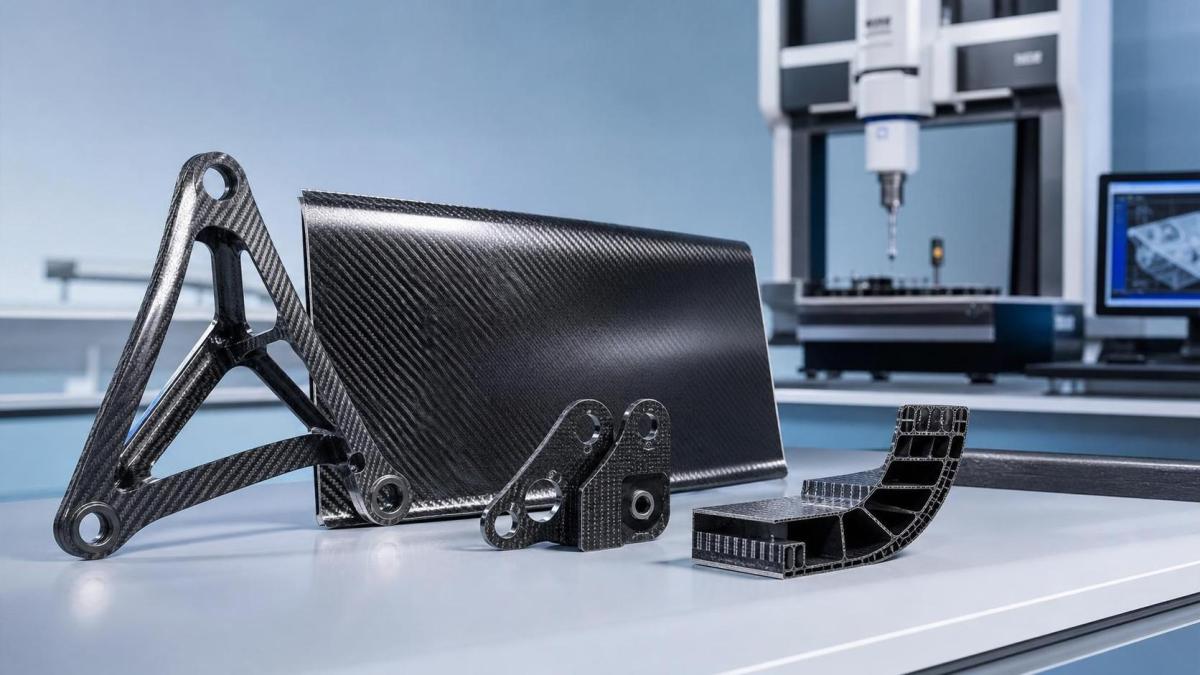
Specifying aerospace carbon fiber assemblies for lightweight, load-bearing parts starts with one basic rule: broad claims are not enough.
For real qualification work, performance has to be tied to measured data, process control, and application-specific load paths.
That is especially true when aerospace carbon fiber assemblies replace metal in brackets, panels, supports, housings, spars, or bonded substructures.
A lighter part alone is not the goal. The part also needs stable stiffness, predictable fatigue behavior, and repeatable quality across production lots.
In practice, many sourcing failures happen because drawings define geometry, while critical composite requirements stay vague.
That gap creates risk in tooling, layup consistency, bond strength, and inspection acceptance.
This guide focuses on the engineering criteria that matter when selecting aerospace carbon fiber assemblies for lightweight, load-bearing applications.
The objective is simple: write specifications that suppliers can build to, inspect to, and defend with data.
Start With the Actual Load Case
Aerospace carbon fiber assemblies should never be specified from material datasheets alone.
The real starting point is the structural duty of the part inside the aircraft, UAV, or payload system.
Ask four questions first.
- What are the dominant loads: tension, compression, shear, bending, or torsion?
- Are loads static, cyclic, impact-driven, or vibration-heavy?
- What are the temperature, humidity, and chemical exposure conditions?
- Which failure mode is least acceptable: deflection, cracking, delamination, or bond loss?
These answers shape material choice far more than a headline tensile strength number.
For example, a compression-loaded bracket and a bending-dominated skin stiffener may both use carbon fiber, but not the same laminate design.
This is where good aerospace carbon fiber assemblies separate themselves from generic composite parts.
Define Laminate Architecture, Not Just Material Family
A common mistake is specifying only “carbon fiber composite” on the drawing or RFQ.
That language is too loose for aerospace carbon fiber assemblies with structural responsibility.
The specification should identify the laminate architecture in a way that supports both manufacturing and verification.
- Fiber type: standard modulus, intermediate modulus, or high modulus.
- Reinforcement form: unidirectional tape, woven fabric, braided sleeve, or prepreg system.
- Resin system: epoxy, BMI, cyanate ester, or other qualified matrix.
- Layup sequence and ply orientation.
- Nominal fiber volume fraction and cured thickness tolerance.
- Core material, if the part is sandwich-based.
This level of detail matters because stiffness and failure behavior are direction-dependent.
A supplier may offer high-strength material, yet still miss the structural target if the ply schedule is poorly matched to the load path.
For lightweight, load-bearing parts, stiffness-to-weight usually matters as much as ultimate strength.
Request the Right Mechanical Data
Not every test value belongs in a decision package, but several are essential.
When comparing aerospace carbon fiber assemblies, ask for test results that reflect actual service risks.
More importantly, verify test conditions.
Aerospace carbon fiber assemblies should be backed by data that states specimen orientation, environment, cure route, and test standard.
Without that context, a strong-looking dataset may be impossible to compare across suppliers.
Treat Bonding and Joining as Primary Design Inputs
Many aerospace carbon fiber assemblies fail at interfaces, not in the laminate body.
That is why joint design must be specified early.
If the part includes adhesive bonding, define the adhesive family, surface preparation method, cure window, and inspection criteria.
If the part is mechanically fastened, define insert materials, hole quality limits, edge distance, and galvanic isolation requirements.
Hybrid joining is also common in lightweight, load-bearing parts.
In those cases, the spec should make clear which load is carried by the bondline and which is carried by fasteners.
This avoids hidden assumptions during tooling and assembly planning.
For aerospace carbon fiber assemblies, interface clarity is a sourcing advantage because it reduces nonconformance risk later.
Specify Manufacturing Controls and Tolerances
A strong composite design can still underperform if process control is weak.
That is why aerospace carbon fiber assemblies should include manufacturing requirements, not just final dimensions.
Useful specification items include:
- Allowed process route: autoclave, OOA prepreg, RTM, infusion, or filament winding.
- Cure cycle limits and required traceability records.
- Void content threshold and porosity acceptance.
- Fiber orientation tolerance and ply drop rules.
- Trim edge quality and hole positional tolerance.
- Flatness, thickness, and surface finish criteria.
This is where many generic RFQs remain too soft.
A drawing may show plus-minus dimensional limits, yet say nothing about internal quality or cure consistency.
For load-bearing aerospace carbon fiber assemblies, those hidden variables strongly influence repeatability.
Ask How Inspection Will Prove Conformance
Inspection should not be an afterthought added after supplier nomination.
When specifying aerospace carbon fiber assemblies, define how conformity will be verified for both geometry and structure.
Depending on part criticality, that may include ultrasonic inspection, tap testing, CT scanning, bondline evaluation, and coupon correlation.
The best suppliers can explain which defects each method can and cannot detect.
That point matters more than a long equipment list.
For example, ultrasonic coverage may be strong for laminate flaws, while bondline issues may need a different validation plan.
In real sourcing decisions, inspection capability is often the clearest signal of process maturity.
Compare Suppliers on Evidence, Not Presentation
At this stage, a structured comparison matrix helps.
Aerospace carbon fiber assemblies should be evaluated against data quality, process repeatability, and application fit.
Useful scoring categories include material traceability, laminate control, joint validation, NDI capability, tolerance control, and prior aerospace delivery history.
It also helps to ask suppliers for one documented example of a similar lightweight, load-bearing part.
Not a marketing case study, but a technical summary with measurable constraints and achieved results.
That kind of evidence aligns well with TSV’s data-first view of hard-tech sourcing.
Parameters matter because they expose whether a supplier can truly hold the requirements your structure depends on.
Build a Specification That Lowers Qualification Risk
The best specification for aerospace carbon fiber assemblies is not the longest one.
It is the one that removes ambiguity around performance, process, and acceptance.
Before release, make sure the document clearly states:
- The real load environment and critical failure modes.
- The laminate architecture and resin system.
- The required mechanical and fatigue data.
- The joining method and interface acceptance rules.
- The manufacturing controls and traceability records.
- The dimensional and internal quality inspection plan.
That framework keeps decision-making grounded in engineering reality.
It also shortens the back-and-forth that slows supplier qualification.
As lightweight structures become more demanding, aerospace carbon fiber assemblies will keep gaining importance across commercial aviation, UAV platforms, and advanced payload systems.
The teams that specify them well usually see fewer surprises in testing, clearer supplier comparisons, and stronger confidence at release.
That is the practical standard worth aiming for: less noise, tighter data, and specifications built around verifiable engineering truth.
Search News
Hot Articles
- Carbon Fiber StructuresHow to Specify Aerospace Carbon Fiber Assemblies for Lightweight, Load-Bearing PartsJul 11, 2026
- Machine VisionXiaomi, Alibaba DAMO Academy Drive Open-Source Robotics Model Ecosystem, Lowering Algorithm Development Barriers for Overseas SMEs Adopting Chinese Robotics SolutionsMar 30, 2026
- Cobots & ArmsShanxi 'AI+' Conference Showcases Embodied Intelligence with Multinational Buyer Engagement: Key Industry ImplicationsMar 30, 2026
Popular Tags
Recommended News
 Jul 11, 2026How to Specify Aerospace Carbon Fiber Assemblies for Lightweight, Load-Bearing PartsAerospace carbon fiber assemblies: learn how to specify laminate design, load data, joining methods, and inspection controls for lighter, reliable load-bearing aerospace parts.Elena Rostova (UAV Systems Researcher)
 Mar 30, 2026Xiaomi, Alibaba DAMO Academy Drive Open-Source Robotics Model Ecosystem, Lowering Algorithm Development Barriers for Overseas SMEs Adopting Chinese Robotics SolutionsXiaomi & Alibaba DAMO Academy's open-source robotics models lower algorithm barriers for global SMEs. Boost efficiency in manufacturing, logistics & smart retail with ROS 2 compatible solutions.TSV Data Lab
 Mar 30, 2026Shanxi 'AI+' Conference Showcases Embodied Intelligence with Multinational Buyer Engagement: Key Industry ImplicationsShanxi 'AI+' Conference highlights embodied intelligence with Tesla, Ubtech & Jiantao showcasing multimodal robotics. 40+ global buyers validated tech on-site, creating new B2B channels for industrial automation & AI solutions.Chen Wei (Automation Lead Engineer)
 Mar 30, 2026Zhongguancun Unveils 6G Integrated Sensing-Computing-Intelligence Platform to Empower Embodied Robots for Global Industrial ApplicationsZhongguancun's new 6G platform revolutionizes industrial robotics with <10ms latency, empowering global automotive, logistics & port automation. Discover how this tech boosts China's smart manufacturing exports.TSV Data Lab
 Mar 30, 2026Mech-Mind Tianjin Embodied Intelligence R&D and Production Base Goes Live, Cutting Delivery Time by 20%–30% for Global Customized AMR+Vision SolutionsMech-Mind's Tianjin AMR+Vision production base cuts delivery time by 20%-30% for欧美 & Latin American markets. Discover how this PLd-certified facility accelerates customized robotics solutions for smart manufacturing and logistics.Chen Wei (Automation Lead Engineer)
 Mar 30, 2026Boao Forum Reveals 'Co-evolution of Big and Small Brains' Trend in Humanoid Robots, China's Embodied Intelligence Accelerates Adaptation to Overseas Manufacturing Service ScenariosDiscover how China's humanoid robots, featuring 'Co-evolution of Big and Small Brains,' are revolutionizing global manufacturing. Learn about Embodied Tian Gong 3.0's ISO compliance and overseas deployment at Boao Forum 2026.Chen Wei (Automation Lead Engineer)
 Mar 30, 2026China Railway Industrial Secures Patent for Embodied Robotics in Material Handling, Boosting High-Precision Delivery Capabilities for Overseas Infrastructure and Manufacturing ProjectsChina Railway Industrial's new patent for embodied robotics in material handling boosts high-precision delivery for global infrastructure & manufacturing. Discover how this innovation enhances logistics accuracy in automotive, rail transit & EPC projects.Chen Wei (Automation Lead Engineer)
 Oct 10, 2026How to Select a Machine Performance Monitoring Platform for OEE and Downtime ReductionMachine performance monitoring platform selection guide: validate machine states, OEE data, downtime reasons, integrations, and scalability to reduce losses with confidence.TSV Data Lab
 Oct 08, 2026How to Machine Inconel 625 Blades Without Heat Cracks or Edge ChippingInconel 625 blade machining guide: prevent heat cracks, edge chipping, chatter, and work hardening with proven tooling, cooling, fixturing, and inspection strategies.Dr. Marcus Vance
 Oct 07, 2026How to Evaluate an HMI Panel Distributor for Industrial Automation ProjectsHMI panel distributor evaluation guide: verify technical compatibility, traceability, supply reliability, lifecycle support, and total cost for automation projects.Victor Lin (Chief Software Architect)
 Oct 06, 2026Navigation Fault Tolerance Standards for AMRs: What Safety Teams Must VerifyNavigation fault tolerance standards: learn what AMR safety teams must verify, from localization loss and sensor faults to stopping distance, safe restart, and site-specific validation.Chen Wei (Automation Lead Engineer)
 Oct 05, 2026Calculating Edge Computing Total Cost of Ownership Across Distributed SitesEdge computing ownership cost explained: calculate deployment, energy, connectivity, security, remote support, and refresh costs across distributed sites.TSV Data Lab
 Oct 04, 2026CAD/CAM Benchmarking in the GCC: What Manufacturers Should Ask a ConsultantCAD CAM benchmark consultant GCC guide: learn the key questions manufacturers should ask to validate post-processors, workflows, machine performance, and production risk.Victor Lin (Chief Software Architect)
 Oct 03, 2026Selecting Automotive Radar Sensor Modules for ADAS Range, Resolution, and IntegrationAutomotive radar sensor module selection guide for ADAS: compare range, resolution, field of view, latency, and integration to build safer, reliable vehicle systems.TSV Data Lab
 Oct 02, 2026How to Qualify Machined Parts Suppliers for Hard Tech ProgramsHard tech supply chain machined parts demand rigorous supplier qualification. Learn how to assess capability, traceability, quality controls, and delivery resilience.Dr. Marcus Vance
 Oct 01, 2026How to Select an Outdoor Security Radar Sensor for Perimeter Detection?Outdoor security radar sensor selection guide: compare range, accuracy, false-alarm control, integration, and field testing for reliable perimeter detection.TSV Data Lab
 Sep 30, 2026How to Evaluate Solid-State LiDAR Hardware for Outdoor Autonomous VehiclesSolid state LiDAR hardware evaluation guide for outdoor autonomous vehicles—compare range, point-cloud quality, environmental resilience, integration, and safety.TSV Data Lab
 Sep 29, 2026ISO 9283 Repeatability: How to Evaluate Cobot Positioning PerformanceISO 9283 cobot repeatability explained: learn how payload, reach, approach direction, and test conditions affect positioning performance and cell capability.Chen Wei (Automation Lead Engineer)
 Oct 09, 2026What does a manufacturing robot really cost beyond the purchase price?Manufacturing robot cost goes far beyond the purchase price. Explore integration, tooling, safety, uptime, and total ownership factors for smarter automation investments.Chen Wei (Automation Lead Engineer)
 Oct 08, 2026AGV vs. AMR: Which Is Better for Frequently Changing Routes?Which is better for changing routes? Compare AGVs and AMRs for flexible navigation, docking precision, traffic control, and faster facility reconfiguration.Chen Wei (Automation Lead Engineer)
 Oct 07, 2026How Much Does an Automated Guided Vehicle Cost in 2026?How much does an automated guided vehicle cost in 2026? Explore AGV price ranges, hidden deployment costs, and smart buying factors for stronger ROI.Chen Wei (Automation Lead Engineer)
 Oct 06, 2026Are Collaborative Robots Safe Enough to Operate Without Fencing?Are collaborative robots safe enough to work without fencing? Explore risk assessment, safeguarding options, and practical guidance for safer, productive cobot cells.Chen Wei (Automation Lead Engineer)
 Oct 05, 2026What Causes Machine Vision Systems to Miss Small Defects?What causes machine vision systems to miss small defects? Discover how lighting, optics, motion, and AI thresholds affect detection—and prevent costly escapes.TSV Data Lab
 Oct 04, 2026How Should You Compare 5-Axis CNC Machine Accuracy Claims?How do I compare 5-axis CNC machine accuracy claims? Learn how to assess standards, thermal stability, TCP accuracy, and real-world test evidence.Dr. Marcus Vance