Are Collaborative Robots Safe Enough to Operate Without Fencing?
Publication Date
author
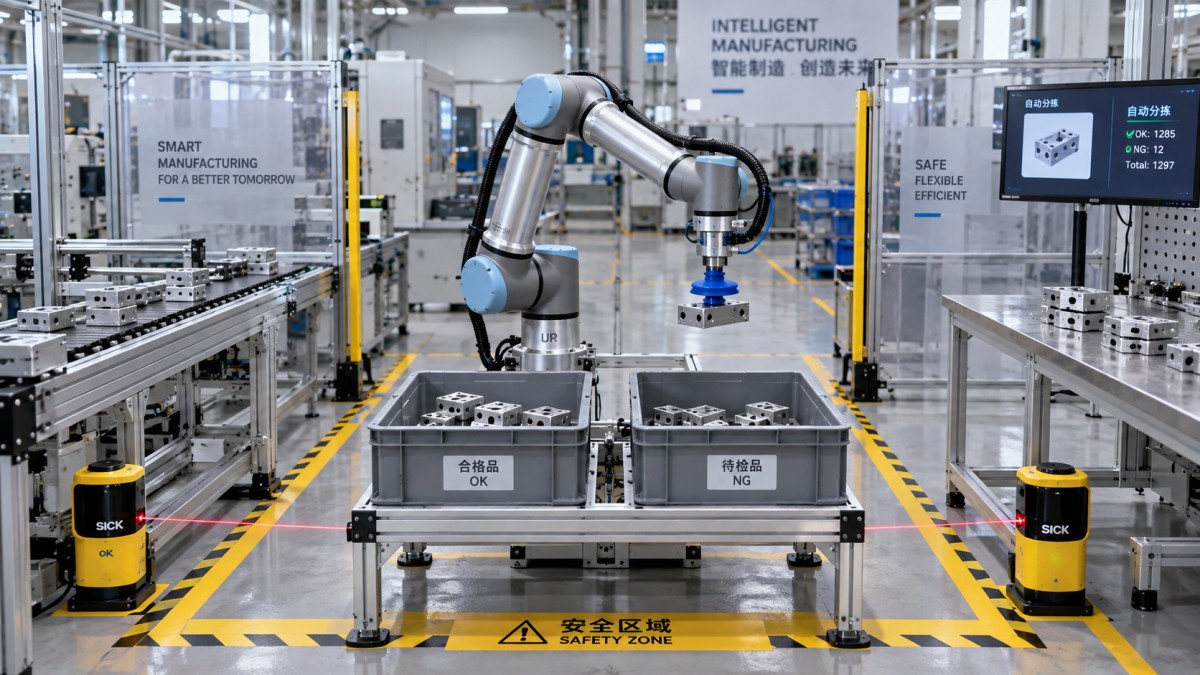
Are collaborative robots safe enough to work without fencing? Sometimes, but a cobot is not automatically safe simply because it is sold as “collaborative.” Fence-free operation is a system-level decision. It depends on the robot, the end effector, the workpiece, the programmed motion, the surrounding equipment, and the way people actually enter and use the workspace.
A collaborative robot can make an open workstation practical when the residual risk is low enough after safety measures are applied. In other cases, a perimeter guard, light curtain, scanner, safety-rated monitored zone, or partial enclosure remains necessary. The right question is not “Can this robot work beside a person?” It is “Can this complete application control foreseeable contact, trapping, unexpected movement, and process hazards at every point in its cycle?”
A cobot arm is only one part of the safety case
Most collaborative robots are designed with safety functions that can limit speed, force, power, or motion when a person is present. Some can detect abnormal external force and stop. Others can operate at reduced speed in a shared zone and resume a faster cycle when the area is clear. These functions are valuable, but they do not remove every hazard.
The arm may be capable of safe contact while the application is not. A metal part with a sharp edge, a gripper with pinch points, a hot tool, a rotating spindle, a welding torch, or a press fixture can make an otherwise suitable cobot cell unsafe without physical separation. Even a simple pick-and-place task can create a crush hazard if the robot moves a box against a fixed table, rack, conveyor, or machine frame.
This is why a fencing decision should never be made from a product brochure or a payload specification alone. The robot’s collaborative mode is a control function. The final risk comes from the entire working cell.
Start with the task, not the robot model
Before comparing cobots, map the work cycle in plain operational terms. Identify what the robot carries, where it travels, where a person may stand, and what happens when the normal sequence is interrupted. Include loading, unloading, clearing a jam, teaching, quality checks, maintenance, and recovery after a stop. These are often the moments when workers get closest to moving equipment.
A useful first screen is to divide applications into three groups.
The categories are not a substitute for assessment. They do, however, prevent a common procurement error: choosing a cobot based on the assumption that collaboration always means direct, unrestricted human proximity.
Evaluate the four collaborative operating methods in practical terms
Collaborative applications generally rely on one or more recognized approaches to managing interaction. Understanding the operating logic is more useful than memorizing labels.
Safety-rated monitored stop
The robot stops when a person enters the shared area and remains stopped while that person is present. This can support an open-looking cell, but it is not simultaneous collaboration. It works well when an operator needs periodic access for loading, inspection, or adjustment and the productivity loss from stopping is acceptable.
The overlooked requirement is reliable detection. The safeguarding method must cover the routes people can use to enter the hazard area, including approaches from the side or behind the robot. A poorly placed sensor can leave a gap between detection and the actual hazardous motion.
Hand guiding
In hand-guided operation, a person physically guides the robot through a task or position. This is useful for teaching and certain assistive operations, but it does not make the whole automatic production cycle collaborative. The transition between guided and automatic modes needs clear control, predictable restart behavior, and safeguards against unexpected movement.
Speed and separation monitoring
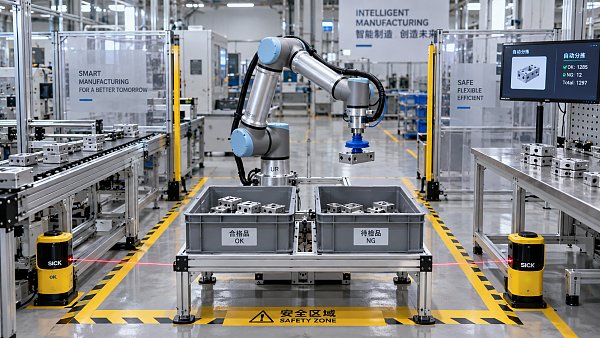
This method allows the robot to move while people are nearby, provided it slows or stops as separation distance decreases. It can preserve throughput better than a full stop, especially where operators regularly approach a station. It also places higher demands on the sensing system, layout, and validation.
Separation distance is not just a line drawn on the floor. The system must account for robot stopping behavior, approach speed, human movement, sensor detection performance, and the time required for the safety system to react. A vision sensor that is excellent for quality inspection is not automatically appropriate for personnel safeguarding. The safety function, field coverage, response behavior, and fault handling all matter.
Power and force limiting
Power and force limiting is the operating mode most people associate with cobots: the robot is intended to limit contact forces so that incidental contact is tolerable. It is useful for low-force, low-speed tasks in open shared spaces. Yet it has firm boundaries. Contact can still be hazardous when a body part is trapped between the robot and a fixed object, when the tool has a pinch point, or when the robot carries a rigid or irregular workpiece.
A contact-limited arm does not turn a clamping fixture, a blade, or a hot component into a contact-limited device.
Assess contact risk where contact would actually occur
Risk assessment is often weakened by treating the robot flange as the only point that can hit a person. In a real cell, contact may occur at the elbow, wrist, gripper finger, cable bundle, carried part, or a corner of an attached fixture. The most severe location may be nowhere near the robot’s centerline.
Review each relevant motion and ask three questions: What could make contact? Which body area could be exposed? Could that body area be trapped, compressed, cut, burned, or struck against something fixed? The third question is frequently decisive. A light robot moving slowly may be acceptable in free space but unacceptable where it can close against a column, tote rack, conveyor, or machine door.
Tooling deserves the same scrutiny as the robot arm. Vacuum cups are often easier to manage than mechanical fingers, but suction failure can drop a part. Parallel grippers can create pinch zones. Pneumatic systems can retain stored energy. Long tools increase reach and may increase impact severity. Sharp castings, glass, stamped sheet, and unfinished parts may require containment even if the robot movement itself is gentle.
Use speed limits as part of a designed workflow
Reducing robot speed is a common safety response, but “slow” is not a complete design. A robot can still create risk at low speed if it moves through a trapping zone or carries a hazardous object. Conversely, a task may safely run faster when people are prevented from entering the robot’s higher-risk envelope.
Many effective cells use distinct zones rather than one universal speed. The robot can perform its fastest movements in a separated part of the cell, then shift to a reduced speed near the handoff point. Operators receive parts in a defined access area instead of reaching across the full robot path. This approach often produces a better balance of safety and cycle time than operating the entire application at a permanently reduced speed.
Make the handoff predictable. Avoid motion paths that cross an operator’s normal reach zone without a clear reason. Position bins, controls, and inspection points so people do not need to lean into the robot envelope. A modest change in fixture location can remove more risk than a complicated sensor arrangement.
Do not confuse a risk assessment with a one-time document
A documented assessment is necessary, but its value comes from testing the assumptions behind it. The cell should be evaluated in normal production conditions, including realistic payloads, actual grippers, production parts, cable routing, and the intended operating speeds. A safe demonstration using an empty arm is not sufficient evidence for a loaded application.
Also test foreseeable abnormal conditions: a misplaced part, a dropped component, a sensor obstruction, a jam, a power interruption, a restart, and a worker entering the cell during recovery. Determine how the system stops, who can reset it, and whether reset allows motion to resume only after the area is safe. The restart sequence deserves special attention because it often happens under time pressure.
Changes must trigger a review. Switching from plastic components to metal castings, fitting a longer gripper, increasing speed to recover cycle time, moving a rack, or adding a second operator can change the risk profile substantially. Treat the approved configuration as a controlled baseline, not a rough suggestion.
When fencing is the better engineering choice
Fencing is not a failure to use cobot technology correctly. It can be the most efficient and defensible solution when the process contains hazards that collaborative controls cannot reasonably reduce.
Use physical separation when the operation includes high-energy processes, hazardous tools, substantial payloads, unstable workpieces, rapid long-reach motion, or a credible possibility of trapping. A guarded cell may also be appropriate when uninterrupted cycle time matters more than frequent human access. In these cases, a cobot can still be useful because it is easier to program, redeploy, or fit into a compact space, but its collaborative capability may not be the primary safety measure.
Partial guarding is often the practical middle ground. Guard the machine interface, sharp-part staging area, or high-risk side of the robot path, while preserving open access for safe loading or inspection. This is usually more effective than trying to force an entirely fence-free design onto a process that does not suit it.
What to request before approving a fence-free cell
Procurement teams should request application-specific evidence, not general claims that a robot is safe for human collaboration. The supplier or integrator should be able to explain the proposed operating mode, the safeguarded space, the end-effector hazards, the intended speed settings, and the conditions under which the robot stops or slows.
- A clear cell layout showing robot reach, fixed hazards, operator positions, material flow, and access routes.
- A description of every tool, workpiece, and fixture that could introduce cutting, crushing, heat, electrical, or dropped-load hazards.
- The planned safety functions, including what detects a person and what action the robot takes after detection.
- Defined limits for payload, speed, reach, tooling, and product changes that remain within the approved application.
- A commissioning and validation plan covering normal operation, access, fault recovery, and restart.
- Training content that explains safe operating boundaries without relying on workers to remember unwritten rules.
Parameter-level comparison is more useful than marketing language here. TechStat Vanguard’s engineering-first approach is relevant because a meaningful evaluation looks beyond repeatability or nominal payload. Decision-makers need to compare sensing behavior, stopping performance, tool integration, fault handling, and reliability under the actual duty cycle. Those details determine whether an open cell remains safe after installation, not just during a controlled demonstration.
The decision should be conditional, not ideological
A fence-free cobot workstation can be a sound choice for low-risk handling, inspection, and assembly where the workspace is deliberately designed for shared access. It becomes much harder to justify when the application adds sharp, hot, heavy, fast-moving, or trapping hazards. The arm’s collaborative rating does not override those conditions.
Start by defining the task and every credible human interaction. Then choose the protective method that controls the real hazards: force limiting for suitable low-risk contact, monitored stopping for periodic access, separation monitoring for controlled shared movement, or guarding where the process demands it. The best result is not the least visible safety hardware. It is a workstation where the robot, tooling, layout, controls, and operating procedure make unsafe interaction difficult in normal work and during recovery.
Search News
Hot Articles
- Carbon Fiber StructuresHow to Specify Aerospace Carbon Fiber Assemblies for Lightweight, Load-Bearing PartsJul 11, 2026
- Machine VisionXiaomi, Alibaba DAMO Academy Drive Open-Source Robotics Model Ecosystem, Lowering Algorithm Development Barriers for Overseas SMEs Adopting Chinese Robotics SolutionsMar 30, 2026
- Cobots & ArmsShanxi 'AI+' Conference Showcases Embodied Intelligence with Multinational Buyer Engagement: Key Industry ImplicationsMar 30, 2026
Popular Tags
Recommended News
 Jul 11, 2026How to Specify Aerospace Carbon Fiber Assemblies for Lightweight, Load-Bearing PartsAerospace carbon fiber assemblies: learn how to specify laminate design, load data, joining methods, and inspection controls for lighter, reliable load-bearing aerospace parts.Elena Rostova (UAV Systems Researcher)
 Mar 30, 2026Xiaomi, Alibaba DAMO Academy Drive Open-Source Robotics Model Ecosystem, Lowering Algorithm Development Barriers for Overseas SMEs Adopting Chinese Robotics SolutionsXiaomi & Alibaba DAMO Academy's open-source robotics models lower algorithm barriers for global SMEs. Boost efficiency in manufacturing, logistics & smart retail with ROS 2 compatible solutions.TSV Data Lab
 Mar 30, 2026Shanxi 'AI+' Conference Showcases Embodied Intelligence with Multinational Buyer Engagement: Key Industry ImplicationsShanxi 'AI+' Conference highlights embodied intelligence with Tesla, Ubtech & Jiantao showcasing multimodal robotics. 40+ global buyers validated tech on-site, creating new B2B channels for industrial automation & AI solutions.Chen Wei (Automation Lead Engineer)
 Mar 30, 2026Zhongguancun Unveils 6G Integrated Sensing-Computing-Intelligence Platform to Empower Embodied Robots for Global Industrial ApplicationsZhongguancun's new 6G platform revolutionizes industrial robotics with <10ms latency, empowering global automotive, logistics & port automation. Discover how this tech boosts China's smart manufacturing exports.TSV Data Lab
 Mar 30, 2026Mech-Mind Tianjin Embodied Intelligence R&D and Production Base Goes Live, Cutting Delivery Time by 20%–30% for Global Customized AMR+Vision SolutionsMech-Mind's Tianjin AMR+Vision production base cuts delivery time by 20%-30% for欧美 & Latin American markets. Discover how this PLd-certified facility accelerates customized robotics solutions for smart manufacturing and logistics.Chen Wei (Automation Lead Engineer)
 Mar 30, 2026Boao Forum Reveals 'Co-evolution of Big and Small Brains' Trend in Humanoid Robots, China's Embodied Intelligence Accelerates Adaptation to Overseas Manufacturing Service ScenariosDiscover how China's humanoid robots, featuring 'Co-evolution of Big and Small Brains,' are revolutionizing global manufacturing. Learn about Embodied Tian Gong 3.0's ISO compliance and overseas deployment at Boao Forum 2026.Chen Wei (Automation Lead Engineer)
 Mar 30, 2026China Railway Industrial Secures Patent for Embodied Robotics in Material Handling, Boosting High-Precision Delivery Capabilities for Overseas Infrastructure and Manufacturing ProjectsChina Railway Industrial's new patent for embodied robotics in material handling boosts high-precision delivery for global infrastructure & manufacturing. Discover how this innovation enhances logistics accuracy in automotive, rail transit & EPC projects.Chen Wei (Automation Lead Engineer)
 Oct 06, 2026Navigation Fault Tolerance Standards for AMRs: What Safety Teams Must VerifyNavigation fault tolerance standards: learn what AMR safety teams must verify, from localization loss and sensor faults to stopping distance, safe restart, and site-specific validation.Chen Wei (Automation Lead Engineer)
 Oct 05, 2026Calculating Edge Computing Total Cost of Ownership Across Distributed SitesEdge computing ownership cost explained: calculate deployment, energy, connectivity, security, remote support, and refresh costs across distributed sites.TSV Data Lab
 Oct 04, 2026CAD/CAM Benchmarking in the GCC: What Manufacturers Should Ask a ConsultantCAD CAM benchmark consultant GCC guide: learn the key questions manufacturers should ask to validate post-processors, workflows, machine performance, and production risk.Victor Lin (Chief Software Architect)
 Oct 03, 2026Selecting Automotive Radar Sensor Modules for ADAS Range, Resolution, and IntegrationAutomotive radar sensor module selection guide for ADAS: compare range, resolution, field of view, latency, and integration to build safer, reliable vehicle systems.TSV Data Lab
 Oct 02, 2026How to Qualify Machined Parts Suppliers for Hard Tech ProgramsHard tech supply chain machined parts demand rigorous supplier qualification. Learn how to assess capability, traceability, quality controls, and delivery resilience.Dr. Marcus Vance
 Oct 01, 2026How to Select an Outdoor Security Radar Sensor for Perimeter Detection?Outdoor security radar sensor selection guide: compare range, accuracy, false-alarm control, integration, and field testing for reliable perimeter detection.TSV Data Lab
 Sep 30, 2026How to Evaluate Solid-State LiDAR Hardware for Outdoor Autonomous VehiclesSolid state LiDAR hardware evaluation guide for outdoor autonomous vehicles—compare range, point-cloud quality, environmental resilience, integration, and safety.TSV Data Lab
 Sep 29, 2026ISO 9283 Repeatability: How to Evaluate Cobot Positioning PerformanceISO 9283 cobot repeatability explained: learn how payload, reach, approach direction, and test conditions affect positioning performance and cell capability.Chen Wei (Automation Lead Engineer)
 Oct 06, 2026Are Collaborative Robots Safe Enough to Operate Without Fencing?Are collaborative robots safe enough to work without fencing? Explore risk assessment, safeguarding options, and practical guidance for safer, productive cobot cells.Chen Wei (Automation Lead Engineer)
 Oct 05, 2026What Causes Machine Vision Systems to Miss Small Defects?What causes machine vision systems to miss small defects? Discover how lighting, optics, motion, and AI thresholds affect detection—and prevent costly escapes.TSV Data Lab
 Oct 04, 2026How Should You Compare 5-Axis CNC Machine Accuracy Claims?How do I compare 5-axis CNC machine accuracy claims? Learn how to assess standards, thermal stability, TCP accuracy, and real-world test evidence.Dr. Marcus Vance
 Oct 03, 2026Is Edge Computing Necessary for Real-Time Quality Inspection?Is industrial edge computing necessary for real-time quality inspection? Explore how latency, data volume, reliability, and control integration shape the right architecture.TSV Data Lab
 Oct 02, 2026What Documents Prove a Precision Machining Supplier Can Hold Tolerance?What documents prove a precision machining supplier can hold tolerance? Explore certificates, FAI reports, calibration, SPC, and traceability evidence to qualify suppliers with confidence.Dr. Marcus Vance
 Oct 01, 2026Can a Machining Supplier Meet Aerospace Fatigue Testing Requirements?Can a machining supplier meet aerospace fatigue testing requirements? Learn the traceability, process control, and test evidence needed for reliable aerospace parts.Dr. Marcus Vance
 Sep 30, 2026Which Industrial Robot Specifications Matter for High-Precision Assembly?Which industrial robot specifications matter most for high-precision assembly? Explore repeatability, accuracy, stiffness, vibration, calibration, and force control for reliable yields.Chen Wei (Automation Lead Engineer)
 Sep 29, 2026How Do You Verify Servo Motor Torque Under Continuous Load?How do I verify servo motor torque under continuous load? Learn RMS torque checks, torque-speed limits, thermal derating, and real-machine testing.Chen Wei (Automation Lead Engineer)
 Oct 02, 2026ZD330 Software Configuration: Verifying Cut-List Import Before PurchaseZD330 software and machine configuration: verify cut-list imports, data mapping, labels, and workflow before purchase to reduce errors and choose with confidence.Victor Lin (Chief Software Architect)