
ISO 9283 Repeatability: How to Evaluate Cobot Positioning Performance
Publication Date
author
A cobot’s repeatability value is useful only when the measurement conditions are known. A catalog figure such as ±0.02 mm may indicate strong mechanical consistency, but it does not by itself establish how the robot behaves at different reaches, under a production payload, after warm-up, or when approaching a target from changing directions. ISO 9283 provides a controlled framework for separating these questions.
The central distinction is simple but commercially important: repeatability is not accuracy. Repeatability describes how closely a robot returns to the same achieved pose when it is commanded to repeat an identical movement under defined conditions. Accuracy describes how close that achieved pose is to the commanded pose. A robot can therefore be highly repeatable while maintaining a consistent offset from its programmed coordinates. For dispensing, welding, polishing, and machine tending, repeatability may be the principal concern. For offline programming, fixture interchangeability, calibrated inspection, or absolute positioning relative to external equipment, accuracy and calibration stability become equally important.
What ISO 9283 actually evaluates
ISO 9283, Manipulating industrial robots — Performance criteria and related test methods, defines terminology, performance characteristics, and test methods for manipulating industrial robots. It is applicable to cobots as a class of industrial robot, but it is not a cobot-specific safety standard and should not be interpreted as a safety certification.
The standard covers more than point-to-point positioning. Its performance framework includes pose and distance accuracy, pose and distance repeatability, overshoot, path performance, velocity-related behavior, settling characteristics, static compliance, and weaving performance where relevant. Not every characteristic carries equal weight in every application. A palletizing cell may be mainly concerned with reach-dependent repeatability, cycle time, and payload. A robotic inspection or metrology process may require more attention to absolute accuracy, path accuracy, and the relationship between robot coordinates and an external measurement frame.
For cobot comparisons, the ISO 9283 repeatability discussion generally centers on the robot’s ability to reproduce a programmed pose. The measured result is influenced by joint transmission behavior, encoder resolution, structural stiffness, controller interpolation, servo tuning, thermal condition, cable routing, payload inertia, and the selected test path. That is why a single repeatability number should be treated as a result of a specified test, not as a universal property that remains unchanged across all tasks.
Repeatability, accuracy, and the “±” notation
Manufacturers frequently state repeatability in millimeters with a plus/minus sign. This convention is easy to read but can conceal important methodological differences. Before comparing values, confirm whether the declaration refers to ISO 9283 pose repeatability, an internal factory method, a best-case point in the work envelope, or a value derived from a particular payload and cycle condition.
Under ISO 9283-style testing, the robot is repeatedly moved to a target pose. The actual achieved positions are measured over a series of repetitions. The collection of measured points has a center, or mean position, and a scatter around that center. Repeatability is based on this distribution of returned positions rather than the gap between the commanded point and the mean achieved point.
Accuracy asks a different question: where is the center of that point cluster relative to the programmed target? If all return points lie tightly together but are displaced by 0.5 mm from the target, repeatability can be excellent while accuracy is poor. A calibration routine may improve absolute accuracy substantially without changing the underlying repeatability by the same amount.
The practical implication is that a ±0.03 mm declaration is not automatically superior or inferior to ±0.05 mm. The difference may be meaningful, negligible, or not directly comparable, depending on the test configuration and the tolerance stack of the process.
The measurement conditions are part of the result
ISO 9283 is valuable because it treats testing as a system of controlled conditions rather than a single endpoint reading. Positioning performance must be evaluated within a defined test volume and at specified poses. The robot is not assessed only in the mechanically favorable area closest to its base. A meaningful evaluation samples the portion of the work envelope relevant to the intended task.
For articulated cobots, geometry matters. At extended reach, structural deflection and joint compliance generally have more influence than near the base. Near kinematic singularities, a small Cartesian movement can require disproportionate joint motion, and controller behavior may differ from that observed in a central working zone. A repeatability value measured at one point cannot establish equal performance throughout the whole reachable envelope.
Payload conditions also require close attention. The mass of the tool is only one part of the load case. Center of gravity, moment of inertia, cable drag, hose stiffness, and off-axis loading can affect settling and positional behavior. A lightweight gripper mounted close to the flange is not equivalent to a long, offset screwdriver, a vision head, or a dispensing assembly with moving hoses. If the production end effector differs materially from the declared test load, the catalog number should be considered a baseline rather than an acceptance value.
Temperature and duty cycle are another source of confusion. Gearboxes, motors, brakes, and links change condition as the robot warms. A short demonstration involving isolated point moves can produce a different result from a continuous production sequence. Where dimensional control is critical, the evaluation protocol should define warm-up, speed and acceleration settings, dwell or settling time, environmental conditions, payload, and the number of cycles. These details make a result reproducible.
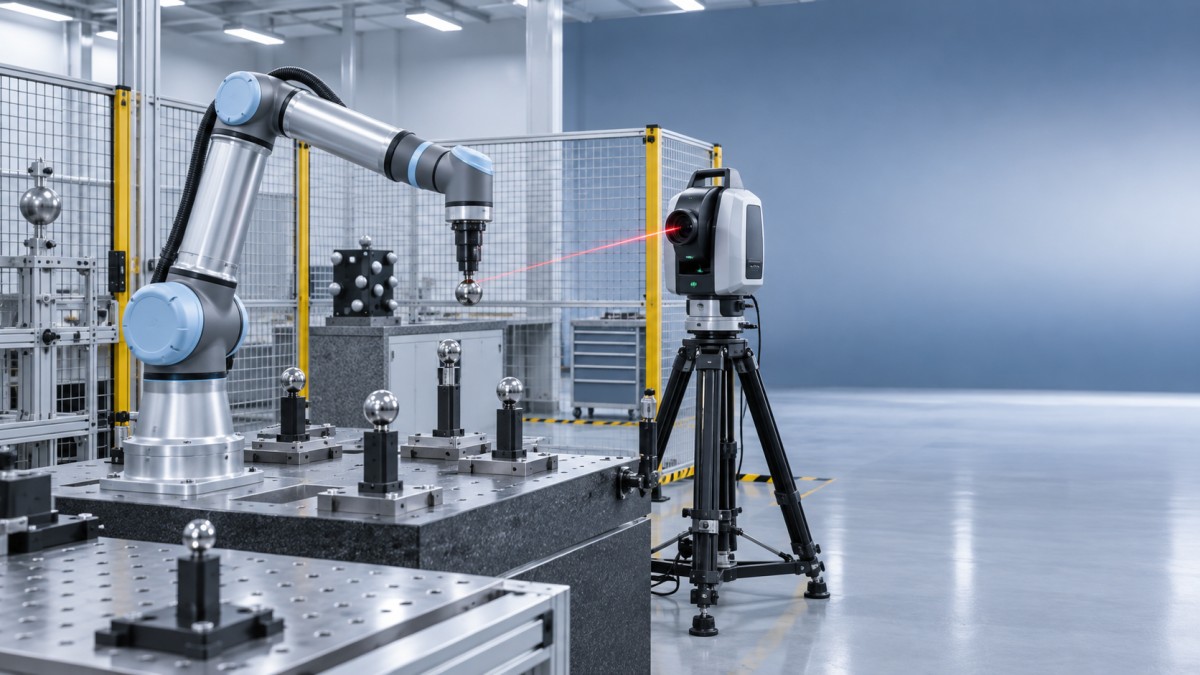
How an ISO 9283 positioning test should be read
A positioning test begins with a defined robot configuration, test payload, and measurement arrangement. The robot moves to selected target poses repeatedly. At each target, a measuring system records the achieved position; orientation may also be evaluated depending on the test objective. The repeated measurements reveal both the average attained position and the spread of returns around it.
The measurement system must be capable of resolving the performance being claimed. If a robot is being assessed for repeatability in the hundredths-of-a-millimeter range, a coarse indicator or an inadequately controlled vision setup cannot provide a defensible result. Laser trackers, high-accuracy optical systems, calibrated dial-based arrangements in limited cases, or other traceable metrology solutions may be used depending on the required uncertainty and measurement volume. The critical issue is not the brand of instrument but whether its uncertainty, setup, and coordinate transformation are appropriate for the expected robot performance.
Direction of approach deserves explicit treatment. Backlash, friction, gravity loading, and control compensation can make a robot reach a nominal point differently when approaching from opposite directions. A procedure that always approaches the target through the same trajectory measures one form of repeatability: repeatability under controlled, repeatable approach conditions. That can be entirely valid for a process with a fixed programmed approach. It does not prove equivalent behavior when the application permits varied approach paths or frequent task changes.
Settling time matters for the same reason. Taking the measurement immediately after deceleration can include transient vibration or residual servo motion. Measuring only after an extended dwell may obscure a cycle-time limitation. The correct dwell time is therefore not merely a metrology choice; it must reflect the process requirement. A vision-guided pick station may tolerate a pause. A high-throughput dispensing or inspection path may not.
Why ISO 9283 repeatability is not the same as cell capability
Even a properly reported ISO 9283 cobot repeatability value describes the unloaded or specified-load robot performance under a controlled test method. Production capability depends on the full tolerance chain:
- robot positioning behavior at the required poses and orientations;
- flange, tool, and fixture compliance;
- tool-center-point definition and calibration quality;
- part location variation and fixture repeatability;
- gripper variation, part deformation, and contact force;
- vision calibration, conveyor tracking, or external-axis synchronization where used;
- thermal movement of the cell, process equipment, and workpiece.
Consider a screwdriving application with a hole-position tolerance of ±0.20 mm. A robot repeatability specification of ±0.03 mm looks comfortably smaller, but it does not guarantee successful engagement. The driver can deflect, the bit can float, the fixture can shift, the part may vary, and the target location may be derived from a camera with its own uncertainty. Conversely, a robot with a less impressive catalog repeatability value may perform reliably if the process includes a compliant mechanism, a locating feature, or force-guided search.
For this reason, the appropriate engineering question is not “Which cobot has the smallest repeatability figure?” It is “What portion of the process tolerance is allocated to robot positioning after all other error sources are accounted for?” That allocation should include a margin for operational variation rather than relying on a nominal best-case number.
Common interpretation errors during technical comparison
Using repeatability as proof of absolute placement. A cobot can repeatedly return to a location that is offset from CAD coordinates or from a second cell. Applications requiring coordinate transfer, fixture replacement, or offline-generated paths need evidence of accuracy, calibration method, and recalibration stability.
Comparing values without the tested payload and reach. A published result measured near the center of the workspace with a compact nominal load cannot be assumed at maximum reach with a high-inertia tool. Ask for the declared conditions and for any performance curves or test records available for the intended operating region.
Ignoring orientation. A robot’s tool point can be positioned acceptably while its orientation error affects insertion, sealing, scanning angle, welding torch geometry, or camera focus. Position and orientation must be considered together where the process is sensitive to both.
Equating a point test with path performance. Point-to-point repeatability does not establish that a cobot will maintain a uniform bead, follow a contour accurately, or scan at constant stand-off. Continuous-path work requires evaluation of trajectory behavior, velocity fluctuation, cornering deviation, and dynamic deflection.
Assuming compliance is irrelevant because the robot is collaborative. Collaborative design and force-limited operation do not eliminate structural deflection. In fact, contact processes can make stiffness and force-control behavior more consequential than no-load positioning repeatability.
What to request in an engineering evaluation
A supplier declaration that references ISO 9283 should identify the standard edition and clearly state the specific characteristic being reported. “ISO 9283 compliant” is too broad if no test item, operating condition, or result is provided. The useful evidence is a test report or performance declaration that connects the stated repeatability figure to a defined method.
The technical record should establish the robot model, controller and software version where relevant, test payload and center of gravity, selected test poses, reach region, programmed speed and acceleration, approach conditions, warm-up state, dwell time, number of repetitions, measurement equipment, and reported result format. If the proposed application operates in a special configuration—such as ceiling mounting, a mobile base, a seventh axis, or a long-reach tool—those conditions should be represented in acceptance testing rather than inferred from a standard floor-mounted test.
For a production decision, factory acceptance data and an application-level validation serve different purposes. ISO 9283 provides a disciplined basis for characterizing robot performance. The final cell test should validate the actual critical quality output: insertion success, bead placement, inspection registration, placement error, or another process-specific measure. The first proves what the robot can reproduce under defined conditions; the second proves whether the integrated process meets its functional requirement.
A defensible way to use the specification
ISO 9283 repeatability is most valuable when it is used to narrow uncertainty, not when it is treated as a standalone purchasing shortcut. It gives technical evaluators a common language for asking how a value was obtained, what it represents, and whether two vendor declarations are genuinely comparable.
A low repeatability number supports confidence only when the test volume, payload, approach path, metrology method, and dynamic conditions resemble the intended use. Where process tolerances are tight, the decision should be based on the complete error budget and an acceptance test built around the actual end effector, part presentation, and production cycle. That approach turns a catalog parameter into an engineering decision: not simply whether the cobot can return to a point, but whether it can maintain the required process outcome over repeated real cycles.
Search News
Hot Articles
- Carbon Fiber StructuresHow to Specify Aerospace Carbon Fiber Assemblies for Lightweight, Load-Bearing PartsJul 11, 2026
- Machine VisionXiaomi, Alibaba DAMO Academy Drive Open-Source Robotics Model Ecosystem, Lowering Algorithm Development Barriers for Overseas SMEs Adopting Chinese Robotics SolutionsMar 30, 2026
- Cobots & ArmsShanxi 'AI+' Conference Showcases Embodied Intelligence with Multinational Buyer Engagement: Key Industry ImplicationsMar 30, 2026
Popular Tags
Recommended News
 Jul 11, 2026How to Specify Aerospace Carbon Fiber Assemblies for Lightweight, Load-Bearing PartsAerospace carbon fiber assemblies: learn how to specify laminate design, load data, joining methods, and inspection controls for lighter, reliable load-bearing aerospace parts.Elena Rostova (UAV Systems Researcher)
 Mar 30, 2026Xiaomi, Alibaba DAMO Academy Drive Open-Source Robotics Model Ecosystem, Lowering Algorithm Development Barriers for Overseas SMEs Adopting Chinese Robotics SolutionsXiaomi & Alibaba DAMO Academy's open-source robotics models lower algorithm barriers for global SMEs. Boost efficiency in manufacturing, logistics & smart retail with ROS 2 compatible solutions.TSV Data Lab
 Mar 30, 2026Shanxi 'AI+' Conference Showcases Embodied Intelligence with Multinational Buyer Engagement: Key Industry ImplicationsShanxi 'AI+' Conference highlights embodied intelligence with Tesla, Ubtech & Jiantao showcasing multimodal robotics. 40+ global buyers validated tech on-site, creating new B2B channels for industrial automation & AI solutions.Chen Wei (Automation Lead Engineer)
 Mar 30, 2026Zhongguancun Unveils 6G Integrated Sensing-Computing-Intelligence Platform to Empower Embodied Robots for Global Industrial ApplicationsZhongguancun's new 6G platform revolutionizes industrial robotics with <10ms latency, empowering global automotive, logistics & port automation. Discover how this tech boosts China's smart manufacturing exports.TSV Data Lab
 Mar 30, 2026Mech-Mind Tianjin Embodied Intelligence R&D and Production Base Goes Live, Cutting Delivery Time by 20%–30% for Global Customized AMR+Vision SolutionsMech-Mind's Tianjin AMR+Vision production base cuts delivery time by 20%-30% for欧美 & Latin American markets. Discover how this PLd-certified facility accelerates customized robotics solutions for smart manufacturing and logistics.Chen Wei (Automation Lead Engineer)
 Mar 30, 2026Boao Forum Reveals 'Co-evolution of Big and Small Brains' Trend in Humanoid Robots, China's Embodied Intelligence Accelerates Adaptation to Overseas Manufacturing Service ScenariosDiscover how China's humanoid robots, featuring 'Co-evolution of Big and Small Brains,' are revolutionizing global manufacturing. Learn about Embodied Tian Gong 3.0's ISO compliance and overseas deployment at Boao Forum 2026.Chen Wei (Automation Lead Engineer)
 Mar 30, 2026China Railway Industrial Secures Patent for Embodied Robotics in Material Handling, Boosting High-Precision Delivery Capabilities for Overseas Infrastructure and Manufacturing ProjectsChina Railway Industrial's new patent for embodied robotics in material handling boosts high-precision delivery for global infrastructure & manufacturing. Discover how this innovation enhances logistics accuracy in automotive, rail transit & EPC projects.Chen Wei (Automation Lead Engineer)
 Sep 29, 2026ISO 9283 Repeatability: How to Evaluate Cobot Positioning PerformanceISO 9283 cobot repeatability explained: learn how payload, reach, approach direction, and test conditions affect positioning performance and cell capability.Chen Wei (Automation Lead Engineer)
 Sep 28, 2026Spindle Runout Measurement in Germany: DIN Standards, Methods, and Acceptance LimitsSpindle runout measurement Germany: explore DIN standards, proven methods, acceptance limits, and audit-ready practices for reliable machining quality.Dr. Marcus Vance
 Sep 27, 2026How to Select Wall-Mount Edge Devices for Space-Constrained Factory NetworksWall mount edge devices for space-constrained factories: evaluate workload, thermal design, power resilience, cable access, and network reliability for smarter deployments.TSV Data Lab
 Sep 26, 2026Machining Tolerance Analysis: How to Set Limits That Meet Function and Cost TargetsMachining tolerance analysis: learn how to set functional limits, control tolerance stacks, reduce inspection risk, and balance precision with production cost.Dr. Marcus Vance
 Sep 25, 2026How to Evaluate an Industrial Infrastructure Data Platform for Multi-Site OperationsIndustrial infrastructure data platform evaluation guide for multi-site operations: compare data quality, edge resilience, interoperability, governance, and scalable proof-of-value criteria.Victor Lin (Chief Software Architect)
 Sep 24, 2026How to Select Machine Vision Optics for Accurate Inspection at Different Working DistancesMachine vision optics selection guide for accurate inspection at every working distance. Compare FOV, pixel scale, DOF, distortion, lighting, and telecentric options.TSV Data Lab
 Sep 23, 2026How to Evaluate a Machine Vision System Integrator for High-Speed Inspection LinesChoose a machine vision system integrator with proven expertise in high-speed inspection, reliable reject timing, robust optics, and measurable acceptance criteria.TSV Data Lab
 Sep 28, 2026When is a SCADA API the right choice for connecting plant systems?SCADA API guide: learn when governed plant data integration improves traceability, security, and scalability—without compromising real-time control.Victor Lin (Chief Software Architect)
 Sep 27, 2026How SCADA data integration improves traceability across production linesSCADA data integration connects production-line data to improve traceability, accelerate quality investigations, and strengthen safety decisions.Victor Lin (Chief Software Architect)
 Sep 26, 2026What to define before starting SCADA integration planningSCADA integration planning starts with clear scope, control boundaries, data models, cybersecurity, and testing. Discover the definitions that reduce risk and costly rework.Victor Lin (Chief Software Architect)
 Sep 25, 2026How a smart factory with Industrial IoT reduces production blind spotsDiscover how a smart factory with Industrial IoT turns real-time machine, quality, and workflow data into actionable insights that reduce production blind spots and delivery risks.Victor Lin (Chief Software Architect)
 Sep 24, 2026When does Industrial IoT make smart manufacturing easier to scale?Smart manufacturing Industrial IoT scales when trusted data, interoperable systems, and secure workflows turn connected assets into measurable gains.TSV Data Lab
 Sep 23, 2026What drives ultra-precision machining cost at 1-micron tolerance?Ultra precision machining cost per part at 1 micron tolerance depends on process, material, metrology, and yield. Learn how to compare quotes confidently.Dr. Marcus Vance
 Sep 22, 2026Drone Engine-T550CC Applications: Build the UAV Power System Around the MissionAn application guide for Drone Engine-T550CC integration, covering payload planning, airframe matching, cooling, fuel, vibration, test procedures, documentation, and service preparation.Elena Rostova (UAV Systems Researcher)
 Sep 22, 2026How to Evaluate Industrial Edge Computing Vendors for Factory DeploymentIndustrial edge computing vendor evaluation guide for factories: compare latency, protocol fit, reliability, security, and lifecycle support before deployment.TSV Data Lab
 Sep 21, 2026Drone Payload Integration: Matching Power, Data, and Center of Gravity for Reliable FlightsDrone payload integration made practical: balance power, data, center of gravity, and endurance to build safer, more reliable mission-ready flights.Elena Rostova (UAV Systems Researcher)
 Sep 20, 2026Autonomous Navigation Pricing: Cost Drivers and Budget Benchmarks for AMR ProjectsAutonomous navigation price explained: compare AMR cost drivers, software, sensors, integration, safety, and lifecycle budgets to build a scalable project plan.Chen Wei (Automation Lead Engineer)























