What a PEEK sterilization test should prove before approval
Publication Date
author
Before a component reaches clinical use, a medical grade PEEK sterilization test must prove more than basic heat resistance. Approval decisions depend on whether repeated sterilization preserves dimensions, strength, chemistry, cleanliness, and documented compliance. A robust test program should generate evidence that survives engineering review, quality audit, and regulatory scrutiny.
Why a checklist-based approval review matters
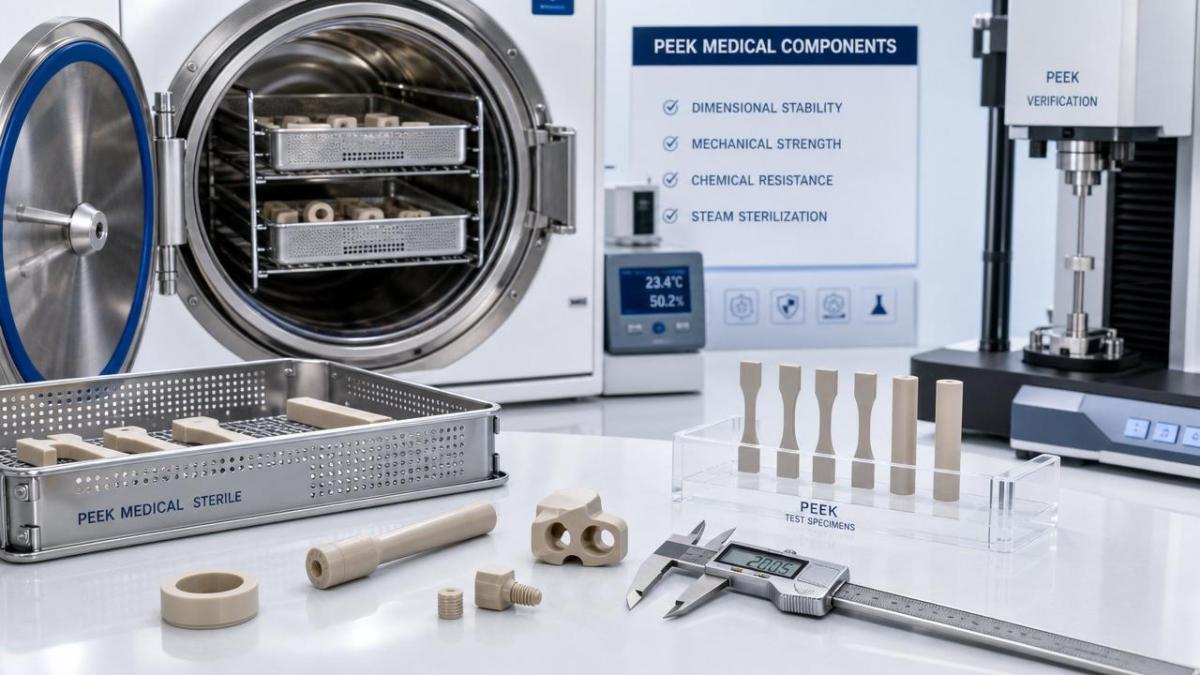
PEEK is widely selected for reusable medical parts because it combines strength, thermal stability, and chemical resistance. Yet sterilization exposure is cumulative, not theoretical.
An approval-ready review cannot stop at a single autoclave cycle. It should show what happens after repeated steam, EtO, gamma, or plasma exposure under controlled, traceable conditions.
That is why a checklist is useful. It forces the medical grade PEEK sterilization test to answer the same questions engineering, quality, and compliance functions will ask later.
Core checklist: what a medical grade PEEK sterilization test should prove
- Define the exact resin grade, filler content, colorant status, and processing history, because approval evidence is only valid when the tested material matches released production material.
- Match the sterilization method to real use, including cycle count, dwell time, humidity, radiation dose, packaging condition, and worst-case loading configuration.
- Measure dimensional stability before and after exposure using repeatable metrology, with tolerances linked to fit, sealing, alignment, and assembly function.
- Verify mechanical retention through tensile, flexural, impact, fatigue, or creep testing, depending on whether the part sees load, deflection, or repeated engagement.
- Check surface integrity for microcracking, warpage, discoloration, roughness shift, or particulate generation, since small surface changes can affect performance and cleanliness.
- Confirm chemical stability with spectroscopy, thermal analysis, or extractables review, proving the sterilization process does not create harmful degradation products.
- Demonstrate biocompatibility is maintained after sterilization, especially when repeated cycles could alter the surface and change cytotoxicity or irritation outcomes.
- Assess packaging interaction where relevant, because barrier materials, trays, and labels can alter moisture uptake, radiation response, or residue risk.
- Document cleanliness and residue limits after processing, including EtO residuals or handling contamination, to connect material performance with patient safety requirements.
- Establish statistically sound sampling, acceptance criteria, and lot traceability, so the medical grade PEEK sterilization test supports approval instead of generating isolated lab data.
Evidence categories that should appear in the test report
- Material identity records, certificates, molding parameters, and post-processing controls.
- Sterilization protocol, equipment settings, calibration status, and cycle validation records.
- Pre- and post-cycle dimensional, visual, and mechanical comparison tables.
- Biocompatibility, residue, and chemical characterization summaries tied to the tested configuration.
- Deviation handling, statistical rationale, and final pass-fail justification.
What “pass” should mean in practical terms
A passing result is not simply “no visible damage.” The medical grade PEEK sterilization test should prove the component remains functionally equivalent after the defined sterilization life.
Functionally equivalent means dimensions stay within drawing limits, strength remains above design minimums, and no new chemical or biological risk appears after exposure.
Where the part is reusable, the test should represent end-of-life conditions. Where the part is single-use, it should still cover maximum validated sterilization severity.
Scenario notes for different application conditions
Reusable surgical instrument components
Steam sterilization is often the critical challenge here. Repeated heat and moisture can drive dimensional drift, stress relaxation, and surface change at assembly interfaces.
For this case, the medical grade PEEK sterilization test should emphasize cycle endurance, latch or joint wear, retained stiffness, and visual inspection under magnification.
Implant-adjacent guides and temporary procedural tools
Dimensional precision becomes central when positioning accuracy affects procedure quality. Even small geometry changes may reduce fit or alter guided alignment.
Testing should combine metrology with application simulation. Sterilization data alone is weaker if it is not linked to actual fixture, seating, or guidance performance.
Electromechanical housings and sensor-adjacent parts
In these assemblies, sterilization can affect both structure and interface reliability. Flatness, screw retention, sealing surfaces, and insulation behavior may all matter.
A useful medical grade PEEK sterilization test should therefore include dimensional checks at mounting points and any feature that controls sealing or alignment.
Commonly missed risks that delay approval
Testing the wrong sample condition
Machined plaques or generic coupons may not reflect molded crystallinity, internal stress, knit lines, or thin-wall behavior. Approval data should represent the real part form.
Ignoring cumulative sterilization effects
One-cycle success says little about repeated use. Many failures emerge only after stacked thermal, chemical, or radiation exposure near end-of-life conditions.
Separating material data from device function
A resin may retain acceptable tensile strength while the component still fails sealing, snap-fit retention, or guidance accuracy. Functional verification must accompany material metrics.
Overlooking residue and cleanliness evidence
Especially with EtO or complex handling steps, residuals and particulate risk can become approval blockers even when the PEEK itself remains structurally stable.
Using weak acceptance criteria
If pass-fail limits are vague, reviewers may reject the package. Criteria should be linked to drawings, risk analysis, validated sterilization windows, and intended service life.
Practical execution steps
- Start from the device risk file and identify which part attributes sterilization could change.
- Build a worst-case matrix covering material lot, geometry, sterilization method, and maximum cycle count.
- Use production-equivalent samples, not convenience specimens, unless equivalence is formally justified.
- Pair bench measurements with functional checks, especially for fit, sealing, wear, and precision interfaces.
- Write acceptance criteria before testing starts and tie them to design inputs and compliance requirements.
- Summarize the medical grade PEEK sterilization test in a traceable report package ready for technical and quality review.
Conclusion and next action
A strong medical grade PEEK sterilization test should prove repeatable sterilization does not compromise geometry, mechanics, chemistry, cleanliness, or biocompatibility within the approved use envelope.
The most credible approval packages connect lab data to real device function, real production material, and real sterilization severity. That is the difference between a material claim and approval-grade evidence.
As a next step, convert this checklist into a test matrix with defined cycles, measurements, acceptance limits, and traceability fields. If any line item remains unproven, approval risk is still open.
Search News
Hot Articles
- Carbon Fiber StructuresHow to Specify Aerospace Carbon Fiber Assemblies for Lightweight, Load-Bearing PartsJul 11, 2026
- Machine VisionXiaomi, Alibaba DAMO Academy Drive Open-Source Robotics Model Ecosystem, Lowering Algorithm Development Barriers for Overseas SMEs Adopting Chinese Robotics SolutionsMar 30, 2026
- Cobots & ArmsShanxi 'AI+' Conference Showcases Embodied Intelligence with Multinational Buyer Engagement: Key Industry ImplicationsMar 30, 2026
Popular Tags
Recommended News
 Jul 11, 2026How to Specify Aerospace Carbon Fiber Assemblies for Lightweight, Load-Bearing PartsAerospace carbon fiber assemblies: learn how to specify laminate design, load data, joining methods, and inspection controls for lighter, reliable load-bearing aerospace parts.Elena Rostova (UAV Systems Researcher)
 Mar 30, 2026Xiaomi, Alibaba DAMO Academy Drive Open-Source Robotics Model Ecosystem, Lowering Algorithm Development Barriers for Overseas SMEs Adopting Chinese Robotics SolutionsXiaomi & Alibaba DAMO Academy's open-source robotics models lower algorithm barriers for global SMEs. Boost efficiency in manufacturing, logistics & smart retail with ROS 2 compatible solutions.TSV Data Lab
 Mar 30, 2026Shanxi 'AI+' Conference Showcases Embodied Intelligence with Multinational Buyer Engagement: Key Industry ImplicationsShanxi 'AI+' Conference highlights embodied intelligence with Tesla, Ubtech & Jiantao showcasing multimodal robotics. 40+ global buyers validated tech on-site, creating new B2B channels for industrial automation & AI solutions.Chen Wei (Automation Lead Engineer)
 Mar 30, 2026Zhongguancun Unveils 6G Integrated Sensing-Computing-Intelligence Platform to Empower Embodied Robots for Global Industrial ApplicationsZhongguancun's new 6G platform revolutionizes industrial robotics with <10ms latency, empowering global automotive, logistics & port automation. Discover how this tech boosts China's smart manufacturing exports.TSV Data Lab
 Mar 30, 2026Mech-Mind Tianjin Embodied Intelligence R&D and Production Base Goes Live, Cutting Delivery Time by 20%–30% for Global Customized AMR+Vision SolutionsMech-Mind's Tianjin AMR+Vision production base cuts delivery time by 20%-30% for欧美 & Latin American markets. Discover how this PLd-certified facility accelerates customized robotics solutions for smart manufacturing and logistics.Chen Wei (Automation Lead Engineer)
 Mar 30, 2026Boao Forum Reveals 'Co-evolution of Big and Small Brains' Trend in Humanoid Robots, China's Embodied Intelligence Accelerates Adaptation to Overseas Manufacturing Service ScenariosDiscover how China's humanoid robots, featuring 'Co-evolution of Big and Small Brains,' are revolutionizing global manufacturing. Learn about Embodied Tian Gong 3.0's ISO compliance and overseas deployment at Boao Forum 2026.Chen Wei (Automation Lead Engineer)
 Mar 30, 2026China Railway Industrial Secures Patent for Embodied Robotics in Material Handling, Boosting High-Precision Delivery Capabilities for Overseas Infrastructure and Manufacturing ProjectsChina Railway Industrial's new patent for embodied robotics in material handling boosts high-precision delivery for global infrastructure & manufacturing. Discover how this innovation enhances logistics accuracy in automotive, rail transit & EPC projects.Chen Wei (Automation Lead Engineer)
 Oct 04, 2026CAD/CAM Benchmarking in the GCC: What Manufacturers Should Ask a ConsultantCAD CAM benchmark consultant GCC guide: learn the key questions manufacturers should ask to validate post-processors, workflows, machine performance, and production risk.Victor Lin (Chief Software Architect)
 Oct 03, 2026Selecting Automotive Radar Sensor Modules for ADAS Range, Resolution, and IntegrationAutomotive radar sensor module selection guide for ADAS: compare range, resolution, field of view, latency, and integration to build safer, reliable vehicle systems.TSV Data Lab
 Oct 02, 2026How to Qualify Machined Parts Suppliers for Hard Tech ProgramsHard tech supply chain machined parts demand rigorous supplier qualification. Learn how to assess capability, traceability, quality controls, and delivery resilience.Dr. Marcus Vance
 Oct 01, 2026How to Select an Outdoor Security Radar Sensor for Perimeter Detection?Outdoor security radar sensor selection guide: compare range, accuracy, false-alarm control, integration, and field testing for reliable perimeter detection.TSV Data Lab
 Sep 30, 2026How to Evaluate Solid-State LiDAR Hardware for Outdoor Autonomous VehiclesSolid state LiDAR hardware evaluation guide for outdoor autonomous vehicles—compare range, point-cloud quality, environmental resilience, integration, and safety.TSV Data Lab
 Sep 29, 2026ISO 9283 Repeatability: How to Evaluate Cobot Positioning PerformanceISO 9283 cobot repeatability explained: learn how payload, reach, approach direction, and test conditions affect positioning performance and cell capability.Chen Wei (Automation Lead Engineer)
 Oct 04, 2026How Should You Compare 5-Axis CNC Machine Accuracy Claims?How do I compare 5-axis CNC machine accuracy claims? Learn how to assess standards, thermal stability, TCP accuracy, and real-world test evidence.Dr. Marcus Vance
 Oct 03, 2026Is Edge Computing Necessary for Real-Time Quality Inspection?Is industrial edge computing necessary for real-time quality inspection? Explore how latency, data volume, reliability, and control integration shape the right architecture.TSV Data Lab
 Oct 02, 2026What Documents Prove a Precision Machining Supplier Can Hold Tolerance?What documents prove a precision machining supplier can hold tolerance? Explore certificates, FAI reports, calibration, SPC, and traceability evidence to qualify suppliers with confidence.Dr. Marcus Vance
 Oct 01, 2026Can a Machining Supplier Meet Aerospace Fatigue Testing Requirements?Can a machining supplier meet aerospace fatigue testing requirements? Learn the traceability, process control, and test evidence needed for reliable aerospace parts.Dr. Marcus Vance
 Sep 30, 2026Which Industrial Robot Specifications Matter for High-Precision Assembly?Which industrial robot specifications matter most for high-precision assembly? Explore repeatability, accuracy, stiffness, vibration, calibration, and force control for reliable yields.Chen Wei (Automation Lead Engineer)
 Sep 29, 2026How Do You Verify Servo Motor Torque Under Continuous Load?How do I verify servo motor torque under continuous load? Learn RMS torque checks, torque-speed limits, thermal derating, and real-machine testing.Chen Wei (Automation Lead Engineer)
 Oct 02, 2026ZD330 Software Configuration: Verifying Cut-List Import Before PurchaseZD330 software and machine configuration: verify cut-list imports, data mapping, labels, and workflow before purchase to reduce errors and choose with confidence.Victor Lin (Chief Software Architect)
 Sep 28, 2026Spindle Runout Measurement in Germany: DIN Standards, Methods, and Acceptance LimitsSpindle runout measurement Germany: explore DIN standards, proven methods, acceptance limits, and audit-ready practices for reliable machining quality.Dr. Marcus Vance
 Sep 27, 2026How to Select Wall-Mount Edge Devices for Space-Constrained Factory NetworksWall mount edge devices for space-constrained factories: evaluate workload, thermal design, power resilience, cable access, and network reliability for smarter deployments.TSV Data Lab
 Sep 26, 2026Machining Tolerance Analysis: How to Set Limits That Meet Function and Cost TargetsMachining tolerance analysis: learn how to set functional limits, control tolerance stacks, reduce inspection risk, and balance precision with production cost.Dr. Marcus Vance
 Sep 25, 2026How to Evaluate an Industrial Infrastructure Data Platform for Multi-Site OperationsIndustrial infrastructure data platform evaluation guide for multi-site operations: compare data quality, edge resilience, interoperability, governance, and scalable proof-of-value criteria.Victor Lin (Chief Software Architect)