What to Inspect First When Reviewing a Trampoline Park for Sale
Publication Date
author
When evaluating a trampoline park for sale, the first inspection should go beyond surface appeal and focus on operational facts, safety compliance, equipment condition, and cash-flow reliability. For procurement professionals and decision-makers, an attractive venue means little without verified maintenance records, realistic revenue data, and facility-level risk visibility. A disciplined first review helps separate marketable assets from costly liabilities before deeper due diligence begins.
For most buyers, the right starting point is not the lobby design, the social media presence, or even headline revenue. The first inspection should answer one practical question: is this an operating asset with controllable risk, or a business that only looks attractive until the technical, legal, and financial details are tested?
That question matters even more for procurement-led teams, investment committees, and multi-site operators. A trampoline park can generate strong family entertainment demand, but it can also hide expensive issues in safety systems, lease terms, deferred maintenance, staffing structure, and customer concentration. The fastest way to reduce acquisition risk is to review the park in layers, beginning with the factors most likely to affect continuity, liability, and true earning power.
Start With Safety Compliance, Because Every Other Asset Depends on It
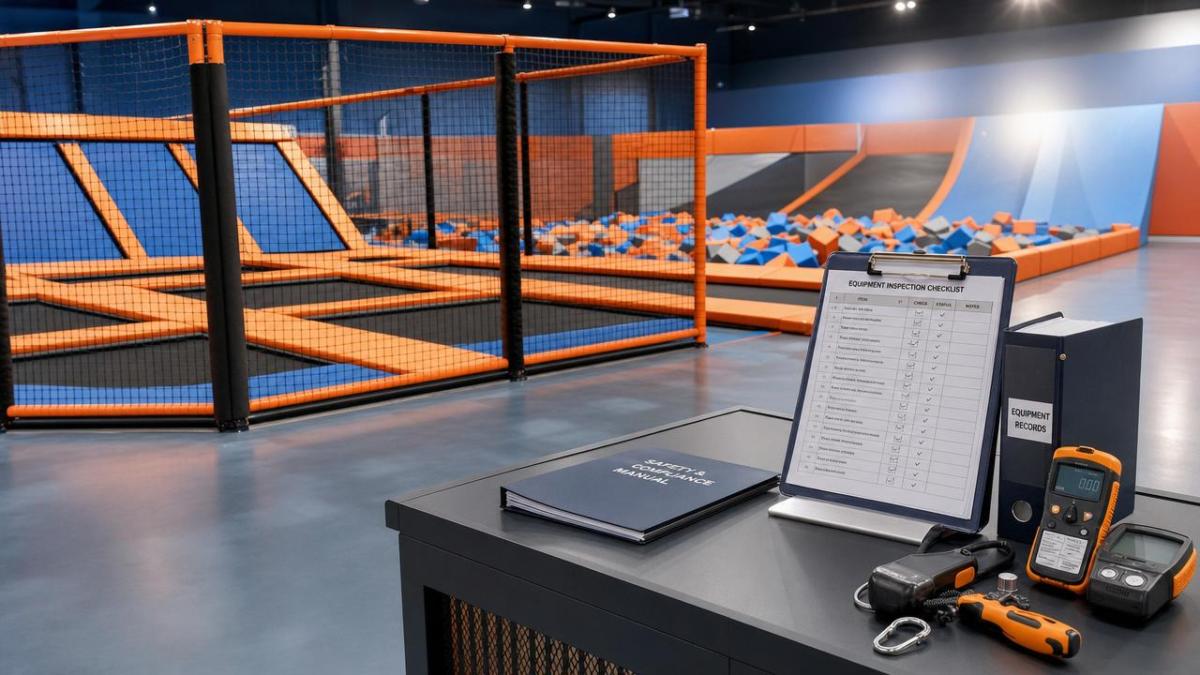
If you are reviewing a trampoline park for sale, safety compliance should be the first inspection priority. Unlike many other recreation businesses, a trampoline park carries direct bodily injury exposure. That means the value of the business is inseparable from its maintenance discipline, documented inspection routines, staff training quality, and compliance history.
Begin by requesting incident logs, insurance claims history, equipment inspection reports, local fire and occupancy approvals, and any relevant third-party safety certifications. A seller may present the business as busy and profitable, but unresolved safety issues can reduce insurability, increase legal exposure, and undermine future operating margins.
Look closely at whether the park follows documented daily, weekly, and monthly inspection routines. Ask who performs these inspections, how findings are recorded, how repairs are escalated, and whether any attractions are currently operating under temporary fixes. A mature operator should be able to show not just forms, but a pattern of disciplined execution.
Staff training is equally important. Verify how court monitors, floor managers, and maintenance personnel are trained, how refreshers are handled, and whether emergency response procedures are documented and practiced. In a trampoline environment, weak frontline supervision can convert a manageable operational issue into a severe liability event.
Also review waiver systems, surveillance coverage, signage clarity, and age- or activity-specific risk controls. These elements may seem procedural, but they directly influence claim frequency and the park’s defensibility in the event of an incident. For a buyer, poor safety governance is often a larger red flag than an aging foam pit or worn visual branding.
Inspect the Condition and Remaining Useful Life of the Core Equipment
Once baseline safety compliance is understood, the next priority is the physical condition of the park’s revenue-generating infrastructure. Buyers should not think only in terms of whether equipment “looks good.” The better question is how much capital expenditure will be required within the next 12 to 36 months to keep the park fully operational and commercially competitive.
Review the condition of trampoline beds, springs, pads, deck framing, netting, air bags, foam pits, climbing features, ninja courses, zip elements if present, soft play areas, and any arcade or redemption equipment attached to the business model. Ask for the installation dates, replacement cycles, manufacturer details, repair history, and warranty status for each major equipment group.
Pay attention to partial upgrades. Some sellers modernize customer-facing attractions while delaying behind-the-scenes repairs or structural replacements. A refreshed dodgeball zone does not offset neglected anchor points, worn padding systems, or outdated support components. Procurement-minded buyers should separate cosmetic updates from structural asset integrity.
A site walkthrough should include flooring transitions, railings, HVAC performance, restroom condition, lighting quality, point-of-sale hardware, kitchen equipment if food service is present, and the state of party rooms. In family entertainment centers, customer experience and repeat traffic depend not only on attractions, but on comfort, cleanliness, and reliability across the entire facility.
It is also wise to assess whether the current attraction mix still matches local demand. A trampoline park for sale may be mechanically sound yet commercially dated. If surrounding competitors offer modern hybrid entertainment formats, you may need to invest in new attractions to defend market share. That future upgrade cost should be included in your first-pass valuation thinking.
Verify Revenue Quality Before You Trust Revenue Size
Revenue claims often attract initial attention, but experienced buyers know that not all revenue is equally reliable. During the first review, focus less on top-line volume and more on the composition, consistency, and resilience of earnings.
Ask for at least 24 to 36 months of monthly revenue by category: open jump, memberships, birthday parties, corporate events, school bookings, food and beverage, arcade, merchandise, and seasonal promotions. This breakdown reveals whether the business is diversified or overly dependent on one traffic source.
A healthy trampoline park usually combines recurring walk-in demand with event-based and membership-based revenue. If a large share of income comes from birthday parties alone, for example, the business may be more vulnerable to local competition, seasonal swings, or customer sentiment changes. If nearly all growth came from deep discount campaigns, the current revenue base may not be sustainable.
Compare sales patterns against staffing levels, local school calendars, weather seasonality, and promotional calendars. Sudden spikes may reflect one-time campaigns rather than durable customer demand. Similarly, a recovery after a shutdown period should not be mistaken for stable normalized growth without examining the full time series.
Procurement and acquisition teams should also ask how much of the revenue is system-verified through POS, booking platforms, and membership software. Manual spreadsheets alone are not enough. The cleaner the system integration, the easier it is to validate ticket volume, average spend, refund rates, and customer frequency.
Check Cash Flow Reliability, Not Just Reported Profitability
After revenue quality, move directly to cash flow reliability. Many trampoline parks appear profitable on paper while carrying hidden pressure in repairs, insurance costs, promotional spending, deferred payroll liabilities, or owner-dependent operations. A first inspection should surface these issues early.
Request profit and loss statements, bank statement summaries, payroll data, merchant processor reports, rent schedules, utility expenses, insurance premiums, and maintenance spending. Then test whether earnings are supported by actual cash generation, not aggressive add-backs or vague normalization assumptions.
Pay special attention to EBITDA adjustments. Sellers often add back owner salary, discretionary marketing, one-time repairs, or “non-recurring” costs. Some adjustments are legitimate, but others are recurring operating realities in disguise. In a trampoline park, maintenance, insurance, and staffing volatility should not be minimized simply to support a higher asking price.
Membership businesses deserve extra scrutiny. Deferred revenue from prepaid passes or memberships can improve cash collection in the short term while creating future service obligations. Understanding the timing mismatch between cash received and services owed helps buyers avoid overstating free cash flow.
Also examine refund behavior, chargebacks, coupon dependency, and unpaid vendor balances. These often reveal stress before headline financial statements do. If a trampoline park for sale has rising revenue but declining maintenance spending or increasing payables, the apparent margin strength may be temporary.
Review the Lease, Facility Constraints, and Site-Level Economics
In many acquisitions, the lease is one of the most important assets—or one of the biggest risks. A trampoline park depends heavily on ceiling height, floor span, visibility, parking access, and zoning suitability. If the lease terms are weak, even a well-run operation can become a poor long-term asset.
Start with remaining lease term, renewal options, rent escalations, common area charges, landlord obligations, assignment rights, and any restrictions on use. Confirm whether the seller can transfer the lease smoothly and whether landlord consent is required. A profitable park in a strategic location may lose much of its value if the lease transfer is uncertain.
Evaluate occupancy cost as a percentage of revenue, but do not stop there. Consider whether the site still fits the operating model. Is parking sufficient for parties and weekend peak traffic? Are ingress and egress easy for families? Is the ceiling height adequate for future attraction upgrades? Are there structural limitations that could make modernization expensive?
Check zoning, occupancy limits, ADA compliance, fire system adequacy, and any municipal permits tied to amusement operations. Buyers should also review whether neighboring tenants or property conditions create brand or traffic risk. For example, difficult parking, poor nighttime lighting, or declining retail co-tenancy can erode customer demand over time.
If food service, alcohol service, or group events are part of the revenue model, verify that the facility supports them operationally and legally. A location may be functional today but constrained in ways that limit future growth. Strong first-stage buyers inspect not only what the facility is, but what it can realistically become.
Measure Local Market Strength and Competitive Pressure
A trampoline park for sale should never be reviewed in isolation. The same financial profile can represent either a strong buying opportunity or a fragile asset depending on the local market structure. Demand durability depends on population mix, family demographics, school density, income levels, competition, and entertainment alternatives.
Study the catchment area, drive-time population, child and teen demographics, household income bands, local event culture, and nearby competitors. Include not just other trampoline parks, but family entertainment centers, climbing gyms, indoor playgrounds, bowling venues, and community recreation facilities.
Look at online reviews in detail. The goal is not simply to average star ratings, but to detect patterns: repeated concerns about cleanliness, safety enforcement, staff attitude, food quality, wait times, or broken attractions. These signals often align with operational weaknesses that later appear in cash flow or insurance performance.
It is also helpful to assess whether growth depends on aggressive discounting through third-party promotion channels. Heavy coupon dependence can indicate weak brand pull. By contrast, strong repeat party bookings, school programs, and memberships often suggest deeper local relevance and better revenue resilience.
For procurement professionals used to technical sourcing, think of market review as field validation. The seller’s narrative is a claim; the local competitive landscape is the test environment. A disciplined first inspection uses both.
Understand How Dependent the Business Is on the Current Owner or Key Staff
Another early inspection priority is operational transferability. Some trampoline parks look stable until the owner exits. If customer relationships, staff retention, vendor coordination, local marketing, or safety oversight depend heavily on one individual, the business may be harder to transition than the financials suggest.
Map the management structure. Who runs day-to-day operations? Who manages scheduling, party sales, local partnerships, repairs, and compliance? Is there a capable general manager in place, or is the owner still the control center for every important decision?
Review staff turnover, wage structure, shift coverage, and recruitment challenges. Entertainment venues often rely on younger hourly labor, which can increase churn and training needs. If the park has stable supervisory staff with clear procedures, transition risk is lower. If not, the buyer may need immediate post-close operating support.
Ask about vendor relationships for equipment maintenance, cleaning, POS systems, food supply, uniforms, and insurance brokerage. Standardized vendor contracts are usually easier to transfer than informal local arrangements managed by the owner. The more process-driven the business is, the easier it is to preserve continuity after acquisition.
Use a First-Inspection Checklist to Decide Whether Deeper Due Diligence Is Worth It
The first review is not meant to answer every acquisition question. Its purpose is to determine whether the opportunity deserves deeper legal, technical, and financial diligence. A practical first-pass checklist can keep buyers from spending time on assets with obvious structural issues.
At minimum, your initial review of a trampoline park for sale should cover five areas: safety documentation, equipment condition, revenue composition, cash flow quality, and lease strength. If any of these areas fail basic credibility tests, the deal may require repricing—or a fast exit from the process.
Useful green flags include current inspection logs, low unresolved incident exposure, system-backed revenue reporting, diversified customer demand, manageable occupancy cost, and a facility with no immediate major capex burden. These indicators do not guarantee a good acquisition, but they justify deeper analysis.
Red flags include missing maintenance records, unresolved insurance issues, unclear financial reconciliation, heavy dependence on discounts, lease transfer uncertainty, major equipment wear without reserves, and owner-centric operations. One red flag may be manageable; several together usually signal value erosion.
For procurement-oriented teams, this step resembles supplier qualification. You are not buying the seller’s story. You are qualifying an asset under operating, compliance, and economic criteria. That mindset leads to better decisions and fewer post-acquisition surprises.
Conclusion: Inspect Risk First, Then Evaluate Upside
When reviewing a trampoline park for sale, the smartest first inspection is the one that prioritizes risk visibility over visual appeal. Safety compliance, equipment integrity, lease quality, revenue reliability, and cash flow truth matter more than branding polish or headline sales numbers. These factors determine whether the business is genuinely investable or simply marketable.
For buyers, especially procurement professionals and decision-makers used to disciplined evaluation frameworks, the advantage comes from sequence. Start with the elements that can destroy value quickly: liability exposure, deferred capex, weak lease terms, unverifiable earnings, and fragile operations. Only after those are understood should you spend time modeling growth, expansion, or repositioning opportunities.
A well-run trampoline park can be a durable entertainment asset with repeat family demand and multiple revenue streams. But only a structured first review can tell you whether the opportunity in front of you is a scalable business, a turnaround project, or an avoidable liability. In acquisition work, the first things you inspect usually determine the questions you ask next—and the price you should be willing to pay.
Search News
Hot Articles
- Carbon Fiber StructuresHow to Specify Aerospace Carbon Fiber Assemblies for Lightweight, Load-Bearing PartsJul 11, 2026
- Machine VisionXiaomi, Alibaba DAMO Academy Drive Open-Source Robotics Model Ecosystem, Lowering Algorithm Development Barriers for Overseas SMEs Adopting Chinese Robotics SolutionsMar 30, 2026
- Cobots & ArmsShanxi 'AI+' Conference Showcases Embodied Intelligence with Multinational Buyer Engagement: Key Industry ImplicationsMar 30, 2026
Popular Tags
Recommended News
 Jul 11, 2026How to Specify Aerospace Carbon Fiber Assemblies for Lightweight, Load-Bearing PartsAerospace carbon fiber assemblies: learn how to specify laminate design, load data, joining methods, and inspection controls for lighter, reliable load-bearing aerospace parts.Elena Rostova (UAV Systems Researcher)
 Mar 30, 2026Xiaomi, Alibaba DAMO Academy Drive Open-Source Robotics Model Ecosystem, Lowering Algorithm Development Barriers for Overseas SMEs Adopting Chinese Robotics SolutionsXiaomi & Alibaba DAMO Academy's open-source robotics models lower algorithm barriers for global SMEs. Boost efficiency in manufacturing, logistics & smart retail with ROS 2 compatible solutions.TSV Data Lab
 Mar 30, 2026Shanxi 'AI+' Conference Showcases Embodied Intelligence with Multinational Buyer Engagement: Key Industry ImplicationsShanxi 'AI+' Conference highlights embodied intelligence with Tesla, Ubtech & Jiantao showcasing multimodal robotics. 40+ global buyers validated tech on-site, creating new B2B channels for industrial automation & AI solutions.Chen Wei (Automation Lead Engineer)
 Mar 30, 2026Zhongguancun Unveils 6G Integrated Sensing-Computing-Intelligence Platform to Empower Embodied Robots for Global Industrial ApplicationsZhongguancun's new 6G platform revolutionizes industrial robotics with <10ms latency, empowering global automotive, logistics & port automation. Discover how this tech boosts China's smart manufacturing exports.TSV Data Lab
 Mar 30, 2026Mech-Mind Tianjin Embodied Intelligence R&D and Production Base Goes Live, Cutting Delivery Time by 20%–30% for Global Customized AMR+Vision SolutionsMech-Mind's Tianjin AMR+Vision production base cuts delivery time by 20%-30% for欧美 & Latin American markets. Discover how this PLd-certified facility accelerates customized robotics solutions for smart manufacturing and logistics.Chen Wei (Automation Lead Engineer)
 Mar 30, 2026Boao Forum Reveals 'Co-evolution of Big and Small Brains' Trend in Humanoid Robots, China's Embodied Intelligence Accelerates Adaptation to Overseas Manufacturing Service ScenariosDiscover how China's humanoid robots, featuring 'Co-evolution of Big and Small Brains,' are revolutionizing global manufacturing. Learn about Embodied Tian Gong 3.0's ISO compliance and overseas deployment at Boao Forum 2026.Chen Wei (Automation Lead Engineer)
 Mar 30, 2026China Railway Industrial Secures Patent for Embodied Robotics in Material Handling, Boosting High-Precision Delivery Capabilities for Overseas Infrastructure and Manufacturing ProjectsChina Railway Industrial's new patent for embodied robotics in material handling boosts high-precision delivery for global infrastructure & manufacturing. Discover how this innovation enhances logistics accuracy in automotive, rail transit & EPC projects.Chen Wei (Automation Lead Engineer)
 Sep 29, 2026ISO 9283 Repeatability: How to Evaluate Cobot Positioning PerformanceISO 9283 cobot repeatability explained: learn how payload, reach, approach direction, and test conditions affect positioning performance and cell capability.Chen Wei (Automation Lead Engineer)
 Sep 28, 2026Spindle Runout Measurement in Germany: DIN Standards, Methods, and Acceptance LimitsSpindle runout measurement Germany: explore DIN standards, proven methods, acceptance limits, and audit-ready practices for reliable machining quality.Dr. Marcus Vance
 Sep 27, 2026How to Select Wall-Mount Edge Devices for Space-Constrained Factory NetworksWall mount edge devices for space-constrained factories: evaluate workload, thermal design, power resilience, cable access, and network reliability for smarter deployments.TSV Data Lab
 Sep 26, 2026Machining Tolerance Analysis: How to Set Limits That Meet Function and Cost TargetsMachining tolerance analysis: learn how to set functional limits, control tolerance stacks, reduce inspection risk, and balance precision with production cost.Dr. Marcus Vance
 Sep 25, 2026How to Evaluate an Industrial Infrastructure Data Platform for Multi-Site OperationsIndustrial infrastructure data platform evaluation guide for multi-site operations: compare data quality, edge resilience, interoperability, governance, and scalable proof-of-value criteria.Victor Lin (Chief Software Architect)
 Sep 24, 2026How to Select Machine Vision Optics for Accurate Inspection at Different Working DistancesMachine vision optics selection guide for accurate inspection at every working distance. Compare FOV, pixel scale, DOF, distortion, lighting, and telecentric options.TSV Data Lab
 Sep 23, 2026How to Evaluate a Machine Vision System Integrator for High-Speed Inspection LinesChoose a machine vision system integrator with proven expertise in high-speed inspection, reliable reject timing, robust optics, and measurable acceptance criteria.TSV Data Lab
 Sep 28, 2026When is a SCADA API the right choice for connecting plant systems?SCADA API guide: learn when governed plant data integration improves traceability, security, and scalability—without compromising real-time control.Victor Lin (Chief Software Architect)
 Sep 27, 2026How SCADA data integration improves traceability across production linesSCADA data integration connects production-line data to improve traceability, accelerate quality investigations, and strengthen safety decisions.Victor Lin (Chief Software Architect)
 Sep 26, 2026What to define before starting SCADA integration planningSCADA integration planning starts with clear scope, control boundaries, data models, cybersecurity, and testing. Discover the definitions that reduce risk and costly rework.Victor Lin (Chief Software Architect)
 Sep 25, 2026How a smart factory with Industrial IoT reduces production blind spotsDiscover how a smart factory with Industrial IoT turns real-time machine, quality, and workflow data into actionable insights that reduce production blind spots and delivery risks.Victor Lin (Chief Software Architect)
 Sep 24, 2026When does Industrial IoT make smart manufacturing easier to scale?Smart manufacturing Industrial IoT scales when trusted data, interoperable systems, and secure workflows turn connected assets into measurable gains.TSV Data Lab
 Sep 23, 2026What drives ultra-precision machining cost at 1-micron tolerance?Ultra precision machining cost per part at 1 micron tolerance depends on process, material, metrology, and yield. Learn how to compare quotes confidently.Dr. Marcus Vance
 Sep 22, 2026Drone Engine-T550CC Applications: Build the UAV Power System Around the MissionAn application guide for Drone Engine-T550CC integration, covering payload planning, airframe matching, cooling, fuel, vibration, test procedures, documentation, and service preparation.Elena Rostova (UAV Systems Researcher)
 Sep 22, 2026How to Evaluate Industrial Edge Computing Vendors for Factory DeploymentIndustrial edge computing vendor evaluation guide for factories: compare latency, protocol fit, reliability, security, and lifecycle support before deployment.TSV Data Lab
 Sep 21, 2026Drone Payload Integration: Matching Power, Data, and Center of Gravity for Reliable FlightsDrone payload integration made practical: balance power, data, center of gravity, and endurance to build safer, more reliable mission-ready flights.Elena Rostova (UAV Systems Researcher)
 Sep 20, 2026Autonomous Navigation Pricing: Cost Drivers and Budget Benchmarks for AMR ProjectsAutonomous navigation price explained: compare AMR cost drivers, software, sensors, integration, safety, and lifecycle budgets to build a scalable project plan.Chen Wei (Automation Lead Engineer)