A Trampoline Park for Sale Can Look Profitable and Still Be Risky
Publication Date
author
A trampoline park for sale can appear attractive on paper, but sharp decision-makers know that revenue snapshots rarely reveal the full operational risk. From equipment fatigue and safety liabilities to lease terms, maintenance records, and local demand stability, every metric matters. For business leaders evaluating acquisition opportunities, a data-driven review is essential to separate apparent profitability from long-term viability.
Why can a trampoline park for sale look profitable while hiding operational risk?
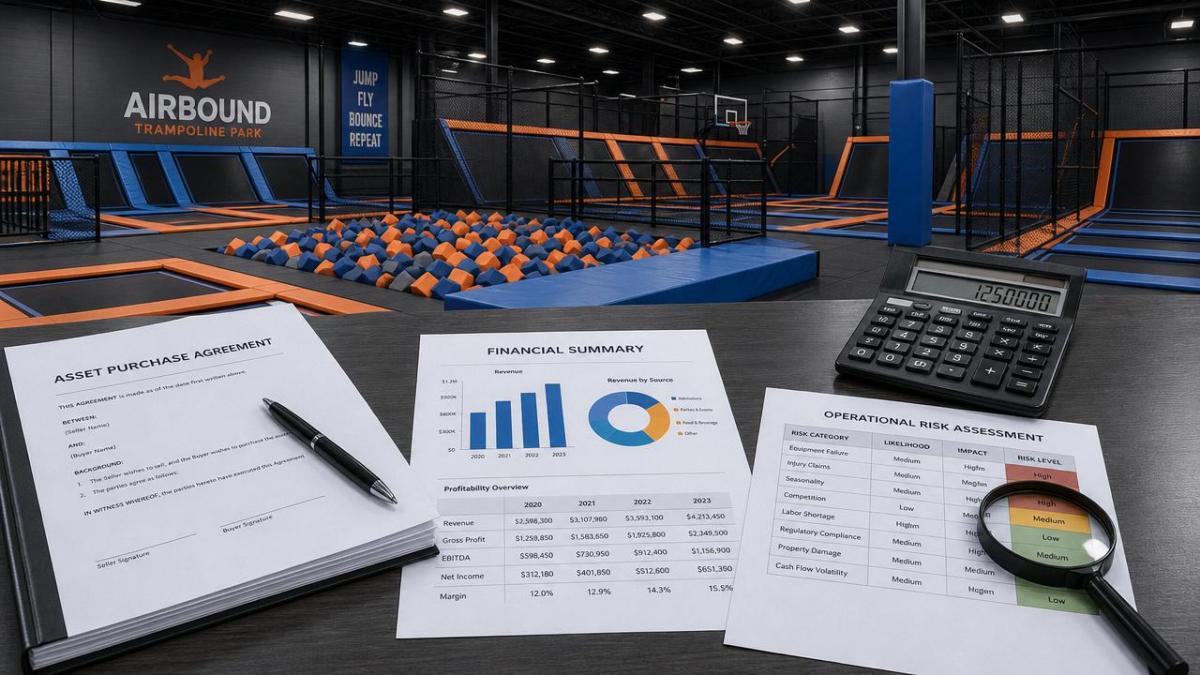
A trampoline park for sale often reaches the market with a polished earnings story: strong weekend traffic, attractive party bookings, and a headline EBITDA figure that looks compelling in a broker summary. Yet enterprise buyers, investors, and operators know that location-based entertainment businesses are not judged by revenue alone. They are judged by how durable that revenue is when safety, asset wear, staffing volatility, lease pressure, and local competition are tested.
This is where a data-first approach matters. TechStat Vanguard (TSV) was built around one principle: parameters do not lie. While TSV is best known for engineering benchmarking across hard-tech sectors, the same discipline applies to acquisition analysis in the broader commercial landscape. Whether assessing a CNC production line or a trampoline park for sale, the right question is never “Does it sell well today?” but “Can its performance remain stable under real operating stress?”
For business decision-makers, the real acquisition challenge is signal versus noise. Sellers emphasize gross sales, social media engagement, and holiday peaks. Buyers must focus on traceable records, maintenance frequency, insurance history, replacement cycles, accident exposure, and throughput limitations. A trampoline park for sale is not simply a leisure brand; it is a safety-dependent operating system with mechanical, legal, and demand-side variables.
- Revenue concentration risk: one strong season or a few school-holiday spikes can distort annual performance.
- Asset fatigue risk: jumping surfaces, springs, padding, netting, and frame structures degrade unevenly.
- Compliance risk: incident logs, inspection intervals, and local code obligations may not be fully disclosed in a teaser package.
- Occupancy risk: rent escalations and lease renewal clauses can materially change margins after acquisition.
- Demand stability risk: customer retention, birthday-party repeat rates, and school-group contracts may be weaker than advertised.
In other words, the core task is not to reject every trampoline park for sale. It is to separate an efficiently run, maintainable facility from one that monetized early growth while deferring capital expenditure. That distinction determines whether the business is scalable, merely survivable, or structurally risky.
What should buyers audit before acquiring a trampoline park for sale?
Before evaluating valuation multiples, leadership teams should build a disciplined diligence framework. This helps procurement-minded executives, private investors, and operating groups compare opportunities using measurable inputs instead of sales language. The table below outlines a practical screening matrix for any trampoline park for sale under review.
This screening matrix helps buyers turn a trampoline park for sale into an auditable asset class. Without these records, decision-makers are not buying a business with known performance. They are buying uncertainty wrapped in a sales narrative.
Key diligence questions for enterprise buyers
- Is EBITDA adjusted with realistic owner add-backs, or does it rely on one-off cost exclusions?
- How much of the current customer base is event-driven versus repeat membership-driven?
- What percentage of core equipment is within its practical replacement window?
- Has the seller deferred repairs that will convert into immediate post-acquisition spending?
- Do local demographics support continued traffic, or was performance lifted by temporary market gaps?
TSV’s broader analytical philosophy is useful here: do not accept top-line claims until operating parameters are validated. That mindset reduces trial-and-error costs in manufacturing procurement, and it also reduces acquisition error in service-based businesses.
Which performance indicators matter more than headline revenue?
When comparing more than one trampoline park for sale, revenue alone is a weak decision tool. A better approach is to evaluate normalized operating performance, throughput efficiency, customer acquisition cost, and maintenance intensity. Buyers should also distinguish between nominal profitability and resilient profitability.
The table below compares the difference between a healthy operating profile and a risk-heavy profile. These are decision dimensions, not fixed benchmarks, and they should be tested against local market conditions.
This comparison is valuable because many listings for a trampoline park for sale are marketed on gross income and social proof. Yet resilient value comes from system stability: repeat demand, controllable safety procedures, maintainable equipment, and enough gross margin to absorb inspections, renewals, and downtime.
How to read operating metrics more critically
- A rising sales line can still mask weaker net margins if insurance, utilities, and labor have escalated faster than admission pricing.
- High utilization is not automatically positive if it accelerates surface wear and raises injury risk without planned replacement budgets.
- Strong online reviews are useful, but they do not replace evidence of maintenance discipline and procedural control.
How do safety, maintenance, and compliance affect valuation?
A trampoline park for sale is unusual because the customer experience and risk profile are physically inseparable. If equipment condition declines, customer satisfaction, injury exposure, and insurer confidence can all deteriorate at the same time. That means valuation is highly sensitive to non-financial records.
Executives should not assume that a recent inspection alone proves low risk. An isolated pass report may say little about consistency of procedures, employee enforcement of rules, or adequacy of spare parts replacement. A serious review should examine trends, intervals, and response quality when issues were found.
Documents worth verifying line by line
- Daily and weekly inspection logs for mats, frame pads, springs, netting, and access zones.
- Staff training records covering supervision ratios, emergency response, and incident escalation.
- Insurance renewals, exclusions, deductibles, and claim history over multiple periods.
- Local authority notices, fire safety obligations, occupancy requirements, and waiver handling procedures.
From a TSV-style analytical perspective, these are operating parameters. In hard-tech procurement, buyers look at tolerance drift, fatigue thresholds, and failure intervals. In a trampoline park acquisition, the equivalents are wear progression, incident frequency, repair response time, and compliance consistency. The decision logic is the same: remove marketing language and test the system under real conditions.
What are the most common acquisition mistakes when reviewing a trampoline park for sale?
Many buyers do not fail because they misread the concept. They fail because they underestimate execution friction. A trampoline park for sale may be commercially viable, but the margin for operational error can be narrow if the site has aging assets, weak controls, or unstable demand drivers.
Frequent buyer misjudgments
- Treating seller-provided adjusted profit as durable cash flow without stress-testing maintenance and insurance costs.
- Ignoring landlord leverage, especially where renewal options are short or rent steps are aggressive.
- Assuming footfall will remain stable after ownership transition despite weak local loyalty or limited brand moat.
- Underestimating the managerial burden of safety training, supervision, cleaning, and customer incident handling.
- Failing to budget for immediate remediation work needed to align operations with tighter internal standards.
The practical lesson is simple. If a trampoline park for sale only works under optimistic assumptions, it is not a strong acquisition. It is a fragile turnaround disguised as an easy buy-in.
How should business leaders structure a smarter procurement and acquisition process?
Enterprise decision-makers benefit from treating an acquisition like a structured sourcing project. That means defining evaluation criteria in advance, requesting evidence in a standardized format, and scoring each opportunity against operational and risk factors. This is especially useful when comparing multiple listings for a trampoline park for sale across different regions.
A disciplined acquisition workflow
- Establish the investment thesis: cash-flow yield, regional expansion, operational turnaround, or platform acquisition.
- Build a diligence checklist covering finance, asset condition, compliance, lease exposure, and local demand indicators.
- Request normalized operating data by month, not only annual summaries, to reveal seasonality and margin compression.
- Conduct site inspections with a maintenance and safety lens, not just a customer experience lens.
- Rebuild post-acquisition economics using conservative assumptions for staffing, repairs, insurance, and occupancy cost.
- Use findings to renegotiate price, request indemnities, or walk away if risk cannot be priced rationally.
This process reflects TSV’s wider methodology: benchmark first, decide second. In sectors driven by technical truth, rushed judgment is expensive. The same principle protects acquirers in broader commercial deals where promotional noise can outpace evidence.
FAQ: what do buyers ask most often about a trampoline park for sale?
How do I know if a trampoline park for sale is overpriced?
Start by normalizing earnings and separating one-time boosts from recurring revenue. Then estimate near-term capital expenditure, insurance sensitivity, and lease pressure. If the valuation assumes current margins continue without added maintenance or compliance cost, the price may be too aggressive.
What operating records are non-negotiable during due diligence?
At minimum, request monthly financials, maintenance logs, incident records, inspection reports, insurance details, lease documents, and evidence of staff training. A trampoline park for sale without these records should be treated cautiously because missing documentation often means hidden execution risk.
Is strong revenue enough to justify acquisition?
No. Strong revenue can coexist with weak free cash flow, deferred repairs, poor customer retention, or elevated claims exposure. Decision-makers should prioritize cash quality, asset condition, and risk-adjusted operating stability.
Which buyers are best suited to acquire this type of business?
The best-fit buyers are operators with process discipline, multi-site oversight capability, and enough capital to absorb repairs, training upgrades, and working capital swings. A trampoline park for sale is less suitable for passive ownership models that rely on minimal supervision.
Why work with a data-driven advisory perspective before moving forward?
In noisy markets, the costliest mistake is not paying slightly more for a good asset. It is paying a fair-looking price for an asset whose risks were never quantified. That is why TSV’s perspective matters. We apply the same discipline used in engineering benchmarking, technical verification, and supply-chain traceability to decision environments where evidence must outweigh marketing.
If you are reviewing a trampoline park for sale, we can help frame the right evaluation questions before capital is committed. Useful consultation topics include parameter confirmation for operating records, acquisition screening criteria, site-level risk review, documentation gap analysis, cost scenario planning, and comparison of multiple targets under one scoring framework.
Contact us if you need support with diligence structure, operating metric interpretation, supplier or maintenance documentation review, compliance checkpoint planning, acquisition-side benchmarking, or a clearer discussion around post-close repair budgets and timeline assumptions. The goal is straightforward: replace promotional ambiguity with decision-grade evidence.
Search News
Hot Articles
- Carbon Fiber StructuresHow to Specify Aerospace Carbon Fiber Assemblies for Lightweight, Load-Bearing PartsJul 11, 2026
- Machine VisionXiaomi, Alibaba DAMO Academy Drive Open-Source Robotics Model Ecosystem, Lowering Algorithm Development Barriers for Overseas SMEs Adopting Chinese Robotics SolutionsMar 30, 2026
- Cobots & ArmsShanxi 'AI+' Conference Showcases Embodied Intelligence with Multinational Buyer Engagement: Key Industry ImplicationsMar 30, 2026
Popular Tags
Recommended News
 Jul 11, 2026How to Specify Aerospace Carbon Fiber Assemblies for Lightweight, Load-Bearing PartsAerospace carbon fiber assemblies: learn how to specify laminate design, load data, joining methods, and inspection controls for lighter, reliable load-bearing aerospace parts.Elena Rostova (UAV Systems Researcher)
 Mar 30, 2026Xiaomi, Alibaba DAMO Academy Drive Open-Source Robotics Model Ecosystem, Lowering Algorithm Development Barriers for Overseas SMEs Adopting Chinese Robotics SolutionsXiaomi & Alibaba DAMO Academy's open-source robotics models lower algorithm barriers for global SMEs. Boost efficiency in manufacturing, logistics & smart retail with ROS 2 compatible solutions.TSV Data Lab
 Mar 30, 2026Shanxi 'AI+' Conference Showcases Embodied Intelligence with Multinational Buyer Engagement: Key Industry ImplicationsShanxi 'AI+' Conference highlights embodied intelligence with Tesla, Ubtech & Jiantao showcasing multimodal robotics. 40+ global buyers validated tech on-site, creating new B2B channels for industrial automation & AI solutions.Chen Wei (Automation Lead Engineer)
 Mar 30, 2026Zhongguancun Unveils 6G Integrated Sensing-Computing-Intelligence Platform to Empower Embodied Robots for Global Industrial ApplicationsZhongguancun's new 6G platform revolutionizes industrial robotics with <10ms latency, empowering global automotive, logistics & port automation. Discover how this tech boosts China's smart manufacturing exports.TSV Data Lab
 Mar 30, 2026Mech-Mind Tianjin Embodied Intelligence R&D and Production Base Goes Live, Cutting Delivery Time by 20%–30% for Global Customized AMR+Vision SolutionsMech-Mind's Tianjin AMR+Vision production base cuts delivery time by 20%-30% for欧美 & Latin American markets. Discover how this PLd-certified facility accelerates customized robotics solutions for smart manufacturing and logistics.Chen Wei (Automation Lead Engineer)
 Mar 30, 2026Boao Forum Reveals 'Co-evolution of Big and Small Brains' Trend in Humanoid Robots, China's Embodied Intelligence Accelerates Adaptation to Overseas Manufacturing Service ScenariosDiscover how China's humanoid robots, featuring 'Co-evolution of Big and Small Brains,' are revolutionizing global manufacturing. Learn about Embodied Tian Gong 3.0's ISO compliance and overseas deployment at Boao Forum 2026.Chen Wei (Automation Lead Engineer)
 Mar 30, 2026China Railway Industrial Secures Patent for Embodied Robotics in Material Handling, Boosting High-Precision Delivery Capabilities for Overseas Infrastructure and Manufacturing ProjectsChina Railway Industrial's new patent for embodied robotics in material handling boosts high-precision delivery for global infrastructure & manufacturing. Discover how this innovation enhances logistics accuracy in automotive, rail transit & EPC projects.Chen Wei (Automation Lead Engineer)
 Sep 28, 2026Spindle Runout Measurement in Germany: DIN Standards, Methods, and Acceptance LimitsSpindle runout measurement Germany: explore DIN standards, proven methods, acceptance limits, and audit-ready practices for reliable machining quality.Dr. Marcus Vance
 Sep 27, 2026How to Select Wall-Mount Edge Devices for Space-Constrained Factory NetworksWall mount edge devices for space-constrained factories: evaluate workload, thermal design, power resilience, cable access, and network reliability for smarter deployments.TSV Data Lab
 Sep 26, 2026Machining Tolerance Analysis: How to Set Limits That Meet Function and Cost TargetsMachining tolerance analysis: learn how to set functional limits, control tolerance stacks, reduce inspection risk, and balance precision with production cost.Dr. Marcus Vance
 Sep 25, 2026How to Evaluate an Industrial Infrastructure Data Platform for Multi-Site OperationsIndustrial infrastructure data platform evaluation guide for multi-site operations: compare data quality, edge resilience, interoperability, governance, and scalable proof-of-value criteria.Victor Lin (Chief Software Architect)
 Sep 24, 2026How to Select Machine Vision Optics for Accurate Inspection at Different Working DistancesMachine vision optics selection guide for accurate inspection at every working distance. Compare FOV, pixel scale, DOF, distortion, lighting, and telecentric options.TSV Data Lab
 Sep 23, 2026How to Evaluate a Machine Vision System Integrator for High-Speed Inspection LinesChoose a machine vision system integrator with proven expertise in high-speed inspection, reliable reject timing, robust optics, and measurable acceptance criteria.TSV Data Lab
 Sep 28, 2026When is a SCADA API the right choice for connecting plant systems?SCADA API guide: learn when governed plant data integration improves traceability, security, and scalability—without compromising real-time control.Victor Lin (Chief Software Architect)
 Sep 27, 2026How SCADA data integration improves traceability across production linesSCADA data integration connects production-line data to improve traceability, accelerate quality investigations, and strengthen safety decisions.Victor Lin (Chief Software Architect)
 Sep 26, 2026What to define before starting SCADA integration planningSCADA integration planning starts with clear scope, control boundaries, data models, cybersecurity, and testing. Discover the definitions that reduce risk and costly rework.Victor Lin (Chief Software Architect)
 Sep 25, 2026How a smart factory with Industrial IoT reduces production blind spotsDiscover how a smart factory with Industrial IoT turns real-time machine, quality, and workflow data into actionable insights that reduce production blind spots and delivery risks.Victor Lin (Chief Software Architect)
 Sep 24, 2026When does Industrial IoT make smart manufacturing easier to scale?Smart manufacturing Industrial IoT scales when trusted data, interoperable systems, and secure workflows turn connected assets into measurable gains.TSV Data Lab
 Sep 23, 2026What drives ultra-precision machining cost at 1-micron tolerance?Ultra precision machining cost per part at 1 micron tolerance depends on process, material, metrology, and yield. Learn how to compare quotes confidently.Dr. Marcus Vance
 Sep 22, 2026Drone Engine-T550CC Applications: Build the UAV Power System Around the MissionAn application guide for Drone Engine-T550CC integration, covering payload planning, airframe matching, cooling, fuel, vibration, test procedures, documentation, and service preparation.Elena Rostova (UAV Systems Researcher)
 Sep 22, 2026How to Evaluate Industrial Edge Computing Vendors for Factory DeploymentIndustrial edge computing vendor evaluation guide for factories: compare latency, protocol fit, reliability, security, and lifecycle support before deployment.TSV Data Lab
 Sep 21, 2026Drone Payload Integration: Matching Power, Data, and Center of Gravity for Reliable FlightsDrone payload integration made practical: balance power, data, center of gravity, and endurance to build safer, more reliable mission-ready flights.Elena Rostova (UAV Systems Researcher)
 Sep 20, 2026Autonomous Navigation Pricing: Cost Drivers and Budget Benchmarks for AMR ProjectsAutonomous navigation price explained: compare AMR cost drivers, software, sensors, integration, safety, and lifecycle budgets to build a scalable project plan.Chen Wei (Automation Lead Engineer)
 Sep 19, 2026How to Scope Automation Integration Services for Multi-System Factory ProjectsAutomation integration services: learn how to scope multi-system factory projects with clear workflows, interface contracts, safety boundaries, and acceptance criteria.Victor Lin (Chief Software Architect)