How a smart factory with Industrial IoT reduces production blind spots
Publication Date
author
A production schedule can appear stable in a planning system while the shop floor is already drifting away from it. A machine may be cycling more slowly after a tool change, a buffer may be filling because a downstream station is waiting for material, or a quality hold may exist only in a local spreadsheet. By the time these signals reach a project review, the delay has become a recovery problem rather than an operational adjustment.
A smart factory with Industrial IoT reduces these blind spots by connecting machine-state data, sensor readings, production events, and operational context into a usable view of what is happening now. The value is not simply collecting more data. It is making exceptions visible early enough for project leaders to determine whether the issue is local, recurring, or likely to affect delivery, cost, quality, or resource plans.
Where production blind spots usually begin
Blind spots rarely come from a complete absence of information. More often, the information exists but is fragmented, delayed, or difficult to interpret. Maintenance may know that a motor has been drawing unusual current. Quality may have noticed a rising inspection failure pattern. The production team may be compensating by slowing a line or increasing manual checks. Yet no one has connected those conditions to the project milestone that depends on the affected work order.
This is especially difficult in operations with mixed equipment ages, multiple shifts, outsourced processes, or frequent product changes. The project plan may show work as “in progress,” but that status does not reveal whether the job is actively producing good parts, waiting for an operator, held for inspection, or repeatedly restarted after minor faults.
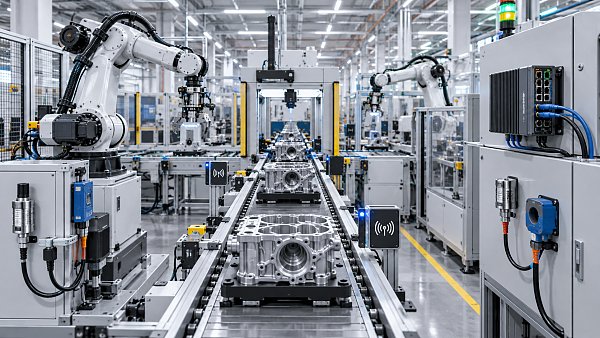
Industrial IoT helps by creating a common operational layer between physical equipment and production management. Sensors, controllers, machine interfaces, barcode or RFID events, edge gateways, and manufacturing software can each provide part of the picture. The practical goal is to replace assumptions with observable conditions.
Typical signals that remain hidden without connected visibility
- Short, repeated machine stops that do not appear in daily downtime reports.
- Actual cycle times that differ from routing assumptions or quoted capacity.
- Work-in-progress accumulating between two processes without a clear owner.
- Manual rework that changes lead time but is not reflected in standard production status.
- Utilities, temperature, vibration, pressure, or energy conditions that affect process stability.
- Material shortages discovered at the machine instead of before a scheduled run.
- Quality events that are recorded after the same process has already produced more questionable output.
Not every signal deserves a dashboard tile. A useful system focuses on conditions that can change a production decision. Project leaders need enough detail to ask the right question, but not a stream of raw tags that creates a new form of noise.
Turn machine activity into production context
One of the most common mistakes is treating equipment connectivity as proof of visibility. A connected machine can report whether it is running, idle, stopped, or in alarm. That is useful, but it does not automatically explain whether the machine is meeting the needs of the production plan.
Machine-state data becomes more valuable when it is tied to the order, operation, product version, tooling condition, operator action, and expected output for that period. A machine may be running continuously while producing at a reduced rate. It may also appear idle because it is waiting for a scheduled inspection, not because of a fault. Without this context, an alert can be technically accurate and operationally misleading.
For a project leader, the distinction matters because different causes require different recovery actions. Adding overtime will not solve a bottleneck caused by an inspection hold. Rescheduling a downstream process may not help if the upstream asset is producing output that will later be rejected. Connected data should therefore support decisions about sequence, capacity, escalation, and risk—not merely report activity.
Start with the decisions that are currently delayed
A practical Industrial IoT rollout should begin with specific decisions that are being made too late or with weak evidence. Starting from available technology often leads to a broad sensor deployment that produces data without clear ownership. Starting from recurring operational uncertainty creates a narrower and more useful design.
Consider the questions raised during a production status meeting. Which questions require someone to call the shop floor? Which answers depend on yesterday’s report? Which risks become visible only after a missed target? These are strong candidates for connected visibility.
For example, a project team may regularly struggle to determine whether a late operation is caused by machine availability, insufficient material, setup duration, or a quality release delay. The solution does not require every asset to be instrumented immediately. It requires reliable status points around that operation: job arrival, setup start, first good part, machine interruption, inspection disposition, job completion, and reason codes for meaningful exceptions.
Define an event model before selecting dashboards
An event model describes what should be captured, when it should be timestamped, and how it relates to the production process. It should distinguish between machine events and business events. A controller alarm is a machine event. A work order being blocked by that alarm is a business event. Both matter, but they serve different users.
At minimum, define the states that affect planning accuracy. These often include equipment available, setup, producing, waiting for material, waiting for operator, waiting for quality decision, planned downtime, unplanned downtime, and completed operation. The state definitions need to be understood consistently across shifts. Otherwise, a digital system simply preserves inconsistent reporting at a faster speed.
Reason codes deserve particular attention. They should be limited enough that people can use them reliably, while still separating causes that require different action. “Other” may be necessary, but when it becomes the dominant category, the data cannot guide improvement. Review the use of broad codes regularly and refine them based on recurring real conditions.
Use edge gateways where production cannot depend on the cloud
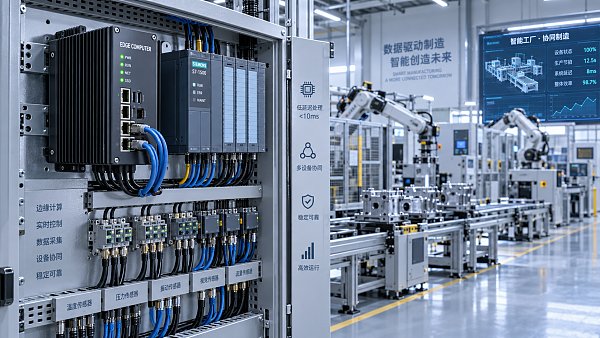
Industrial environments often contain equipment with different interfaces, ages, and network constraints. Some assets provide structured controller data; others require external sensors, signal capture, or operator input. An edge gateway can collect and normalize information close to the production equipment before forwarding selected data to higher-level systems.
This local layer is important when low-latency response, intermittent connectivity, or data volume makes direct cloud dependence impractical. It can also help preserve local operation during a network interruption. The gateway should not become an unmanaged black box, however. Project teams need a clear record of what data is collected, how it is transformed, who maintains the configuration, and how device changes are controlled.
For high-value processes, edge logic may identify an exception immediately: a cycle exceeds its expected band, a sensor value breaches a process limit, or a sequence of faults suggests that a machine needs attention. The appropriate response may be a local notification, a maintenance request, a quality hold, or an escalation to the production scheduler. The response should match the risk. Not every anomaly should stop production, and not every warning should wait for a weekly review.
Design alerts for action, not visibility theater
A screen covered with red and amber indicators can make a factory look monitored while leaving the team unable to prioritize work. Alert fatigue develops quickly when thresholds are copied from equipment settings without considering production consequences. A meaningful alert answers three questions: what changed, what is affected, and who needs to decide or act.
Thresholds should combine technical and operational logic where possible. A vibration increase may be relevant only when it persists across a defined number of cycles, occurs on a critical asset, or coincides with declining throughput. A queue length may be normal before a scheduled batch transfer but concerning when it grows while the downstream resource is available.
Escalation paths should be agreed before alerts go live. A maintenance team may own a machine-condition alert, while the production supervisor owns a dispatch problem and the project manager owns a delivery-risk decision. When responsibilities overlap, define who acknowledges the event and who decides whether the schedule needs to change. Unassigned alerts become background noise.
Separate leading indicators from completed losses
Completed losses are easy to see: missed output, unplanned downtime, rejected parts, or a late shipment. They remain necessary for review, but they describe a problem after it has affected the plan. Leading indicators provide a chance to intervene earlier. Examples include rising cycle-time variability, repeated manual overrides, a growing number of short stops, declining first-pass yield, or extended waits between operations.
The best leading indicators are specific to the process. A high-volume automated cell may need attention on micro-stoppages and cycle stability. A precision machining operation may depend more on tooling condition, inspection queue time, and setup verification. A mixed-model assembly area may benefit from visibility into material readiness and work instruction version control. Reusing the same indicators everywhere can hide the signals that matter most.
Build visibility across handoffs, not only at machines
Production blind spots often sit between systems and teams. A machine may report good operating status while the job remains blocked because the correct material has not been issued, a program revision is awaiting approval, or inspection results have not been released. These handoffs are often more damaging than a single equipment fault because they create idle time that has no obvious mechanical cause.
Map the path of a work order from release to completion. At every handoff, ask what confirms that the next activity can begin. This may include material verification, tool availability, approved instructions, fixture readiness, operator qualification, process parameters, inspection requirements, and transport status. The purpose is not to digitize every form. It is to make the conditions that block flow visible before the job reaches the station.
Connected identification technologies and operator terminals can help validate movement and status, but the process design still matters. A scan event is useful only if it represents a meaningful state change. Requiring excessive scans encourages workarounds; collecting too few creates ambiguity. The right level of capture is the minimum needed to identify where work is, what is preventing progress, and whether the recorded state can be trusted.
Make data quality a production responsibility
Industrial IoT programs sometimes fail because inaccurate timestamps, duplicate tags, missing units, or inconsistent naming are treated as IT issues rather than production risks. Poor data quality can create false bottlenecks, hide actual delays, and undermine confidence in the entire system. Once teams stop trusting the dashboard, they return to calls, spreadsheets, and informal updates.
Data ownership should be explicit. Engineering may define process parameters; operations may validate state definitions; maintenance may maintain asset identifiers and condition signals; quality may govern disposition events; and information security may control access and network rules. A cross-functional owner should decide how changes are approved when an asset, route, or data source is modified.
Before expanding the deployment, test whether digital records agree with physical reality over a representative operating period. Check whether a completed cycle matches actual output, whether downtime categories reflect observed events, whether job status changes occur at the right moment, and whether data remains available through normal shift changes. This validation is less glamorous than installing sensors, but it determines whether the information can support project decisions.
Measure whether visibility is reducing uncertainty
The success of a smart factory initiative should not be judged only by the number of connected assets or dashboard users. The stronger test is whether the organization can identify and resolve production risks earlier than before. Look for changes in the time required to detect an exception, confirm its cause, assign an owner, and decide on a schedule response.
Project leaders can also compare planned and actual process durations, track the duration of waiting states, and review whether recurring causes are becoming more visible. A recurring issue that was previously labeled as “delay” may become distinguishable as material readiness, equipment instability, quality disposition time, or setup variation. That distinction is the foundation for targeted corrective action.
The most useful implementation is usually incremental. Connect a constrained process, define the decisions it must support, validate the data, and establish an action routine. Once the team can trust that view, extend the same discipline to adjacent handoffs and critical assets. Visibility improves when data, process ownership, and response rules mature together; installing more devices alone will not remove the blind spots.
Search News
Hot Articles
- Carbon Fiber StructuresHow to Specify Aerospace Carbon Fiber Assemblies for Lightweight, Load-Bearing PartsJul 11, 2026
- Machine VisionXiaomi, Alibaba DAMO Academy Drive Open-Source Robotics Model Ecosystem, Lowering Algorithm Development Barriers for Overseas SMEs Adopting Chinese Robotics SolutionsMar 30, 2026
- Cobots & ArmsShanxi 'AI+' Conference Showcases Embodied Intelligence with Multinational Buyer Engagement: Key Industry ImplicationsMar 30, 2026
Popular Tags
Recommended News
 Jul 11, 2026How to Specify Aerospace Carbon Fiber Assemblies for Lightweight, Load-Bearing PartsAerospace carbon fiber assemblies: learn how to specify laminate design, load data, joining methods, and inspection controls for lighter, reliable load-bearing aerospace parts.Elena Rostova (UAV Systems Researcher)
 Mar 30, 2026Xiaomi, Alibaba DAMO Academy Drive Open-Source Robotics Model Ecosystem, Lowering Algorithm Development Barriers for Overseas SMEs Adopting Chinese Robotics SolutionsXiaomi & Alibaba DAMO Academy's open-source robotics models lower algorithm barriers for global SMEs. Boost efficiency in manufacturing, logistics & smart retail with ROS 2 compatible solutions.TSV Data Lab
 Mar 30, 2026Shanxi 'AI+' Conference Showcases Embodied Intelligence with Multinational Buyer Engagement: Key Industry ImplicationsShanxi 'AI+' Conference highlights embodied intelligence with Tesla, Ubtech & Jiantao showcasing multimodal robotics. 40+ global buyers validated tech on-site, creating new B2B channels for industrial automation & AI solutions.Chen Wei (Automation Lead Engineer)
 Mar 30, 2026Zhongguancun Unveils 6G Integrated Sensing-Computing-Intelligence Platform to Empower Embodied Robots for Global Industrial ApplicationsZhongguancun's new 6G platform revolutionizes industrial robotics with <10ms latency, empowering global automotive, logistics & port automation. Discover how this tech boosts China's smart manufacturing exports.TSV Data Lab
 Mar 30, 2026Mech-Mind Tianjin Embodied Intelligence R&D and Production Base Goes Live, Cutting Delivery Time by 20%–30% for Global Customized AMR+Vision SolutionsMech-Mind's Tianjin AMR+Vision production base cuts delivery time by 20%-30% for欧美 & Latin American markets. Discover how this PLd-certified facility accelerates customized robotics solutions for smart manufacturing and logistics.Chen Wei (Automation Lead Engineer)
 Mar 30, 2026Boao Forum Reveals 'Co-evolution of Big and Small Brains' Trend in Humanoid Robots, China's Embodied Intelligence Accelerates Adaptation to Overseas Manufacturing Service ScenariosDiscover how China's humanoid robots, featuring 'Co-evolution of Big and Small Brains,' are revolutionizing global manufacturing. Learn about Embodied Tian Gong 3.0's ISO compliance and overseas deployment at Boao Forum 2026.Chen Wei (Automation Lead Engineer)
 Mar 30, 2026China Railway Industrial Secures Patent for Embodied Robotics in Material Handling, Boosting High-Precision Delivery Capabilities for Overseas Infrastructure and Manufacturing ProjectsChina Railway Industrial's new patent for embodied robotics in material handling boosts high-precision delivery for global infrastructure & manufacturing. Discover how this innovation enhances logistics accuracy in automotive, rail transit & EPC projects.Chen Wei (Automation Lead Engineer)
 Sep 25, 2026How to Evaluate an Industrial Infrastructure Data Platform for Multi-Site OperationsIndustrial infrastructure data platform evaluation guide for multi-site operations: compare data quality, edge resilience, interoperability, governance, and scalable proof-of-value criteria.Victor Lin (Chief Software Architect)
 Sep 24, 2026How to Select Machine Vision Optics for Accurate Inspection at Different Working DistancesMachine vision optics selection guide for accurate inspection at every working distance. Compare FOV, pixel scale, DOF, distortion, lighting, and telecentric options.TSV Data Lab
 Sep 23, 2026How to Evaluate a Machine Vision System Integrator for High-Speed Inspection LinesChoose a machine vision system integrator with proven expertise in high-speed inspection, reliable reject timing, robust optics, and measurable acceptance criteria.TSV Data Lab
 Sep 25, 2026How a smart factory with Industrial IoT reduces production blind spotsDiscover how a smart factory with Industrial IoT turns real-time machine, quality, and workflow data into actionable insights that reduce production blind spots and delivery risks.Victor Lin (Chief Software Architect)
 Sep 24, 2026When does Industrial IoT make smart manufacturing easier to scale?Smart manufacturing Industrial IoT scales when trusted data, interoperable systems, and secure workflows turn connected assets into measurable gains.TSV Data Lab
 Sep 23, 2026What drives ultra-precision machining cost at 1-micron tolerance?Ultra precision machining cost per part at 1 micron tolerance depends on process, material, metrology, and yield. Learn how to compare quotes confidently.Dr. Marcus Vance
 Sep 22, 2026Drone Engine-T550CC Applications: Build the UAV Power System Around the MissionAn application guide for Drone Engine-T550CC integration, covering payload planning, airframe matching, cooling, fuel, vibration, test procedures, documentation, and service preparation.Elena Rostova (UAV Systems Researcher)
 Sep 22, 2026How to Evaluate Industrial Edge Computing Vendors for Factory DeploymentIndustrial edge computing vendor evaluation guide for factories: compare latency, protocol fit, reliability, security, and lifecycle support before deployment.TSV Data Lab
 Sep 21, 2026Drone Payload Integration: Matching Power, Data, and Center of Gravity for Reliable FlightsDrone payload integration made practical: balance power, data, center of gravity, and endurance to build safer, more reliable mission-ready flights.Elena Rostova (UAV Systems Researcher)
 Sep 20, 2026Autonomous Navigation Pricing: Cost Drivers and Budget Benchmarks for AMR ProjectsAutonomous navigation price explained: compare AMR cost drivers, software, sensors, integration, safety, and lifecycle budgets to build a scalable project plan.Chen Wei (Automation Lead Engineer)
 Sep 19, 2026How to Scope Automation Integration Services for Multi-System Factory ProjectsAutomation integration services: learn how to scope multi-system factory projects with clear workflows, interface contracts, safety boundaries, and acceptance criteria.Victor Lin (Chief Software Architect)
 Sep 18, 2026Selecting UAV Aerospace Structural Parts for Strength, Weight, and Fatigue LifeUAV aerospace structural parts guide: compare strength, weight, stiffness, fatigue life, joints, and traceability to select reliable flight-ready components.Elena Rostova (UAV Systems Researcher)
 Sep 17, 2026Selecting Commercial Drone Payloads for European Inspection ProjectsCommercial drone payloads Europe: learn how to select RGB, thermal and LiDAR systems for compliant, reliable inspection data and better project outcomes.Elena Rostova (UAV Systems Researcher)
 Sep 16, 2026Machining Tolerance Validation: How to Verify Critical Dimensions Before Production ReleaseMachining tolerance analysis validation: verify critical dimensions, measurement systems, process capability, and tolerance stacks before production release.Dr. Marcus Vance
 Sep 15, 2026AGV Tape Guidance vs Laser Navigation: Which Fits Your Warehouse Layout?AGV tape guidance comparison: discover how tape and laser navigation fit changing warehouse layouts, docking needs, floor conditions, maintenance, and route flexibility.Chen Wei (Automation Lead Engineer)
 Sep 14, 2026How Point Cloud Analytics Improves Asset Inspection Workflows Across GCC ProjectsPoint cloud analytics GCC helps project leaders improve asset inspections with accurate change detection, safer workflows, and faster maintenance decisions.TSV Data Lab
 Sep 13, 2026How Aerospace Manufacturers Can Build a Digital Thread From Design to Certified ProductionDigital manufacturing for aerospace: learn how to build a traceable digital thread from design through certified production, supplier control, and audit-ready compliance.Victor Lin (Chief Software Architect)