Autonomous Navigation Pricing: Cost Drivers and Budget Benchmarks for AMR Projects
Publication Date
author
An autonomous navigation price is rarely meaningful when quoted as a single number. A low vehicle price can become an expensive deployment once mapping, traffic management, interfaces, safety work, and on-site recovery procedures are added. A higher initial quote may be easier to defend if it includes a proven navigation stack, clear support boundaries, and a path to expand the fleet without rebuilding the system.
For procurement teams, the useful question is not “What does autonomous navigation cost?” It is: “What level of navigation reliability, operating coverage, and operational ownership are we buying for this workflow?” The answer changes materially between a few AMRs moving cartons on a controlled warehouse floor and a fleet serving mixed pedestrian, forklift, elevator, and outdoor transfer routes.
A practical budget should separate the mobile platform from the navigation system and then identify the costs needed to make both reliable in the intended environment. That separation makes vendor proposals easier to compare and exposes costs that are often deferred until late in the project.
Why AMR navigation budgets vary so widely
Autonomous mobile robots combine hardware, embedded software, fleet-level software, infrastructure, and engineering services. The navigation function reaches across all of them. A robot that can localize itself in a simple indoor layout is not necessarily equipped to handle seasonal layout changes, reflective materials, poor visual features, congested intersections, or an automated handoff to production equipment.
The base vehicle is therefore only one part of the autonomous navigation price. Buyers should expect the commercial scope to depend on four broad decisions:
- How difficult the environment is to perceive: clean, stable indoor aisles place different demands on sensors than glass partitions, high-bay racking, bright loading doors, dust, vibration, or mixed indoor-outdoor routes.
- How independently the robot must operate: a robot that stops whenever its route is blocked has a lower engineering burden than one expected to reroute around changing obstacles while maintaining throughput.
- How many systems it must work with: connecting AMRs to doors, elevators, conveyors, warehouse software, manufacturing execution systems, or fire alarms adds integration and acceptance work.
- What happens when the robot cannot proceed: recovery workflows, remote support, fault reporting, and manual intervention are part of the operating model, not incidental details.
This is why a quote based solely on payload, travel speed, or unit count is incomplete. Those specifications describe the vehicle, but they do not establish how well the navigation system will behave in the facility that pays for it.
Sensor architecture is a direct cost driver
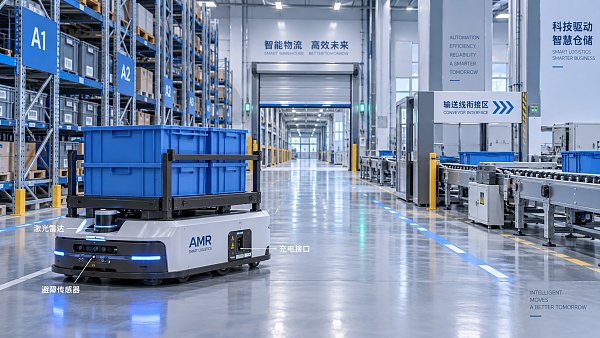
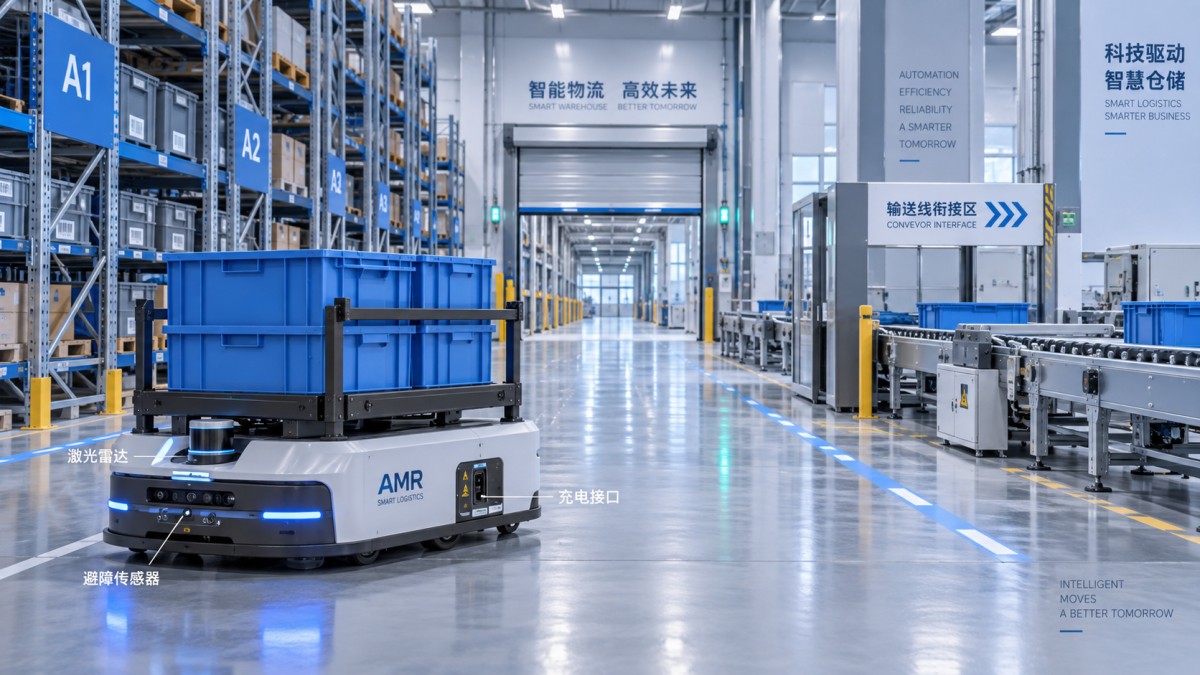
Sensor selection affects the purchase price, but its larger effect may be on deployment confidence and maintenance exposure. Many indoor AMRs use laser-based localization and safety sensing because it can provide repeatable operation in structured spaces. Yet a given sensor configuration may be adequate only when floor plans, landmarks, lighting conditions, and traffic patterns remain within defined limits.
More demanding environments may require additional perception layers: multiple laser scanners, cameras, depth sensing, radar, inertial measurement, wheel encoders, or positioning aids. Redundancy can be justified where a loss of perception would create safety or uptime consequences, but it should not be bought as a vague insurance policy. Each added sensing modality creates costs in hardware, calibration, software validation, diagnostics, replacement parts, and support skills.
Procurement should ask vendors to describe the operating envelope in measurable terms. For example, what types of surfaces, aisle widths, reflective materials, lighting changes, slopes, transitions, dust conditions, and pedestrian density are within the supported design? How does localization degrade when a rack row is moved or a temporary staging area appears? A statement that the robot uses “advanced AI navigation” does not answer these questions.
The cost difference between navigation stacks often reflects the degree of environmental tolerance promised. Buyers should seek evidence tied to their routes, especially where the route includes tight turns, blind crossings, dock doors, shared traffic, or areas where the map is likely to change.
Software licensing can change the economics of scale
Navigation software is commonly priced through a mixture of embedded robot licenses, fleet-management licenses, annual subscriptions, support packages, and paid integration modules. The commercial model matters as much as the quoted amount. A low initial price may be tied to recurring fees that increase with every additional robot, every site, or every interface.
Fleet software deserves particular scrutiny. One AMR can navigate autonomously without proving that ten or fifty robots will avoid congestion, share charging resources, prioritize urgent jobs, and recover from blocked routes predictably. Fleet orchestration may be included in a starter package, limited by robot count, or sold as a separate platform. In multi-vendor environments, an additional layer may be needed to coordinate task assignment and traffic rules.
Before comparing proposals, request a commercial schedule that identifies:
- Per-robot software included at delivery and software charged annually;
- Fleet-management limits, including robot count, map count, site count, users, or transaction volume;
- Charges for software updates, cybersecurity patches, remote monitoring, and data retention;
- Pricing for application programming interfaces, warehouse or manufacturing system connectors, and third-party equipment integrations;
- Fees triggered by adding a robot, changing a route, opening another facility, or upgrading the fleet platform.
This level of detail prevents a common comparison error: treating a one-site pilot configuration as though it were the commercial model for the planned network. Procurement should model the final intended fleet size as well as the first deployment phase. The objective is not to avoid subscriptions categorically. It is to ensure that recurring costs remain proportionate to the operational value delivered.
Integration often determines whether the budget holds
The navigation stack may work well in a vendor demonstration while the wider material-flow process remains unfinished. An AMR project begins to absorb engineering time when a robot needs to know when a conveyor is ready, when an elevator can be called, where a pallet is available, whether a doorway is locked, or which job takes priority.
Those interfaces are not interchangeable. A standard API may reduce development effort, but it does not remove the need to define states, exception handling, ownership, test cases, and handover criteria. An automated door that opens reliably is straightforward. A door that must remain safe during fire events, communicate its state to the fleet manager, and recover correctly after a network interruption requires a more complete integration design.
Buyers should avoid accepting a broad line item labelled “system integration” without a scoped deliverable. The statement of work should state which assets and software systems are connected, what each interface is expected to do, who supplies the controls changes, and what conditions define acceptance. It should also establish who owns troubleshooting when the robot, network, host system, and connected equipment each appear functional in isolation but fail as a combined process.
Mapping and commissioning deserve the same discipline. Facilities that are operationally mature often have temporary storage zones, seasonal changes, construction work, or production rearrangements. If a map update requires a vendor visit or a specialist service engagement, that operating dependency belongs in the lifecycle budget. If internal personnel can update maps and traffic rules, training, access controls, and change-management responsibility need to be included instead.
Safety validation should be treated as project scope, not a contingency
Safety-related costs are sometimes underestimated because buyers assume that a robot advertised with safety scanners arrives ready for any shared workspace. In practice, safe deployment depends on the complete application: speed, load type, stopping performance, visibility, route design, intersection control, human traffic, peripheral equipment, and the behavior of operators around the robot.
The budget should allow for risk assessment, site validation, operating rules, emergency procedures, signage where appropriate, and documented acceptance testing. Requirements may also arise from the site’s insurer, internal safety governance, customer obligations, or local rules. The applicable framework should be determined for the specific site and application rather than inferred from a general product claim.
There is a commercial consequence as well. If safety requirements require lower speed, additional scanners, route segregation, gates, or changes to load handling, the expected throughput may change. A project should not measure return on investment using an unconstrained travel-speed assumption and then discover during commissioning that safe operation requires a materially different workflow.
Budget in phases, but price the full operating model
A phased rollout is sensible when the facility has uncertainty around throughput, traffic behavior, or integration readiness. It gives the team an opportunity to test assumptions before committing to a large fleet. However, a pilot should have explicit learning goals. Deploying one robot on an easy route may validate basic motion but reveal little about fleet congestion, charging capacity, recovery workload, or host-system reliability.
A procurement plan can separate costs into three decision layers:
- Initial deployment: vehicles, navigation hardware, fleet software, mapping, commissioning, training, safety work, and the first set of interfaces.
- Scale-up: incremental robot licenses, charging capacity, fleet-server capacity, additional maps or zones, traffic-control changes, and expansion of support coverage.
- Lifecycle operation: software renewals, preventive maintenance, sensor replacement, batteries or other wear items, spare parts, cybersecurity maintenance, remapping, and technical support.
This structure is more useful than forcing every project into a universal per-robot benchmark. A facility with a stable route and manual pickup/drop-off stations may have relatively modest system costs after the first vehicle. Another site may require substantial up-front work before even a small fleet can operate reliably. The cost pattern is determined by system complexity, not just fleet size.
Questions that expose weak AMR pricing proposals
Supplier quotations become more comparable when they are tested against operational failure modes rather than feature lists. Procurement teams can use a short set of questions to reveal whether the autonomous navigation scope is fully defined.
- What environmental assumptions must remain true for the quoted navigation performance?
- Which sensors are used for localization, obstacle detection, and safety functions, and what is the intended behavior if a sensor becomes degraded or unavailable?
- What events force a robot to stop, wait, request help, reroute, or enter a safe state?
- Which map changes can trained site personnel make, and which changes require supplier involvement?
- What fleet size, route complexity, and traffic density are included in the quoted software and commissioning scope?
- Which integrations are production-ready within the price, and which are custom engineering work?
- How are software updates, security patches, remote diagnostics, and replacement sensors priced after acceptance?
- What acceptance tests demonstrate that navigation, safety behavior, and process throughput meet the agreed requirement?
A supplier should be able to answer these questions with stated boundaries and assumptions. Precision is more valuable than an optimistic promise of universal autonomy. It lets the buyer compare cost against a defined operating envelope and allocate responsibility before deployment pressure makes those discussions harder.
How to use benchmarks without buying on the lowest price
There is no dependable universal benchmark for an autonomous navigation price because project scope changes the number. The more defensible benchmark is an internal comparison between proposals normalized to the same route, payload, traffic conditions, integrations, service period, and acceptance criteria.
Start with a reference workflow: origin and destination points, load characteristics, expected moves, available operating hours, obstacles, human interaction, exception scenarios, and future expansion. Ask each supplier to price that workflow with assumptions visible. Then compare the one-time deployment cost and the recurring cost over the anticipated service period.
The lowest quote can be appropriate for a tightly bounded transport task with stable conditions and a team prepared to manage operational exceptions. It becomes risky when it leaves the buyer to fund unstated integration, map maintenance, safety remediation, or response to navigation faults. Conversely, a more expensive architecture is justified only when its additional sensing, software, or support resolves a documented operational constraint.
AMR projects are easier to approve when the navigation budget is connected to a specific material-flow outcome: fewer manual transfers, more predictable movement, better use of constrained labor, or a process that cannot be supported reliably by fixed automation. Price the system against that outcome, define the conditions under which it must perform, and retain enough budget for the work that turns a mobile robot into an operating transport service.
Search News
Hot Articles
- Carbon Fiber StructuresHow to Specify Aerospace Carbon Fiber Assemblies for Lightweight, Load-Bearing PartsJul 11, 2026
- Machine VisionXiaomi, Alibaba DAMO Academy Drive Open-Source Robotics Model Ecosystem, Lowering Algorithm Development Barriers for Overseas SMEs Adopting Chinese Robotics SolutionsMar 30, 2026
- Cobots & ArmsShanxi 'AI+' Conference Showcases Embodied Intelligence with Multinational Buyer Engagement: Key Industry ImplicationsMar 30, 2026
Popular Tags
Recommended News
 Jul 11, 2026How to Specify Aerospace Carbon Fiber Assemblies for Lightweight, Load-Bearing PartsAerospace carbon fiber assemblies: learn how to specify laminate design, load data, joining methods, and inspection controls for lighter, reliable load-bearing aerospace parts.Elena Rostova (UAV Systems Researcher)
 Mar 30, 2026Xiaomi, Alibaba DAMO Academy Drive Open-Source Robotics Model Ecosystem, Lowering Algorithm Development Barriers for Overseas SMEs Adopting Chinese Robotics SolutionsXiaomi & Alibaba DAMO Academy's open-source robotics models lower algorithm barriers for global SMEs. Boost efficiency in manufacturing, logistics & smart retail with ROS 2 compatible solutions.TSV Data Lab
 Mar 30, 2026Shanxi 'AI+' Conference Showcases Embodied Intelligence with Multinational Buyer Engagement: Key Industry ImplicationsShanxi 'AI+' Conference highlights embodied intelligence with Tesla, Ubtech & Jiantao showcasing multimodal robotics. 40+ global buyers validated tech on-site, creating new B2B channels for industrial automation & AI solutions.Chen Wei (Automation Lead Engineer)
 Mar 30, 2026Zhongguancun Unveils 6G Integrated Sensing-Computing-Intelligence Platform to Empower Embodied Robots for Global Industrial ApplicationsZhongguancun's new 6G platform revolutionizes industrial robotics with <10ms latency, empowering global automotive, logistics & port automation. Discover how this tech boosts China's smart manufacturing exports.TSV Data Lab
 Mar 30, 2026Mech-Mind Tianjin Embodied Intelligence R&D and Production Base Goes Live, Cutting Delivery Time by 20%–30% for Global Customized AMR+Vision SolutionsMech-Mind's Tianjin AMR+Vision production base cuts delivery time by 20%-30% for欧美 & Latin American markets. Discover how this PLd-certified facility accelerates customized robotics solutions for smart manufacturing and logistics.Chen Wei (Automation Lead Engineer)
 Mar 30, 2026Boao Forum Reveals 'Co-evolution of Big and Small Brains' Trend in Humanoid Robots, China's Embodied Intelligence Accelerates Adaptation to Overseas Manufacturing Service ScenariosDiscover how China's humanoid robots, featuring 'Co-evolution of Big and Small Brains,' are revolutionizing global manufacturing. Learn about Embodied Tian Gong 3.0's ISO compliance and overseas deployment at Boao Forum 2026.Chen Wei (Automation Lead Engineer)
 Mar 30, 2026China Railway Industrial Secures Patent for Embodied Robotics in Material Handling, Boosting High-Precision Delivery Capabilities for Overseas Infrastructure and Manufacturing ProjectsChina Railway Industrial's new patent for embodied robotics in material handling boosts high-precision delivery for global infrastructure & manufacturing. Discover how this innovation enhances logistics accuracy in automotive, rail transit & EPC projects.Chen Wei (Automation Lead Engineer)
 Sep 20, 2026Autonomous Navigation Pricing: Cost Drivers and Budget Benchmarks for AMR ProjectsAutonomous navigation price explained: compare AMR cost drivers, software, sensors, integration, safety, and lifecycle budgets to build a scalable project plan.Chen Wei (Automation Lead Engineer)
 Sep 19, 2026How to Scope Automation Integration Services for Multi-System Factory ProjectsAutomation integration services: learn how to scope multi-system factory projects with clear workflows, interface contracts, safety boundaries, and acceptance criteria.Victor Lin (Chief Software Architect)
 Sep 18, 2026Selecting UAV Aerospace Structural Parts for Strength, Weight, and Fatigue LifeUAV aerospace structural parts guide: compare strength, weight, stiffness, fatigue life, joints, and traceability to select reliable flight-ready components.Elena Rostova (UAV Systems Researcher)
 Sep 17, 2026Selecting Commercial Drone Payloads for European Inspection ProjectsCommercial drone payloads Europe: learn how to select RGB, thermal and LiDAR systems for compliant, reliable inspection data and better project outcomes.Elena Rostova (UAV Systems Researcher)
 Sep 16, 2026Machining Tolerance Validation: How to Verify Critical Dimensions Before Production ReleaseMachining tolerance analysis validation: verify critical dimensions, measurement systems, process capability, and tolerance stacks before production release.Dr. Marcus Vance
 Sep 15, 2026AGV Tape Guidance vs Laser Navigation: Which Fits Your Warehouse Layout?AGV tape guidance comparison: discover how tape and laser navigation fit changing warehouse layouts, docking needs, floor conditions, maintenance, and route flexibility.Chen Wei (Automation Lead Engineer)
 Sep 14, 2026How Point Cloud Analytics Improves Asset Inspection Workflows Across GCC ProjectsPoint cloud analytics GCC helps project leaders improve asset inspections with accurate change detection, safer workflows, and faster maintenance decisions.TSV Data Lab
 Sep 13, 2026How Aerospace Manufacturers Can Build a Digital Thread From Design to Certified ProductionDigital manufacturing for aerospace: learn how to build a traceable digital thread from design through certified production, supplier control, and audit-ready compliance.Victor Lin (Chief Software Architect)
 Sep 12, 2026How to Select a Thermal Sensor for Mapping Drones in Surveying ProjectsMapping drone thermal sensor selection made simple: compare GSD, radiometric data, NETD, calibration, and workflow fit for accurate, survey-ready thermal maps.Elena Rostova (UAV Systems Researcher)
 Sep 11, 2026Integrating Photogrammetry Workflows into Digital Twin Projects Without Data BottlenecksPhotogrammetry workflow integration for digital twins: learn how to streamline capture, validation, versioning, and delivery to prevent data bottlenecks.Victor Lin (Chief Software Architect)
 Sep 10, 2026Hard-Tech Supply Chain Procurement: Qualifying Suppliers to Cut Lead-Time RiskHard-tech supply chain procurement guide: qualify suppliers with proven process, traceability, capacity, and change control to reduce lead-time risk.Chen Wei (Automation Lead Engineer)
 Sep 09, 2026Industrial Application Notes: Cost Factors That Shape Automation Project BudgetsIndustrial application notes cost factors explained: uncover the engineering, safety, integration, and commissioning variables that shape accurate automation budgets.Victor Lin (Chief Software Architect)
 Sep 08, 2026Supplier Discovery for Sourcing: How Buyers Can Verify Capability and Supply RiskSupplier discovery for sourcing: learn how to verify supplier capability, traceability, quote assumptions, and supply risk before placing production orders.TSV Data Lab
 Sep 07, 2026What Determines Process Control Systems Pricing? A Buyer’s Cost GuideProcess control systems pricing explained: compare hardware, engineering, integration, cybersecurity, validation, and lifecycle costs to choose the right-value solution.Victor Lin (Chief Software Architect)
 Sep 07, 2026AMR Robots in ASEAN: Which Industries Are Adopting Them—and Why?AMR robots ASEAN adoption is accelerating in electronics, automotive, warehousing, healthcare, and cold chain. Explore use cases, risks, and deployment insights.Chen Wei (Automation Lead Engineer)
 Sep 05, 2026How to Evaluate Supplier Qualification Support Tools for Industrial Procurement TeamsSupplier qualification support tools help industrial procurement teams verify technical evidence, manage risk, and make defensible supplier approvals. Learn what to evaluate.Victor Lin (Chief Software Architect)
 Sep 04, 2026Grinding Tolerance Analysis: How to Set Realistic Limits for Precision PartsGrinding tolerance analysis explains how to set realistic limits for precision parts, balance fit, geometry, process capability, and inspection for reliable performance.Dr. Marcus Vance