The Real Cost Drivers Behind a Trampoline Park Business
Publication Date
author
For financial approvers evaluating a trampoline park business, the real question is not the headline investment but the cost structure hidden beneath equipment quotes and revenue projections. From facility build-out and insurance to maintenance cycles, staffing, and compliance, each cost driver shapes long-term profitability, risk exposure, and payback period. Understanding these factors is essential for making capital decisions grounded in measurable operational reality rather than optimistic assumptions.
Why the cost profile of a trampoline park business is changing
The trampoline park business is no longer judged only by opening-day demand or a simple build-versus-ticket-sales equation. Over the past several years, operators and investors have had to adapt to tighter safety expectations, more complex facility designs, inflation in construction inputs, rising insurance scrutiny, and a customer base that expects more than rows of trampolines. These shifts have changed the economics of the model.
For finance teams, this means the most important numbers now sit below the surface. Capital expenditure still matters, but ongoing operating expenditure, replacement cycles, legal risk controls, and utilization assumptions matter more than ever. A trampoline park business that looks attractive on a vendor quote can become structurally weak if the budget ignores downtime, compliance upgrades, labor intensity, or local real estate constraints.
The broader signal is clear: the sector is moving from a novelty entertainment model toward a risk-managed, experience-led, operationally disciplined business. Financial approvers should evaluate this transition as a change in cost architecture, not just a change in customer demand.
The main cost drivers behind a trampoline park business now extend far beyond equipment
A modern trampoline park business typically includes multiple cost layers that interact with one another. Equipment pricing remains highly visible, but it is only one component of the financial picture. In many cases, the drivers that most affect cash flow are the ones that scale over time: occupancy costs, claims exposure, labor scheduling, maintenance, utilities, and the cost of keeping the venue attractive enough to sustain repeat visits.
The market is also rewarding operators that build diversified attractions such as ninja courses, climbing walls, foam pits, toddler zones, party rooms, and food service areas. While these additions can improve revenue mix, they also increase inspection obligations, training requirements, cleaning standards, and replacement budgets. As a result, the trampoline park business has become more of a multi-zone family entertainment center than a single-attraction venue.
Real estate and build-out are becoming bigger swing factors
For many projects, the first major shift is in the property itself. A trampoline park business needs clear height, structural suitability, traffic accessibility, parking capacity, and zoning compatibility. Suitable buildings are not always plentiful, and retrofit work can be expensive. Floor reinforcement, HVAC adaptation, fire safety upgrades, restroom expansion, acoustic treatment, and spectator space all affect capital deployment before revenue even begins.
This is especially relevant in second-generation retail spaces. Such locations may appear attractive because of lower base rent or faster entry, but hidden retrofit costs can erode the initial advantage. Ceiling obstructions, legacy mechanical systems, poor circulation, and inefficient back-of-house layouts often increase contractor scope. Financial approvers should therefore evaluate occupancy cost as a combined metric: rent, common area charges, fit-out cost, and time-to-open.
A useful judgment signal is whether the project economics still hold after including contingency for permit delays and tenant improvement overruns. If returns work only under best-case assumptions, the trampoline park business may be too fragile for approval.
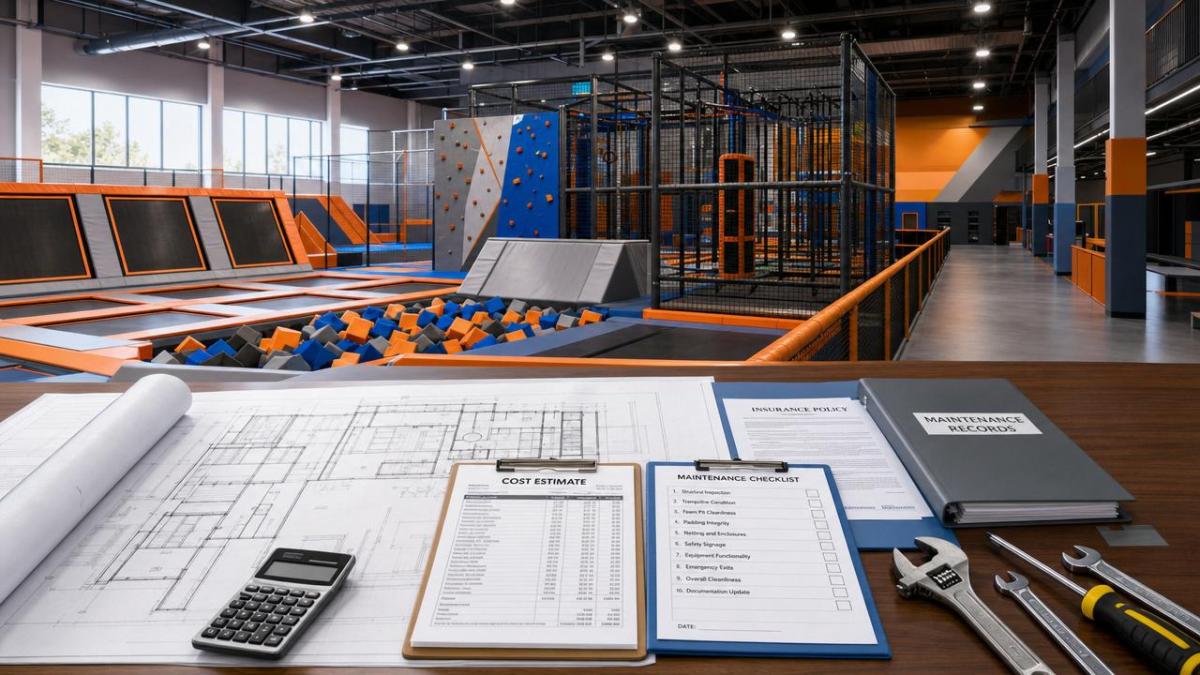
Insurance and liability pressure are reshaping the business model
Among all cost drivers, insurance has become one of the most decisive. The trampoline park business operates in a category where injury risk, waiver enforcement, supervision practices, and incident documentation all influence underwriting outcomes. Premiums are not simply a line item; they are a reflection of operational discipline.
Insurers increasingly look at staff training, age-segmented play policies, equipment inspection logs, surveillance coverage, and incident response procedures. A park with weak operational controls may face higher premiums, narrower coverage terms, or more restrictive renewal conditions. That means a finance approver should ask not only what the current premium is, but also what the cost trend could be over the next three to five years.
This trend has a second-order impact: it pushes operators to invest more in prevention. Better padding, clearer zone design, digital waiver systems, staff certification, and documented inspection routines all add cost. However, these expenses may be financially rational if they reduce claims volatility and protect insurability. In other words, in a trampoline park business, some safety spending functions as insurance cost control.
Maintenance cycles are shorter when parks pursue higher throughput
Revenue forecasts often assume strong attendance growth, party bookings, school events, and peak weekend utilization. But higher throughput accelerates wear. Trampoline beds, springs, padding, foam materials, netting, grip surfaces, and support elements all face fatigue under repeated impact. The more aggressively a trampoline park business is used, the more disciplined the maintenance reserve must be.
What has changed is that customer expectations leave less room for visible wear. Parents notice frayed pads, stained foam pits, poor cleanliness, or delayed repairs. Those signs do not just affect guest satisfaction; they affect repeat business, online reviews, and perceived safety. Financial approvers should therefore model maintenance not as a minimal repair expense, but as a strategic uptime budget.
A prudent approach is to separate routine maintenance, preventive replacement, and major refresh capital. Bundling everything into one line can hide the true lifecycle cost of a trampoline park business and understate future cash requirements.
Labor costs are rising because the venue is more operationally complex
The old assumption that a trampoline park business can run with a lean front-line team is becoming less reliable. Multiple activity zones, birthday rooms, check-in management, waiver processing, food service, cleaning, supervision, and event support create a layered staffing model. At busy times, under-staffing is not just a service issue; it can become a safety issue.
Labor cost pressure is also shaped by turnover. Many parks rely on part-time or younger staff, which can increase recruitment frequency, training repetition, and supervision needs. A low hourly wage structure may still produce a high total labor burden if churn is constant. For financial approvers, the important signal is labor productivity per guest or per revenue hour, not simply average wage.
Technology can offset some pressure through online reservations, automated waivers, digital scheduling, and POS integration. Still, automation does not eliminate the need for visible floor supervision and guest engagement. The trampoline park business remains people-intensive, and payroll assumptions should reflect that reality.
Customer demand is shifting toward experience variety, which raises both revenue potential and cost exposure
Another major change is on the demand side. Guests increasingly compare a trampoline park business not only with other trampoline venues, but with family entertainment centers, indoor playgrounds, climbing gyms, and hybrid leisure concepts. This pushes operators to expand attraction variety and refresh the guest journey more frequently.
The upside is stronger monetization through parties, memberships, food and beverage, premium zones, and group events. The downside is that every added revenue stream brings more operational burden. Party rooms require scheduling precision and cleaning turnarounds. Food service adds inventory, waste, and compliance responsibilities. Memberships create expectations for consistently high standards and sustained facility appeal.
For finance teams, this means revenue diversification should not be accepted at face value. Each new income source in a trampoline park business needs paired analysis: incremental labor, incremental maintenance, incremental marketing, and potential cannibalization of general admission flow.
What different stakeholders should watch most closely
How to judge a trampoline park business more rigorously in the current environment
A more disciplined review starts with scenario analysis. Financial approvers should test the trampoline park business under multiple occupancy levels, not just the base case. What happens if weekday traffic lags? What happens if party conversion is lower than projected? What if insurance renews at a materially higher premium? A robust investment case should survive moderate stress without immediate cash strain.
The second priority is lifecycle costing. Rather than focusing on the opening budget alone, review expected replacement intervals, annual maintenance reserve, staffing ramp, software subscriptions, and refresh capex. This approach is consistent with TSV’s broader principle: decisions improve when assumptions are translated into measurable operating parameters instead of marketing optimism.
Third, evaluate the supplier ecosystem carefully. In a trampoline park business, low upfront equipment pricing can be misleading if lead times are long, parts are difficult to source, warranty service is weak, or documentation is poor. Vendor selection should be tied to reliability, inspection support, and total lifecycle value, not just initial purchase price.
Practical signals that support a stronger approval decision
When reviewing a trampoline park business proposal, several signals deserve close attention. One is whether the model separates fixed and variable costs clearly enough to show break-even sensitivity. Another is whether maintenance and insurance are based on realistic operating conditions rather than placeholder figures. A third is whether the design supports efficient supervision and guest flow, since layout quality directly affects both labor needs and risk control.
- Use downside cases for attendance, pricing, and party volume.
- Require explicit reserves for repairs, replacements, and compliance updates.
- Review lease terms against the actual ramp-up period, not the ideal one.
- Check whether insurance assumptions are broker-validated.
- Confirm that staffing plans reflect supervision ratios and turnover reality.
FAQ: key approval questions about a trampoline park business
Which cost driver is most commonly underestimated?
Insurance and maintenance are frequently underestimated because they are treated as stable expenses, when in fact they can rise with claims history, utilization intensity, and facility complexity.
Is cheaper equipment always a better starting point?
No. In a trampoline park business, lower upfront equipment cost can lead to higher total cost if replacement intervals are shorter, downtime is higher, or compliance documentation is weak.
What matters more: rent or fit-out?
Both matter, but they should be evaluated together. A low-rent site with expensive structural adaptation can be less attractive than a higher-rent site with faster, cleaner deployment.
Final judgment: follow the changing cost structure, not the opening-day narrative
The real lesson for today’s financial approvers is that the trampoline park business is becoming more operationally sophisticated, more compliance-sensitive, and more dependent on disciplined cost control than many early models suggested. The biggest changes are not cosmetic. They sit in real estate suitability, insurance pressure, maintenance intensity, labor complexity, and the cost of sustaining a differentiated guest experience.
If an organization wants to judge whether a trampoline park business is truly investable, it should ask a focused set of questions: Which costs rise fastest as volume grows? Which assumptions are most exposed to regulatory or insurance shifts? How resilient is cash flow if utilization softens? And which supplier, layout, and operating choices improve lifecycle economics rather than just reducing upfront spend?
Those are the questions that move approval decisions from optimism to evidence. In a market where experience venues must balance demand, safety, and capital discipline, the best decisions will come from seeing the full cost structure before committing the first dollar.
Search News
Hot Articles
- Carbon Fiber StructuresHow to Specify Aerospace Carbon Fiber Assemblies for Lightweight, Load-Bearing PartsJul 11, 2026
- Machine VisionXiaomi, Alibaba DAMO Academy Drive Open-Source Robotics Model Ecosystem, Lowering Algorithm Development Barriers for Overseas SMEs Adopting Chinese Robotics SolutionsMar 30, 2026
- Cobots & ArmsShanxi 'AI+' Conference Showcases Embodied Intelligence with Multinational Buyer Engagement: Key Industry ImplicationsMar 30, 2026
Popular Tags
Recommended News
 Jul 11, 2026How to Specify Aerospace Carbon Fiber Assemblies for Lightweight, Load-Bearing PartsAerospace carbon fiber assemblies: learn how to specify laminate design, load data, joining methods, and inspection controls for lighter, reliable load-bearing aerospace parts.Elena Rostova (UAV Systems Researcher)
 Mar 30, 2026Xiaomi, Alibaba DAMO Academy Drive Open-Source Robotics Model Ecosystem, Lowering Algorithm Development Barriers for Overseas SMEs Adopting Chinese Robotics SolutionsXiaomi & Alibaba DAMO Academy's open-source robotics models lower algorithm barriers for global SMEs. Boost efficiency in manufacturing, logistics & smart retail with ROS 2 compatible solutions.TSV Data Lab
 Mar 30, 2026Shanxi 'AI+' Conference Showcases Embodied Intelligence with Multinational Buyer Engagement: Key Industry ImplicationsShanxi 'AI+' Conference highlights embodied intelligence with Tesla, Ubtech & Jiantao showcasing multimodal robotics. 40+ global buyers validated tech on-site, creating new B2B channels for industrial automation & AI solutions.Chen Wei (Automation Lead Engineer)
 Mar 30, 2026Zhongguancun Unveils 6G Integrated Sensing-Computing-Intelligence Platform to Empower Embodied Robots for Global Industrial ApplicationsZhongguancun's new 6G platform revolutionizes industrial robotics with <10ms latency, empowering global automotive, logistics & port automation. Discover how this tech boosts China's smart manufacturing exports.TSV Data Lab
 Mar 30, 2026Mech-Mind Tianjin Embodied Intelligence R&D and Production Base Goes Live, Cutting Delivery Time by 20%–30% for Global Customized AMR+Vision SolutionsMech-Mind's Tianjin AMR+Vision production base cuts delivery time by 20%-30% for欧美 & Latin American markets. Discover how this PLd-certified facility accelerates customized robotics solutions for smart manufacturing and logistics.Chen Wei (Automation Lead Engineer)
 Mar 30, 2026Boao Forum Reveals 'Co-evolution of Big and Small Brains' Trend in Humanoid Robots, China's Embodied Intelligence Accelerates Adaptation to Overseas Manufacturing Service ScenariosDiscover how China's humanoid robots, featuring 'Co-evolution of Big and Small Brains,' are revolutionizing global manufacturing. Learn about Embodied Tian Gong 3.0's ISO compliance and overseas deployment at Boao Forum 2026.Chen Wei (Automation Lead Engineer)
 Mar 30, 2026China Railway Industrial Secures Patent for Embodied Robotics in Material Handling, Boosting High-Precision Delivery Capabilities for Overseas Infrastructure and Manufacturing ProjectsChina Railway Industrial's new patent for embodied robotics in material handling boosts high-precision delivery for global infrastructure & manufacturing. Discover how this innovation enhances logistics accuracy in automotive, rail transit & EPC projects.Chen Wei (Automation Lead Engineer)
 Sep 28, 2026Spindle Runout Measurement in Germany: DIN Standards, Methods, and Acceptance LimitsSpindle runout measurement Germany: explore DIN standards, proven methods, acceptance limits, and audit-ready practices for reliable machining quality.Dr. Marcus Vance
 Sep 27, 2026How to Select Wall-Mount Edge Devices for Space-Constrained Factory NetworksWall mount edge devices for space-constrained factories: evaluate workload, thermal design, power resilience, cable access, and network reliability for smarter deployments.TSV Data Lab
 Sep 26, 2026Machining Tolerance Analysis: How to Set Limits That Meet Function and Cost TargetsMachining tolerance analysis: learn how to set functional limits, control tolerance stacks, reduce inspection risk, and balance precision with production cost.Dr. Marcus Vance
 Sep 25, 2026How to Evaluate an Industrial Infrastructure Data Platform for Multi-Site OperationsIndustrial infrastructure data platform evaluation guide for multi-site operations: compare data quality, edge resilience, interoperability, governance, and scalable proof-of-value criteria.Victor Lin (Chief Software Architect)
 Sep 24, 2026How to Select Machine Vision Optics for Accurate Inspection at Different Working DistancesMachine vision optics selection guide for accurate inspection at every working distance. Compare FOV, pixel scale, DOF, distortion, lighting, and telecentric options.TSV Data Lab
 Sep 23, 2026How to Evaluate a Machine Vision System Integrator for High-Speed Inspection LinesChoose a machine vision system integrator with proven expertise in high-speed inspection, reliable reject timing, robust optics, and measurable acceptance criteria.TSV Data Lab
 Sep 28, 2026When is a SCADA API the right choice for connecting plant systems?SCADA API guide: learn when governed plant data integration improves traceability, security, and scalability—without compromising real-time control.Victor Lin (Chief Software Architect)
 Sep 27, 2026How SCADA data integration improves traceability across production linesSCADA data integration connects production-line data to improve traceability, accelerate quality investigations, and strengthen safety decisions.Victor Lin (Chief Software Architect)
 Sep 26, 2026What to define before starting SCADA integration planningSCADA integration planning starts with clear scope, control boundaries, data models, cybersecurity, and testing. Discover the definitions that reduce risk and costly rework.Victor Lin (Chief Software Architect)
 Sep 25, 2026How a smart factory with Industrial IoT reduces production blind spotsDiscover how a smart factory with Industrial IoT turns real-time machine, quality, and workflow data into actionable insights that reduce production blind spots and delivery risks.Victor Lin (Chief Software Architect)
 Sep 24, 2026When does Industrial IoT make smart manufacturing easier to scale?Smart manufacturing Industrial IoT scales when trusted data, interoperable systems, and secure workflows turn connected assets into measurable gains.TSV Data Lab
 Sep 23, 2026What drives ultra-precision machining cost at 1-micron tolerance?Ultra precision machining cost per part at 1 micron tolerance depends on process, material, metrology, and yield. Learn how to compare quotes confidently.Dr. Marcus Vance
 Sep 22, 2026Drone Engine-T550CC Applications: Build the UAV Power System Around the MissionAn application guide for Drone Engine-T550CC integration, covering payload planning, airframe matching, cooling, fuel, vibration, test procedures, documentation, and service preparation.Elena Rostova (UAV Systems Researcher)
 Sep 22, 2026How to Evaluate Industrial Edge Computing Vendors for Factory DeploymentIndustrial edge computing vendor evaluation guide for factories: compare latency, protocol fit, reliability, security, and lifecycle support before deployment.TSV Data Lab
 Sep 21, 2026Drone Payload Integration: Matching Power, Data, and Center of Gravity for Reliable FlightsDrone payload integration made practical: balance power, data, center of gravity, and endurance to build safer, more reliable mission-ready flights.Elena Rostova (UAV Systems Researcher)
 Sep 20, 2026Autonomous Navigation Pricing: Cost Drivers and Budget Benchmarks for AMR ProjectsAutonomous navigation price explained: compare AMR cost drivers, software, sensors, integration, safety, and lifecycle budgets to build a scalable project plan.Chen Wei (Automation Lead Engineer)
 Sep 19, 2026How to Scope Automation Integration Services for Multi-System Factory ProjectsAutomation integration services: learn how to scope multi-system factory projects with clear workflows, interface contracts, safety boundaries, and acceptance criteria.Victor Lin (Chief Software Architect)