The hidden cost drivers behind trampoline park budgets
Publication Date
author
Behind every trampoline park budget, the real pressure rarely comes from the obvious line items alone. For financial approvers evaluating trampoline park cost, hidden drivers such as compliance engineering, equipment lifecycle risk, insurance exposure, energy demand, and maintenance downtime can significantly distort total investment. A data-led view helps separate surface estimates from true capital requirements and supports more defensible approval decisions.
Why does trampoline park cost so often exceed the first budget draft?
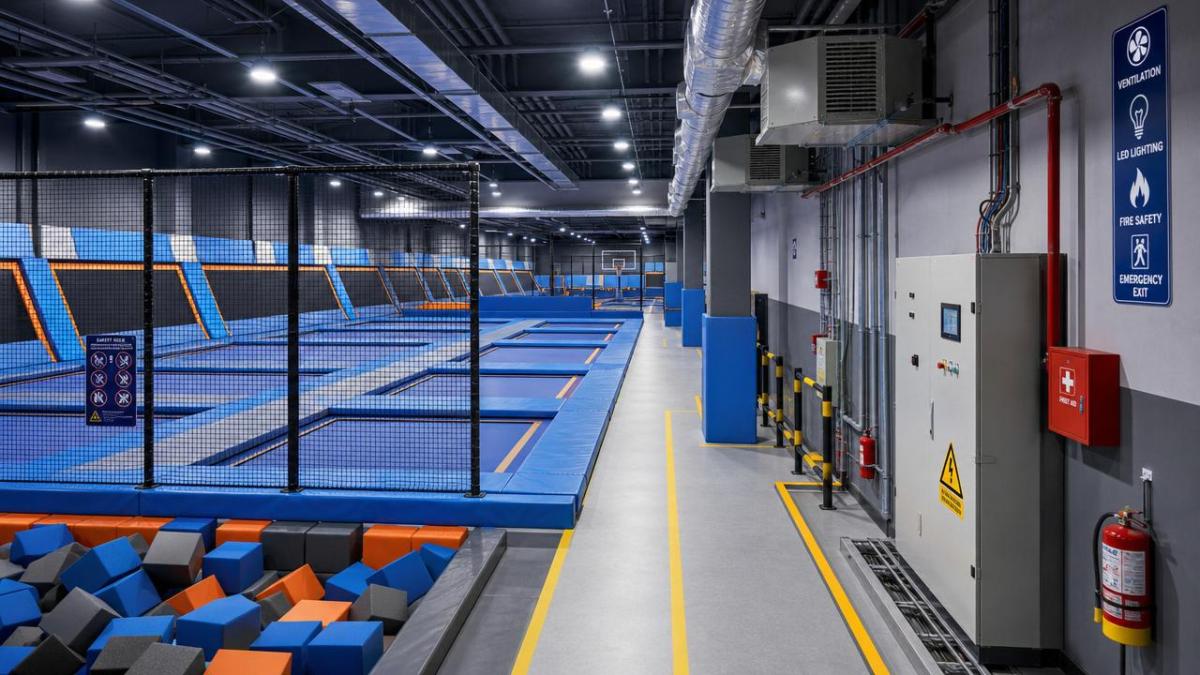
A first-pass budget for a trampoline park usually focuses on what is easy to quote: frame systems, trampoline beds, foam pits, wall pads, flooring, and basic fit-out. That is only the visible layer. For a finance team, the more consequential question is not the opening quote, but the full cost structure over the approval horizon: design review, building adaptation, safety redundancy, operational downtime, replacement cycles, and claims exposure.
In many procurement environments, cost overruns happen because suppliers present attractive package pricing while leaving technical dependencies outside the core quotation. HVAC reinforcement, slab condition correction, electrical upgrades, fire separation, acoustics treatment, traffic flow redesign, and regional code interpretation may all sit in separate budgets. If they are not modeled early, trampoline park cost can move from acceptable to problematic after approval has already been granted.
This is where a data-driven review matters. TechStat Vanguard applies the same principle used in industrial sourcing and engineering benchmarking: marketing language is a weak decision tool, while parameters, tolerances, and traceable cost assumptions provide clarity. A financial approver does not need vague promises about a “premium attraction package.” They need to know which variables are fixed, which are usage-dependent, and which can trigger budget escalation.
- Quoted equipment price is often only one part of total capital deployment.
- Compliance and building adaptation may vary sharply by region, landlord condition, and occupancy category.
- Lifecycle spending can materially exceed the difference between two initial supplier bids.
- Insurance and downtime risk can reshape the payback period more than small upfront savings.
What finance approvers should challenge before signing off
Any trampoline park cost proposal should be stress-tested against a few practical questions. Is the quote tied to a specific floor loading assumption? Are netting systems and impact zones priced to actual layout dimensions or to a concept drawing? Does the vendor state replacement intervals for high-wear components? Are freight, installation supervision, and local compliance modifications included or excluded? Approval discipline starts when these questions are documented rather than assumed.
Which hidden cost drivers most affect trampoline park cost?
The table below isolates major cost drivers that frequently sit behind an apparently simple trampoline park cost estimate. For financial planning, the objective is to identify not just whether a line item exists, but whether its variability is high, medium, or low during design, installation, and operation.
The key insight is that hidden drivers rarely arrive as one dramatic surprise. They accumulate in layers. That is why TSV-style analysis treats trampoline park cost as a systems budget, not an equipment invoice. Once finance teams map these variables early, they can compare proposals on a normalized basis rather than on headline price alone.
The most overlooked variable: operational intensity
Two parks with the same layout may have very different cost profiles if one is designed for moderate weekday traffic and the other for high-volume weekend events, parties, and seasonal peaks. The utilization curve affects labor planning, cleaning frequency, soft material replacement, and inspection workload. Financial approvers should therefore request scenario budgets tied to expected occupancy bands, not just a single annual estimate.
How should you compare suppliers when evaluating trampoline park cost?
A low supplier quote can still be the most expensive option if scope is incomplete, technical assumptions are weak, or service support is uncertain. The comparison table below helps finance teams review trampoline park cost using procurement logic closer to industrial capex assessment.
For finance teams, a high-clarity proposal reduces uncertainty even when the initial number is not the lowest. Better scoping supports cleaner capex planning, more reliable cash-flow timing, and fewer change orders. This is aligned with TSV’s broader procurement philosophy: decision quality improves when technical claims are traceable and assumptions are explicit.
A practical procurement checklist
- Request a site-specific drawing review before locking the budget.
- Separate base equipment, building works, compliance items, and owner-supplied items.
- Ask for wear-part forecast by monthly attendance scenario.
- Model insurance, utilities, and maintenance as part of total cost, not overhead noise.
- Review opening timeline sensitivity, because delayed launch changes payback assumptions.
What standards, compliance factors, and engineering details influence budget risk?
Financial approvers are not expected to become safety engineers, but they do need to know which compliance factors commonly shift trampoline park cost. In active entertainment venues, budget risk often comes from the interface between equipment design and the building itself. Safety spacing, access control, impact attenuation, emergency circulation, and fire protection coordination can all require design changes after initial concept approval.
A disciplined review typically includes applicable local building rules, occupancy calculations, fire and life-safety provisions, electrical capacity checks, and maintenance-access planning. General international references may inform the process, but local authority requirements govern what is ultimately approved. Any supplier claiming simple universal compliance without site review should be evaluated carefully.
Where finance teams should pay special attention
- Ceiling height constraints may reduce attraction mix or force redesign of jump zones and elevated features.
- Floor slab condition can affect anchoring methods, leveling work, and structural verification scope.
- Fire-rated separations, exits, and crowd flow can reduce usable revenue-generating area.
- Inspection and maintenance access provisions influence both safety and long-term labor cost.
TSV’s engineering-first viewpoint is useful here because it avoids generic sales framing. In hard-tech sourcing, hidden risk often sits at interfaces: machine to floor, sensor to network, component to certification pathway. Trampoline park cost follows the same logic. The interface between attraction, building, and operating procedures is often where budget distortion begins.
How can finance teams model total cost instead of just purchase price?
A stronger approval decision comes from shifting the conversation from acquisition price to total cost of ownership. For trampoline park cost, that means building a model that covers pre-opening, first-year stabilization, and recurring operations. Even a simple three-layer model improves budget reliability.
Layer 1: upfront capital
Include attraction systems, shipping, installation, site preparation, MEP adaptation, flooring transitions, safety barriers, signage, training, authority review support, and contingency. Capex should also reflect the practical cost of launch readiness, not merely delivered hardware.
Layer 2: first-year stabilization
The first year often reveals actual maintenance frequencies, staffing patterns, and insurance outcomes. A prudent model should include soft-opening inefficiencies, early replacement of high-contact materials, and process adjustment costs. These are not failures; they are common stabilization expenses.
Layer 3: recurring operating cost
Recurring cost includes utilities, inspections, routine repairs, premium adjustments, cleaning, training refreshers, and inventory for wear parts. If attendance is highly seasonal, finance teams should also model cash-flow stress during low-demand periods while fixed obligations remain in place.
When these layers are visible, trampoline park cost becomes easier to benchmark across vendors, locations, and operating concepts. This is the same reason TSV emphasizes engineering parameters in complex sourcing: once variables are structured, approval decisions become more resilient and less vulnerable to incomplete commercial narratives.
Common mistakes that distort trampoline park cost approvals
Mistake 1: treating concept drawings as final scope
Concept visuals are useful for stakeholder alignment, but not sufficient for final financial approval. They rarely capture service access, column interference, drainage issues, or local code revisions. Budgets approved from concept-only inputs often face later change orders.
Mistake 2: comparing quotes with different exclusion logic
One supplier may include freight and installation supervision while another excludes them. One may price standard pads, while another prices higher-durability materials. Without a normalization sheet, apparent savings are misleading.
Mistake 3: underestimating downtime economics
A venue that closes sections frequently for repairs does not just incur maintenance cost. It loses throughput, weakens customer experience, and may face event cancellations. The financial effect is much larger than the repair invoice itself.
Mistake 4: ignoring traceability of replacement parts
Lead times for custom soft goods, springs, pads, or specialty netting can extend downtime if parts planning is weak. Finance teams should ask whether critical consumables are standardized, stocked, or made to order.
FAQ: what do financial approvers ask most about trampoline park cost?
How should I judge whether a trampoline park cost quote is realistic?
Check whether the quote is linked to a verified site condition, defined scope boundaries, and explicit exclusions. A realistic quote should explain what is included for installation, site readiness, compliance support, and after-sales maintenance. If those items are vague, the budget is likely incomplete rather than competitive.
Which hidden costs are most likely to appear after approval?
The most common post-approval additions include landlord-required building modifications, local authority compliance revisions, slab correction, electrical or HVAC upgrades, extra safety padding, and replacement inventory. Insurance adjustments after the first operating period are also common.
Is the lowest trampoline park cost usually the best financial choice?
Not necessarily. The best choice is usually the proposal with the strongest cost transparency and the lowest uncertainty-adjusted lifetime burden. A slightly higher initial spend may reduce maintenance interruptions, change orders, and early replacement needs. Finance teams should compare total exposure, not just acquisition price.
How much contingency should be considered?
Contingency depends on site maturity and design completeness. A project with incomplete surveys, uncertain building condition, or evolving authority review generally requires more reserve than a well-documented retrofit. The important point is not a universal percentage, but that contingency should reflect measurable uncertainty rather than optimism.
Why work with a data-led review partner before approving trampoline park cost?
Financial approvers need more than sales brochures and conceptual estimates. They need a framework that filters noise, tests assumptions, and converts technical ambiguity into decision-ready insight. That is where TechStat Vanguard brings a different advantage. Our approach is built on engineering truth, benchmark discipline, and traceable procurement logic.
If you are reviewing trampoline park cost for investment approval, expansion, or supplier comparison, we can help structure the evaluation around the questions that matter: parameter confirmation, scope normalization, lifecycle cost assumptions, risk mapping, delivery timing, and compliance dependencies. This is especially valuable when multiple vendors present quotes that appear similar on the surface but differ materially underneath.
- Request support for parameter confirmation and scope-gap review before final approval.
- Ask for supplier comparison logic that separates equipment, fit-out, compliance, and operating risk.
- Discuss delivery schedule assumptions, replacement-part planning, and maintenance exposure.
- Clarify whether your project needs tailored budgeting for site conditions, certification pathways, or phased rollout.
- Open a quote discussion based on total cost logic rather than list price alone.
For finance leaders, the goal is not simply to lower trampoline park cost on paper. It is to approve a budget that can survive real-world engineering, compliance, and operating conditions. When data leads the conversation, approvals become faster to defend, easier to audit, and more aligned with long-term performance.
Search News
Hot Articles
- Carbon Fiber StructuresHow to Specify Aerospace Carbon Fiber Assemblies for Lightweight, Load-Bearing PartsJul 11, 2026
- Machine VisionXiaomi, Alibaba DAMO Academy Drive Open-Source Robotics Model Ecosystem, Lowering Algorithm Development Barriers for Overseas SMEs Adopting Chinese Robotics SolutionsMar 30, 2026
- Cobots & ArmsShanxi 'AI+' Conference Showcases Embodied Intelligence with Multinational Buyer Engagement: Key Industry ImplicationsMar 30, 2026
Popular Tags
Recommended News
 Jul 11, 2026How to Specify Aerospace Carbon Fiber Assemblies for Lightweight, Load-Bearing PartsAerospace carbon fiber assemblies: learn how to specify laminate design, load data, joining methods, and inspection controls for lighter, reliable load-bearing aerospace parts.Elena Rostova (UAV Systems Researcher)
 Mar 30, 2026Xiaomi, Alibaba DAMO Academy Drive Open-Source Robotics Model Ecosystem, Lowering Algorithm Development Barriers for Overseas SMEs Adopting Chinese Robotics SolutionsXiaomi & Alibaba DAMO Academy's open-source robotics models lower algorithm barriers for global SMEs. Boost efficiency in manufacturing, logistics & smart retail with ROS 2 compatible solutions.TSV Data Lab
 Mar 30, 2026Shanxi 'AI+' Conference Showcases Embodied Intelligence with Multinational Buyer Engagement: Key Industry ImplicationsShanxi 'AI+' Conference highlights embodied intelligence with Tesla, Ubtech & Jiantao showcasing multimodal robotics. 40+ global buyers validated tech on-site, creating new B2B channels for industrial automation & AI solutions.Chen Wei (Automation Lead Engineer)
 Mar 30, 2026Zhongguancun Unveils 6G Integrated Sensing-Computing-Intelligence Platform to Empower Embodied Robots for Global Industrial ApplicationsZhongguancun's new 6G platform revolutionizes industrial robotics with <10ms latency, empowering global automotive, logistics & port automation. Discover how this tech boosts China's smart manufacturing exports.TSV Data Lab
 Mar 30, 2026Mech-Mind Tianjin Embodied Intelligence R&D and Production Base Goes Live, Cutting Delivery Time by 20%–30% for Global Customized AMR+Vision SolutionsMech-Mind's Tianjin AMR+Vision production base cuts delivery time by 20%-30% for欧美 & Latin American markets. Discover how this PLd-certified facility accelerates customized robotics solutions for smart manufacturing and logistics.Chen Wei (Automation Lead Engineer)
 Mar 30, 2026Boao Forum Reveals 'Co-evolution of Big and Small Brains' Trend in Humanoid Robots, China's Embodied Intelligence Accelerates Adaptation to Overseas Manufacturing Service ScenariosDiscover how China's humanoid robots, featuring 'Co-evolution of Big and Small Brains,' are revolutionizing global manufacturing. Learn about Embodied Tian Gong 3.0's ISO compliance and overseas deployment at Boao Forum 2026.Chen Wei (Automation Lead Engineer)
 Mar 30, 2026China Railway Industrial Secures Patent for Embodied Robotics in Material Handling, Boosting High-Precision Delivery Capabilities for Overseas Infrastructure and Manufacturing ProjectsChina Railway Industrial's new patent for embodied robotics in material handling boosts high-precision delivery for global infrastructure & manufacturing. Discover how this innovation enhances logistics accuracy in automotive, rail transit & EPC projects.Chen Wei (Automation Lead Engineer)
 Sep 29, 2026ISO 9283 Repeatability: How to Evaluate Cobot Positioning PerformanceISO 9283 cobot repeatability explained: learn how payload, reach, approach direction, and test conditions affect positioning performance and cell capability.Chen Wei (Automation Lead Engineer)
 Sep 28, 2026Spindle Runout Measurement in Germany: DIN Standards, Methods, and Acceptance LimitsSpindle runout measurement Germany: explore DIN standards, proven methods, acceptance limits, and audit-ready practices for reliable machining quality.Dr. Marcus Vance
 Sep 27, 2026How to Select Wall-Mount Edge Devices for Space-Constrained Factory NetworksWall mount edge devices for space-constrained factories: evaluate workload, thermal design, power resilience, cable access, and network reliability for smarter deployments.TSV Data Lab
 Sep 26, 2026Machining Tolerance Analysis: How to Set Limits That Meet Function and Cost TargetsMachining tolerance analysis: learn how to set functional limits, control tolerance stacks, reduce inspection risk, and balance precision with production cost.Dr. Marcus Vance
 Sep 25, 2026How to Evaluate an Industrial Infrastructure Data Platform for Multi-Site OperationsIndustrial infrastructure data platform evaluation guide for multi-site operations: compare data quality, edge resilience, interoperability, governance, and scalable proof-of-value criteria.Victor Lin (Chief Software Architect)
 Sep 24, 2026How to Select Machine Vision Optics for Accurate Inspection at Different Working DistancesMachine vision optics selection guide for accurate inspection at every working distance. Compare FOV, pixel scale, DOF, distortion, lighting, and telecentric options.TSV Data Lab
 Sep 23, 2026How to Evaluate a Machine Vision System Integrator for High-Speed Inspection LinesChoose a machine vision system integrator with proven expertise in high-speed inspection, reliable reject timing, robust optics, and measurable acceptance criteria.TSV Data Lab
 Sep 28, 2026When is a SCADA API the right choice for connecting plant systems?SCADA API guide: learn when governed plant data integration improves traceability, security, and scalability—without compromising real-time control.Victor Lin (Chief Software Architect)
 Sep 27, 2026How SCADA data integration improves traceability across production linesSCADA data integration connects production-line data to improve traceability, accelerate quality investigations, and strengthen safety decisions.Victor Lin (Chief Software Architect)
 Sep 26, 2026What to define before starting SCADA integration planningSCADA integration planning starts with clear scope, control boundaries, data models, cybersecurity, and testing. Discover the definitions that reduce risk and costly rework.Victor Lin (Chief Software Architect)
 Sep 25, 2026How a smart factory with Industrial IoT reduces production blind spotsDiscover how a smart factory with Industrial IoT turns real-time machine, quality, and workflow data into actionable insights that reduce production blind spots and delivery risks.Victor Lin (Chief Software Architect)
 Sep 24, 2026When does Industrial IoT make smart manufacturing easier to scale?Smart manufacturing Industrial IoT scales when trusted data, interoperable systems, and secure workflows turn connected assets into measurable gains.TSV Data Lab
 Sep 23, 2026What drives ultra-precision machining cost at 1-micron tolerance?Ultra precision machining cost per part at 1 micron tolerance depends on process, material, metrology, and yield. Learn how to compare quotes confidently.Dr. Marcus Vance
 Sep 22, 2026Drone Engine-T550CC Applications: Build the UAV Power System Around the MissionAn application guide for Drone Engine-T550CC integration, covering payload planning, airframe matching, cooling, fuel, vibration, test procedures, documentation, and service preparation.Elena Rostova (UAV Systems Researcher)
 Sep 22, 2026How to Evaluate Industrial Edge Computing Vendors for Factory DeploymentIndustrial edge computing vendor evaluation guide for factories: compare latency, protocol fit, reliability, security, and lifecycle support before deployment.TSV Data Lab
 Sep 21, 2026Drone Payload Integration: Matching Power, Data, and Center of Gravity for Reliable FlightsDrone payload integration made practical: balance power, data, center of gravity, and endurance to build safer, more reliable mission-ready flights.Elena Rostova (UAV Systems Researcher)
 Sep 20, 2026Autonomous Navigation Pricing: Cost Drivers and Budget Benchmarks for AMR ProjectsAutonomous navigation price explained: compare AMR cost drivers, software, sensors, integration, safety, and lifecycle budgets to build a scalable project plan.Chen Wei (Automation Lead Engineer)