The Hidden Costs Behind a New Trampoline Park Business
Publication Date
author
Starting a trampoline park business may look exciting on paper, but the real financial picture often hides behind optimistic projections. For financial approvers, the key risk is not the visible startup budget—it is the layered costs tied to compliance, insurance, equipment lifecycle, site conversion, staffing, and ongoing liability control. Before approving capital, it is essential to examine where margins are quietly eroded and how these hidden expenses shape long-term return.
Understanding the real cost structure of a trampoline park business
A trampoline park business is often presented as a high-energy leisure venture with strong family demand, birthday party revenue, and scalable group bookings. That surface-level view is not wrong, but it is incomplete. For a financial approver, the more useful lens is to treat the business as a liability-sensitive, operations-heavy indoor entertainment asset with above-average maintenance complexity and high dependence on risk control.
In practical terms, the hidden costs behind a new trampoline park business begin long before the first ticket is sold. They appear in engineering reviews, fire code upgrades, floor reinforcement, zoning approvals, insurance underwriting, equipment certification, staff training, and reserve capital for replacements. These expenses do not always look dramatic line by line, but together they can alter payback periods, debt service coverage, and long-term cash stability.
This is exactly where a data-first mindset matters. As TechStat Vanguard emphasizes in hard-tech and industrial decision-making, engineering truth lives in measurable parameters, not in attractive claims. The same principle applies here: a new trampoline park business should be assessed through verified operating assumptions, lifecycle cost models, and risk-adjusted margin analysis rather than headline revenue scenarios.
Why the industry keeps underestimating hidden expenses
The indoor recreation sector often markets itself through utilization rates, party packages, and seasonal demand. Yet many new operators underestimate cost because the business sits at the intersection of entertainment, facility management, public safety, and insurance exposure. Each of those domains introduces its own standards, service contracts, and contingency demands.
In addition, a trampoline park business is not simply a lease-and-launch concept. Every location behaves differently based on ceiling height, load-bearing conditions, parking ratios, local code enforcement, and demographic fit. A budget model built from a generic operator brochure can therefore fail to reflect site-specific conversion realities. Financial approvers should be cautious when startup projections assume smooth permitting, flat maintenance rates, or stable insurance pricing across multiple years.
A practical overview of hidden cost categories
Before capital approval, it helps to classify hidden costs into structured groups. This makes the trampoline park business easier to evaluate as an investment rather than a concept.
For a financial approver, this table is more than a checklist. It is a reminder that the economics of a trampoline park business depend on the quality of assumption-building across both capital expenditure and operating expenditure.
Site conversion is often the first major budget distortion
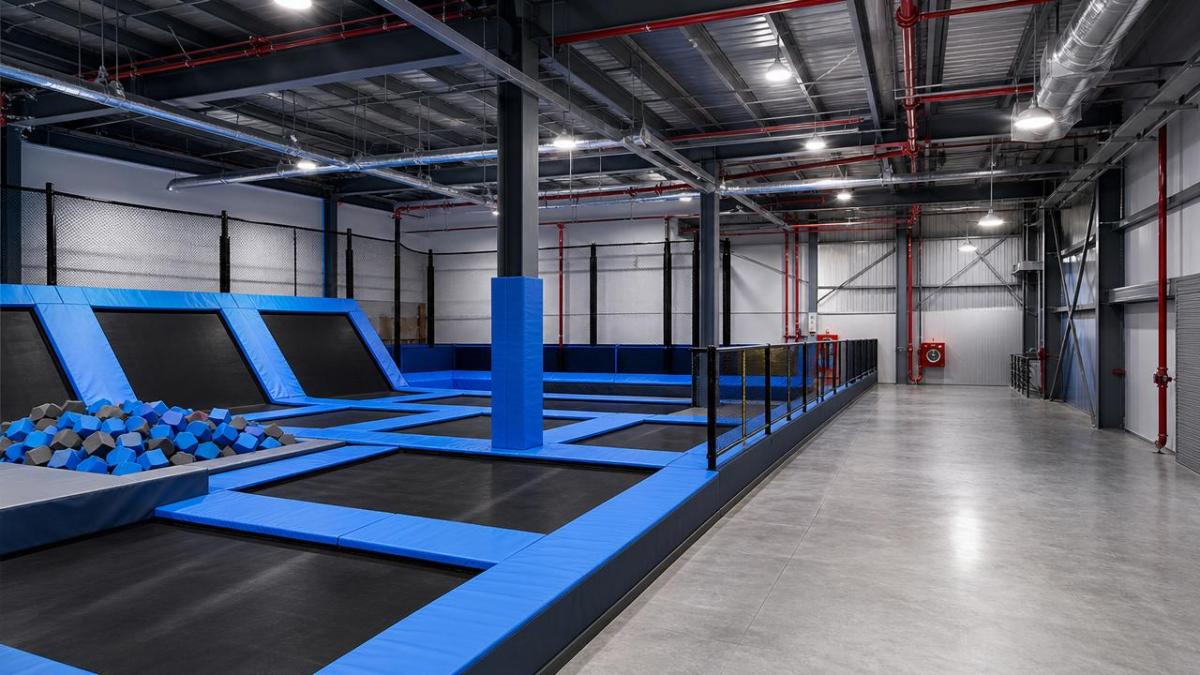
One of the most underestimated issues in a new trampoline park business is building conversion. A large empty warehouse may seem ideal, but suitability on paper rarely equals readiness in practice. Ceiling clearance, ventilation demands, emergency exit design, restroom capacity, accessibility compliance, and spectator circulation all affect final construction scope.
Landlords may deliver a shell that still requires significant tenant investment. Even seemingly small changes, such as upgrading lighting for safety visibility or reinforcing flooring around anchor systems, can increase capital need substantially. Delays are equally costly. Every extra month spent in redesign, inspections, or contractor scheduling adds rent, financing cost, and lost launch revenue.
Insurance and liability control reshape the business model
Insurance is not just another operating line in a trampoline park business. It is a core determinant of viability. Premiums can be materially affected by claims history, local legal climate, age segmentation of visitors, supervision protocols, and the design of higher-risk attractions such as dodgeball courts, ninja elements, or foam pits.
Financial approvers should not only ask for the initial quote. They should ask how the premium behaves after year one, what exclusions apply, how deductibles affect cash reserves, and whether any attractions could become uninsurable or disproportionately expensive to cover. A business that appears profitable before insurance normalization may look far less attractive after proper risk pricing is applied.
This is also where rigorous operational data becomes valuable. Injury logs, inspection records, staff-to-guest ratios, and maintenance traceability can influence underwriting confidence. In a sense, a trampoline park business increasingly rewards operators who can document safety with the same discipline that advanced industries document performance.
Equipment depreciation is more active than many forecasts assume
Another hidden cost lies in how quickly high-contact recreational equipment ages under daily use. Trampoline beds, protective pads, netting, impact surfaces, foam materials, and structural components all face wear patterns that are affected by traffic volume, age mix, humidity, cleaning frequency, and misuse.
A new trampoline park business should therefore not rely on simple straight-line depreciation as the only planning tool. Some components require replacement according to use intensity rather than calendar age. Others may remain technically functional but become unsuitable from a safety, appearance, or brand-standard perspective. When replacement reserves are underfunded, operators face a bad choice between visible deterioration and sudden capex shocks.
Labor costs extend beyond wages
Staffing in a trampoline park business includes more than reception and basic supervision. Floor monitors, party coordinators, cleaning teams, maintenance personnel, managers, first-aid-capable staff, and training leads all play a role in safe operations. Because service speed and safety oversight directly affect guest experience, understaffing creates both revenue and liability risk.
Turnover can also be expensive. New hires require onboarding, emergency procedure education, rule enforcement coaching, and often repeated training cycles because many parks depend on younger hourly workers. Financial approvers should model labor at realistic fully loaded cost, including payroll taxes, benefits where applicable, uniforms, scheduling inefficiency, and the hidden managerial time spent supervising inexperienced teams.
Typical cost pressure points by business stage
The hidden costs of a trampoline park business do not arrive all at once. They emerge differently across the investment timeline.
Why this matters specifically to financial approvers
A financial approver is not judging whether a trampoline park business sounds attractive to families. The real task is to evaluate whether the asset can preserve cash discipline under stress. That means testing downside cases: slower ramp-up, premium increases, one-time legal expenses, component failure, local competition, or seasonal traffic weakness.
In approval terms, the most reliable questions are simple but demanding. What assumptions are based on signed quotations rather than estimates? What reserve policies exist for maintenance and claims? How sensitive is EBITDA to insurance repricing? What percentage of startup capex is exposed to site conditions not yet verified by engineering review? These questions bring decision-making back to evidence, which is consistent with TSV’s broader principle that durable decisions require validated data instead of promotional optimism.
Practical evaluation steps before approving a trampoline park business
A disciplined review process can significantly reduce surprises. First, require a site-specific technical due diligence package, not just a concept budget. Second, separate fixed launch costs from usage-driven replacement reserves. Third, request multiple insurance scenarios, including adverse renewal assumptions. Fourth, verify that the staffing model reflects actual safety coverage by operating hour, not just ideal payroll percentages.
It is also wise to review vendor support terms in detail. Warranty language, spare parts lead times, inspection obligations, and maintenance documentation standards all influence lifecycle economics. A cheaper equipment package can become expensive if replacement intervals are short or service support is weak. For any trampoline park business, the quality of documentation is often a useful proxy for the quality of operational predictability.
A disciplined conclusion for decision-makers
The hidden costs behind a new trampoline park business are not random surprises; they are predictable categories that become expensive when they are ignored, generalized, or underestimated. Site conversion, compliance, insurance, equipment wear, labor complexity, and claims exposure all have measurable financial consequences. When these are modeled properly, the investment case becomes clearer and more defensible.
For financial approvers, the best next step is not to reject the trampoline park business outright, but to demand a stricter evidence standard before capital is released. Validate assumptions with technical documentation, pressure-test operating scenarios, and build reserves that reflect real risk. In any industry, sound approvals begin when attractive concepts are translated into verified numbers—and that is where sustainable returns are most likely to be found.
Search News
Hot Articles
- Carbon Fiber StructuresHow to Specify Aerospace Carbon Fiber Assemblies for Lightweight, Load-Bearing PartsJul 11, 2026
- Machine VisionXiaomi, Alibaba DAMO Academy Drive Open-Source Robotics Model Ecosystem, Lowering Algorithm Development Barriers for Overseas SMEs Adopting Chinese Robotics SolutionsMar 30, 2026
- Cobots & ArmsShanxi 'AI+' Conference Showcases Embodied Intelligence with Multinational Buyer Engagement: Key Industry ImplicationsMar 30, 2026
Popular Tags
Recommended News
 Jul 11, 2026How to Specify Aerospace Carbon Fiber Assemblies for Lightweight, Load-Bearing PartsAerospace carbon fiber assemblies: learn how to specify laminate design, load data, joining methods, and inspection controls for lighter, reliable load-bearing aerospace parts.Elena Rostova (UAV Systems Researcher)
 Mar 30, 2026Xiaomi, Alibaba DAMO Academy Drive Open-Source Robotics Model Ecosystem, Lowering Algorithm Development Barriers for Overseas SMEs Adopting Chinese Robotics SolutionsXiaomi & Alibaba DAMO Academy's open-source robotics models lower algorithm barriers for global SMEs. Boost efficiency in manufacturing, logistics & smart retail with ROS 2 compatible solutions.TSV Data Lab
 Mar 30, 2026Shanxi 'AI+' Conference Showcases Embodied Intelligence with Multinational Buyer Engagement: Key Industry ImplicationsShanxi 'AI+' Conference highlights embodied intelligence with Tesla, Ubtech & Jiantao showcasing multimodal robotics. 40+ global buyers validated tech on-site, creating new B2B channels for industrial automation & AI solutions.Chen Wei (Automation Lead Engineer)
 Mar 30, 2026Zhongguancun Unveils 6G Integrated Sensing-Computing-Intelligence Platform to Empower Embodied Robots for Global Industrial ApplicationsZhongguancun's new 6G platform revolutionizes industrial robotics with <10ms latency, empowering global automotive, logistics & port automation. Discover how this tech boosts China's smart manufacturing exports.TSV Data Lab
 Mar 30, 2026Mech-Mind Tianjin Embodied Intelligence R&D and Production Base Goes Live, Cutting Delivery Time by 20%–30% for Global Customized AMR+Vision SolutionsMech-Mind's Tianjin AMR+Vision production base cuts delivery time by 20%-30% for欧美 & Latin American markets. Discover how this PLd-certified facility accelerates customized robotics solutions for smart manufacturing and logistics.Chen Wei (Automation Lead Engineer)
 Mar 30, 2026Boao Forum Reveals 'Co-evolution of Big and Small Brains' Trend in Humanoid Robots, China's Embodied Intelligence Accelerates Adaptation to Overseas Manufacturing Service ScenariosDiscover how China's humanoid robots, featuring 'Co-evolution of Big and Small Brains,' are revolutionizing global manufacturing. Learn about Embodied Tian Gong 3.0's ISO compliance and overseas deployment at Boao Forum 2026.Chen Wei (Automation Lead Engineer)
 Mar 30, 2026China Railway Industrial Secures Patent for Embodied Robotics in Material Handling, Boosting High-Precision Delivery Capabilities for Overseas Infrastructure and Manufacturing ProjectsChina Railway Industrial's new patent for embodied robotics in material handling boosts high-precision delivery for global infrastructure & manufacturing. Discover how this innovation enhances logistics accuracy in automotive, rail transit & EPC projects.Chen Wei (Automation Lead Engineer)
 Sep 29, 2026ISO 9283 Repeatability: How to Evaluate Cobot Positioning PerformanceISO 9283 cobot repeatability explained: learn how payload, reach, approach direction, and test conditions affect positioning performance and cell capability.Chen Wei (Automation Lead Engineer)
 Sep 28, 2026Spindle Runout Measurement in Germany: DIN Standards, Methods, and Acceptance LimitsSpindle runout measurement Germany: explore DIN standards, proven methods, acceptance limits, and audit-ready practices for reliable machining quality.Dr. Marcus Vance
 Sep 27, 2026How to Select Wall-Mount Edge Devices for Space-Constrained Factory NetworksWall mount edge devices for space-constrained factories: evaluate workload, thermal design, power resilience, cable access, and network reliability for smarter deployments.TSV Data Lab
 Sep 26, 2026Machining Tolerance Analysis: How to Set Limits That Meet Function and Cost TargetsMachining tolerance analysis: learn how to set functional limits, control tolerance stacks, reduce inspection risk, and balance precision with production cost.Dr. Marcus Vance
 Sep 25, 2026How to Evaluate an Industrial Infrastructure Data Platform for Multi-Site OperationsIndustrial infrastructure data platform evaluation guide for multi-site operations: compare data quality, edge resilience, interoperability, governance, and scalable proof-of-value criteria.Victor Lin (Chief Software Architect)
 Sep 24, 2026How to Select Machine Vision Optics for Accurate Inspection at Different Working DistancesMachine vision optics selection guide for accurate inspection at every working distance. Compare FOV, pixel scale, DOF, distortion, lighting, and telecentric options.TSV Data Lab
 Sep 23, 2026How to Evaluate a Machine Vision System Integrator for High-Speed Inspection LinesChoose a machine vision system integrator with proven expertise in high-speed inspection, reliable reject timing, robust optics, and measurable acceptance criteria.TSV Data Lab
 Sep 28, 2026When is a SCADA API the right choice for connecting plant systems?SCADA API guide: learn when governed plant data integration improves traceability, security, and scalability—without compromising real-time control.Victor Lin (Chief Software Architect)
 Sep 27, 2026How SCADA data integration improves traceability across production linesSCADA data integration connects production-line data to improve traceability, accelerate quality investigations, and strengthen safety decisions.Victor Lin (Chief Software Architect)
 Sep 26, 2026What to define before starting SCADA integration planningSCADA integration planning starts with clear scope, control boundaries, data models, cybersecurity, and testing. Discover the definitions that reduce risk and costly rework.Victor Lin (Chief Software Architect)
 Sep 25, 2026How a smart factory with Industrial IoT reduces production blind spotsDiscover how a smart factory with Industrial IoT turns real-time machine, quality, and workflow data into actionable insights that reduce production blind spots and delivery risks.Victor Lin (Chief Software Architect)
 Sep 24, 2026When does Industrial IoT make smart manufacturing easier to scale?Smart manufacturing Industrial IoT scales when trusted data, interoperable systems, and secure workflows turn connected assets into measurable gains.TSV Data Lab
 Sep 23, 2026What drives ultra-precision machining cost at 1-micron tolerance?Ultra precision machining cost per part at 1 micron tolerance depends on process, material, metrology, and yield. Learn how to compare quotes confidently.Dr. Marcus Vance
 Sep 22, 2026Drone Engine-T550CC Applications: Build the UAV Power System Around the MissionAn application guide for Drone Engine-T550CC integration, covering payload planning, airframe matching, cooling, fuel, vibration, test procedures, documentation, and service preparation.Elena Rostova (UAV Systems Researcher)
 Sep 22, 2026How to Evaluate Industrial Edge Computing Vendors for Factory DeploymentIndustrial edge computing vendor evaluation guide for factories: compare latency, protocol fit, reliability, security, and lifecycle support before deployment.TSV Data Lab
 Sep 21, 2026Drone Payload Integration: Matching Power, Data, and Center of Gravity for Reliable FlightsDrone payload integration made practical: balance power, data, center of gravity, and endurance to build safer, more reliable mission-ready flights.Elena Rostova (UAV Systems Researcher)
 Sep 20, 2026Autonomous Navigation Pricing: Cost Drivers and Budget Benchmarks for AMR ProjectsAutonomous navigation price explained: compare AMR cost drivers, software, sensors, integration, safety, and lifecycle budgets to build a scalable project plan.Chen Wei (Automation Lead Engineer)