Is a Trampoline Park Business Still Profitable in 2026?
Publication Date
author
As investors and operators reassess location-based entertainment, one question stands out: is a trampoline park business still profitable in 2026? For decision-makers, the answer depends less on hype and more on measurable factors such as utilization rates, operating costs, safety liabilities, customer retention, and local demand. This article examines the business case through a practical, data-aware lens to help leaders evaluate real profit potential.
Why scenario differences matter when evaluating a trampoline park business
A trampoline park business is not a single operating model. Profitability in 2026 depends heavily on context: urban family entertainment centers, suburban destination parks, mixed-use retail sites, and franchise-style expansion models all perform differently. The same revenue target can be realistic in one market and risky in another because rent intensity, labor availability, local competition, insurance exposure, and customer acquisition costs vary by scenario.
For business decision-makers, this means the question is not simply whether the trampoline park business can make money. The real question is which operating scenario creates a durable margin after accounting for capacity utilization, downtime, seasonality, maintenance, and legal risk. In practical terms, profitability comes from matching the right concept to the right demand environment, not from assuming that foot traffic alone guarantees success.
This is especially relevant in 2026, when consumers expect more than basic jump sessions. Successful operators increasingly combine active play, birthday events, food and beverage, digital booking, memberships, and corporate group packages. A trampoline park business that stays narrow may still survive, but one that aligns its offer with local customer behavior is more likely to produce stable cash flow.
The main business scenarios where a trampoline park business can still be profitable
1. Family entertainment districts with strong weekend traffic
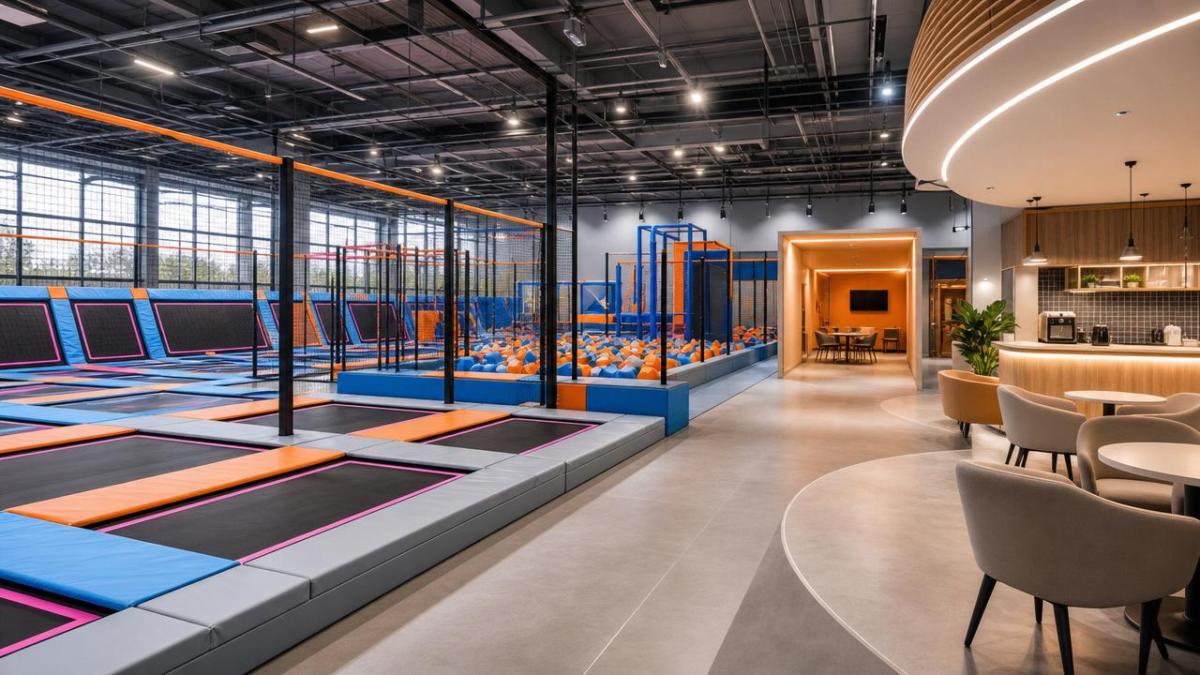
This is one of the strongest scenarios for a trampoline park business. Parks located near cinemas, restaurants, schools, and family retail clusters benefit from existing destination traffic. In these markets, customers are already planning group outings, and the park becomes part of a broader leisure routine. Profitability tends to improve when operators can upsell party rooms, arcade elements, cafes, and premium timed packages.
However, rent can be higher in these districts, so the model works best when occupancy is actively managed. Peak weekends alone are not enough; operators need school holiday programming, weekday promotions, and event partnerships to fill off-peak hours.
2. Suburban large-format parks serving repeat local users
A suburban trampoline park business can be profitable if it captures a broad catchment area and offers enough value for repeat visits. Lower rent relative to city centers often improves margin potential, but this is only true if demand density supports repeat attendance. Memberships, parent-friendly waiting areas, youth programs, and seasonal camps become important in this scenario.
The challenge is avoiding underutilized floor space. Large sites create fixed-cost pressure, especially for staffing, energy use, cleaning, and maintenance. Operators in suburban markets need strong local brand trust and disciplined capacity planning.
3. Hybrid venues inside malls or retail redevelopment projects
In 2026, many retail landlords continue searching for experience-driven tenants. That creates an opportunity for the trampoline park business in malls, former big-box retail spaces, or mixed-use redevelopments. The appeal here is landlord interest in traffic-driving attractions, which may create flexible lease structures or fit-out support.
Still, this scenario requires caution. Mall-based traffic is not always conversion-ready. Casual browsing does not necessarily turn into high-value jump sessions. Operators need visible branding, smooth online reservations, and a pricing strategy that converts impulse visits into recurring business.
4. Premium activity parks targeting corporate and group events
Some operators position the trampoline park business beyond children’s entertainment and focus on schools, team-building, private rentals, and organized group events. This can improve revenue per booking because group customers usually buy bundled services, reserve in advance, and occupy off-peak time slots.
This model often works best in metro areas with a dense base of schools, youth organizations, and employers. It also depends on operational reliability, event management capability, and a safety record that supports institutional trust.
Scenario comparison: where the profit outlook is strongest
The table below highlights how the trampoline park business performs under different operating scenarios. Leaders should use it as a screening tool before moving into detailed financial modeling.
What different decision-makers should examine before entering the market
For first-time investors
A trampoline park business may look attractive because of visible customer activity and perceived demand from families. But first-time investors should pay close attention to capital intensity, launch timelines, and insurance requirements. Fit-out costs, equipment certification, flooring systems, HVAC load, and local compliance can materially change the payback period.
The best scenario for new entrants is usually a market with proven family demand, limited direct competition, and a site that allows event rooms and flexible attractions rather than a basic jump-only layout.
For multi-site entertainment operators
Existing operators can often make a trampoline park business more profitable than new entrants because they already understand staffing, bookings, food service, local marketing, and customer lifetime value. Their advantage lies in cross-selling and operational standardization. In this case, the key question is whether the new park fills a geographic gap or adds a new use case to the portfolio.
For landlords and redevelopment stakeholders
From a property perspective, the trampoline park business can serve as an anchor that increases dwell time and supports surrounding tenants. But landlords should analyze whether the venue will generate repeat destination traffic or simply consume large floor space at low rent productivity. The right operator matters as much as the concept.
The core demand differences that shape profitability in 2026
Across scenarios, five variables determine whether a trampoline park business remains profitable in 2026.
- Demand consistency: one-time traffic is less valuable than repeat local use.
- Revenue mix: parks with parties, food, memberships, and group sales are more resilient.
- Safety cost control: insurance, staff training, and maintenance directly affect margin.
- Site economics: rent, utility load, and parking convenience can make or break the model.
- Competitive positioning: a park that feels interchangeable will face pricing pressure quickly.
These variables are closely linked. For example, a low-rent site may still underperform if access is weak. A premium site may succeed if average revenue per visitor is lifted through events and bundled offerings. This is why scenario-based evaluation matters more than generic industry optimism.
When a trampoline park business is a strong fit—and when caution is justified
Strong-fit conditions
A trampoline park business is usually a stronger opportunity when the market has family population density, limited premium active-entertainment alternatives, convenient parking, and an operator capable of selling events rather than relying only on admissions. Strong-fit markets also tend to support digital bookings, school partnerships, and repeat visitation patterns.
Caution conditions
Caution is warranted when the concept depends on high rent districts without a clear premium strategy, when insurance costs are rising faster than revenue potential, or when the local market is already crowded with similar indoor attractions. Another warning sign is a business plan built around optimistic peak-week assumptions but weak weekday utilization.
In 2026, weak differentiation is a major risk. A trampoline park business that offers only standard jump zones may struggle to defend pricing against competitors with more immersive attractions or better event packaging.
Common misjudgments in trampoline park business planning
Many investment mistakes come from viewing the trampoline park business as a simple volume play. In reality, several common misjudgments distort the financial picture:
- Overestimating walk-in demand while underestimating the need for active marketing.
- Treating birthday parties as incidental revenue rather than a core profit engine.
- Ignoring maintenance cycles and the revenue impact of temporary attraction closures.
- Underpricing admission in response to competition, which weakens long-term viability.
- Failing to plan for waiver systems, safety monitoring, and training consistency.
Decision-makers should stress-test every forecast against conservative utilization assumptions. If the model only works under best-case weekend attendance, it is unlikely to be robust enough for real-world operations.
FAQ: practical questions leaders ask about a trampoline park business
Is the trampoline park business saturated?
In some urban markets, yes. But saturation is local, not universal. The better question is whether your target market lacks a differentiated active-entertainment offer with strong event and retention capability.
Can a trampoline park business survive rising insurance and labor costs?
Yes, but only if pricing, staffing efficiency, and ancillary revenue are managed well. Parks that depend solely on low-ticket admissions face greater pressure.
What revenue streams matter most in 2026?
Admissions remain important, but parties, memberships, food and beverage, private events, and school or corporate packages usually make the trampoline park business more stable.
Final assessment and next-step guidance
So, is a trampoline park business still profitable in 2026? In the right scenario, yes. But profitability is no longer driven by concept novelty. It comes from careful site selection, realistic capacity planning, diversified revenue, disciplined safety management, and a clear fit between the venue and local demand behavior.
For enterprise decision-makers, the most reliable path is to evaluate the trampoline park business through a scenario framework: who the core customer is, when they visit, what else they buy, how much fixed cost the site carries, and what competitive advantage the operator can sustain. If these answers are precise, the business can still generate attractive returns. If they are vague, caution is justified.
The next step is straightforward: build a market-specific model based on utilization, event conversion, insurance assumptions, rent structure, and repeat visit potential. That is where real opportunity becomes visible—and where weak concepts are filtered out before capital is committed.
Search News
Hot Articles
- Carbon Fiber StructuresHow to Specify Aerospace Carbon Fiber Assemblies for Lightweight, Load-Bearing PartsJul 11, 2026
- Machine VisionXiaomi, Alibaba DAMO Academy Drive Open-Source Robotics Model Ecosystem, Lowering Algorithm Development Barriers for Overseas SMEs Adopting Chinese Robotics SolutionsMar 30, 2026
- Cobots & ArmsShanxi 'AI+' Conference Showcases Embodied Intelligence with Multinational Buyer Engagement: Key Industry ImplicationsMar 30, 2026
Popular Tags
Recommended News
 Jul 11, 2026How to Specify Aerospace Carbon Fiber Assemblies for Lightweight, Load-Bearing PartsAerospace carbon fiber assemblies: learn how to specify laminate design, load data, joining methods, and inspection controls for lighter, reliable load-bearing aerospace parts.Elena Rostova (UAV Systems Researcher)
 Mar 30, 2026Xiaomi, Alibaba DAMO Academy Drive Open-Source Robotics Model Ecosystem, Lowering Algorithm Development Barriers for Overseas SMEs Adopting Chinese Robotics SolutionsXiaomi & Alibaba DAMO Academy's open-source robotics models lower algorithm barriers for global SMEs. Boost efficiency in manufacturing, logistics & smart retail with ROS 2 compatible solutions.TSV Data Lab
 Mar 30, 2026Shanxi 'AI+' Conference Showcases Embodied Intelligence with Multinational Buyer Engagement: Key Industry ImplicationsShanxi 'AI+' Conference highlights embodied intelligence with Tesla, Ubtech & Jiantao showcasing multimodal robotics. 40+ global buyers validated tech on-site, creating new B2B channels for industrial automation & AI solutions.Chen Wei (Automation Lead Engineer)
 Mar 30, 2026Zhongguancun Unveils 6G Integrated Sensing-Computing-Intelligence Platform to Empower Embodied Robots for Global Industrial ApplicationsZhongguancun's new 6G platform revolutionizes industrial robotics with <10ms latency, empowering global automotive, logistics & port automation. Discover how this tech boosts China's smart manufacturing exports.TSV Data Lab
 Mar 30, 2026Mech-Mind Tianjin Embodied Intelligence R&D and Production Base Goes Live, Cutting Delivery Time by 20%–30% for Global Customized AMR+Vision SolutionsMech-Mind's Tianjin AMR+Vision production base cuts delivery time by 20%-30% for欧美 & Latin American markets. Discover how this PLd-certified facility accelerates customized robotics solutions for smart manufacturing and logistics.Chen Wei (Automation Lead Engineer)
 Mar 30, 2026Boao Forum Reveals 'Co-evolution of Big and Small Brains' Trend in Humanoid Robots, China's Embodied Intelligence Accelerates Adaptation to Overseas Manufacturing Service ScenariosDiscover how China's humanoid robots, featuring 'Co-evolution of Big and Small Brains,' are revolutionizing global manufacturing. Learn about Embodied Tian Gong 3.0's ISO compliance and overseas deployment at Boao Forum 2026.Chen Wei (Automation Lead Engineer)
 Mar 30, 2026China Railway Industrial Secures Patent for Embodied Robotics in Material Handling, Boosting High-Precision Delivery Capabilities for Overseas Infrastructure and Manufacturing ProjectsChina Railway Industrial's new patent for embodied robotics in material handling boosts high-precision delivery for global infrastructure & manufacturing. Discover how this innovation enhances logistics accuracy in automotive, rail transit & EPC projects.Chen Wei (Automation Lead Engineer)
 Sep 28, 2026Spindle Runout Measurement in Germany: DIN Standards, Methods, and Acceptance LimitsSpindle runout measurement Germany: explore DIN standards, proven methods, acceptance limits, and audit-ready practices for reliable machining quality.Dr. Marcus Vance
 Sep 27, 2026How to Select Wall-Mount Edge Devices for Space-Constrained Factory NetworksWall mount edge devices for space-constrained factories: evaluate workload, thermal design, power resilience, cable access, and network reliability for smarter deployments.TSV Data Lab
 Sep 26, 2026Machining Tolerance Analysis: How to Set Limits That Meet Function and Cost TargetsMachining tolerance analysis: learn how to set functional limits, control tolerance stacks, reduce inspection risk, and balance precision with production cost.Dr. Marcus Vance
 Sep 25, 2026How to Evaluate an Industrial Infrastructure Data Platform for Multi-Site OperationsIndustrial infrastructure data platform evaluation guide for multi-site operations: compare data quality, edge resilience, interoperability, governance, and scalable proof-of-value criteria.Victor Lin (Chief Software Architect)
 Sep 24, 2026How to Select Machine Vision Optics for Accurate Inspection at Different Working DistancesMachine vision optics selection guide for accurate inspection at every working distance. Compare FOV, pixel scale, DOF, distortion, lighting, and telecentric options.TSV Data Lab
 Sep 23, 2026How to Evaluate a Machine Vision System Integrator for High-Speed Inspection LinesChoose a machine vision system integrator with proven expertise in high-speed inspection, reliable reject timing, robust optics, and measurable acceptance criteria.TSV Data Lab
 Sep 28, 2026When is a SCADA API the right choice for connecting plant systems?SCADA API guide: learn when governed plant data integration improves traceability, security, and scalability—without compromising real-time control.Victor Lin (Chief Software Architect)
 Sep 27, 2026How SCADA data integration improves traceability across production linesSCADA data integration connects production-line data to improve traceability, accelerate quality investigations, and strengthen safety decisions.Victor Lin (Chief Software Architect)
 Sep 26, 2026What to define before starting SCADA integration planningSCADA integration planning starts with clear scope, control boundaries, data models, cybersecurity, and testing. Discover the definitions that reduce risk and costly rework.Victor Lin (Chief Software Architect)
 Sep 25, 2026How a smart factory with Industrial IoT reduces production blind spotsDiscover how a smart factory with Industrial IoT turns real-time machine, quality, and workflow data into actionable insights that reduce production blind spots and delivery risks.Victor Lin (Chief Software Architect)
 Sep 24, 2026When does Industrial IoT make smart manufacturing easier to scale?Smart manufacturing Industrial IoT scales when trusted data, interoperable systems, and secure workflows turn connected assets into measurable gains.TSV Data Lab
 Sep 23, 2026What drives ultra-precision machining cost at 1-micron tolerance?Ultra precision machining cost per part at 1 micron tolerance depends on process, material, metrology, and yield. Learn how to compare quotes confidently.Dr. Marcus Vance
 Sep 22, 2026Drone Engine-T550CC Applications: Build the UAV Power System Around the MissionAn application guide for Drone Engine-T550CC integration, covering payload planning, airframe matching, cooling, fuel, vibration, test procedures, documentation, and service preparation.Elena Rostova (UAV Systems Researcher)
 Sep 22, 2026How to Evaluate Industrial Edge Computing Vendors for Factory DeploymentIndustrial edge computing vendor evaluation guide for factories: compare latency, protocol fit, reliability, security, and lifecycle support before deployment.TSV Data Lab
 Sep 21, 2026Drone Payload Integration: Matching Power, Data, and Center of Gravity for Reliable FlightsDrone payload integration made practical: balance power, data, center of gravity, and endurance to build safer, more reliable mission-ready flights.Elena Rostova (UAV Systems Researcher)
 Sep 20, 2026Autonomous Navigation Pricing: Cost Drivers and Budget Benchmarks for AMR ProjectsAutonomous navigation price explained: compare AMR cost drivers, software, sensors, integration, safety, and lifecycle budgets to build a scalable project plan.Chen Wei (Automation Lead Engineer)
 Sep 19, 2026How to Scope Automation Integration Services for Multi-System Factory ProjectsAutomation integration services: learn how to scope multi-system factory projects with clear workflows, interface contracts, safety boundaries, and acceptance criteria.Victor Lin (Chief Software Architect)