What to Inspect Before Buying a Trampoline Park for Sale
Publication Date
author
Evaluating a trampoline park for sale requires more than a surface-level walkthrough. For procurement teams and technical decision-makers, the real value lies in safety compliance, equipment condition, maintenance records, insurance exposure, and long-term operating efficiency. This guide outlines the critical checkpoints that help buyers reduce acquisition risk, validate asset quality, and make decisions based on verifiable facts rather than sales language.
Why the inspection standard for a trampoline park for sale is changing
The buying environment for a trampoline park for sale has shifted. In earlier years, many buyers focused on headline metrics such as floor area, visitor capacity, ticket revenue, and visible equipment appeal. That approach is now incomplete. Operators, investors, and procurement teams are facing tighter insurance scrutiny, stronger expectations around documented maintenance, and greater sensitivity to downtime, injury exposure, and asset replacement costs.
This means a modern acquisition review must move beyond “Does the venue look busy?” and ask “Can the business prove safe, efficient, and sustainable operation?” For technical buyers, the value of a trampoline park for sale increasingly depends on record quality, engineering condition, compliance evidence, and the future cost of keeping the park open without disruptive repairs.
Another important change is that buyers are no longer evaluating only a leisure venue. They are evaluating a physical asset base, an operating system, a risk profile, and a brand experience at the same time. A park with attractive social media appeal but weak frame integrity, poor padding wear status, or incomplete incident logs may carry hidden liabilities that outweigh the purchase price advantage.
Key market signals buyers should not ignore
Several signals are shaping how procurement professionals assess any trampoline park for sale. First, safety documentation is becoming a more decisive asset than broad marketing claims. Second, mixed-use family entertainment formats are raising expectations for equipment flexibility and layout efficiency. Third, buyers are placing more emphasis on replacement cycles, spare parts access, and maintenance labor requirements rather than relying only on seller revenue narratives.
These signals matter because indoor recreation assets age unevenly. Foam pits, springs, pads, netting, stitching, anchor points, and steel support structures do not degrade at the same rate. A park may appear commercially active while carrying deferred maintenance in high-impact zones. For that reason, the inspection process should be treated as a technical validation exercise, not simply a business tour.
What to inspect first: the asset base behind the sales story
When reviewing a trampoline park for sale, start with the physical structure. Ask for original equipment specifications, installation records, manufacturer details, repair history, and any third-party safety assessments. If the seller cannot provide these quickly and clearly, treat that as a signal. Documentation gaps often indicate future uncertainty, especially if major parts have been replaced without consistent records.
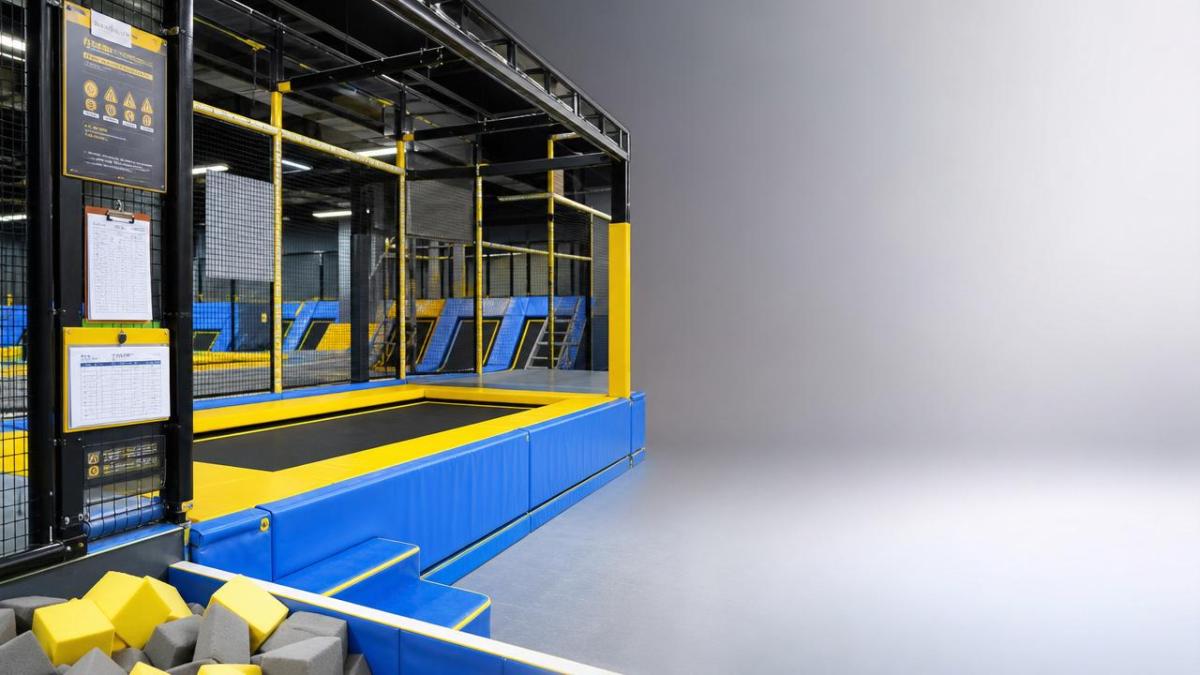
Inspect steel frames for corrosion, deformation, weld quality concerns, loose fasteners, and evidence of repetitive stress. Examine jump mats for uneven wear, fraying, and reduced rebound consistency. Check springs and connectors for fatigue, rust, elongation, or mismatched replacement parts. Padding should be reviewed for compression loss, torn covers, exposed edges, and shifting positions that can reduce impact protection.
High-risk transition zones deserve extra attention. These include landing areas, dodgeball sections, wall interfaces, elevated platforms, foam pit perimeters, and access points for children. In many facilities, these are the sections where usage intensity is highest and maintenance discipline is tested most clearly. A good inspection does not only note whether damage exists; it also assesses whether wear patterns suggest chronic underinvestment.
Why maintenance records now carry more weight than visual appearance
A clean facility can still be a weak acquisition. For a trampoline park for sale, maintenance discipline is often the clearest predictor of future operating stability. Buyers should request daily, weekly, monthly, and annual inspection logs. These records should show what was checked, what defects were found, what actions were taken, who approved the work, and whether repairs were verified after completion.
Well-kept logs reveal more than compliance. They show management maturity. If recurring issues appear in the same zone without permanent correction, that suggests deeper structural or operational weakness. If parts were replaced too infrequently for the traffic level, budget stress may have delayed necessary upkeep. If logs are generic, duplicated, or incomplete, buyers should assume additional forensic review is needed.
From a procurement perspective, maintenance records also support post-acquisition planning. They help estimate near-term capital expenditure, staffing needs, spare-part priorities, and reopening risk if the park requires immediate corrective work after transfer.
Compliance, insurance, and legal exposure are becoming central valuation factors
One of the most significant changes in evaluating a trampoline park for sale is the growing importance of risk transfer and legal defensibility. Buyers should confirm whether the facility aligns with applicable local building codes, fire safety standards, occupancy limits, accessibility requirements, and amusement-related operating rules. Do not assume the existing operator’s license or business continuity means everything is compliant today.
Insurance is equally important. Review the current policy scope, premium trend, deductible levels, exclusions, incident reporting procedures, and historical claims. A park that has experienced repeated injury claims may face ongoing cost pressure even if its revenue looks healthy. Procurement teams should work closely with legal and insurance advisors to understand whether the risk profile is temporary, correctable, or structural.
Waiver processes, CCTV coverage, staff supervision protocols, signage quality, emergency response procedures, and accident documentation practices should also be checked. These operating controls influence both safety outcomes and the park’s ability to defend itself in disputes.
The business model behind the trampoline park for sale may be shifting
A technical inspection should be linked to demand trends. Many buyers once viewed a trampoline park for sale as a straightforward admissions business. Today, the model is often broader, combining birthday events, food service, group bookings, fitness programs, school partnerships, and hybrid family entertainment offerings. This shift changes what matters in due diligence.
For example, if event revenue is becoming more important, buyers should inspect party rooms, food preparation areas, visitor flow, queue management, and restroom capacity. If the venue depends heavily on younger children, then supervision design, low-height play elements, and parent waiting areas matter more. If the park plans to upgrade into a multi-attraction center, layout flexibility, ceiling clearance, electrical support, and reconfiguration cost become strategic considerations.
In other words, a trampoline park for sale should be judged not only by current earnings but by how well its physical and operational design fits the next phase of consumer demand.
Which stakeholders are most affected by inspection findings
Inspection results affect more than the buyer. Each finding can change the assumptions of finance teams, insurers, operating managers, and even landlords. Understanding this helps procurement teams frame a more accurate negotiation strategy.
How to judge future upgrade potential, not just current condition
The best acquisition decisions are forward-looking. A trampoline park for sale may be serviceable today but limited tomorrow. Buyers should examine whether the facility can support layout redesign, attraction refresh, digital booking integration, improved traffic circulation, or segmented use zones for different age groups. This is especially relevant in markets where families increasingly expect variety rather than a single core attraction.
Look at ceiling height, structural loading constraints, HVAC adequacy, lighting quality, storage space, reception flow, and power distribution. These practical factors influence whether the park can adapt cost-effectively. If a venue requires major structural work just to modernize the guest experience, the acquisition case may weaken even if the current ticket sales appear acceptable.
This is where a procurement-led review adds value. It connects engineering facts to strategic flexibility. That connection is often missed when a buyer focuses too heavily on seller enthusiasm or short-term revenue snapshots.
A practical inspection framework for decision-makers
To evaluate any trampoline park for sale with discipline, buyers should organize findings into five decision buckets: structural integrity, maintenance reliability, compliance status, operating efficiency, and upgrade potential. This framework helps teams compare multiple targets on a consistent basis and prevents one attractive feature from hiding several critical weaknesses.
A strong target will usually show traceable equipment history, clear operating controls, manageable insurance exposure, predictable maintenance routines, and a layout that supports future business adaptation. A weak target often shows the opposite: cosmetic presentation without technical depth, heavy wear in key zones, inconsistent records, and little flexibility for reinvestment.
If uncertainty remains, buyers should commission an independent technical inspection before final pricing. The cost of third-party validation is often small compared with the financial impact of underestimating repair scope, compliance gaps, or reopening delays.
Final judgment signals before moving forward
Before acquiring a trampoline park for sale, decision-makers should confirm several final questions. Are the safety and maintenance records complete enough to support confidence? Does the insurance and claims history align with the asking price? Are major components near the end of useful life? Can the facility match future entertainment demand, not just past performance? And can the operator prove disciplined control rather than rely on broad promises?
The market is rewarding buyers who inspect with more precision and less emotion. In this environment, the smartest acquisition strategy is to treat the park as an engineered operating asset with measurable risk, not simply a recreational venue with attractive branding. If your team wants to judge whether a specific trampoline park for sale truly fits your investment or sourcing goals, focus first on the facts that can be verified: condition, compliance, records, liability, and adaptability.
Search News
Hot Articles
- Carbon Fiber StructuresHow to Specify Aerospace Carbon Fiber Assemblies for Lightweight, Load-Bearing PartsJul 11, 2026
- Machine VisionXiaomi, Alibaba DAMO Academy Drive Open-Source Robotics Model Ecosystem, Lowering Algorithm Development Barriers for Overseas SMEs Adopting Chinese Robotics SolutionsMar 30, 2026
- Cobots & ArmsShanxi 'AI+' Conference Showcases Embodied Intelligence with Multinational Buyer Engagement: Key Industry ImplicationsMar 30, 2026
Popular Tags
Recommended News
 Jul 11, 2026How to Specify Aerospace Carbon Fiber Assemblies for Lightweight, Load-Bearing PartsAerospace carbon fiber assemblies: learn how to specify laminate design, load data, joining methods, and inspection controls for lighter, reliable load-bearing aerospace parts.Elena Rostova (UAV Systems Researcher)
 Mar 30, 2026Xiaomi, Alibaba DAMO Academy Drive Open-Source Robotics Model Ecosystem, Lowering Algorithm Development Barriers for Overseas SMEs Adopting Chinese Robotics SolutionsXiaomi & Alibaba DAMO Academy's open-source robotics models lower algorithm barriers for global SMEs. Boost efficiency in manufacturing, logistics & smart retail with ROS 2 compatible solutions.TSV Data Lab
 Mar 30, 2026Shanxi 'AI+' Conference Showcases Embodied Intelligence with Multinational Buyer Engagement: Key Industry ImplicationsShanxi 'AI+' Conference highlights embodied intelligence with Tesla, Ubtech & Jiantao showcasing multimodal robotics. 40+ global buyers validated tech on-site, creating new B2B channels for industrial automation & AI solutions.Chen Wei (Automation Lead Engineer)
 Mar 30, 2026Zhongguancun Unveils 6G Integrated Sensing-Computing-Intelligence Platform to Empower Embodied Robots for Global Industrial ApplicationsZhongguancun's new 6G platform revolutionizes industrial robotics with <10ms latency, empowering global automotive, logistics & port automation. Discover how this tech boosts China's smart manufacturing exports.TSV Data Lab
 Mar 30, 2026Mech-Mind Tianjin Embodied Intelligence R&D and Production Base Goes Live, Cutting Delivery Time by 20%–30% for Global Customized AMR+Vision SolutionsMech-Mind's Tianjin AMR+Vision production base cuts delivery time by 20%-30% for欧美 & Latin American markets. Discover how this PLd-certified facility accelerates customized robotics solutions for smart manufacturing and logistics.Chen Wei (Automation Lead Engineer)
 Mar 30, 2026Boao Forum Reveals 'Co-evolution of Big and Small Brains' Trend in Humanoid Robots, China's Embodied Intelligence Accelerates Adaptation to Overseas Manufacturing Service ScenariosDiscover how China's humanoid robots, featuring 'Co-evolution of Big and Small Brains,' are revolutionizing global manufacturing. Learn about Embodied Tian Gong 3.0's ISO compliance and overseas deployment at Boao Forum 2026.Chen Wei (Automation Lead Engineer)
 Mar 30, 2026China Railway Industrial Secures Patent for Embodied Robotics in Material Handling, Boosting High-Precision Delivery Capabilities for Overseas Infrastructure and Manufacturing ProjectsChina Railway Industrial's new patent for embodied robotics in material handling boosts high-precision delivery for global infrastructure & manufacturing. Discover how this innovation enhances logistics accuracy in automotive, rail transit & EPC projects.Chen Wei (Automation Lead Engineer)
 Sep 28, 2026Spindle Runout Measurement in Germany: DIN Standards, Methods, and Acceptance LimitsSpindle runout measurement Germany: explore DIN standards, proven methods, acceptance limits, and audit-ready practices for reliable machining quality.Dr. Marcus Vance
 Sep 27, 2026How to Select Wall-Mount Edge Devices for Space-Constrained Factory NetworksWall mount edge devices for space-constrained factories: evaluate workload, thermal design, power resilience, cable access, and network reliability for smarter deployments.TSV Data Lab
 Sep 26, 2026Machining Tolerance Analysis: How to Set Limits That Meet Function and Cost TargetsMachining tolerance analysis: learn how to set functional limits, control tolerance stacks, reduce inspection risk, and balance precision with production cost.Dr. Marcus Vance
 Sep 25, 2026How to Evaluate an Industrial Infrastructure Data Platform for Multi-Site OperationsIndustrial infrastructure data platform evaluation guide for multi-site operations: compare data quality, edge resilience, interoperability, governance, and scalable proof-of-value criteria.Victor Lin (Chief Software Architect)
 Sep 24, 2026How to Select Machine Vision Optics for Accurate Inspection at Different Working DistancesMachine vision optics selection guide for accurate inspection at every working distance. Compare FOV, pixel scale, DOF, distortion, lighting, and telecentric options.TSV Data Lab
 Sep 23, 2026How to Evaluate a Machine Vision System Integrator for High-Speed Inspection LinesChoose a machine vision system integrator with proven expertise in high-speed inspection, reliable reject timing, robust optics, and measurable acceptance criteria.TSV Data Lab
 Sep 28, 2026When is a SCADA API the right choice for connecting plant systems?SCADA API guide: learn when governed plant data integration improves traceability, security, and scalability—without compromising real-time control.Victor Lin (Chief Software Architect)
 Sep 27, 2026How SCADA data integration improves traceability across production linesSCADA data integration connects production-line data to improve traceability, accelerate quality investigations, and strengthen safety decisions.Victor Lin (Chief Software Architect)
 Sep 26, 2026What to define before starting SCADA integration planningSCADA integration planning starts with clear scope, control boundaries, data models, cybersecurity, and testing. Discover the definitions that reduce risk and costly rework.Victor Lin (Chief Software Architect)
 Sep 25, 2026How a smart factory with Industrial IoT reduces production blind spotsDiscover how a smart factory with Industrial IoT turns real-time machine, quality, and workflow data into actionable insights that reduce production blind spots and delivery risks.Victor Lin (Chief Software Architect)
 Sep 24, 2026When does Industrial IoT make smart manufacturing easier to scale?Smart manufacturing Industrial IoT scales when trusted data, interoperable systems, and secure workflows turn connected assets into measurable gains.TSV Data Lab
 Sep 23, 2026What drives ultra-precision machining cost at 1-micron tolerance?Ultra precision machining cost per part at 1 micron tolerance depends on process, material, metrology, and yield. Learn how to compare quotes confidently.Dr. Marcus Vance
 Sep 22, 2026Drone Engine-T550CC Applications: Build the UAV Power System Around the MissionAn application guide for Drone Engine-T550CC integration, covering payload planning, airframe matching, cooling, fuel, vibration, test procedures, documentation, and service preparation.Elena Rostova (UAV Systems Researcher)
 Sep 22, 2026How to Evaluate Industrial Edge Computing Vendors for Factory DeploymentIndustrial edge computing vendor evaluation guide for factories: compare latency, protocol fit, reliability, security, and lifecycle support before deployment.TSV Data Lab
 Sep 21, 2026Drone Payload Integration: Matching Power, Data, and Center of Gravity for Reliable FlightsDrone payload integration made practical: balance power, data, center of gravity, and endurance to build safer, more reliable mission-ready flights.Elena Rostova (UAV Systems Researcher)
 Sep 20, 2026Autonomous Navigation Pricing: Cost Drivers and Budget Benchmarks for AMR ProjectsAutonomous navigation price explained: compare AMR cost drivers, software, sensors, integration, safety, and lifecycle budgets to build a scalable project plan.Chen Wei (Automation Lead Engineer)
 Sep 19, 2026How to Scope Automation Integration Services for Multi-System Factory ProjectsAutomation integration services: learn how to scope multi-system factory projects with clear workflows, interface contracts, safety boundaries, and acceptance criteria.Victor Lin (Chief Software Architect)