Is white label ERP for manufacturing worth the cost
Publication Date
author
For finance approvers, the real question is not whether white label ERP for manufacturing supports production, but whether it improves margins with manageable risk.
In modern industry, ERP decisions affect planning accuracy, inventory discipline, supplier visibility, and reporting quality across the entire operating model.
That is why the cost debate around white label ERP for manufacturing should be framed through measurable outcomes, not branding alone.
What white label ERP for manufacturing means
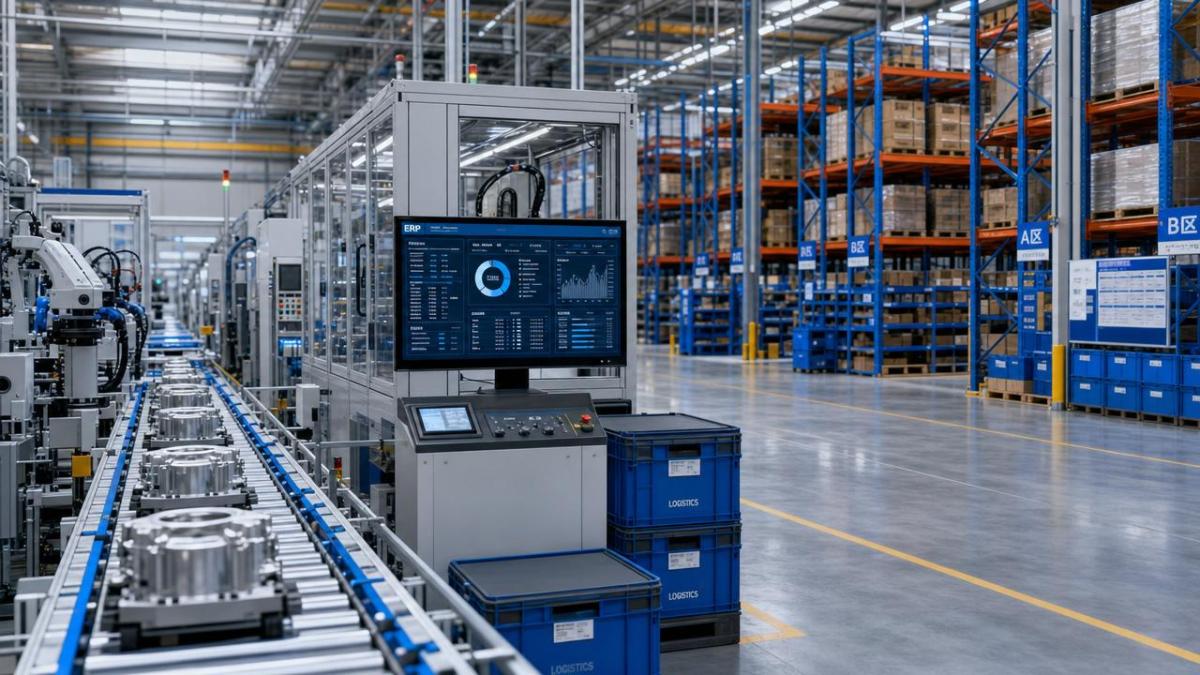
White label ERP for manufacturing is a production management platform developed by one provider and rebranded by another business.
The underlying software may include modules for production scheduling, procurement, quality control, warehouse management, finance, and maintenance.
The white label model changes presentation, service packaging, and sometimes workflow configuration, while the core architecture often remains shared.
For industrial operations, this model can reduce time to market compared with building ERP software from scratch.
However, cost value depends on customization depth, data structure, integration quality, and long-term governance.
Industry context shaping ERP investment decisions
Manufacturing is now driven by tighter traceability demands, shorter lead times, and more volatile supply conditions.
At the same time, engineering teams require cleaner operational data to support automation, edge analytics, and quality benchmarking.
This aligns with the TechStat Vanguard view that decisions should be grounded in parameters, process discipline, and verified performance.
When evaluating white label ERP for manufacturing, several market signals matter more than headline license fees.
Where white label ERP for manufacturing creates value
The strongest case for white label ERP for manufacturing appears when speed, structure, and service flexibility matter more than owning a unique code base.
Its value should be measured across operational and financial dimensions, not software appearance.
1. Faster deployment
A mature platform can shorten implementation timelines because core modules already exist and have prior deployment history.
That can lower project uncertainty, especially when standard production workflows match most business requirements.
2. Lower initial development cost
Building a manufacturing ERP internally often demands major spending on developers, testers, infrastructure, and security maintenance.
A white label ERP for manufacturing can avoid that burden, shifting investment toward configuration and adoption.
3. Better process standardization
Many industrial businesses struggle with inconsistent routing, bill of materials control, and inventory transaction discipline.
Standard ERP logic can improve process consistency across planning, purchasing, production, and accounting.
4. Scalable reporting visibility
When data is centralized, cycle times, scrap trends, stock turns, and order status become easier to monitor.
This supports the TSV principle that engineering truth starts with reliable data rather than unsupported claims.
Cost factors that determine whether it is worth it
The total cost of white label ERP for manufacturing extends far beyond subscription pricing.
A realistic review should include direct, indirect, and hidden cost categories.
- License or subscription fees
- Implementation and workflow configuration
- Data migration from legacy systems
- Integration with MES, WMS, CRM, or IoT tools
- User training and change management
- Support, upgrades, and vendor responsiveness
- Custom reporting and compliance adjustments
In many cases, customization is the biggest cost multiplier.
If the business needs highly specific routing logic, serial traceability, or advanced quality checkpoints, costs can rise sharply.
That does not automatically make white label ERP for manufacturing poor value.
It simply means the approval decision should compare customization cost against process savings and risk reduction.
Typical scenarios where the investment makes sense
Not every operating environment benefits equally from a white label approach.
The following scenarios often show the clearest return profile.
When white label ERP for manufacturing may not justify the cost
There are also conditions where the economics become less attractive.
- Process complexity is so unique that deep customization replaces most standard functionality.
- Operational data is too inconsistent for reliable migration.
- Existing systems already meet most planning and control needs.
- Internal teams are not ready to maintain governance after launch.
- The rebranding partner lacks strong technical support depth.
In such cases, the software may still function, but payback periods can stretch beyond expectations.
The issue is rarely the concept of white label ERP for manufacturing itself.
The issue is mismatch between platform design and operational reality.
Practical evaluation criteria before approval
A disciplined approval process should test value with evidence, not sales positioning.
- Map current pain points to measurable KPIs such as scrap, lead time, inventory variance, and on-time delivery.
- Separate must-have workflows from optional preferences.
- Request a detailed integration scope with ownership boundaries.
- Validate upgrade policies for custom functions.
- Estimate total cost of ownership over three to five years.
- Run a pilot using real production data, not generic demonstrations.
This is especially important in advanced manufacturing environments where machine connectivity and traceability standards are non-negotiable.
TSV’s broader framework is useful here: benchmark claims against operational parameters, tolerance requirements, and documented performance.
Final assessment and next step
So, is white label ERP for manufacturing worth the cost?
In many industrial settings, yes, if the platform fits real workflows, integration is planned carefully, and governance remains strong after deployment.
The strongest returns usually come from reduced manual errors, faster reporting, tighter inventory control, and better supplier coordination.
The weakest outcomes appear when branding hides limitations in data structure, support quality, or customization durability.
A practical next step is to build a short decision matrix for white label ERP for manufacturing using cost, risk, scalability, and operational fit.
Then compare each option against hard metrics, implementation evidence, and long-term maintainability before committing capital.
In manufacturing, worthwhile software is not defined by label value.
It is defined by whether data quality, process control, and financial performance improve together.
Search News
Hot Articles
- Carbon Fiber StructuresHow to Specify Aerospace Carbon Fiber Assemblies for Lightweight, Load-Bearing PartsJul 11, 2026
- Machine VisionXiaomi, Alibaba DAMO Academy Drive Open-Source Robotics Model Ecosystem, Lowering Algorithm Development Barriers for Overseas SMEs Adopting Chinese Robotics SolutionsMar 30, 2026
- Cobots & ArmsShanxi 'AI+' Conference Showcases Embodied Intelligence with Multinational Buyer Engagement: Key Industry ImplicationsMar 30, 2026
Popular Tags
Recommended News
 Jul 11, 2026How to Specify Aerospace Carbon Fiber Assemblies for Lightweight, Load-Bearing PartsAerospace carbon fiber assemblies: learn how to specify laminate design, load data, joining methods, and inspection controls for lighter, reliable load-bearing aerospace parts.Elena Rostova (UAV Systems Researcher)
 Mar 30, 2026Xiaomi, Alibaba DAMO Academy Drive Open-Source Robotics Model Ecosystem, Lowering Algorithm Development Barriers for Overseas SMEs Adopting Chinese Robotics SolutionsXiaomi & Alibaba DAMO Academy's open-source robotics models lower algorithm barriers for global SMEs. Boost efficiency in manufacturing, logistics & smart retail with ROS 2 compatible solutions.TSV Data Lab
 Mar 30, 2026Shanxi 'AI+' Conference Showcases Embodied Intelligence with Multinational Buyer Engagement: Key Industry ImplicationsShanxi 'AI+' Conference highlights embodied intelligence with Tesla, Ubtech & Jiantao showcasing multimodal robotics. 40+ global buyers validated tech on-site, creating new B2B channels for industrial automation & AI solutions.Chen Wei (Automation Lead Engineer)
 Mar 30, 2026Zhongguancun Unveils 6G Integrated Sensing-Computing-Intelligence Platform to Empower Embodied Robots for Global Industrial ApplicationsZhongguancun's new 6G platform revolutionizes industrial robotics with <10ms latency, empowering global automotive, logistics & port automation. Discover how this tech boosts China's smart manufacturing exports.TSV Data Lab
 Mar 30, 2026Mech-Mind Tianjin Embodied Intelligence R&D and Production Base Goes Live, Cutting Delivery Time by 20%–30% for Global Customized AMR+Vision SolutionsMech-Mind's Tianjin AMR+Vision production base cuts delivery time by 20%-30% for欧美 & Latin American markets. Discover how this PLd-certified facility accelerates customized robotics solutions for smart manufacturing and logistics.Chen Wei (Automation Lead Engineer)
 Mar 30, 2026Boao Forum Reveals 'Co-evolution of Big and Small Brains' Trend in Humanoid Robots, China's Embodied Intelligence Accelerates Adaptation to Overseas Manufacturing Service ScenariosDiscover how China's humanoid robots, featuring 'Co-evolution of Big and Small Brains,' are revolutionizing global manufacturing. Learn about Embodied Tian Gong 3.0's ISO compliance and overseas deployment at Boao Forum 2026.Chen Wei (Automation Lead Engineer)
 Mar 30, 2026China Railway Industrial Secures Patent for Embodied Robotics in Material Handling, Boosting High-Precision Delivery Capabilities for Overseas Infrastructure and Manufacturing ProjectsChina Railway Industrial's new patent for embodied robotics in material handling boosts high-precision delivery for global infrastructure & manufacturing. Discover how this innovation enhances logistics accuracy in automotive, rail transit & EPC projects.Chen Wei (Automation Lead Engineer)
 Oct 08, 2026How to Machine Inconel 625 Blades Without Heat Cracks or Edge ChippingInconel 625 blade machining guide: prevent heat cracks, edge chipping, chatter, and work hardening with proven tooling, cooling, fixturing, and inspection strategies.Dr. Marcus Vance
 Oct 07, 2026How to Evaluate an HMI Panel Distributor for Industrial Automation ProjectsHMI panel distributor evaluation guide: verify technical compatibility, traceability, supply reliability, lifecycle support, and total cost for automation projects.Victor Lin (Chief Software Architect)
 Oct 06, 2026Navigation Fault Tolerance Standards for AMRs: What Safety Teams Must VerifyNavigation fault tolerance standards: learn what AMR safety teams must verify, from localization loss and sensor faults to stopping distance, safe restart, and site-specific validation.Chen Wei (Automation Lead Engineer)
 Oct 05, 2026Calculating Edge Computing Total Cost of Ownership Across Distributed SitesEdge computing ownership cost explained: calculate deployment, energy, connectivity, security, remote support, and refresh costs across distributed sites.TSV Data Lab
 Oct 04, 2026CAD/CAM Benchmarking in the GCC: What Manufacturers Should Ask a ConsultantCAD CAM benchmark consultant GCC guide: learn the key questions manufacturers should ask to validate post-processors, workflows, machine performance, and production risk.Victor Lin (Chief Software Architect)
 Oct 03, 2026Selecting Automotive Radar Sensor Modules for ADAS Range, Resolution, and IntegrationAutomotive radar sensor module selection guide for ADAS: compare range, resolution, field of view, latency, and integration to build safer, reliable vehicle systems.TSV Data Lab
 Oct 02, 2026How to Qualify Machined Parts Suppliers for Hard Tech ProgramsHard tech supply chain machined parts demand rigorous supplier qualification. Learn how to assess capability, traceability, quality controls, and delivery resilience.Dr. Marcus Vance
 Oct 01, 2026How to Select an Outdoor Security Radar Sensor for Perimeter Detection?Outdoor security radar sensor selection guide: compare range, accuracy, false-alarm control, integration, and field testing for reliable perimeter detection.TSV Data Lab
 Sep 30, 2026How to Evaluate Solid-State LiDAR Hardware for Outdoor Autonomous VehiclesSolid state LiDAR hardware evaluation guide for outdoor autonomous vehicles—compare range, point-cloud quality, environmental resilience, integration, and safety.TSV Data Lab
 Sep 29, 2026ISO 9283 Repeatability: How to Evaluate Cobot Positioning PerformanceISO 9283 cobot repeatability explained: learn how payload, reach, approach direction, and test conditions affect positioning performance and cell capability.Chen Wei (Automation Lead Engineer)
 Oct 08, 2026AGV vs. AMR: Which Is Better for Frequently Changing Routes?Which is better for changing routes? Compare AGVs and AMRs for flexible navigation, docking precision, traffic control, and faster facility reconfiguration.Chen Wei (Automation Lead Engineer)
 Oct 07, 2026How Much Does an Automated Guided Vehicle Cost in 2026?How much does an automated guided vehicle cost in 2026? Explore AGV price ranges, hidden deployment costs, and smart buying factors for stronger ROI.Chen Wei (Automation Lead Engineer)
 Oct 06, 2026Are Collaborative Robots Safe Enough to Operate Without Fencing?Are collaborative robots safe enough to work without fencing? Explore risk assessment, safeguarding options, and practical guidance for safer, productive cobot cells.Chen Wei (Automation Lead Engineer)
 Oct 05, 2026What Causes Machine Vision Systems to Miss Small Defects?What causes machine vision systems to miss small defects? Discover how lighting, optics, motion, and AI thresholds affect detection—and prevent costly escapes.TSV Data Lab
 Oct 04, 2026How Should You Compare 5-Axis CNC Machine Accuracy Claims?How do I compare 5-axis CNC machine accuracy claims? Learn how to assess standards, thermal stability, TCP accuracy, and real-world test evidence.Dr. Marcus Vance
 Oct 03, 2026Is Edge Computing Necessary for Real-Time Quality Inspection?Is industrial edge computing necessary for real-time quality inspection? Explore how latency, data volume, reliability, and control integration shape the right architecture.TSV Data Lab
 Oct 02, 2026What Documents Prove a Precision Machining Supplier Can Hold Tolerance?What documents prove a precision machining supplier can hold tolerance? Explore certificates, FAI reports, calibration, SPC, and traceability evidence to qualify suppliers with confidence.Dr. Marcus Vance