Industrial cobot manufacturer China: what affects lead time most?
Publication Date
author
For distributors, agents, and sourcing partners evaluating an industrial cobot manufacturer China, lead time is rarely a simple “factory speed” issue. In most real projects, the biggest drivers are configuration complexity, critical component availability, production scheduling discipline, certification requirements, and export execution. The practical takeaway is clear: the supplier with the shortest quoted lead time is not always the supplier with the shortest real lead time.
For channel partners, this matters directly to margin protection, project delivery confidence, and after-sales reputation. If you promise a customer an eight-week arrival and the shipment slips to fourteen, the problem is no longer procurement alone. It becomes a commercial risk affecting trust, service planning, cash flow, and future reorder probability.
When assessing an industrial cobot manufacturer China, the better question is not “What is your standard lead time?” but “Which specific variables usually extend your lead time, and how do you control them?” This article breaks down those variables in a decision-oriented way so distributors and sourcing intermediaries can evaluate suppliers based on execution reality rather than generic sales claims.
What search intent is really behind this topic?
The core search intent behind “industrial cobot manufacturer China: what affects lead time most?” is commercial and comparative. The reader is not looking for a basic definition of collaborative robots. They want to understand why delivery timing varies between suppliers, how to predict delay risk before placing an order, and which manufacturers are more dependable for channel business.
For distributors and agents, the concern is operational. They need to know whether lead time is driven mainly by actuator and controller supply, payload-specific customization, software integration, testing queues, compliance documentation, or international shipping constraints. They also want practical methods for qualifying an industrial cobot manufacturer China before committing to sample orders, regional representation, or volume agreements.
That means the most useful content is not broad industry background. What helps most is a clear ranking of delay factors, signals of supplier maturity, and a checklist for separating stable manufacturers from factories that only quote aggressively to win inquiries.
The short answer: the biggest lead-time factor is usually configuration depth, not simple assembly time
In most distributor-facing cobot projects, the single strongest lead-time driver is not final assembly. It is the depth of configuration required before the robot is ready to ship. A standard 6-axis collaborative arm with a stocked payload class, standard reach, common controller, and default teach pendant can often move through planning quickly. But once a project requires non-standard end-of-arm tooling compatibility, special voltage, software localization, custom I/O, vision integration, or modified safety logic, lead time expands fast.
This happens because each additional layer of customization touches multiple departments. Engineering must validate compatibility. Procurement must confirm parts. Production planning must adjust line slots. Quality teams may need additional verification records. Documentation teams may need custom manuals or region-specific labeling. What looks like a small customer request often triggers a chain of internal tasks.
For channel partners, this is important because many customer requirements are introduced informally during quoting. A buyer may ask for a different gripper package, a modified pedestal, or fieldbus compatibility “if possible.” These requests should never be treated as neutral details. In lead-time terms, they are often the real schedule drivers.
Component availability is the second major factor—and the riskiest one if the supplier lacks visibility
For any industrial cobot manufacturer China, stable delivery depends heavily on a few critical components rather than on the total bill of materials. Harmonic reducers, servo motors, encoders, controllers, safety-rated sensors, and certain industrial chips can all become bottlenecks. Even if 95% of the system is available, one constrained item can delay shipment by weeks.
The risk becomes higher when the manufacturer relies on a narrow vendor base or has weak inventory planning. Some factories quote based on ideal procurement assumptions rather than confirmed supply status. That approach creates a dangerous gap between quoted lead time and actual production readiness.
Distributors should therefore ask for more than a calendar number. Ask which components are single-source, which are safety-critical, and which historically cause schedule volatility. A mature supplier should be able to explain its buffer strategy, approved alternative parts policy, and how it handles shortages without compromising repeatability, safety, or regulatory consistency.
If a supplier cannot discuss component risk at this level, that is a stronger warning sign than a slightly longer quote. In channel business, predictability usually creates more value than nominal speed.
Production scheduling discipline often separates reliable manufacturers from optimistic ones
Two cobot factories may have similar products, similar headcount, and similar listed capacity, yet very different lead-time performance. The difference is often production scheduling discipline. Some manufacturers manage order intake, subassembly planning, testing windows, and shipment booking through a controlled system. Others still depend on ad hoc coordination between sales, procurement, and workshop supervisors.
Why does this matter? Because cobot orders for distributors are rarely isolated. A factory may be juggling OEM batches, domestic integrator orders, export samples, and customized projects at the same time. If the planning system is weak, urgent orders interrupt normal flow, test benches become overloaded, and promised shipping dates drift.
When evaluating an industrial cobot manufacturer China, ask how orders are prioritized and locked into schedule. Is there a formal production slot after deposit? How often are material readiness and assembly readiness reviewed? Are burn-in tests and final inspections capacity-constrained? These questions reveal whether the manufacturer is managing lead time as a process metric or treating it as a sales promise.
Certification and compliance work can quietly add weeks
Many buyers underestimate how much certification-related work can affect delivery. For export-focused cobots, the robot itself may already have baseline certification, but the final shipped configuration may still require additional checks. Differences in end effector package, guarding options, cable routing, voltage standards, labeling, manuals, or destination-market documentation can all add time.
For channel partners, this issue becomes especially relevant when serving customers in the EU, North America, or regulated industrial segments. If the customer expects a ready-to-deploy package, not just a bare robot arm, then conformity and documentation become part of lead time. Delays may come not from manufacturing, but from technical file completion, labeling revision, declaration paperwork, or third-party verification needs.
A dependable supplier should clearly distinguish between standard product lead time and market-ready configured lead time. If they do not separate those two, distributors may think they are buying an eight-week product when they are actually committing to a twelve-week deliverable.
Software, interface, and application support can be bigger schedule drivers than hardware
In collaborative robotics, hardware is only part of what the customer buys. The application environment often determines the real delivery timeline. If the end user requires PLC communication, machine vision handshaking, force-control tuning, palletizing templates, welding package adaptation, or remote diagnostics functions, software work may become the longest path.
This is where many sourcing discussions go wrong. A factory may technically have the cobot platform in stock, but if the project needs non-standard interface validation or application engineering support, shipment may wait until integration confidence is acceptable. Some suppliers are transparent about this. Others continue quoting hardware lead time even when application work is unresolved.
Distributors should therefore identify whether the customer is buying a standard cobot unit, a bundled workcell, or a semi-custom application package. Those are very different lead-time categories. A manufacturer that delivers quickly on standard units may still be slow on application-level execution if software engineering resources are limited.
Testing protocol and quality release standards matter more than fast assembly
Buyers often focus on how fast a factory can build a cobot, but for professional channel business, the more important question is how the unit is released. Repeatability checks, joint calibration, controller verification, communication tests, safety function validation, and burn-in procedures all take time. Strong manufacturers do not skip these steps simply to protect a ship date.
This creates an important tradeoff. A supplier that quotes unusually short lead times may be doing one of three things: shipping only the most standard SKUs, carrying high finished inventory, or compressing test and validation steps. The first two can be acceptable if clearly explained. The third is dangerous because it transfers risk downstream to the distributor and end user.
For this reason, a sourcing partner should ask for the release sequence. What tests are done before packing? Which records can be shared? How are safety functions verified? Can the supplier provide FAT-style evidence for larger orders? These questions not only protect quality; they also clarify whether quoted lead time includes genuine readiness to deploy.
Export logistics are not the biggest factor—but they become critical when everything else is already tight
International shipping is often blamed for delays, but in many cobot transactions it is not the main root cause. Ocean transit, customs processing, and inland delivery are relatively manageable when the factory finishes on time and documents are correct. The problem is that logistics become highly visible when upstream manufacturing has already consumed schedule buffer.
For example, if a supplier completes production three weeks later than promised, even normal vessel booking delays suddenly become business-critical. Air shipment may protect the schedule, but at the cost of distributor margin. In this way, logistics are often the final amplifier of an earlier manufacturing problem.
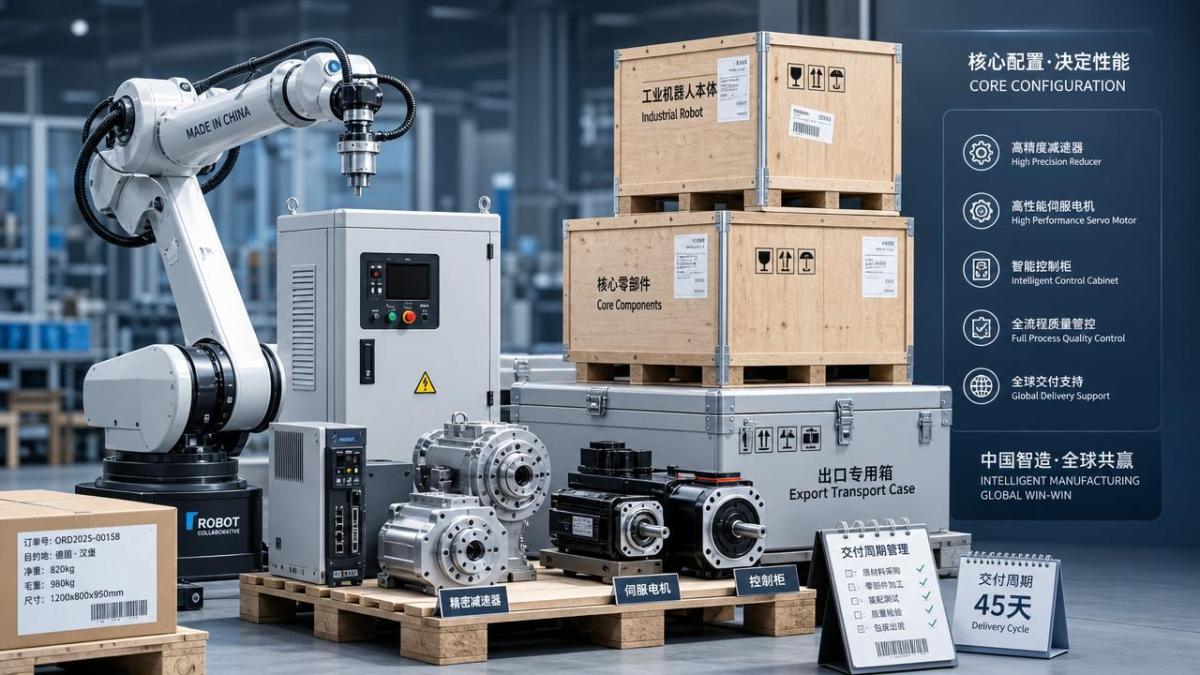
Still, logistics capability matters. A strong industrial cobot manufacturer China should be able to prepare export packaging suited to precision equipment, provide complete HS code and customs data, support destination documentation, and coordinate with forwarders efficiently. Distributors should not treat this as a minor back-office issue. Poor export execution can erase the benefit of otherwise good factory performance.
How distributors should evaluate lead-time reliability before placing orders
The most effective way to evaluate lead time is to break it into stages and request evidence for each stage. Instead of accepting one total number, ask for order confirmation time, material readiness time, assembly duration, testing duration, packaging duration, and export handover duration. This reveals where the supplier truly has control and where uncertainty remains.
It is also useful to ask for three versions of lead time: standard model lead time, configured model lead time, and repeat order lead time. A serious manufacturer can usually differentiate these. If every answer is the same, the quote may be more commercial than operational.
Another valuable tactic is to ask what caused the last five delayed shipments. Not in theory, but in reality. Was it reducers, servo inventory, software debugging, certification paperwork, or shipping booking? A supplier that tracks delay root causes is usually more capable of preventing them.
For agents and distributors, one more question is essential: can the supplier reserve capacity for channel partners? If you intend to build local market demand, you need to know whether forecast-based planning, safety stock, or framework agreements are possible. Otherwise, your growth may outpace the factory’s willingness to prioritize you.
Red flags that suggest quoted lead time may not be credible
Several warning signs appear frequently in the market. The first is when a manufacturer gives a very short lead time without first clarifying payload class, reach, controller version, export destination, or application package. That usually means the quote is generic.
The second red flag is when sales staff cannot explain whether key components are stocked, allocated after deposit, or purchased per order. The third is when “customization” is described as easy, but no engineering review process is visible. The fourth is when quality release steps are vague or undocumented. The fifth is when export documentation is treated as something arranged only after production finishes.
For sourcing intermediaries, these signals matter because the cost of being wrong is high. A delayed cobot order can trigger installation rescheduling, technician idle time, payment disputes, and damage to local market credibility. In distribution, lead-time failure is not just a factory issue. It becomes your issue.
What a strong industrial cobot manufacturer China should be able to prove
A credible supplier should be able to show more than a product catalog. At minimum, they should demonstrate BOM control for key components, a structured production planning system, documented testing and calibration procedures, clear certification scope, and export readiness. Ideally, they should also provide historical delivery performance data by product type.
For channel partnerships, the strongest manufacturers usually share realistic lead-time bands instead of one absolute number. They explain what is standard, what is configurable, what needs engineering review, and what conditions trigger schedule changes. This kind of transparency is a positive sign, not a weakness. It indicates process maturity.
In practice, distributors often benefit more from a supplier who consistently delivers in ten weeks than from one who advertises six weeks but lands at twelve. Reliability supports forecasting, customer communication, and after-sales planning. In most markets, those advantages are worth more than an aggressive initial promise.
Conclusion: ask which variable controls the schedule, not just how many weeks are quoted
When evaluating an industrial cobot manufacturer China, the most important insight is that lead time is usually shaped by a small number of high-impact variables: configuration depth, critical component availability, scheduling discipline, certification scope, software and integration demands, testing rigor, and export execution. The factory that manages these variables transparently is usually the safer long-term partner.
For distributors, agents, and sourcing partners, the goal is not simply to find the fastest quote. It is to find the manufacturer whose quoted lead time survives contact with real engineering, real procurement constraints, and real export conditions. That is what protects margin, delivery credibility, and channel reputation.
In short, if you want better sourcing outcomes, stop asking only “How fast can you ship?” Start asking “Which exact factors could delay this cobot order, and how do you control each one?” The answer to that question will tell you far more about supplier quality than any brochure ever will.
Search News
Hot Articles
- Carbon Fiber StructuresHow to Specify Aerospace Carbon Fiber Assemblies for Lightweight, Load-Bearing PartsJul 11, 2026
- Machine VisionXiaomi, Alibaba DAMO Academy Drive Open-Source Robotics Model Ecosystem, Lowering Algorithm Development Barriers for Overseas SMEs Adopting Chinese Robotics SolutionsMar 30, 2026
- Cobots & ArmsShanxi 'AI+' Conference Showcases Embodied Intelligence with Multinational Buyer Engagement: Key Industry ImplicationsMar 30, 2026
Popular Tags
Recommended News
 Jul 11, 2026How to Specify Aerospace Carbon Fiber Assemblies for Lightweight, Load-Bearing PartsAerospace carbon fiber assemblies: learn how to specify laminate design, load data, joining methods, and inspection controls for lighter, reliable load-bearing aerospace parts.Elena Rostova (UAV Systems Researcher)
 Mar 30, 2026Xiaomi, Alibaba DAMO Academy Drive Open-Source Robotics Model Ecosystem, Lowering Algorithm Development Barriers for Overseas SMEs Adopting Chinese Robotics SolutionsXiaomi & Alibaba DAMO Academy's open-source robotics models lower algorithm barriers for global SMEs. Boost efficiency in manufacturing, logistics & smart retail with ROS 2 compatible solutions.TSV Data Lab
 Mar 30, 2026Shanxi 'AI+' Conference Showcases Embodied Intelligence with Multinational Buyer Engagement: Key Industry ImplicationsShanxi 'AI+' Conference highlights embodied intelligence with Tesla, Ubtech & Jiantao showcasing multimodal robotics. 40+ global buyers validated tech on-site, creating new B2B channels for industrial automation & AI solutions.Chen Wei (Automation Lead Engineer)
 Mar 30, 2026Zhongguancun Unveils 6G Integrated Sensing-Computing-Intelligence Platform to Empower Embodied Robots for Global Industrial ApplicationsZhongguancun's new 6G platform revolutionizes industrial robotics with <10ms latency, empowering global automotive, logistics & port automation. Discover how this tech boosts China's smart manufacturing exports.TSV Data Lab
 Mar 30, 2026Mech-Mind Tianjin Embodied Intelligence R&D and Production Base Goes Live, Cutting Delivery Time by 20%–30% for Global Customized AMR+Vision SolutionsMech-Mind's Tianjin AMR+Vision production base cuts delivery time by 20%-30% for欧美 & Latin American markets. Discover how this PLd-certified facility accelerates customized robotics solutions for smart manufacturing and logistics.Chen Wei (Automation Lead Engineer)
 Mar 30, 2026Boao Forum Reveals 'Co-evolution of Big and Small Brains' Trend in Humanoid Robots, China's Embodied Intelligence Accelerates Adaptation to Overseas Manufacturing Service ScenariosDiscover how China's humanoid robots, featuring 'Co-evolution of Big and Small Brains,' are revolutionizing global manufacturing. Learn about Embodied Tian Gong 3.0's ISO compliance and overseas deployment at Boao Forum 2026.Chen Wei (Automation Lead Engineer)
 Mar 30, 2026China Railway Industrial Secures Patent for Embodied Robotics in Material Handling, Boosting High-Precision Delivery Capabilities for Overseas Infrastructure and Manufacturing ProjectsChina Railway Industrial's new patent for embodied robotics in material handling boosts high-precision delivery for global infrastructure & manufacturing. Discover how this innovation enhances logistics accuracy in automotive, rail transit & EPC projects.Chen Wei (Automation Lead Engineer)
 Sep 29, 2026ISO 9283 Repeatability: How to Evaluate Cobot Positioning PerformanceISO 9283 cobot repeatability explained: learn how payload, reach, approach direction, and test conditions affect positioning performance and cell capability.Chen Wei (Automation Lead Engineer)
 Sep 28, 2026Spindle Runout Measurement in Germany: DIN Standards, Methods, and Acceptance LimitsSpindle runout measurement Germany: explore DIN standards, proven methods, acceptance limits, and audit-ready practices for reliable machining quality.Dr. Marcus Vance
 Sep 27, 2026How to Select Wall-Mount Edge Devices for Space-Constrained Factory NetworksWall mount edge devices for space-constrained factories: evaluate workload, thermal design, power resilience, cable access, and network reliability for smarter deployments.TSV Data Lab
 Sep 26, 2026Machining Tolerance Analysis: How to Set Limits That Meet Function and Cost TargetsMachining tolerance analysis: learn how to set functional limits, control tolerance stacks, reduce inspection risk, and balance precision with production cost.Dr. Marcus Vance
 Sep 25, 2026How to Evaluate an Industrial Infrastructure Data Platform for Multi-Site OperationsIndustrial infrastructure data platform evaluation guide for multi-site operations: compare data quality, edge resilience, interoperability, governance, and scalable proof-of-value criteria.Victor Lin (Chief Software Architect)
 Sep 24, 2026How to Select Machine Vision Optics for Accurate Inspection at Different Working DistancesMachine vision optics selection guide for accurate inspection at every working distance. Compare FOV, pixel scale, DOF, distortion, lighting, and telecentric options.TSV Data Lab
 Sep 23, 2026How to Evaluate a Machine Vision System Integrator for High-Speed Inspection LinesChoose a machine vision system integrator with proven expertise in high-speed inspection, reliable reject timing, robust optics, and measurable acceptance criteria.TSV Data Lab
 Sep 28, 2026When is a SCADA API the right choice for connecting plant systems?SCADA API guide: learn when governed plant data integration improves traceability, security, and scalability—without compromising real-time control.Victor Lin (Chief Software Architect)
 Sep 27, 2026How SCADA data integration improves traceability across production linesSCADA data integration connects production-line data to improve traceability, accelerate quality investigations, and strengthen safety decisions.Victor Lin (Chief Software Architect)
 Sep 26, 2026What to define before starting SCADA integration planningSCADA integration planning starts with clear scope, control boundaries, data models, cybersecurity, and testing. Discover the definitions that reduce risk and costly rework.Victor Lin (Chief Software Architect)
 Sep 25, 2026How a smart factory with Industrial IoT reduces production blind spotsDiscover how a smart factory with Industrial IoT turns real-time machine, quality, and workflow data into actionable insights that reduce production blind spots and delivery risks.Victor Lin (Chief Software Architect)
 Sep 24, 2026When does Industrial IoT make smart manufacturing easier to scale?Smart manufacturing Industrial IoT scales when trusted data, interoperable systems, and secure workflows turn connected assets into measurable gains.TSV Data Lab
 Sep 23, 2026What drives ultra-precision machining cost at 1-micron tolerance?Ultra precision machining cost per part at 1 micron tolerance depends on process, material, metrology, and yield. Learn how to compare quotes confidently.Dr. Marcus Vance
 Sep 22, 2026Drone Engine-T550CC Applications: Build the UAV Power System Around the MissionAn application guide for Drone Engine-T550CC integration, covering payload planning, airframe matching, cooling, fuel, vibration, test procedures, documentation, and service preparation.Elena Rostova (UAV Systems Researcher)
 Sep 22, 2026How to Evaluate Industrial Edge Computing Vendors for Factory DeploymentIndustrial edge computing vendor evaluation guide for factories: compare latency, protocol fit, reliability, security, and lifecycle support before deployment.TSV Data Lab
 Sep 21, 2026Drone Payload Integration: Matching Power, Data, and Center of Gravity for Reliable FlightsDrone payload integration made practical: balance power, data, center of gravity, and endurance to build safer, more reliable mission-ready flights.Elena Rostova (UAV Systems Researcher)
 Sep 20, 2026Autonomous Navigation Pricing: Cost Drivers and Budget Benchmarks for AMR ProjectsAutonomous navigation price explained: compare AMR cost drivers, software, sensors, integration, safety, and lifecycle budgets to build a scalable project plan.Chen Wei (Automation Lead Engineer)