How AGV AMR obstacle avoidance systems reduce safety stops
Publication Date
author
In fast-moving warehouses and production sites, unnecessary safety stops can erode throughput, strain workflows, and mask deeper navigation risks. This article explains how AGV AMR obstacle avoidance systems help quality and safety teams reduce false stops, improve route stability, and maintain protection standards through better sensor fusion, real-time decision logic, and measurable performance data.
For quality and safety teams, the central question is not whether obstacle avoidance matters. It is whether the system can distinguish real hazards from routine motion without compromising protective margins.
The short answer is yes, but only when the avoidance stack is engineered as a measurable safety-performance system rather than a marketing feature. Sensor quality, software logic, vehicle tuning, and site conditions all decide the result.
When AGV AMR obstacle avoidance systems are well designed, they reduce nuisance stops by improving object detection confidence, prediction accuracy, path planning stability, and speed control under dynamic conditions.
When they are poorly tuned, the opposite happens. Vehicles stop too often, operators lose trust, throughput drops, and true risks can become harder to identify because alarms and stops are no longer meaningful.
Why unnecessary safety stops are a quality and safety problem, not only an efficiency problem
Many operations first notice excessive stops as a productivity issue. Orders slow down, routes clog, and labor must repeatedly intervene. But from a quality and safety perspective, frequent false stops create deeper operational weaknesses.
First, repeated nuisance stopping conditions people to ignore alerts. If operators and supervisors see constant interruptions that do not correspond to real threats, response discipline can weaken during a genuine hazard event.
Second, unstable navigation often signals inconsistent environmental perception. A vehicle that overreacts to shadows, floor reflections, pallet overhangs, or crossing traffic may also struggle to classify edge cases correctly.
Third, excessive stopping can destabilize process flow. In tightly sequenced intralogistics systems, stop-and-go movement creates congestion, timing drift, and unexpected human workarounds that introduce additional safety exposure.
For quality control personnel, this makes obstacle avoidance a process capability issue. The goal is not simply fewer stops. The goal is fewer unjustified stops while preserving deterministic responses to actual obstacles.
How AGV AMR obstacle avoidance systems actually reduce false stops
High-performing AGV AMR obstacle avoidance systems reduce safety stops by making better decisions earlier. That depends on three linked capabilities: sensing the environment accurately, interpreting risk correctly, and selecting a stable motion response.
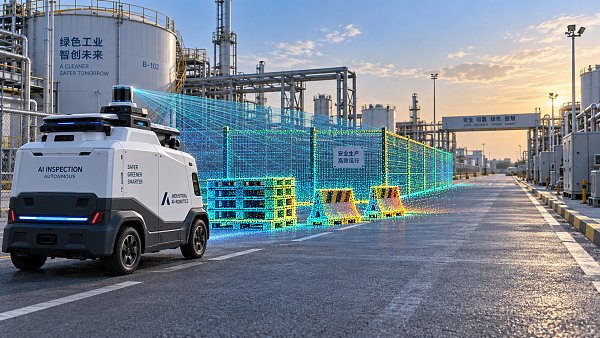
At the sensing level, modern platforms combine safety laser scanners, LiDAR, stereo or depth cameras, ultrasonic sensors, wheel encoders, and inertial measurement units. Each sensor covers different failure modes and environmental conditions.
Laser scanners provide reliable distance-based protective fields and remain central to certified safety functions. Cameras add classification context, helping the system separate a stationary rack leg from a person stepping into the lane.
Ultrasonic sensors can help in close-range detection of low-profile objects that may be difficult for some optical systems. Encoders and inertial inputs support motion estimation, which is necessary for accurate path prediction and braking control.
Sensor fusion is where much of the stop reduction happens. Instead of reacting to one uncertain signal, the controller compares multiple inputs over time and assigns confidence to what the vehicle is seeing.
If one sensor reports a possible obstacle but others do not confirm it, the system may slow slightly rather than trigger a full stop. If multiple sensors agree and the object trajectory indicates conflict, the vehicle escalates immediately.
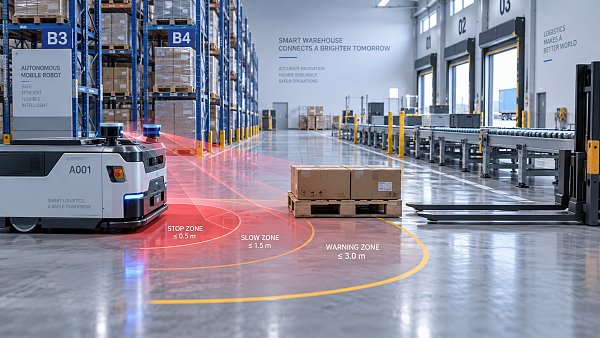
This layered logic reduces binary behavior. Rather than switching between full speed and full stop, the vehicle can apply graded responses such as speed reduction, local rerouting, or controlled pause with rapid restart.
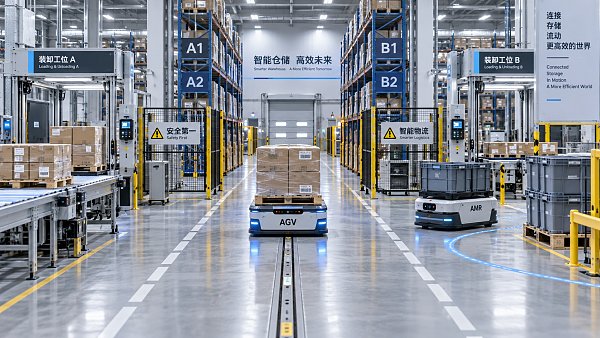
That matters in mixed environments. Warehouses and production floors contain people, forklifts, hanging wraps, partially protruding loads, reflective surfaces, and temporary obstructions. A rigid stop logic creates instability in such conditions.
What quality and safety managers should evaluate in the decision logic
Not all avoidance systems reduce stops in the same way. Some simply shrink sensitivity until interruptions decrease, which may create unacceptable exposure. A better system reduces stops by improving discrimination, not by lowering protection.
Start with object classification behavior. Can the platform distinguish humans, vehicles, static infrastructure, floor anomalies, and transient visual noise? Better classification usually means fewer unnecessary protective actions in normal traffic.
Next, review dynamic field control. Advanced systems do not rely on one fixed detection zone. They adjust safety and warning fields based on speed, direction, load state, turning radius, and local congestion.
This is crucial because stopping distance changes with payload and surface conditions. A vehicle should not carry the same protective behavior at low speed in a clear aisle as at higher speed approaching a busy intersection.
Trajectory prediction is another major differentiator. Mature systems estimate whether an obstacle is actually on a collision path rather than merely nearby. That distinction alone can eliminate many unnecessary stops.
For example, a person walking parallel to the vehicle may enter the sensing field without creating conflict. A basic system stops immediately. A smarter system slows, monitors separation, and continues if predicted paths remain clear.
Also evaluate restart logic. Some vehicles stop safely but resume poorly, requiring long confirmation cycles or manual recovery. Effective obstacle avoidance reduces total disruption by pairing safe stopping with stable autonomous restart behavior.
Which site conditions most often trigger unnecessary stops
Many false stops are not caused by poor hardware alone. They emerge from the interaction between sensors, vehicle settings, and real facility conditions. Quality and safety teams should inspect those conditions before blaming one component.
Floor reflectivity is a common issue. Glossy coatings, wet patches, metal debris, and shrink-wrap reflections can create ambiguous returns for optical sensors, especially when combined with low-angle lighting.
Load geometry is another factor. Overhanging cartons, dangling film, and inconsistent pallet profiles can enter sensor fields unexpectedly. If the vehicle model does not account for carried load dimensions accurately, stop frequency rises.
Traffic design matters as well. Intersections with mixed pedestrian and forklift flow, blind corners, and temporary staging zones create constant near-conflict situations. Even a strong avoidance system struggles when layout rules are weak.
Environmental contamination can further degrade performance. Dust, oil mist, vibration, and lens contamination reduce sensor confidence. In these cases, vehicles may shift toward conservative behavior and stop more often.
Finally, localization instability can look like obstacle avoidance failure. If the vehicle is uncertain about its own position, it may react conservatively to maintain safety margins, even when no true obstacle exists.
How to measure whether stop reduction is real and safe
For the target audience, marketing claims about “smarter navigation” are not enough. Evaluation should focus on measurable indicators that connect directly to safety integrity, route performance, and process stability.
Begin with stop taxonomy. Separate total stops into true hazard stops, caution slowdowns, localization-related pauses, route-blockage stops, and false-positive obstacle stops. Without this breakdown, improvement claims are difficult to verify.
Track false stop rate per operating hour and per kilometer traveled. This helps normalize performance across shifts, routes, and vehicle fleets. Pair it with mean delay time caused by each stop category.
Review intervention metrics too. Measure how often operators must manually clear faults, approve restarts, or physically inspect the route. A good avoidance system should reduce not just stops, but manual dependency.
Safety performance must remain visible. Monitor near-miss reports, protective field intrusions, emergency stop events, braking margin compliance, and obstacle detection reliability across defined test objects and approach scenarios.
Testing should include representative edge cases: low-profile objects, reflective materials, crossing pedestrians, fast-moving forklifts, overhanging loads, partial occlusions, and varying light conditions. Lab success alone is insufficient.
For procurement or qualification, request benchmark evidence with test speed, payload, floor type, lighting condition, and obstacle class clearly documented. Parameters without test context provide limited decision value.
What a strong implementation process looks like
Even capable AGV AMR obstacle avoidance systems underperform when deployment is rushed. The strongest results come from phased validation that aligns safety engineering, route design, and operational behavior before full-scale rollout.
First, map stop hotspots by route segment. Identify where nuisance stops cluster and classify likely causes: reflective surfaces, congested merges, pallet variance, weak localization markers, or uncontrolled pedestrian behavior.
Second, validate sensor placement and maintenance access. Small installation issues such as vibration, contamination exposure, or partial occlusion can distort perception and trigger conservative stopping behavior.
Third, tune detection fields and speed profiles together. Lower speed alone is not a universal fix. In some lanes, better path smoothing and controlled deceleration reduce stop frequency more effectively than simply slowing the vehicle.
Fourth, run acceptance tests under live operational conditions rather than empty-floor demonstrations. Mixed traffic and production variability reveal the practical difference between nominal performance and reliable field performance.
Fifth, establish a change-control process. Layout adjustments, new packaging formats, seasonal lighting changes, and software updates can all affect obstacle behavior. Ongoing validation is necessary to maintain stop performance.
Common mistakes when evaluating vendors or internal solutions
One common mistake is prioritizing average navigation speed without examining stop quality. A vehicle that moves quickly in clean demos may still underperform in real operations if its perception confidence collapses in clutter.
Another mistake is treating all sensors as interchangeable. The practical value lies not only in sensor count, but in detection range, resolution, refresh rate, environmental robustness, and the quality of fusion logic.
Teams also sometimes accept vague claims such as “AI-powered avoidance” without asking how decisions are bounded, validated, and monitored. For safety-related movement, explainability and test traceability matter more than buzzwords.
It is equally risky to focus only on certified stopping hardware while ignoring the upstream logic that determines when slowdown, reroute, or stop commands are issued. Operational performance depends on the whole stack.
Finally, some organizations overlook the human side. Pedestrian discipline, lane marking, forklift rules, and exception handling procedures influence stop outcomes as much as onboard technology does.
Where the business value becomes visible for safety and quality teams
When obstacle avoidance is engineered well, the benefits extend beyond fewer interruptions. Safety managers gain clearer signal quality because alerts and stops correspond more closely to genuine risk conditions.
Quality teams benefit from more stable material flow, fewer process disruptions, and better repeatability in time-sensitive internal logistics. This supports more predictable production behavior and fewer hidden workarounds.
Maintenance teams spend less time on avoidable resets and route checks. Operations teams gain smoother traffic flow and reduced congestion at intersections and handoff points. Procurement teams gain clearer specifications for future scaling.
Most importantly, improved stop quality builds trust. Operators, supervisors, and auditors can see that the system is neither reckless nor overly reactive. It protects correctly and behaves consistently under real plant conditions.
Conclusion: reducing safety stops requires better judgment, not weaker safety
For quality control and safety management professionals, the right conclusion is straightforward. AGV AMR obstacle avoidance systems reduce unnecessary safety stops only when they improve perception certainty and motion decisions without eroding protective margins.
That means evaluating more than vendor claims. Look at sensor fusion, dynamic field control, trajectory prediction, restart behavior, route conditions, and measurable false-stop performance under realistic operating scenarios.
If those elements are engineered and validated properly, fewer stops do not mean less safety. They mean better safety execution, stronger process stability, and a more trustworthy autonomous transport system.
In practical terms, the best AGV AMR obstacle avoidance systems are not the ones that stop the most or the least. They are the ones that stop for the right reasons, at the right time, with repeatable and auditable performance.
Search News
Hot Articles
- Carbon Fiber StructuresHow to Specify Aerospace Carbon Fiber Assemblies for Lightweight, Load-Bearing PartsJul 11, 2026
- Machine VisionXiaomi, Alibaba DAMO Academy Drive Open-Source Robotics Model Ecosystem, Lowering Algorithm Development Barriers for Overseas SMEs Adopting Chinese Robotics SolutionsMar 30, 2026
- Cobots & ArmsShanxi 'AI+' Conference Showcases Embodied Intelligence with Multinational Buyer Engagement: Key Industry ImplicationsMar 30, 2026
Popular Tags
Recommended News
 Jul 11, 2026How to Specify Aerospace Carbon Fiber Assemblies for Lightweight, Load-Bearing PartsAerospace carbon fiber assemblies: learn how to specify laminate design, load data, joining methods, and inspection controls for lighter, reliable load-bearing aerospace parts.Elena Rostova (UAV Systems Researcher)
 Mar 30, 2026Xiaomi, Alibaba DAMO Academy Drive Open-Source Robotics Model Ecosystem, Lowering Algorithm Development Barriers for Overseas SMEs Adopting Chinese Robotics SolutionsXiaomi & Alibaba DAMO Academy's open-source robotics models lower algorithm barriers for global SMEs. Boost efficiency in manufacturing, logistics & smart retail with ROS 2 compatible solutions.TSV Data Lab
 Mar 30, 2026Shanxi 'AI+' Conference Showcases Embodied Intelligence with Multinational Buyer Engagement: Key Industry ImplicationsShanxi 'AI+' Conference highlights embodied intelligence with Tesla, Ubtech & Jiantao showcasing multimodal robotics. 40+ global buyers validated tech on-site, creating new B2B channels for industrial automation & AI solutions.Chen Wei (Automation Lead Engineer)
 Mar 30, 2026Zhongguancun Unveils 6G Integrated Sensing-Computing-Intelligence Platform to Empower Embodied Robots for Global Industrial ApplicationsZhongguancun's new 6G platform revolutionizes industrial robotics with <10ms latency, empowering global automotive, logistics & port automation. Discover how this tech boosts China's smart manufacturing exports.TSV Data Lab
 Mar 30, 2026Mech-Mind Tianjin Embodied Intelligence R&D and Production Base Goes Live, Cutting Delivery Time by 20%–30% for Global Customized AMR+Vision SolutionsMech-Mind's Tianjin AMR+Vision production base cuts delivery time by 20%-30% for欧美 & Latin American markets. Discover how this PLd-certified facility accelerates customized robotics solutions for smart manufacturing and logistics.Chen Wei (Automation Lead Engineer)
 Mar 30, 2026Boao Forum Reveals 'Co-evolution of Big and Small Brains' Trend in Humanoid Robots, China's Embodied Intelligence Accelerates Adaptation to Overseas Manufacturing Service ScenariosDiscover how China's humanoid robots, featuring 'Co-evolution of Big and Small Brains,' are revolutionizing global manufacturing. Learn about Embodied Tian Gong 3.0's ISO compliance and overseas deployment at Boao Forum 2026.Chen Wei (Automation Lead Engineer)
 Mar 30, 2026China Railway Industrial Secures Patent for Embodied Robotics in Material Handling, Boosting High-Precision Delivery Capabilities for Overseas Infrastructure and Manufacturing ProjectsChina Railway Industrial's new patent for embodied robotics in material handling boosts high-precision delivery for global infrastructure & manufacturing. Discover how this innovation enhances logistics accuracy in automotive, rail transit & EPC projects.Chen Wei (Automation Lead Engineer)
 Oct 08, 2026How to Machine Inconel 625 Blades Without Heat Cracks or Edge ChippingInconel 625 blade machining guide: prevent heat cracks, edge chipping, chatter, and work hardening with proven tooling, cooling, fixturing, and inspection strategies.Dr. Marcus Vance
 Oct 07, 2026How to Evaluate an HMI Panel Distributor for Industrial Automation ProjectsHMI panel distributor evaluation guide: verify technical compatibility, traceability, supply reliability, lifecycle support, and total cost for automation projects.Victor Lin (Chief Software Architect)
 Oct 06, 2026Navigation Fault Tolerance Standards for AMRs: What Safety Teams Must VerifyNavigation fault tolerance standards: learn what AMR safety teams must verify, from localization loss and sensor faults to stopping distance, safe restart, and site-specific validation.Chen Wei (Automation Lead Engineer)
 Oct 05, 2026Calculating Edge Computing Total Cost of Ownership Across Distributed SitesEdge computing ownership cost explained: calculate deployment, energy, connectivity, security, remote support, and refresh costs across distributed sites.TSV Data Lab
 Oct 04, 2026CAD/CAM Benchmarking in the GCC: What Manufacturers Should Ask a ConsultantCAD CAM benchmark consultant GCC guide: learn the key questions manufacturers should ask to validate post-processors, workflows, machine performance, and production risk.Victor Lin (Chief Software Architect)
 Oct 03, 2026Selecting Automotive Radar Sensor Modules for ADAS Range, Resolution, and IntegrationAutomotive radar sensor module selection guide for ADAS: compare range, resolution, field of view, latency, and integration to build safer, reliable vehicle systems.TSV Data Lab
 Oct 02, 2026How to Qualify Machined Parts Suppliers for Hard Tech ProgramsHard tech supply chain machined parts demand rigorous supplier qualification. Learn how to assess capability, traceability, quality controls, and delivery resilience.Dr. Marcus Vance
 Oct 01, 2026How to Select an Outdoor Security Radar Sensor for Perimeter Detection?Outdoor security radar sensor selection guide: compare range, accuracy, false-alarm control, integration, and field testing for reliable perimeter detection.TSV Data Lab
 Sep 30, 2026How to Evaluate Solid-State LiDAR Hardware for Outdoor Autonomous VehiclesSolid state LiDAR hardware evaluation guide for outdoor autonomous vehicles—compare range, point-cloud quality, environmental resilience, integration, and safety.TSV Data Lab
 Sep 29, 2026ISO 9283 Repeatability: How to Evaluate Cobot Positioning PerformanceISO 9283 cobot repeatability explained: learn how payload, reach, approach direction, and test conditions affect positioning performance and cell capability.Chen Wei (Automation Lead Engineer)
 Oct 09, 2026What does a manufacturing robot really cost beyond the purchase price?Manufacturing robot cost goes far beyond the purchase price. Explore integration, tooling, safety, uptime, and total ownership factors for smarter automation investments.Chen Wei (Automation Lead Engineer)
 Oct 08, 2026AGV vs. AMR: Which Is Better for Frequently Changing Routes?Which is better for changing routes? Compare AGVs and AMRs for flexible navigation, docking precision, traffic control, and faster facility reconfiguration.Chen Wei (Automation Lead Engineer)
 Oct 07, 2026How Much Does an Automated Guided Vehicle Cost in 2026?How much does an automated guided vehicle cost in 2026? Explore AGV price ranges, hidden deployment costs, and smart buying factors for stronger ROI.Chen Wei (Automation Lead Engineer)
 Oct 06, 2026Are Collaborative Robots Safe Enough to Operate Without Fencing?Are collaborative robots safe enough to work without fencing? Explore risk assessment, safeguarding options, and practical guidance for safer, productive cobot cells.Chen Wei (Automation Lead Engineer)
 Oct 05, 2026What Causes Machine Vision Systems to Miss Small Defects?What causes machine vision systems to miss small defects? Discover how lighting, optics, motion, and AI thresholds affect detection—and prevent costly escapes.TSV Data Lab
 Oct 04, 2026How Should You Compare 5-Axis CNC Machine Accuracy Claims?How do I compare 5-axis CNC machine accuracy claims? Learn how to assess standards, thermal stability, TCP accuracy, and real-world test evidence.Dr. Marcus Vance
 Oct 03, 2026Is Edge Computing Necessary for Real-Time Quality Inspection?Is industrial edge computing necessary for real-time quality inspection? Explore how latency, data volume, reliability, and control integration shape the right architecture.TSV Data Lab