What does a manufacturing robot really cost beyond the purchase price?
Publication Date
author
A robot quote can look straightforward until the approval request reaches finance: robot arm, controller, and perhaps a basic teach pendant. Yet the purchase order is only one part of the financial commitment. The real manufacturing robot cost includes the work required to make the cell productive, safe, supportable, and stable enough to meet an operating plan.
For an approver, the useful question is not “What does the robot cost?” but “What will this automation asset consume and return over its usable life?” A low equipment price can become an expensive project when tooling is incomplete, integration scope is vague, production assumptions are untested, or downtime responsibility is unclear. A sound decision treats the robot as one component of a production system and evaluates its total cost of ownership against a clearly defined business case.
The purchase price is rarely the installed cost
An industrial robot is not productive when it arrives at the factory. It must be installed into a process that includes material presentation, fixtures, sensors, guarding, controls, programming, quality checks, and recovery procedures. Even a comparatively simple pick-and-place application can require more engineering than the robot itself.
The initial capital request should separate the robot hardware from the full commissioned cell. When suppliers provide a budgetary quote, finance should ask which elements are included, excluded, or only assumed. Terms such as “standard integration,” “customer supplied,” and “subject to site survey” can conceal substantial future spending.
Start with the production problem, not the robot model
Cost estimates become unreliable when a project starts with a preferred robot and works backward to justify it. The more disciplined approach begins with the production constraint. Is the objective to remove repetitive manual handling, stabilize a hazardous operation, increase output, improve consistency, reduce scrap, support a new product configuration, or address a labor availability problem? Each objective requires different proof before investment is justified.
A robot assigned to a stable, repeatable task may need relatively modest sensing and programming. The same robot working with variable incoming parts, mixed product variants, flexible materials, or uncertain orientation may require machine vision, force control, custom fixtures, error-proofing, and more extensive software development. The arm price may be similar, while the installed-cell cost and delivery risk are not.
Before requesting final quotations, define the process in operational terms:
- required throughput by shift, including realistic breaks, changeovers, and planned stoppages;
- part range, weight, dimensions, surface condition, and expected variation;
- target cycle time and the time needed for loading, unloading, inspection, and recovery;
- quality requirements, such as placement accuracy, weld consistency, traceability, or rejection handling;
- how material enters and leaves the cell;
- which interventions remain manual and how often they are expected to occur;
- the expected production life of the product or process.
These details turn an attractive demonstration into an assessable manufacturing system. They also help distinguish necessary engineering from optional features that add cost without supporting the economic objective.
Integration is where scope gaps become budget overruns
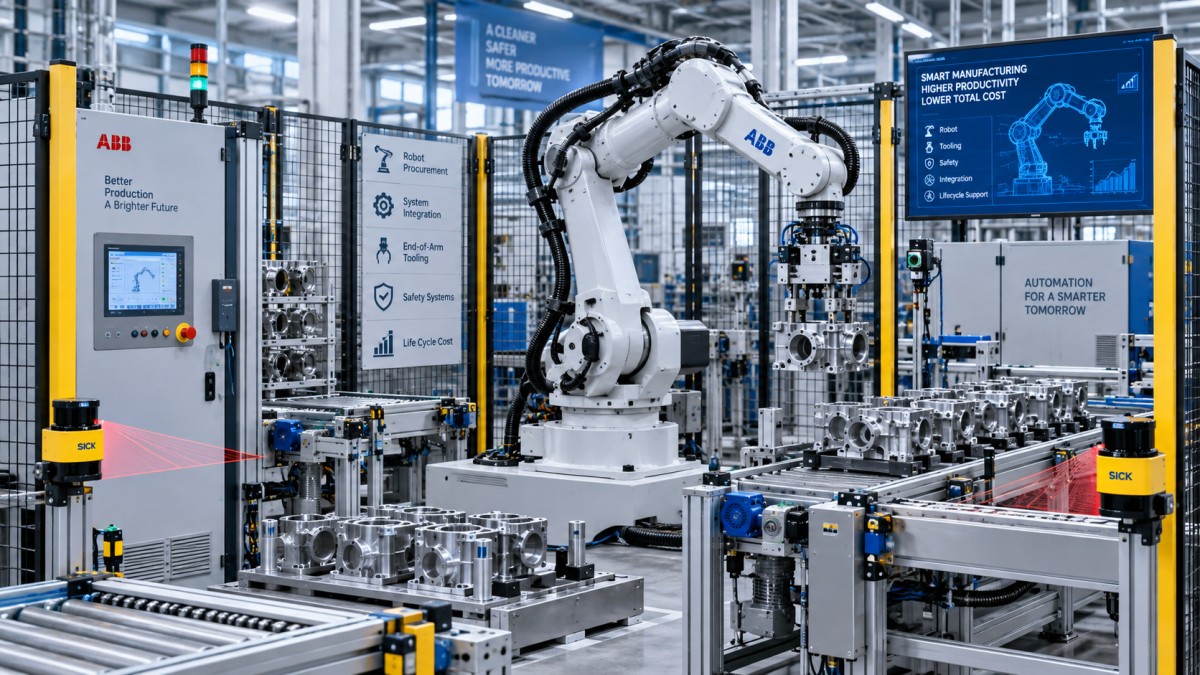
Integration cost is not simply an installer’s labor charge. It is the cost of translating a production requirement into a working cell. The integrator may need to design a pedestal, fixture, conveyors, electrical cabinet modifications, pneumatic circuits, robot logic, human-machine interface screens, fault recovery routines, and interfaces with upstream or downstream equipment.
For finance review, the critical issue is scope ownership. A quotation should identify who supplies the parts, who installs them, who validates performance, and what happens when a dependency is late or incompatible. A robot supplier may be responsible for robot configuration but not for plant network access. A tooling vendor may deliver a gripper but not guarantee that it handles oily, warped, or variable parts. An internal engineering team may be expected to provide fixtures, controls support, or acceptance criteria without those hours appearing in the project budget.
Questions that expose incomplete integration scope
- Does the quoted cycle time include real part loading, unloading, inspection, and transfer time?
- Are fixtures, pallets, part locators, and change parts included for every planned product variant?
- Is vision calibration, lighting, part-presentation control, and exception handling included where orientation is variable?
- Who supplies safety validation documentation and confirms that the final layout meets the site’s risk-reduction requirements?
- Are factory acceptance testing and site acceptance testing defined with measurable pass criteria?
- Does commissioning include production support after handover, or only a limited installation period?
- What internal labor, contractor work, shutdown time, or facility modifications must be funded separately?
These questions do not imply that every project needs the most elaborate specification. They help ensure that a low quote is not being compared with a more complete quote as if both offered the same deliverable.
End-of-arm tooling can decide whether the cell earns its keep
The robot provides motion; the tool performs the value-creating task. A gripper that occasionally drops a part, a vacuum cup that struggles with dusty surfaces, or a welding package that requires frequent attention can destroy the expected productivity of an otherwise capable robot. Tooling should therefore be evaluated as a production asset, not as a small accessory line item.
Approvers should look beyond the initial tooling cost and ask about wear parts, tool change requirements, replacement lead times, cleaning needs, and adjustment procedures. A cheaper custom gripper may be suitable for one stable product. A modular gripper or tool changer may have a higher initial cost but reduce future retooling expense when product mix is expected to change. The right choice depends on the expected life and variability of the process, not on a generic preference for either standard or custom equipment.
Where product geometry varies, it is useful to request a documented description of the tool’s operating envelope: allowable part variation, gripping surfaces, payload limits after accounting for the tool weight, and what the system does when a part is missing, misaligned, or damaged. Those conditions matter more than a nominal payload rating shown in a brochure.
Safety and plant infrastructure belong in the financial model
Safety costs are sometimes deferred because the final layout is still evolving. That approach creates risk. Guarding, scanners, gates, safety-rated controls, emergency-stop architecture, and safe access procedures influence the footprint, throughput, and labor model. A cell designed without adequate consideration of operator access may later require costly changes or create delays during maintenance and changeover.
Collaborative robots can alter the guarding approach in some applications, but they do not remove the need for a task-specific safety assessment. Payload, speed, tool geometry, pinch points, sharp edges, stored energy, and the surrounding equipment all affect the safeguards required. It is financially safer to budget from a defined operating concept than to assume that a collaborative robot automatically means minimal safety expenditure.
Infrastructure should receive similar attention. Confirm available electrical capacity, voltage compatibility, compressed air quality, extraction, cooling, network segmentation, and floor loading. A cell may require crane access, reinforced foundations, new cable routes, or planned production downtime for installation. These expenses may be managed by facilities rather than automation engineering, but they still affect the project’s cash requirement and implementation schedule.
Model operating cost with uptime assumptions you can defend
After commissioning, the cost picture shifts from capital expenditure to operating performance. The robot itself may use relatively modest energy, but a cell can include compressors, vacuum generators, weld power sources, extraction equipment, conveyors, cameras, cooling systems, and peripheral controllers. Energy estimates should reflect the complete cell and its duty cycle rather than robot nameplate power alone.
Labor savings also need careful treatment. Automation does not always remove a full position immediately. It may reassign an operator to loading, inspection, replenishment, exception recovery, or supervision across several machines. The financial case should use the labor that can actually be redeployed, avoided, or eliminated within the relevant planning horizon. Counting every manually touched second as direct savings can overstate the return.
Maintenance assumptions deserve equal scrutiny. Planned maintenance may include lubrication, inspection, calibration checks, cable and hose replacement, battery replacement, tooling service, and software backups. Unplanned downtime can be more expensive, particularly when the robot supports a bottleneck process. Ask for recommended spare parts, their expected replacement conditions, service availability, remote support arrangements, and the internal skills needed to diagnose common faults.
A useful model considers at least three operating cases: expected performance, conservative performance, and a disruption case that includes slower ramp-up or lower availability. The purpose is not to predict every failure. It is to determine whether the project remains economically credible when real production conditions are less favorable than the demonstration environment.
Measure payback against the constraint that matters
Simple payback is often the first financial screen, but it should not be based solely on labor reduction. The annual benefit may come from increased productive hours, reduced scrap, fewer ergonomic incidents, lower rework, improved process consistency, reduced temporary labor dependence, or avoided capacity expansion. Each benefit should have an identifiable operational mechanism.
For example, higher output only has financial value when demand, downstream capacity, material supply, and shipping capability can absorb it. Quality improvements require a baseline measure and a realistic connection between the robotized process and the defect being reduced. Avoided downtime has value only if the existing downtime is attributable to the task being automated rather than to an upstream constraint.
Finance should also separate one-time transition effects from recurring value. Training, initial debugging, production trials, and temporary parallel operation can reduce first-year benefits. Conversely, a robotic cell may retain value after the original product ends if its reach, payload, tooling interfaces, and controls architecture can be adapted for future work. That residual flexibility should be assessed carefully, but not treated as guaranteed value without a plausible reuse path.
Use acceptance criteria to protect the business case
A project is easier to govern when commercial commitments are connected to measurable acceptance criteria. The specification should define the product mix used for testing, expected cycle performance, quality conditions, recovery behavior, operator interaction, and what counts as a successful handover. It should also distinguish between a controlled factory test and performance at the production site, where materials, operators, utilities, and upstream equipment introduce more variation.
Do not accept a vague statement that the cell will be “production ready.” Define the boundaries. Is the supplier responsible for achieving a cycle time on representative parts? Is performance measured continuously or only during a short run? Are planned interruptions excluded? Who resolves issues caused by supplied fixtures, controls interfaces, or incoming material variation? Clear criteria reduce disputes and make it easier to recognize whether additional spending is solving a legitimate scope change or correcting an incomplete original design.
A practical approval view of total cost of ownership
The most reliable manufacturing robot cost estimate combines the full capital requirement, the cost of operating and maintaining the cell, and the financial effect of realistic performance. Request a cost breakdown that allows each element to be challenged: robot hardware, tooling, integration, safety, facilities work, internal engineering, training, spare parts, service, software, and planned production disruption.
Then test the proposal against the operating reality of the task. A financially credible automation project has a defined process boundary, a complete scope, a defensible availability assumption, and benefits tied to a constraint the business can actually relieve. The robot purchase price still matters, but it should be treated as the opening number in the decision—not the number that decides it.
Search News
Hot Articles
- Carbon Fiber StructuresHow to Specify Aerospace Carbon Fiber Assemblies for Lightweight, Load-Bearing PartsJul 11, 2026
- Machine VisionXiaomi, Alibaba DAMO Academy Drive Open-Source Robotics Model Ecosystem, Lowering Algorithm Development Barriers for Overseas SMEs Adopting Chinese Robotics SolutionsMar 30, 2026
- Cobots & ArmsShanxi 'AI+' Conference Showcases Embodied Intelligence with Multinational Buyer Engagement: Key Industry ImplicationsMar 30, 2026
Popular Tags
Recommended News
 Jul 11, 2026How to Specify Aerospace Carbon Fiber Assemblies for Lightweight, Load-Bearing PartsAerospace carbon fiber assemblies: learn how to specify laminate design, load data, joining methods, and inspection controls for lighter, reliable load-bearing aerospace parts.Elena Rostova (UAV Systems Researcher)
 Mar 30, 2026Xiaomi, Alibaba DAMO Academy Drive Open-Source Robotics Model Ecosystem, Lowering Algorithm Development Barriers for Overseas SMEs Adopting Chinese Robotics SolutionsXiaomi & Alibaba DAMO Academy's open-source robotics models lower algorithm barriers for global SMEs. Boost efficiency in manufacturing, logistics & smart retail with ROS 2 compatible solutions.TSV Data Lab
 Mar 30, 2026Shanxi 'AI+' Conference Showcases Embodied Intelligence with Multinational Buyer Engagement: Key Industry ImplicationsShanxi 'AI+' Conference highlights embodied intelligence with Tesla, Ubtech & Jiantao showcasing multimodal robotics. 40+ global buyers validated tech on-site, creating new B2B channels for industrial automation & AI solutions.Chen Wei (Automation Lead Engineer)
 Mar 30, 2026Zhongguancun Unveils 6G Integrated Sensing-Computing-Intelligence Platform to Empower Embodied Robots for Global Industrial ApplicationsZhongguancun's new 6G platform revolutionizes industrial robotics with <10ms latency, empowering global automotive, logistics & port automation. Discover how this tech boosts China's smart manufacturing exports.TSV Data Lab
 Mar 30, 2026Mech-Mind Tianjin Embodied Intelligence R&D and Production Base Goes Live, Cutting Delivery Time by 20%–30% for Global Customized AMR+Vision SolutionsMech-Mind's Tianjin AMR+Vision production base cuts delivery time by 20%-30% for欧美 & Latin American markets. Discover how this PLd-certified facility accelerates customized robotics solutions for smart manufacturing and logistics.Chen Wei (Automation Lead Engineer)
 Mar 30, 2026Boao Forum Reveals 'Co-evolution of Big and Small Brains' Trend in Humanoid Robots, China's Embodied Intelligence Accelerates Adaptation to Overseas Manufacturing Service ScenariosDiscover how China's humanoid robots, featuring 'Co-evolution of Big and Small Brains,' are revolutionizing global manufacturing. Learn about Embodied Tian Gong 3.0's ISO compliance and overseas deployment at Boao Forum 2026.Chen Wei (Automation Lead Engineer)
 Mar 30, 2026China Railway Industrial Secures Patent for Embodied Robotics in Material Handling, Boosting High-Precision Delivery Capabilities for Overseas Infrastructure and Manufacturing ProjectsChina Railway Industrial's new patent for embodied robotics in material handling boosts high-precision delivery for global infrastructure & manufacturing. Discover how this innovation enhances logistics accuracy in automotive, rail transit & EPC projects.Chen Wei (Automation Lead Engineer)
 Oct 08, 2026How to Machine Inconel 625 Blades Without Heat Cracks or Edge ChippingInconel 625 blade machining guide: prevent heat cracks, edge chipping, chatter, and work hardening with proven tooling, cooling, fixturing, and inspection strategies.Dr. Marcus Vance
 Oct 07, 2026How to Evaluate an HMI Panel Distributor for Industrial Automation ProjectsHMI panel distributor evaluation guide: verify technical compatibility, traceability, supply reliability, lifecycle support, and total cost for automation projects.Victor Lin (Chief Software Architect)
 Oct 06, 2026Navigation Fault Tolerance Standards for AMRs: What Safety Teams Must VerifyNavigation fault tolerance standards: learn what AMR safety teams must verify, from localization loss and sensor faults to stopping distance, safe restart, and site-specific validation.Chen Wei (Automation Lead Engineer)
 Oct 05, 2026Calculating Edge Computing Total Cost of Ownership Across Distributed SitesEdge computing ownership cost explained: calculate deployment, energy, connectivity, security, remote support, and refresh costs across distributed sites.TSV Data Lab
 Oct 04, 2026CAD/CAM Benchmarking in the GCC: What Manufacturers Should Ask a ConsultantCAD CAM benchmark consultant GCC guide: learn the key questions manufacturers should ask to validate post-processors, workflows, machine performance, and production risk.Victor Lin (Chief Software Architect)
 Oct 03, 2026Selecting Automotive Radar Sensor Modules for ADAS Range, Resolution, and IntegrationAutomotive radar sensor module selection guide for ADAS: compare range, resolution, field of view, latency, and integration to build safer, reliable vehicle systems.TSV Data Lab
 Oct 02, 2026How to Qualify Machined Parts Suppliers for Hard Tech ProgramsHard tech supply chain machined parts demand rigorous supplier qualification. Learn how to assess capability, traceability, quality controls, and delivery resilience.Dr. Marcus Vance
 Oct 01, 2026How to Select an Outdoor Security Radar Sensor for Perimeter Detection?Outdoor security radar sensor selection guide: compare range, accuracy, false-alarm control, integration, and field testing for reliable perimeter detection.TSV Data Lab
 Sep 30, 2026How to Evaluate Solid-State LiDAR Hardware for Outdoor Autonomous VehiclesSolid state LiDAR hardware evaluation guide for outdoor autonomous vehicles—compare range, point-cloud quality, environmental resilience, integration, and safety.TSV Data Lab
 Sep 29, 2026ISO 9283 Repeatability: How to Evaluate Cobot Positioning PerformanceISO 9283 cobot repeatability explained: learn how payload, reach, approach direction, and test conditions affect positioning performance and cell capability.Chen Wei (Automation Lead Engineer)
 Oct 09, 2026What does a manufacturing robot really cost beyond the purchase price?Manufacturing robot cost goes far beyond the purchase price. Explore integration, tooling, safety, uptime, and total ownership factors for smarter automation investments.Chen Wei (Automation Lead Engineer)
 Oct 08, 2026AGV vs. AMR: Which Is Better for Frequently Changing Routes?Which is better for changing routes? Compare AGVs and AMRs for flexible navigation, docking precision, traffic control, and faster facility reconfiguration.Chen Wei (Automation Lead Engineer)
 Oct 07, 2026How Much Does an Automated Guided Vehicle Cost in 2026?How much does an automated guided vehicle cost in 2026? Explore AGV price ranges, hidden deployment costs, and smart buying factors for stronger ROI.Chen Wei (Automation Lead Engineer)
 Oct 06, 2026Are Collaborative Robots Safe Enough to Operate Without Fencing?Are collaborative robots safe enough to work without fencing? Explore risk assessment, safeguarding options, and practical guidance for safer, productive cobot cells.Chen Wei (Automation Lead Engineer)
 Oct 05, 2026What Causes Machine Vision Systems to Miss Small Defects?What causes machine vision systems to miss small defects? Discover how lighting, optics, motion, and AI thresholds affect detection—and prevent costly escapes.TSV Data Lab
 Oct 04, 2026How Should You Compare 5-Axis CNC Machine Accuracy Claims?How do I compare 5-axis CNC machine accuracy claims? Learn how to assess standards, thermal stability, TCP accuracy, and real-world test evidence.Dr. Marcus Vance
 Oct 03, 2026Is Edge Computing Necessary for Real-Time Quality Inspection?Is industrial edge computing necessary for real-time quality inspection? Explore how latency, data volume, reliability, and control integration shape the right architecture.TSV Data Lab