5-Axis CNC vs 3-Axis: When Complex Parts Justify the Extra Investment
Publication Date
author
5-Axis CNC vs 3-Axis: what actually changes in real production?
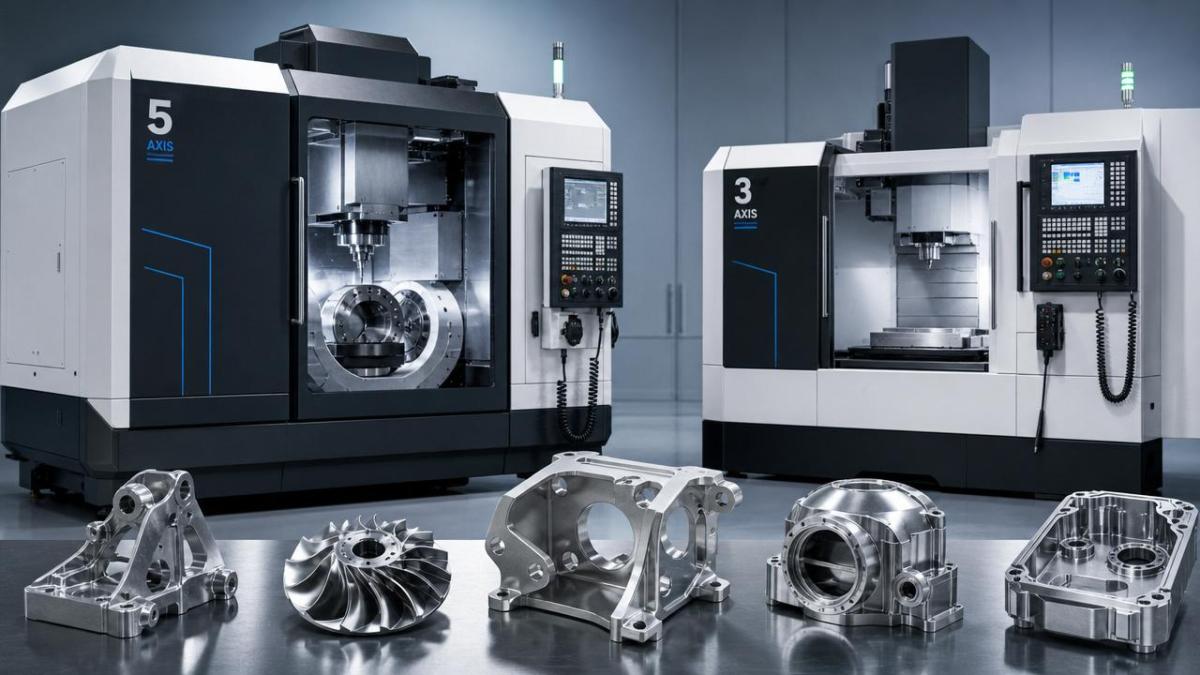
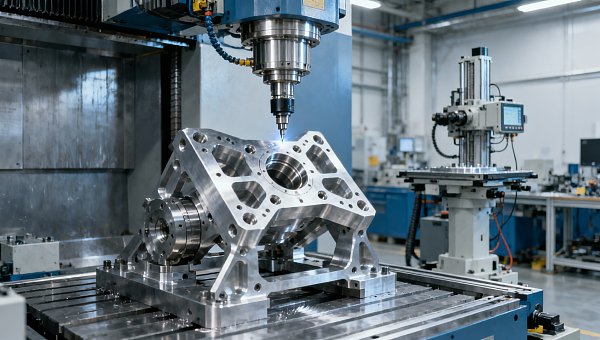
The headline difference is easy to describe, but the decision is not. A 3-axis machine moves along X, Y, and Z. A 5-axis CNC adds rotary motion, letting the tool approach a part from more angles.
That extra motion matters when geometry becomes restrictive. Deep cavities, compound curves, undercuts, and tight wall transitions often force multiple setups on 3-axis equipment.
In practical terms, the question is rarely which machine is more advanced. The better question is whether fewer setups, better access, and more stable tolerances create measurable business value.
This is where the noise in industrial sourcing becomes expensive. Marketing language often says a 5-axis CNC is simply faster or better. That is incomplete.
TechStat Vanguard approaches this issue from a harder benchmark mindset. Parameters matter more than claims. Tolerance retention across setups, surface finish consistency, and cycle time per qualified part tell the real story.
For complex components in aerospace, medical, robotics, and sensor housings, 5-axis CNC can shift the economics. For simpler brackets, plates, and prismatic parts, 3-axis machining often remains the rational choice.
When does a 5-axis CNC machine start paying for itself?
A 5-axis CNC usually earns its premium when setup reduction changes both quality and throughput. If a part needs four or five reclamping steps on 3-axis equipment, every repositioning adds variation.
That variation may be small on paper. In production, it affects datum relationships, coaxiality, blend accuracy, and inspection burden. These are not abstract concerns in regulated or high-reliability sectors.
More common justification signals include:
- Five-sided machining is required to avoid secondary fixtures.
- Surface continuity matters on aerodynamic or optical-adjacent forms.
- Thin-wall parts distort if handled too many times.
- Tight positional tolerance must hold across several faces.
- Tool reach is poor with standard vertical access.
The strongest financial case often comes from scrap prevention rather than raw speed. A difficult titanium bracket, UAV structural node, or medical housing can justify 5-axis CNC if one avoided rejection offsets the machining premium.
Lead time is another overlooked factor. Consolidated machining operations mean fewer custom fixtures, fewer handoffs, and shorter process planning cycles. That can matter as much as spindle hours.
Is 3-axis still the smarter option for many parts?
Absolutely. A 3-axis platform is still highly effective for a large share of industrial components. Flat features, standard pockets, drilled patterns, and simple contour work rarely need the complexity of 5-axis CNC.
In many shops, 3-axis machining remains preferable because programming is simpler, fixturing is familiar, and operator availability is broader. That lowers process risk for medium-complexity work.
A common mistake is assuming a 5-axis CNC should replace 3-axis capacity across the board. In reality, mixed-machine strategy is usually more efficient.
For example, roughing simple stock, creating standard bolt patterns, or producing rectangular enclosures may be more economical on 3-axis equipment. The higher hourly rate of 5-axis CNC is not automatically justified.
The more useful comparison is not old versus new. It is simple geometry versus constrained geometry, low setup sensitivity versus high setup sensitivity, and broad tolerances versus linked critical features.
Which parts usually justify the jump to 5-axis CNC?
Some part families benefit so consistently that the answer is usually clear. These parts combine geometric complexity with quality risk if handled through repeated setups.
The table is a useful starting point, not a rulebook. A part can look simple and still favor 5-axis CNC if tolerance relationships are unusually strict.
That is especially true in sectors TSV monitors closely, where benchmark value comes from traceable engineering data rather than catalog language. AS9100 or ISO13485 programs often expose these hidden cost drivers early.
Where do buyers and engineers misjudge the 5-axis CNC decision?
One common mistake is focusing only on machine purchase price or hourly rate. The larger cost often sits elsewhere, in fixture design, programming effort, inspection time, rework, and qualification delays.
Another mistake is treating 5-axis CNC as an automatic quality guarantee. Machine capability helps, but process discipline still decides the result. CAM strategy, collision control, thermal stability, probing routine, and post-process verification all matter.
It is also easy to underestimate learning curve risk. A sophisticated machine without stable programming and metrology support may produce expensive inconsistency instead of value.
In actual sourcing reviews, the better questions are more specific:
- How many setups are eliminated per part revision?
- What tolerance chain is protected by one-clamp machining?
- How does surface finish change on critical contours?
- What is the scrap rate before and after process change?
- Can inspection confirm repeatability across batches?
Those questions reflect the TSV principle that engineering truth comes from measurable evidence. A 5-axis CNC decision should be defended with data, not prestige.
How should the investment be evaluated beyond machine price?
A sound evaluation uses a full process view. The machine is only one line item. The better model compares total cost per approved part over time.
That review should include:
- Programming hours for first article and design revisions.
- Fixture count and fixture maintenance burden.
- Cycle time at stable production volume.
- Inspection time for geometric verification.
- Scrap exposure on high-value materials.
- Lead time reduction from fewer handoffs.
In many cases, 5-axis CNC looks expensive only at the quoting stage. Once redesign loops, fixture delays, and rejected parts are measured, the premium narrows.
This is especially relevant for specialty alloys, lightweight structural parts, and precision housings for edge devices. When tolerances dictate system performance, process stability becomes an investment variable, not just a manufacturing detail.
A practical decision framework is simple: if complexity raises setup count, setup count raises variation, and variation raises cost of failure, then 5-axis CNC deserves a serious benchmark review.
What is the best next step if the answer still feels uncertain?
Uncertainty usually means the comparison is still too general. The next step is to review actual part families, not abstract machine categories.
Start by separating parts into three groups: clearly 3-axis, clearly 5-axis CNC, and borderline. The borderline group is where most strategic value hides.
Then compare setup count, tolerance chain sensitivity, material cost, and inspection effort for each group. A small pilot run often reveals more than broad assumptions.
It also helps to request evidence in engineering terms. Ask for achievable tolerances, sample CMM data, surface finish results, and process notes on difficult geometries.
That approach aligns with the TSV view of manufacturing intelligence. Strip away slogans, compare traceable parameters, and judge the 5-axis CNC decision by measurable production truth.
If the part is simple, stay simple. If geometry, risk, and tolerance interaction are driving cost, the extra investment in 5-axis CNC is often not a luxury at all. It is the cleaner path to repeatable output.
Search News
Hot Articles
- Carbon Fiber StructuresHow to Specify Aerospace Carbon Fiber Assemblies for Lightweight, Load-Bearing PartsJul 11, 2026
- Machine VisionXiaomi, Alibaba DAMO Academy Drive Open-Source Robotics Model Ecosystem, Lowering Algorithm Development Barriers for Overseas SMEs Adopting Chinese Robotics SolutionsMar 30, 2026
- Cobots & ArmsShanxi 'AI+' Conference Showcases Embodied Intelligence with Multinational Buyer Engagement: Key Industry ImplicationsMar 30, 2026
Popular Tags
Recommended News
 Jul 11, 2026How to Specify Aerospace Carbon Fiber Assemblies for Lightweight, Load-Bearing PartsAerospace carbon fiber assemblies: learn how to specify laminate design, load data, joining methods, and inspection controls for lighter, reliable load-bearing aerospace parts.Elena Rostova (UAV Systems Researcher)
 Mar 30, 2026Xiaomi, Alibaba DAMO Academy Drive Open-Source Robotics Model Ecosystem, Lowering Algorithm Development Barriers for Overseas SMEs Adopting Chinese Robotics SolutionsXiaomi & Alibaba DAMO Academy's open-source robotics models lower algorithm barriers for global SMEs. Boost efficiency in manufacturing, logistics & smart retail with ROS 2 compatible solutions.TSV Data Lab
 Mar 30, 2026Shanxi 'AI+' Conference Showcases Embodied Intelligence with Multinational Buyer Engagement: Key Industry ImplicationsShanxi 'AI+' Conference highlights embodied intelligence with Tesla, Ubtech & Jiantao showcasing multimodal robotics. 40+ global buyers validated tech on-site, creating new B2B channels for industrial automation & AI solutions.Chen Wei (Automation Lead Engineer)
 Mar 30, 2026Zhongguancun Unveils 6G Integrated Sensing-Computing-Intelligence Platform to Empower Embodied Robots for Global Industrial ApplicationsZhongguancun's new 6G platform revolutionizes industrial robotics with <10ms latency, empowering global automotive, logistics & port automation. Discover how this tech boosts China's smart manufacturing exports.TSV Data Lab
 Mar 30, 2026Mech-Mind Tianjin Embodied Intelligence R&D and Production Base Goes Live, Cutting Delivery Time by 20%–30% for Global Customized AMR+Vision SolutionsMech-Mind's Tianjin AMR+Vision production base cuts delivery time by 20%-30% for欧美 & Latin American markets. Discover how this PLd-certified facility accelerates customized robotics solutions for smart manufacturing and logistics.Chen Wei (Automation Lead Engineer)
 Mar 30, 2026Boao Forum Reveals 'Co-evolution of Big and Small Brains' Trend in Humanoid Robots, China's Embodied Intelligence Accelerates Adaptation to Overseas Manufacturing Service ScenariosDiscover how China's humanoid robots, featuring 'Co-evolution of Big and Small Brains,' are revolutionizing global manufacturing. Learn about Embodied Tian Gong 3.0's ISO compliance and overseas deployment at Boao Forum 2026.Chen Wei (Automation Lead Engineer)
 Mar 30, 2026China Railway Industrial Secures Patent for Embodied Robotics in Material Handling, Boosting High-Precision Delivery Capabilities for Overseas Infrastructure and Manufacturing ProjectsChina Railway Industrial's new patent for embodied robotics in material handling boosts high-precision delivery for global infrastructure & manufacturing. Discover how this innovation enhances logistics accuracy in automotive, rail transit & EPC projects.Chen Wei (Automation Lead Engineer)
 Oct 21, 2026China’s Industrial Robot Exports Near RMB 10 Billion in First Nine Months of 2026China’s industrial robot exports neared RMB 10 billion in January–September 2026, with value rising faster than volume. Explore the data and what it could mean for suppliers.Chen Wei (Automation Lead Engineer)
 Oct 21, 2026Low-Latency Industrial Data Processing: Pricing and Key Cost DriversExplore industrial data latency price drivers, from edge hardware to integration and support. Learn how to compare quotes, verify performance, and avoid unnecessary costs.TSV Data Lab
 Oct 20, 2026KUKA Launches iiQKA.AI Vision to Simplify Industrial Image ProcessingKUKA iiQKA.AI Vision simplifies industrial image processing with controller-based 2D and 3D vision. Explore drag-and-drop setup for vision-guided automation.TSV Data Lab
 Oct 20, 2026Smart Industrial Edge Devices: Key Criteria for Legacy PLC IntegrationChoose smart industrial edge devices for legacy PLC integration. Discover key criteria for compatibility, data quality, security, and reliable collection without disrupting control.TSV Data Lab
 Oct 19, 2026Choosing a Radar Sensor by Application: Range, Resolution, and Field of ViewSimplify radar sensor application based product selection. Compare range, resolution, and field of view to avoid blind spots and choose with confidence. Explore the guide.TSV Data Lab
 Oct 18, 2026Comparing Material Options for Procurement: Specs, Costs, and Supply RisksExplore procurement oriented technical content on material options, specs, costs, and supply risks. Compare alternatives to cut hidden expenses and make confident sourcing decisions.Dr. Marcus Vance
 Oct 17, 20265-Axis CNC Positioning Accuracy: How to Interpret ISO 230-2 Test ResultsAssess 5 axis CNC machining positioning accuracy with ISO 230-2. Learn to interpret repeatability, reversal error, and test conditions to compare suppliers and make confident acceptance decisions.Dr. Marcus Vance
 Oct 16, 2026Choosing a Rugged Edge AI Box Supplier: Thermal Tests and Lifecycle SupportChoose a rugged edge AI box supplier with proven thermal performance and reliable lifecycle support. Discover the tests and commitments to verify before you buy.TSV Data Lab
 Oct 15, 2026R&D Cost Reduction Services: How to Evaluate Fees, Savings, and ROIEvaluate R&D cost reduction services with confidence. Compare fees, verify savings, and calculate ROI without compromising performance. Discover how to choose a provider that delivers real value.Chen Wei (Automation Lead Engineer)
 Oct 20, 2026How Do You Measure Industrial IoT Gateway Latency Under Load?Measure industrial IoT gateway latency under load with reliable timestamps, realistic traffic, and tail-latency analysis. Discover how to expose bottlenecks and choose the right gateway.TSV Data Lab
 Oct 19, 2026How Do You Verify That Precision Machined Parts Meet Tolerances?Master precision machining tolerance verification with the right tools, datum setups, and acceptance rules. Learn how to validate parts confidently and reduce costly inspection errors.Dr. Marcus Vance
 Oct 18, 2026What Should an AS9100 Machining Supplier Checklist Include?Build an AS9100 machining supplier checklist that verifies capability, traceability, inspection, and outsourced processes. Discover what to check before approving your next aerospace supplier.Dr. Marcus Vance
 Oct 17, 2026How Should You Interpret Industrial Robot Repeatability Specs?Decode industrial robot repeatability specifications, understand ISO 9283 test conditions, and avoid costly selection mistakes. Learn how to verify performance for your process.Chen Wei (Automation Lead Engineer)
 Oct 16, 2026How Can You Fairly Compare MTBF Across Industrial Servo Motors?Make a fair industrial servo motor MTBF comparison with matched operating profiles, failure criteria, and confidence bounds. Discover how to assess reliability beyond advertised numbers.Chen Wei (Automation Lead Engineer)
 Oct 15, 2026How Should You Compare TechStat Vanguard 5-Axis CNC Tolerances?TechStat Vanguard 5-axis CNC tolerance comparison: learn how to verify part accuracy, assess inspection evidence, and choose suppliers that reliably meet your drawing requirements.Dr. Marcus Vance
 Oct 14, 2026Drone Frame Composites: Carbon Fiber vs. Fiberglass for Weight and StiffnessExplore drone structural materials composites: compare carbon fiber and fiberglass for weight, stiffness, cost, and antenna compatibility. Find the right material for your drone frame.Elena Rostova (UAV Systems Researcher)
 Oct 13, 2026Smart Cameras vs. PC-Based Machine Vision: Which Fits High-Speed Inspection?This industrial product comparison for machine vision weighs smart cameras vs. PC-based systems on latency, throughput, and cost. Discover your best fit for high-speed inspection.TSV Data Lab