Folding Event Tables Buying Guide: Sizes, Weight Capacity, Materials, and Storage Needs
Publication Date
author
Folding Event Tables Buying Guide: what really matters before you compare options?
Buying folding event tables sounds simple until real operating details enter the discussion.
A table that looks identical online may differ sharply in load rating, hinge strength, panel thickness, and storage footprint.
That is why folding event tables should be judged by measurable performance, not by polished catalog language.
In practical terms, the right choice connects four things: usable size, safe weight capacity, material durability, and efficient storage.
This approach aligns with a broader TSV principle: parameters matter more than adjectives, and specifications should reduce uncertainty.
If a supplier cannot define dimensions, static load limits, frame gauge, or folded depth clearly, comparison becomes unreliable from the start.
So the better question is not which table looks best, but which folding event tables match the job without creating transport, setup, or replacement problems later.
How do you decide the right table size without overbuying?
Size decisions usually go wrong in two ways.
One is choosing a tabletop based only on room dimensions.
The other is ignoring circulation space, seated legroom, and handling during setup.
For banquets, training rooms, pop-up displays, and registration areas, table length affects flow as much as capacity.
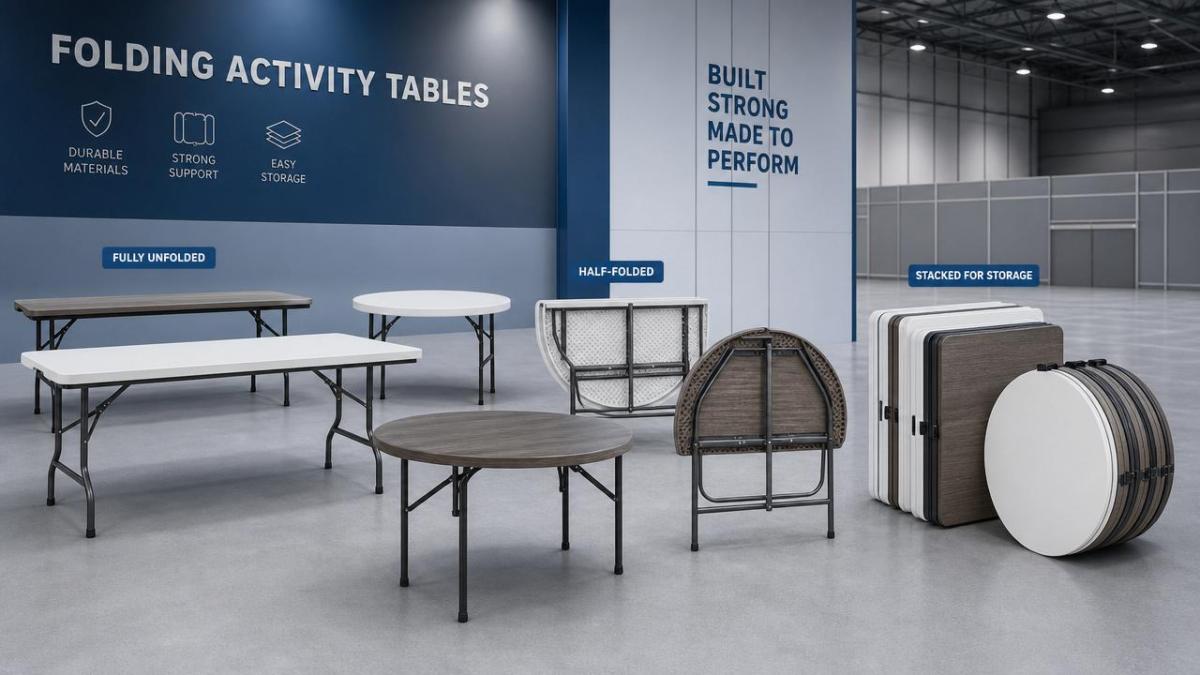
Common rectangular folding event tables range from 4 feet to 8 feet.
Round versions often support social layouts better, but they demand more storage volume per position.
A more useful way to judge size is to map the task first.
- Registration and check-in usually benefit from narrow rectangular tables with easy front access.
- Buffet service often needs deeper surfaces to prevent crowding of trays and small appliances.
- Classroom layouts work better when individual seating space is measured before ordering table length.
- Temporary workstations may require cable clearance, monitor depth, and edge stability.
In other words, footprint alone is not enough.
The usable working surface matters more than nominal size.
When reviewing folding event tables, ask for both open dimensions and folded dimensions.
That single detail often reveals whether a model fits elevators, storage rooms, and transport carts.
Is weight capacity just a number on paper, or does it change real-world safety?
It changes everything, especially when tables carry uneven loads.
Many buyers see a headline capacity figure and assume it covers any setup condition.
That is rarely a safe assumption.
A table may support a strong static load when weight is evenly distributed.
The same table may flex, wobble, or stress the hinge area when equipment is concentrated at one end.
This is especially important for catering hardware, display products, boxed materials, or AV gear.
A useful buying conversation should include these points:
This is where a data-first review becomes valuable.
TSV often emphasizes that a specification only helps when the test condition is visible.
For folding event tables, that means asking how the number was earned, not just what number appears in bold.
Which materials hold up best in repeated event use?
There is no single best material for all folding event tables.
The better choice depends on cleaning demands, setup frequency, load pattern, and indoor or outdoor exposure.
High-density polyethylene is popular because it resists stains, moisture, and casual impact.
It also keeps weight manageable, which helps during frequent transport.
Plywood or wood-core tops often feel more rigid and premium, especially for covered banquet use.
Still, edges, laminates, and moisture protection deserve closer inspection.
Steel frames usually outperform lighter structures in long-cycle service, but coatings matter.
If the finish chips easily, corrosion risk increases in storage or transport environments with humidity.
A practical comparison looks like this:
- Plastic top plus steel frame: balanced for general events, easy cleaning, moderate weight.
- Wood top plus steel frame: stronger presentation, often heavier, sensitive to edge wear.
- Lightweight composite builds: easier handling, but verify long-term hinge and fastener integrity.
In repeated-use settings, durability is not just surface toughness.
It is the combined behavior of top panel, frame, leg locks, feet, rivets, and fold cycles.
That is why material comparisons should include wear points, not just tabletop descriptions.
What storage and transport issues are easy to overlook?
This is one of the most underestimated parts of buying folding event tables.
A table may perform well in use and still create inefficiency every time it is moved, stacked, or stored.
Folded thickness, handle placement, nesting behavior, and cart compatibility all affect labor time.
If storage rooms are shallow, a few extra centimeters per unit can quickly reduce total capacity.
Likewise, if tables do not stack securely, edge damage appears earlier than expected.
More common evaluation points include:
- Folded profile and whether legs lock cleanly without protrusion.
- Actual unit weight, not approximate shipping weight.
- Compatibility with vertical or horizontal storage carts.
- Surface protection during stacking and vehicle loading.
- Doorway, elevator, and corridor clearance during peak movement.
In actual operations, storage efficiency often determines replacement cost indirectly.
Poor handling leads to bent legs, chipped edges, and unstable feet long before the tabletop itself wears out.
That makes storage needs part of the performance discussion, not a separate afterthought.
When comparing folding event tables, where do bad assumptions usually happen?
The biggest mistake is treating all specification sheets as equally precise.
Some list only broad claims such as heavy-duty, commercial grade, or reinforced frame.
Those phrases sound helpful, but they rarely support serious comparison.
A better method is to screen every option against the same decision grid.
This is also where the TSV mindset is useful in a broader industry sense.
Whether the subject is automation hardware or folding event tables, procurement confidence grows when claims are traceable to measurable evidence.
If two tables have similar price points, the one with clearer engineering detail usually carries lower decision risk.
So which next steps lead to a better purchase decision?
Start by translating use into numbers.
How many tables are needed, what loads they carry, how often they move, and how tightly they must store.
Then compare folding event tables using one consistent checklist rather than separate sales pages.
Shortlist only the models that disclose open size, folded size, tested capacity, material composition, and frame details.
If possible, review hinge construction and stacking behavior before scaling the order.
The most reliable buying decisions usually come from reducing vague claims early.
In that sense, choosing folding event tables is less about chasing the broadest promise and more about matching measurable specifications to real use conditions.
That is the practical standard worth applying: clear parameters, realistic handling assumptions, and enough detail to judge long-term value with confidence.
Search News
Hot Articles
- Carbon Fiber StructuresHow to Specify Aerospace Carbon Fiber Assemblies for Lightweight, Load-Bearing PartsJul 11, 2026
- Machine VisionXiaomi, Alibaba DAMO Academy Drive Open-Source Robotics Model Ecosystem, Lowering Algorithm Development Barriers for Overseas SMEs Adopting Chinese Robotics SolutionsMar 30, 2026
- Cobots & ArmsShanxi 'AI+' Conference Showcases Embodied Intelligence with Multinational Buyer Engagement: Key Industry ImplicationsMar 30, 2026
Popular Tags
Recommended News
 Jul 11, 2026How to Specify Aerospace Carbon Fiber Assemblies for Lightweight, Load-Bearing PartsAerospace carbon fiber assemblies: learn how to specify laminate design, load data, joining methods, and inspection controls for lighter, reliable load-bearing aerospace parts.Elena Rostova (UAV Systems Researcher)
 Mar 30, 2026Xiaomi, Alibaba DAMO Academy Drive Open-Source Robotics Model Ecosystem, Lowering Algorithm Development Barriers for Overseas SMEs Adopting Chinese Robotics SolutionsXiaomi & Alibaba DAMO Academy's open-source robotics models lower algorithm barriers for global SMEs. Boost efficiency in manufacturing, logistics & smart retail with ROS 2 compatible solutions.TSV Data Lab
 Mar 30, 2026Shanxi 'AI+' Conference Showcases Embodied Intelligence with Multinational Buyer Engagement: Key Industry ImplicationsShanxi 'AI+' Conference highlights embodied intelligence with Tesla, Ubtech & Jiantao showcasing multimodal robotics. 40+ global buyers validated tech on-site, creating new B2B channels for industrial automation & AI solutions.Chen Wei (Automation Lead Engineer)
 Mar 30, 2026Zhongguancun Unveils 6G Integrated Sensing-Computing-Intelligence Platform to Empower Embodied Robots for Global Industrial ApplicationsZhongguancun's new 6G platform revolutionizes industrial robotics with <10ms latency, empowering global automotive, logistics & port automation. Discover how this tech boosts China's smart manufacturing exports.TSV Data Lab
 Mar 30, 2026Mech-Mind Tianjin Embodied Intelligence R&D and Production Base Goes Live, Cutting Delivery Time by 20%–30% for Global Customized AMR+Vision SolutionsMech-Mind's Tianjin AMR+Vision production base cuts delivery time by 20%-30% for欧美 & Latin American markets. Discover how this PLd-certified facility accelerates customized robotics solutions for smart manufacturing and logistics.Chen Wei (Automation Lead Engineer)
 Mar 30, 2026Boao Forum Reveals 'Co-evolution of Big and Small Brains' Trend in Humanoid Robots, China's Embodied Intelligence Accelerates Adaptation to Overseas Manufacturing Service ScenariosDiscover how China's humanoid robots, featuring 'Co-evolution of Big and Small Brains,' are revolutionizing global manufacturing. Learn about Embodied Tian Gong 3.0's ISO compliance and overseas deployment at Boao Forum 2026.Chen Wei (Automation Lead Engineer)
 Mar 30, 2026China Railway Industrial Secures Patent for Embodied Robotics in Material Handling, Boosting High-Precision Delivery Capabilities for Overseas Infrastructure and Manufacturing ProjectsChina Railway Industrial's new patent for embodied robotics in material handling boosts high-precision delivery for global infrastructure & manufacturing. Discover how this innovation enhances logistics accuracy in automotive, rail transit & EPC projects.Chen Wei (Automation Lead Engineer)
 Oct 20, 2026KUKA Launches iiQKA.AI Vision to Simplify Industrial Image ProcessingKUKA iiQKA.AI Vision simplifies industrial image processing with controller-based 2D and 3D vision. Explore drag-and-drop setup for vision-guided automation.TSV Data Lab
 Oct 20, 2026Smart Industrial Edge Devices: Key Criteria for Legacy PLC IntegrationChoose smart industrial edge devices for legacy PLC integration. Discover key criteria for compatibility, data quality, security, and reliable collection without disrupting control.TSV Data Lab
 Oct 19, 2026Choosing a Radar Sensor by Application: Range, Resolution, and Field of ViewSimplify radar sensor application based product selection. Compare range, resolution, and field of view to avoid blind spots and choose with confidence. Explore the guide.TSV Data Lab
 Oct 18, 2026Comparing Material Options for Procurement: Specs, Costs, and Supply RisksExplore procurement oriented technical content on material options, specs, costs, and supply risks. Compare alternatives to cut hidden expenses and make confident sourcing decisions.Dr. Marcus Vance
 Oct 17, 20265-Axis CNC Positioning Accuracy: How to Interpret ISO 230-2 Test ResultsAssess 5 axis CNC machining positioning accuracy with ISO 230-2. Learn to interpret repeatability, reversal error, and test conditions to compare suppliers and make confident acceptance decisions.Dr. Marcus Vance
 Oct 16, 2026Choosing a Rugged Edge AI Box Supplier: Thermal Tests and Lifecycle SupportChoose a rugged edge AI box supplier with proven thermal performance and reliable lifecycle support. Discover the tests and commitments to verify before you buy.TSV Data Lab
 Oct 15, 2026R&D Cost Reduction Services: How to Evaluate Fees, Savings, and ROIEvaluate R&D cost reduction services with confidence. Compare fees, verify savings, and calculate ROI without compromising performance. Discover how to choose a provider that delivers real value.Chen Wei (Automation Lead Engineer)
 Oct 19, 2026How Do You Verify That Precision Machined Parts Meet Tolerances?Master precision machining tolerance verification with the right tools, datum setups, and acceptance rules. Learn how to validate parts confidently and reduce costly inspection errors.Dr. Marcus Vance
 Oct 18, 2026What Should an AS9100 Machining Supplier Checklist Include?Build an AS9100 machining supplier checklist that verifies capability, traceability, inspection, and outsourced processes. Discover what to check before approving your next aerospace supplier.Dr. Marcus Vance
 Oct 17, 2026How Should You Interpret Industrial Robot Repeatability Specs?Decode industrial robot repeatability specifications, understand ISO 9283 test conditions, and avoid costly selection mistakes. Learn how to verify performance for your process.Chen Wei (Automation Lead Engineer)
 Oct 16, 2026How Can You Fairly Compare MTBF Across Industrial Servo Motors?Make a fair industrial servo motor MTBF comparison with matched operating profiles, failure criteria, and confidence bounds. Discover how to assess reliability beyond advertised numbers.Chen Wei (Automation Lead Engineer)
 Oct 15, 2026How Should You Compare TechStat Vanguard 5-Axis CNC Tolerances?TechStat Vanguard 5-axis CNC tolerance comparison: learn how to verify part accuracy, assess inspection evidence, and choose suppliers that reliably meet your drawing requirements.Dr. Marcus Vance
 Oct 14, 2026Drone Frame Composites: Carbon Fiber vs. Fiberglass for Weight and StiffnessExplore drone structural materials composites: compare carbon fiber and fiberglass for weight, stiffness, cost, and antenna compatibility. Find the right material for your drone frame.Elena Rostova (UAV Systems Researcher)
 Oct 13, 2026Smart Cameras vs. PC-Based Machine Vision: Which Fits High-Speed Inspection?This industrial product comparison for machine vision weighs smart cameras vs. PC-based systems on latency, throughput, and cost. Discover your best fit for high-speed inspection.TSV Data Lab
 Oct 12, 2026How to Verify RoHS Compliance in Industrial Sensing Systems Before DeploymentRoHS compliant sensing systems: learn how to verify materials, supplier declarations, testing, and configuration controls before industrial deployment.TSV Data Lab
 Oct 11, 2026How Procurement-Oriented Content Taxonomy Improves B2B Buying JourneysProcurement-oriented content taxonomy streamlines B2B buying journeys with clearer evidence, supplier comparisons, risk visibility, and faster approvals.TSV Data Lab
 Oct 10, 2026How to Select a Machine Performance Monitoring Platform for OEE and Downtime ReductionMachine performance monitoring platform selection guide: validate machine states, OEE data, downtime reasons, integrations, and scalability to reduce losses with confidence.TSV Data Lab