Smart Industrial Edge Devices: Key Criteria for Legacy PLC Integration
Publication Date
author
Smart industrial edge devices can make a legacy PLC useful to maintenance, quality, and production analytics without replacing the controller. The strongest candidates provide dependable access to the required signals while keeping communication demand within the machine’s operating limits. A device that reads tags successfully during a demonstration has cleared only the first hurdle.
For technical evaluators, selection should turn on four questions: Does the device support the exact controller configuration? Can it collect useful data without disrupting control? Does the data retain enough timing and quality information for its intended use? And can the installation fail, recover, and receive maintenance safely? Processing power and application features matter once those conditions are satisfied.
Establish compatibility at the controller and application level
A protocol name is too broad to serve as a compatibility specification. Two controllers using the same protocol may expose different services, address structures, connection limits, or access permissions. Firmware revisions and communication modules can further change what an edge device can read and how efficiently it can read it.
Build the evaluation around an identified installation: controller model, firmware revision, communication module, physical interface, network topology, and engineering software version. Include any existing supervisory systems, operator panels, historians, and programming connections. An edge gateway becomes another consumer of resources that may already be constrained.
Ask the supplier to demonstrate the required operations against that configuration. Reading a few consecutive registers does not establish support for symbolic tags, structured data, strings, counters, or values spread across several memory areas. Confirm how the driver handles signed values, floating-point formats, byte and word order, and unavailable addresses. A plausible but incorrectly decoded process value can escape detection more easily than a connection failure.
Access requirements also need scrutiny. Some integrations require changes to controller settings, communication hardware, or the PLC program. Others depend on a separate software service or engineering project files. These dependencies affect commissioning effort, licensing, and the ability to restore the installation later. A proposal should identify them before hardware selection.
Choose the connection path around the available access
Direct controller access can be appropriate when a supported interface has enough capacity. An existing OPC server or historian may provide a practical alternative if it already exposes the necessary values with acceptable update rates and quality information. That approach introduces its own availability and licensing dependencies, but it may avoid another direct connection to a constrained controller.
For serial networks, examine the bus arrangement before adding hardware. An additional polling master may be incompatible with the existing communication scheme. Passive observation is an option only where the traffic, electrical interface, and decoding method support it; encrypted traffic and switched network paths can also limit visibility. Where network access cannot meet the requirement, separate sensing may be worth assessing, provided the signal can be measured safely and interpreted reliably.
Compatibility evidence should therefore describe the complete data path, including intermediary software and required configuration changes. A supported-controller list is a useful screening document. It cannot replace a demonstration of the intended deployment.
Set a communication budget before comparing processing power
The useful collection rate depends on the application. Production totals may tolerate relatively slow updates. Short machine events may require controller-side event capture or buffering. High-frequency vibration analysis can require a dedicated acquisition path because ordinary PLC polling may not preserve the signal detail needed for diagnosis.
Start with the decision the data must support, then define the signals and timing needed to support it. Requesting every available tag at the fastest configurable interval creates demand without establishing analytical value. Divide the collection list by required update rate, and identify which signals must be captured together.
Tag count alone is a weak measure of communication load. Contiguous addresses may be retrieved in fewer transactions than scattered values. Request size limits, protocol overhead, controller response time, and driver scheduling all affect the result. Several applications running on one edge device may also generate separate requests unless their access is coordinated.
The evaluation should compare the machine with edge collection disabled and enabled under representative operating conditions. Observe controller task or scan behavior where diagnostics permit, communication utilization, missed responses, and operator-panel responsiveness. Include startup, recipe changes, alarms, and other periods when existing communication demand increases. Average performance during steady production can hide intermittent contention.
Require explicit controls for polling intervals, concurrent requests, response timeouts, retry limits, and reconnect delays. An edge device should reduce or bound its communication demand when the controller becomes unavailable. Repeated aggressive retries can add pressure to an already degraded connection.
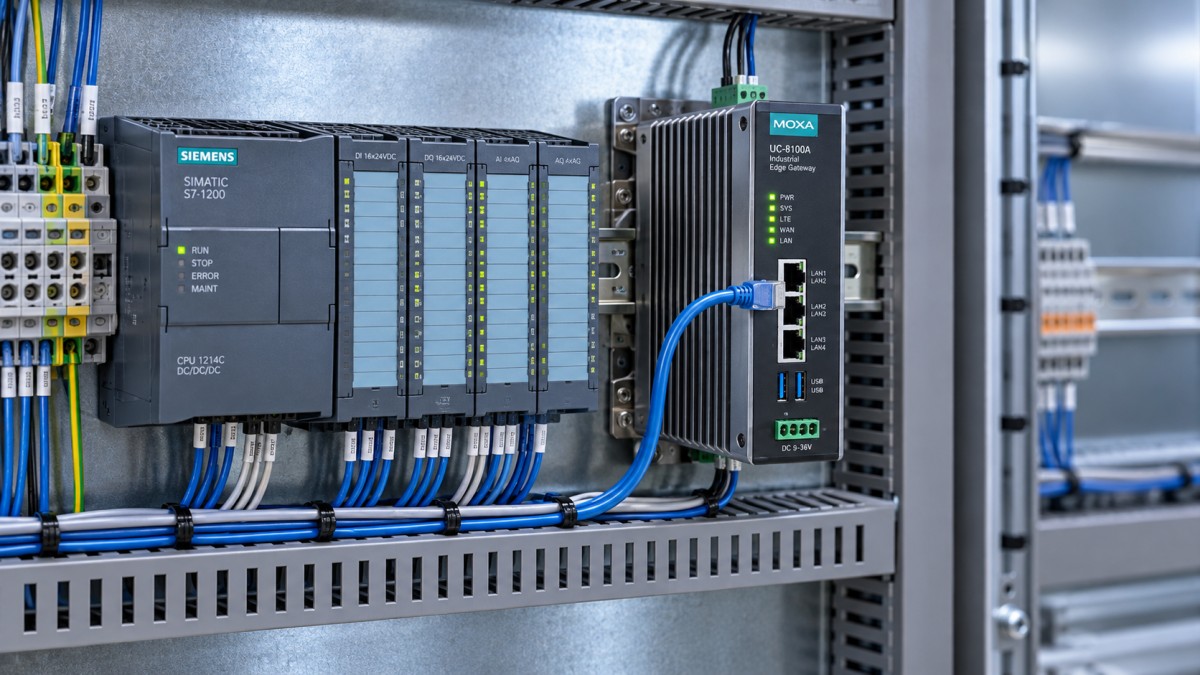
Keep control authority explicit. A monitoring installation should have read-only permissions wherever the controller and protocol support enforcement. A read-only setting in the edge application does not necessarily prevent other software on the same device from issuing writes. If the available interface lacks granular authorization, network restrictions and tightly controlled device administration become more important.
Any proposed write operation deserves a separate assessment covering permitted addresses, value limits, machine states, interlocks, and authorization. Recipe changes and setpoint adjustments extend the device’s role beyond observation. Keeping those functions outside the initial monitoring scope can make commissioning and fault analysis easier.
Evaluate whether the data can support the intended judgment
A dashboard can show changing values while concealing timing errors, stale data, and gaps. Before accepting an edge device, establish what each timestamp represents: the controller’s event time, the gateway’s observation time, or arrival at a downstream platform. These timestamps answer different questions.
If a gateway periodically polls a PLC, its observation time cannot establish the exact moment a physical transition occurred between polls. Faster networking does not remove that uncertainty. Where event order matters, assess whether the controller can provide timestamps, sequence numbers, or buffered events. Otherwise, the application must accommodate the limits of observation-based timing.
Clock synchronization deserves attention when combining data from several machines or systems. Define the acceptable timing uncertainty for the analysis, then check whether the available synchronization method and timestamp source can satisfy it. Additional decimal places in a timestamp do not demonstrate greater accuracy.
Check consistency, quality, and meaning
Values collected in separate transactions may represent different machine states. Even a grouped read does not automatically guarantee a coherent snapshot unless the controller’s behavior supports that guarantee. For applications such as cycle analysis or batch reconciliation, consider controller-side snapshots, sequence counters, or another documented consistency mechanism.
Each signal also needs enough context to remain interpretable: engineering units, scaling, valid range, source address, and a clear description. A counter requires known rollover and reset behavior. A machine-state code requires an agreed mapping. Changes to the PLC program can alter these meanings while communication continues normally, so tag definitions need version control alongside connection settings.
Inspect how the device represents an unsuccessful read. Holding the last value can be useful for display continuity, but downstream users must be able to distinguish it from a fresh observation. Look for quality indicators, last-successful-read time, and explicit handling of unavailable or invalid values. Substituting zero without a quality flag can create false production stops or misleading process trends.
Local buffering requires the same scrutiny. Compare usable storage against expected record volume, storage overhead, retention rules, and the outage duration the business needs to tolerate. Define what happens when capacity is exhausted: discard the oldest records, reject new records, or apply a documented priority policy.
After connectivity returns, replayed records should preserve their original timestamps and quality information. Sequence identifiers or equivalent handling can help downstream systems detect duplicates and missing records. Confirm that backlog transfer is bounded so it does not interfere with live collection. These details determine whether an outage creates a recoverable delay or an invisible defect in the dataset.
Make failure behavior and maintenance part of acceptance
The edge device’s availability should be separated from the machine’s ability to operate. Disconnect its power, interrupt its network connection, and stop its collection service during controlled testing. Confirm that the machine continues within its approved operating conditions and that existing supervisory functions remain usable. An inline installation needs particular scrutiny because its hardware or power failure may interrupt another communication path.
Recovery should be predictable. Check behavior after a PLC restart, an edge restart, loss of time synchronization, storage exhaustion, and a prolonged downstream outage. Successful reconnection is only part of the result: collection should resume without uncontrolled retries, corrupted configuration, or silent loss of quality information.
Physical suitability belongs in this assessment. Compare the device’s specified operating conditions with the actual cabinet environment, including ambient temperature, available airflow, power supply, grounding, and electrical disturbances. Assess storage endurance where the workload involves frequent local writes. Product specifications and certification scope should match the selected model and installation conditions.
Security capabilities should support an architecture the plant can operate. Define which systems may communicate with the device, which services it exposes, and how administrators reach it. An outbound connection to a designated application can reduce the need for inbound access, but the device’s access to the control network still needs limits. Encrypted transport protects a connection; it does not by itself restrict what an authorized or compromised endpoint can do.
Evaluate individual accounts, role separation, credential storage, certificate renewal, logging, and the ability to disable unused services. Remote supplier access needs a defined activation and revocation process. Also determine whether normal collection depends on a cloud account, external license service, or continuous internet availability. Those dependencies belong in the operational specification.
Update and replacement procedures can expose weaknesses that a connectivity trial misses. Require a documented backup and restore process, controlled software updates, and a recovery path for failed updates. Establish how operating-system and driver support are maintained, how security issues are communicated, and how application changes affect resource use. Additional analytics workloads must fit within the capacity reserved for reliable acquisition.
Turn the shortlist into an acceptance test
A useful acceptance plan links each requirement to observable evidence. It should cover the exact controller configuration and intended workload, with limits agreed before testing:
- Access: Required addresses and data types decode correctly, permissions are enforced where supported, and configuration dependencies are documented.
- Control impact: Collection stays within the approved communication budget during representative production states, reconnects, and backlog transfer.
- Data validity: Timing, consistency, quality flags, counter behavior, and scaling support the intended analysis.
- Recovery: Defined failures produce visible status, bounded retries, and predictable collection and replay behavior.
- Maintainability: An authorized technician can restore configuration, replace hardware, and manage credentials and updates using documented procedures.
Set numerical limits from the machine’s baseline and the application’s needs. A supplier’s maximum throughput figure cannot establish an acceptable polling rate for a particular legacy PLC. Retain the tested tag list, firmware and driver versions, configuration, and observations so that later changes have a clear reference.
The defensible selection is the device that delivers the required evidence with an acceptable effect on the machine and a supportable operating burden. When two candidates both meet those conditions, compare the effort required to commission, restore, and maintain them. For a legacy installation expected to remain productive through personnel and software changes, that effort can carry more value than unused computing capacity.
Search News
Hot Articles
- Carbon Fiber StructuresHow to Specify Aerospace Carbon Fiber Assemblies for Lightweight, Load-Bearing PartsJul 11, 2026
- Machine VisionXiaomi, Alibaba DAMO Academy Drive Open-Source Robotics Model Ecosystem, Lowering Algorithm Development Barriers for Overseas SMEs Adopting Chinese Robotics SolutionsMar 30, 2026
- Cobots & ArmsShanxi 'AI+' Conference Showcases Embodied Intelligence with Multinational Buyer Engagement: Key Industry ImplicationsMar 30, 2026
Popular Tags
Recommended News
 Jul 11, 2026How to Specify Aerospace Carbon Fiber Assemblies for Lightweight, Load-Bearing PartsAerospace carbon fiber assemblies: learn how to specify laminate design, load data, joining methods, and inspection controls for lighter, reliable load-bearing aerospace parts.Elena Rostova (UAV Systems Researcher)
 Mar 30, 2026Xiaomi, Alibaba DAMO Academy Drive Open-Source Robotics Model Ecosystem, Lowering Algorithm Development Barriers for Overseas SMEs Adopting Chinese Robotics SolutionsXiaomi & Alibaba DAMO Academy's open-source robotics models lower algorithm barriers for global SMEs. Boost efficiency in manufacturing, logistics & smart retail with ROS 2 compatible solutions.TSV Data Lab
 Mar 30, 2026Shanxi 'AI+' Conference Showcases Embodied Intelligence with Multinational Buyer Engagement: Key Industry ImplicationsShanxi 'AI+' Conference highlights embodied intelligence with Tesla, Ubtech & Jiantao showcasing multimodal robotics. 40+ global buyers validated tech on-site, creating new B2B channels for industrial automation & AI solutions.Chen Wei (Automation Lead Engineer)
 Mar 30, 2026Zhongguancun Unveils 6G Integrated Sensing-Computing-Intelligence Platform to Empower Embodied Robots for Global Industrial ApplicationsZhongguancun's new 6G platform revolutionizes industrial robotics with <10ms latency, empowering global automotive, logistics & port automation. Discover how this tech boosts China's smart manufacturing exports.TSV Data Lab
 Mar 30, 2026Mech-Mind Tianjin Embodied Intelligence R&D and Production Base Goes Live, Cutting Delivery Time by 20%–30% for Global Customized AMR+Vision SolutionsMech-Mind's Tianjin AMR+Vision production base cuts delivery time by 20%-30% for欧美 & Latin American markets. Discover how this PLd-certified facility accelerates customized robotics solutions for smart manufacturing and logistics.Chen Wei (Automation Lead Engineer)
 Mar 30, 2026Boao Forum Reveals 'Co-evolution of Big and Small Brains' Trend in Humanoid Robots, China's Embodied Intelligence Accelerates Adaptation to Overseas Manufacturing Service ScenariosDiscover how China's humanoid robots, featuring 'Co-evolution of Big and Small Brains,' are revolutionizing global manufacturing. Learn about Embodied Tian Gong 3.0's ISO compliance and overseas deployment at Boao Forum 2026.Chen Wei (Automation Lead Engineer)
 Mar 30, 2026China Railway Industrial Secures Patent for Embodied Robotics in Material Handling, Boosting High-Precision Delivery Capabilities for Overseas Infrastructure and Manufacturing ProjectsChina Railway Industrial's new patent for embodied robotics in material handling boosts high-precision delivery for global infrastructure & manufacturing. Discover how this innovation enhances logistics accuracy in automotive, rail transit & EPC projects.Chen Wei (Automation Lead Engineer)
 Oct 20, 2026Smart Industrial Edge Devices: Key Criteria for Legacy PLC IntegrationChoose smart industrial edge devices for legacy PLC integration. Discover key criteria for compatibility, data quality, security, and reliable collection without disrupting control.TSV Data Lab
 Oct 19, 2026Choosing a Radar Sensor by Application: Range, Resolution, and Field of ViewSimplify radar sensor application based product selection. Compare range, resolution, and field of view to avoid blind spots and choose with confidence. Explore the guide.TSV Data Lab
 Oct 18, 2026Comparing Material Options for Procurement: Specs, Costs, and Supply RisksExplore procurement oriented technical content on material options, specs, costs, and supply risks. Compare alternatives to cut hidden expenses and make confident sourcing decisions.Dr. Marcus Vance
 Oct 17, 20265-Axis CNC Positioning Accuracy: How to Interpret ISO 230-2 Test ResultsAssess 5 axis CNC machining positioning accuracy with ISO 230-2. Learn to interpret repeatability, reversal error, and test conditions to compare suppliers and make confident acceptance decisions.Dr. Marcus Vance
 Oct 16, 2026Choosing a Rugged Edge AI Box Supplier: Thermal Tests and Lifecycle SupportChoose a rugged edge AI box supplier with proven thermal performance and reliable lifecycle support. Discover the tests and commitments to verify before you buy.TSV Data Lab
 Oct 15, 2026R&D Cost Reduction Services: How to Evaluate Fees, Savings, and ROIEvaluate R&D cost reduction services with confidence. Compare fees, verify savings, and calculate ROI without compromising performance. Discover how to choose a provider that delivers real value.Chen Wei (Automation Lead Engineer)
 Oct 19, 2026How Do You Verify That Precision Machined Parts Meet Tolerances?Master precision machining tolerance verification with the right tools, datum setups, and acceptance rules. Learn how to validate parts confidently and reduce costly inspection errors.Dr. Marcus Vance
 Oct 18, 2026What Should an AS9100 Machining Supplier Checklist Include?Build an AS9100 machining supplier checklist that verifies capability, traceability, inspection, and outsourced processes. Discover what to check before approving your next aerospace supplier.Dr. Marcus Vance
 Oct 17, 2026How Should You Interpret Industrial Robot Repeatability Specs?Decode industrial robot repeatability specifications, understand ISO 9283 test conditions, and avoid costly selection mistakes. Learn how to verify performance for your process.Chen Wei (Automation Lead Engineer)
 Oct 16, 2026How Can You Fairly Compare MTBF Across Industrial Servo Motors?Make a fair industrial servo motor MTBF comparison with matched operating profiles, failure criteria, and confidence bounds. Discover how to assess reliability beyond advertised numbers.Chen Wei (Automation Lead Engineer)
 Oct 15, 2026How Should You Compare TechStat Vanguard 5-Axis CNC Tolerances?TechStat Vanguard 5-axis CNC tolerance comparison: learn how to verify part accuracy, assess inspection evidence, and choose suppliers that reliably meet your drawing requirements.Dr. Marcus Vance
 Oct 14, 2026Drone Frame Composites: Carbon Fiber vs. Fiberglass for Weight and StiffnessExplore drone structural materials composites: compare carbon fiber and fiberglass for weight, stiffness, cost, and antenna compatibility. Find the right material for your drone frame.Elena Rostova (UAV Systems Researcher)
 Oct 13, 2026Smart Cameras vs. PC-Based Machine Vision: Which Fits High-Speed Inspection?This industrial product comparison for machine vision weighs smart cameras vs. PC-based systems on latency, throughput, and cost. Discover your best fit for high-speed inspection.TSV Data Lab
 Oct 12, 2026How to Verify RoHS Compliance in Industrial Sensing Systems Before DeploymentRoHS compliant sensing systems: learn how to verify materials, supplier declarations, testing, and configuration controls before industrial deployment.TSV Data Lab
 Oct 11, 2026How Procurement-Oriented Content Taxonomy Improves B2B Buying JourneysProcurement-oriented content taxonomy streamlines B2B buying journeys with clearer evidence, supplier comparisons, risk visibility, and faster approvals.TSV Data Lab
 Oct 10, 2026How to Select a Machine Performance Monitoring Platform for OEE and Downtime ReductionMachine performance monitoring platform selection guide: validate machine states, OEE data, downtime reasons, integrations, and scalability to reduce losses with confidence.TSV Data Lab
 Oct 08, 2026How to Machine Inconel 625 Blades Without Heat Cracks or Edge ChippingInconel 625 blade machining guide: prevent heat cracks, edge chipping, chatter, and work hardening with proven tooling, cooling, fixturing, and inspection strategies.Dr. Marcus Vance