What Are the Biggest Risks in Industrial Automation Integration?
Publication Date
author
A production cell can look ready on a layout drawing and still fail during its first real shift. A robot may place parts accurately in a dry run, yet miss its cycle target once the conveyor speed varies. A vision system may identify parts in controlled lighting but lose confidence after a lens collects oil mist. An MES connection may appear functional until network traffic rises and operators begin acting on stale machine states.
The biggest risks in industrial automation integration are not usually the individual robot, PLC, camera, or software platform. They emerge at the interfaces: mechanical handoffs, control logic, data models, safety circuits, network timing, and supplier responsibilities. The practical response is to validate the complete operating envelope before commissioning—not just nominal performance. That means defining acceptance criteria for tolerances, throughput, failure handling, data latency, recovery, and maintainability before equipment is installed.
Interoperability failures hide behind “compatible” equipment
Industrial components can support the same protocol and still behave poorly together. A controller may exchange tags with a robot, but naming conventions, data types, update rates, handshaking logic, and fault states may be interpreted differently by each system. Compatibility at the communication layer does not prove that the production process will remain synchronized.
A typical problem appears at a station handoff. The upstream machine declares a part ready, the robot starts its pick sequence, and a downstream fixture remains clamped because a permissive signal was delayed or mapped incorrectly. The immediate result may be a stopped cell. The more serious issue is that improvised fixes often add timers instead of identifying the missing state logic. Timers can mask a race condition until operating conditions change.
Before integration begins, document each interface as an operating contract rather than a simple I/O list. It should identify:
- the source and owner of every critical signal;
- the permitted state transitions and acknowledgement requirements;
- normal, degraded, faulted, and recovery behavior;
- units, coordinate frames, timestamps, and data types;
- maximum acceptable response time for each control action;
- what happens when data is absent, duplicated, stale, or out of range.
This level of definition is especially important where robotic motion, machine vision, servo positioning, and material handling interact. A few millimeters of fixture variation, a coordinate-frame mismatch, or an unhandled part-present signal can turn a technically sound subsystem into an unstable line.
Mechanical variation is often underestimated
Automation is frequently designed around a nominal part, nominal fixture, and nominal conveyor position. Real production includes part-to-part dimensional variation, wear, thermal expansion, vibration, accumulated debris, and changes caused by upstream processes. A gripper that succeeds with a clean sample part may fail when surfaces are wet, slightly warped, or presented at an angle.
Risk rises when mechanical tolerances are treated as separate from automation logic. The integration team may assume a part will arrive within a defined position window, while the machine builder assumes the vision system will compensate for variation. Neither assumption is safe unless the permitted variation and compensation method are explicitly tested.
Review the physical chain from incoming material to final discharge. Ask where location is established, where it can drift, and which component is expected to correct it. Check fixture repeatability, tool center point verification, gripper compliance, part seating, conveyor tracking, and clearance throughout the full range of motion. For high-speed equipment, also consider dynamic behavior: a part can be correctly positioned when stationary but shift under acceleration or vibration.
Force and torque limits deserve the same attention. A robot may not trigger a collision alarm until after it has damaged a fixture, bent a locating pin, or distorted a sensitive component. Define allowable contact conditions, detection thresholds, and safe retreat paths. A robust system does not merely avoid collisions; it detects abnormal contact early and returns to a recoverable state.
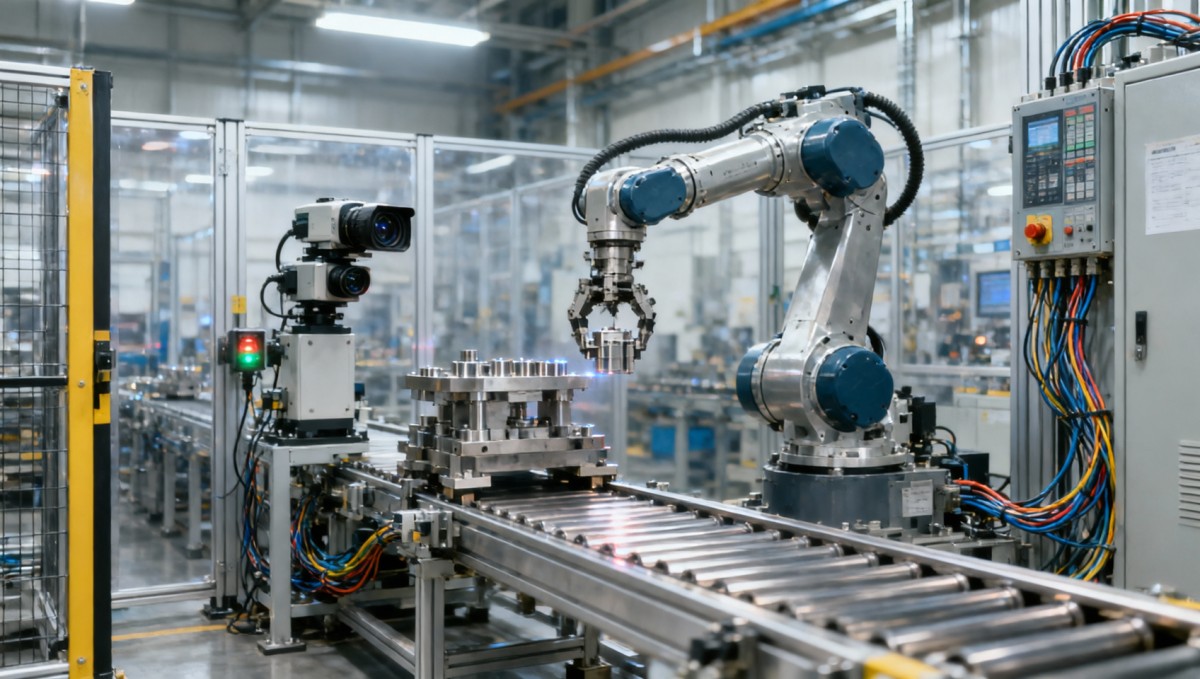
Sensor reliability is a process risk, not a component specification
Sensors are often selected by reading a datasheet under ideal conditions. Integration problems occur because the installed environment differs from the test condition. Reflective surfaces can confuse photoelectric sensors. Dark materials can reduce contrast. Welding arcs, variable ambient light, coolant spray, dust, electromagnetic interference, and cable movement can all affect signal quality.
Machine vision presents a similar challenge. Resolution alone does not determine whether an inspection or guidance application will work. Lens selection, working distance, depth of field, lighting geometry, exposure time, part finish, motion blur, and calibration stability all influence the usable result. A camera may produce a sharp image while still failing to distinguish the feature that matters to the process.
Instead of asking whether a sensor “works,” define the condition it must reliably detect and the conditions it must reject. Test representative variations in material, finish, orientation, contamination, and lighting. Include expected degradation, such as a dirty protective cover or aged illumination. The response to uncertain sensor input should also be engineered. In some processes, a low-confidence vision result should trigger a controlled reject. In others, stopping the cell is safer. Letting uncertain data continue through the process without a defined rule creates both quality and safety exposure.
Do not use filtering to conceal unstable signals
Debounce timers, averaging, and software filters can be appropriate, but they are frequently used to quiet an underlying hardware or process problem. Excessive filtering may delay detection long enough for a robot to act on an outdated state. The better sequence is to inspect mounting rigidity, sensing distance, target geometry, electrical noise, grounding, shielding, and environmental protection before changing logic.
Safety integration can be complete on paper and weak in operation
Safety is more than an emergency-stop circuit. An integrated cell may include guarding, safety scanners, interlocked doors, enabling devices, safe torque off, speed monitoring, zoning, muting logic, and safety-rated communication. Each function can work individually while the combined system leaves unsafe or unproductive gaps.
Consider an operator clearing a jam at a conveyor transfer. The robot may be stopped, but stored pneumatic energy, gravity-loaded tooling, a vertical axis, or an automatic restart sequence can still create danger. Conversely, overly broad safety zoning may stop an entire line whenever a person enters a low-risk service area, encouraging operators to bypass safeguards to maintain output.
The safety design should be reviewed against realistic intervention tasks, not only normal automatic operation. Map how personnel load material, inspect parts, clear faults, change tooling, calibrate sensors, and restart after a protective stop. Each task needs defined conditions for access, energy isolation, motion prevention, and restart authorization. A restart should require the system to confirm that its state is known; it should not assume that a part, tool, or person is where it was before the interruption.
Changes made during commissioning require the same discipline. Temporary bypasses, forced I/O, disabled alarms, and modified safety distances are common sources of latent risk. Every temporary change needs ownership, documentation, a removal condition, and verification before production release.
Cybersecurity and remote access can become an unplanned production dependency
Connecting operational technology to enterprise systems, cloud services, vendor portals, or remote support tools can improve visibility and troubleshooting. It also expands the attack surface and introduces new failure paths. A ransomware event, an unmanaged remote session, a compromised engineering workstation, or an accidental network configuration change can interrupt equipment that was previously isolated.
The integration risk is not solved by treating the plant network like an office network. Industrial controls may have strict availability requirements, older operating environments, proprietary protocols, and limited tolerance for scanning or unplanned updates. The first question is not whether a device can be connected; it is what connection is necessary for the process and what failure behavior is acceptable.
Segment networks according to function and criticality. Limit remote access to approved paths, named users, and defined time windows. Maintain an inventory of controllers, drives, industrial PCs, firmware versions, and software dependencies. Back up validated controller programs, HMI projects, recipes, and configurations in a form that can be restored under pressure. A backup that has never been checked for compatibility with the available hardware is not a recovery plan.
Also establish who can modify logic and who approves changes. Uncontrolled edits made to restore production quickly can create faults that appear weeks later, after the person who made the change is no longer available.
Data latency and poor data quality distort operational decisions
Automation projects increasingly depend on data beyond the local control loop: production counts, traceability records, predictive maintenance signals, quality images, energy data, and alarms sent to supervisory systems. The risk is assuming every data point has the same urgency. A robot safety function cannot rely on a delayed database update. A maintenance dashboard may tolerate delays, but it cannot support useful decisions if timestamps, machine states, or unit definitions are inconsistent.
Separate real-time control from monitoring and business reporting. Determine which decisions must remain inside the PLC, robot controller, drive, or safety system, and which can be handled by edge gateways or higher-level software. For each critical record, define the source of truth, timestamp method, retention requirement, and behavior when connectivity is lost.
Traceability is particularly vulnerable to bad handoffs. If a serial number is attached to a pallet at one station but a rework loop changes pallet order without a controlled association, downstream records may look complete while referring to the wrong physical part. Test loss of communication, duplicated messages, out-of-order events, and manual rework. Data integrity must be validated with the physical process, not only within a database screen.
Supplier boundaries can create the most expensive commissioning delays
Industrial automation integration commonly involves multiple parties: machine builders, robot suppliers, controls engineers, vision specialists, IT teams, safety reviewers, tooling providers, and internal maintenance staff. Problems escalate when each party considers its own equipment complete while no one owns the behavior of the assembled system.
A useful way to expose this risk is to identify every cross-supplier boundary before purchase orders are finalized. Who provides the network architecture? Who sets robot paths after final tooling is installed? Who calibrates the camera after a fixture replacement? Who validates throughput with actual parts? Who corrects a fault that appears only when two machines exchange data? Vague wording such as “integration support included” does not answer these questions.
Acceptance testing should reflect production conditions and known exception states. A factory test can confirm basic functionality, but site acceptance should include representative parts, expected utilities, normal operator actions, planned changeovers, restart behavior, alarm recovery, and defined performance limits. The goal is not to demand perfection from every component. It is to ensure that residual limitations are visible, owned, and acceptable before the cell is handed over.
Commissioning should test recovery as seriously as cycle time
Teams often focus on the best-case cycle. Yet unplanned downtime is usually driven by how the system responds when something is not ideal: a missing part, mispick, communication timeout, safety interruption, power fluctuation, full reject bin, vision failure, or interrupted recipe change. A cell that recovers consistently may deliver more usable output than a faster system that requires engineering intervention after minor faults.
Build fault scenarios into commissioning. For each scenario, record the expected detection method, safe state, operator message, permitted recovery action, and evidence needed before automatic operation resumes. Operator messages should point to a physical condition or clear next action, not only a generic controller error code. Maintenance personnel also need access to diagnostics that distinguish a failed sensor, a blocked mechanism, an unavailable network device, and an interlock that has not been reset.
The question, “What are the biggest risks in industrial automation integration?” therefore has a practical answer: unmanaged interfaces and untested exceptions. Procurement decisions should require evidence of interface ownership, tolerance assumptions, safety behavior, cybersecurity boundaries, and recovery testing. Engineering decisions should translate those commitments into measurable acceptance conditions. When these details are resolved early, automation is far less likely to become a collection of capable machines that cannot reliably operate as one system.
Search News
Hot Articles
- Carbon Fiber StructuresHow to Specify Aerospace Carbon Fiber Assemblies for Lightweight, Load-Bearing PartsJul 11, 2026
- Machine VisionXiaomi, Alibaba DAMO Academy Drive Open-Source Robotics Model Ecosystem, Lowering Algorithm Development Barriers for Overseas SMEs Adopting Chinese Robotics SolutionsMar 30, 2026
- Cobots & ArmsShanxi 'AI+' Conference Showcases Embodied Intelligence with Multinational Buyer Engagement: Key Industry ImplicationsMar 30, 2026
Popular Tags
Recommended News
 Jul 11, 2026How to Specify Aerospace Carbon Fiber Assemblies for Lightweight, Load-Bearing PartsAerospace carbon fiber assemblies: learn how to specify laminate design, load data, joining methods, and inspection controls for lighter, reliable load-bearing aerospace parts.Elena Rostova (UAV Systems Researcher)
 Mar 30, 2026Xiaomi, Alibaba DAMO Academy Drive Open-Source Robotics Model Ecosystem, Lowering Algorithm Development Barriers for Overseas SMEs Adopting Chinese Robotics SolutionsXiaomi & Alibaba DAMO Academy's open-source robotics models lower algorithm barriers for global SMEs. Boost efficiency in manufacturing, logistics & smart retail with ROS 2 compatible solutions.TSV Data Lab
 Mar 30, 2026Shanxi 'AI+' Conference Showcases Embodied Intelligence with Multinational Buyer Engagement: Key Industry ImplicationsShanxi 'AI+' Conference highlights embodied intelligence with Tesla, Ubtech & Jiantao showcasing multimodal robotics. 40+ global buyers validated tech on-site, creating new B2B channels for industrial automation & AI solutions.Chen Wei (Automation Lead Engineer)
 Mar 30, 2026Zhongguancun Unveils 6G Integrated Sensing-Computing-Intelligence Platform to Empower Embodied Robots for Global Industrial ApplicationsZhongguancun's new 6G platform revolutionizes industrial robotics with <10ms latency, empowering global automotive, logistics & port automation. Discover how this tech boosts China's smart manufacturing exports.TSV Data Lab
 Mar 30, 2026Mech-Mind Tianjin Embodied Intelligence R&D and Production Base Goes Live, Cutting Delivery Time by 20%–30% for Global Customized AMR+Vision SolutionsMech-Mind's Tianjin AMR+Vision production base cuts delivery time by 20%-30% for欧美 & Latin American markets. Discover how this PLd-certified facility accelerates customized robotics solutions for smart manufacturing and logistics.Chen Wei (Automation Lead Engineer)
 Mar 30, 2026Boao Forum Reveals 'Co-evolution of Big and Small Brains' Trend in Humanoid Robots, China's Embodied Intelligence Accelerates Adaptation to Overseas Manufacturing Service ScenariosDiscover how China's humanoid robots, featuring 'Co-evolution of Big and Small Brains,' are revolutionizing global manufacturing. Learn about Embodied Tian Gong 3.0's ISO compliance and overseas deployment at Boao Forum 2026.Chen Wei (Automation Lead Engineer)
 Mar 30, 2026China Railway Industrial Secures Patent for Embodied Robotics in Material Handling, Boosting High-Precision Delivery Capabilities for Overseas Infrastructure and Manufacturing ProjectsChina Railway Industrial's new patent for embodied robotics in material handling boosts high-precision delivery for global infrastructure & manufacturing. Discover how this innovation enhances logistics accuracy in automotive, rail transit & EPC projects.Chen Wei (Automation Lead Engineer)
 Oct 10, 2026How to Select a Machine Performance Monitoring Platform for OEE and Downtime ReductionMachine performance monitoring platform selection guide: validate machine states, OEE data, downtime reasons, integrations, and scalability to reduce losses with confidence.TSV Data Lab
 Oct 08, 2026How to Machine Inconel 625 Blades Without Heat Cracks or Edge ChippingInconel 625 blade machining guide: prevent heat cracks, edge chipping, chatter, and work hardening with proven tooling, cooling, fixturing, and inspection strategies.Dr. Marcus Vance
 Oct 07, 2026How to Evaluate an HMI Panel Distributor for Industrial Automation ProjectsHMI panel distributor evaluation guide: verify technical compatibility, traceability, supply reliability, lifecycle support, and total cost for automation projects.Victor Lin (Chief Software Architect)
 Oct 06, 2026Navigation Fault Tolerance Standards for AMRs: What Safety Teams Must VerifyNavigation fault tolerance standards: learn what AMR safety teams must verify, from localization loss and sensor faults to stopping distance, safe restart, and site-specific validation.Chen Wei (Automation Lead Engineer)
 Oct 05, 2026Calculating Edge Computing Total Cost of Ownership Across Distributed SitesEdge computing ownership cost explained: calculate deployment, energy, connectivity, security, remote support, and refresh costs across distributed sites.TSV Data Lab
 Oct 04, 2026CAD/CAM Benchmarking in the GCC: What Manufacturers Should Ask a ConsultantCAD CAM benchmark consultant GCC guide: learn the key questions manufacturers should ask to validate post-processors, workflows, machine performance, and production risk.Victor Lin (Chief Software Architect)
 Oct 03, 2026Selecting Automotive Radar Sensor Modules for ADAS Range, Resolution, and IntegrationAutomotive radar sensor module selection guide for ADAS: compare range, resolution, field of view, latency, and integration to build safer, reliable vehicle systems.TSV Data Lab
 Oct 02, 2026How to Qualify Machined Parts Suppliers for Hard Tech ProgramsHard tech supply chain machined parts demand rigorous supplier qualification. Learn how to assess capability, traceability, quality controls, and delivery resilience.Dr. Marcus Vance
 Oct 01, 2026How to Select an Outdoor Security Radar Sensor for Perimeter Detection?Outdoor security radar sensor selection guide: compare range, accuracy, false-alarm control, integration, and field testing for reliable perimeter detection.TSV Data Lab
 Sep 30, 2026How to Evaluate Solid-State LiDAR Hardware for Outdoor Autonomous VehiclesSolid state LiDAR hardware evaluation guide for outdoor autonomous vehicles—compare range, point-cloud quality, environmental resilience, integration, and safety.TSV Data Lab
 Sep 29, 2026ISO 9283 Repeatability: How to Evaluate Cobot Positioning PerformanceISO 9283 cobot repeatability explained: learn how payload, reach, approach direction, and test conditions affect positioning performance and cell capability.Chen Wei (Automation Lead Engineer)
 Oct 10, 2026When does the cost of industrial robots pay back in high-volume production?Cost of industrial robots: discover how high-volume manufacturers calculate payback through uptime, cycle time, labor, quality, and integration before investing.Chen Wei (Automation Lead Engineer)
 Oct 09, 2026What does a manufacturing robot really cost beyond the purchase price?Manufacturing robot cost goes far beyond the purchase price. Explore integration, tooling, safety, uptime, and total ownership factors for smarter automation investments.Chen Wei (Automation Lead Engineer)
 Oct 08, 2026AGV vs. AMR: Which Is Better for Frequently Changing Routes?Which is better for changing routes? Compare AGVs and AMRs for flexible navigation, docking precision, traffic control, and faster facility reconfiguration.Chen Wei (Automation Lead Engineer)
 Oct 07, 2026How Much Does an Automated Guided Vehicle Cost in 2026?How much does an automated guided vehicle cost in 2026? Explore AGV price ranges, hidden deployment costs, and smart buying factors for stronger ROI.Chen Wei (Automation Lead Engineer)
 Oct 06, 2026Are Collaborative Robots Safe Enough to Operate Without Fencing?Are collaborative robots safe enough to work without fencing? Explore risk assessment, safeguarding options, and practical guidance for safer, productive cobot cells.Chen Wei (Automation Lead Engineer)
 Oct 05, 2026What Causes Machine Vision Systems to Miss Small Defects?What causes machine vision systems to miss small defects? Discover how lighting, optics, motion, and AI thresholds affect detection—and prevent costly escapes.TSV Data Lab