When does the cost of industrial robots pay back in high-volume production?
Publication Date
author
When Does the Cost of Industrial Robots Pay Back in High-Volume Production?
The cost of industrial robots is no longer defined by purchase price alone. In high-volume production, payback depends on cycle time, uptime, labor displacement, maintenance exposure, integration complexity, and measurable quality gains. For enterprise decision-makers, the critical question is not whether automation can improve throughput, but when verified operating data shows that robot deployment has crossed the break-even threshold.
That distinction matters because a robot cell can look economically compelling in a supplier presentation while producing a very different result on the factory floor. A quoted arm price may represent only one visible portion of the investment. End effectors, guarding, vision systems, conveyor changes, controls engineering, safety validation, line commissioning, operator training, spare parts, and production ramp-up can materially change the business case. In high-volume environments, those details are not secondary. They determine whether the system repays its cost quickly, slowly, or not at all.
Payback Begins With the Right Cost Boundary
Procurement teams often begin with a straightforward comparison: annual labor expense versus the capital cost of a robot. It is a useful starting point, but it is not a complete investment model. A better approach is to define the total installed cost and compare it with the annual economic benefit that can be verified after deployment.
The total installed cost should normally include the robot or robots, controller, tooling, fixtures, safety equipment, integration engineering, electrical and pneumatic work, software, commissioning, acceptance testing, and initial training. Depending on the application, machine vision, force sensing, part presentation, palletizing hardware, or traceability interfaces may be substantial items. If an existing line must be stopped or modified to accommodate the cell, the cost of disruption should be visible in the approval process rather than absorbed as an operational surprise.
Annual benefit is equally broader than labor reduction. It may include fewer direct labor hours, reduced overtime and temporary staffing, higher output from a constrained operation, lower scrap, fewer rework cycles, more stable inspection results, and less exposure to repetitive or hazardous tasks. Not every benefit should be assigned the same confidence level. A labor position that can genuinely be redeployed or avoided is different from an assumed productivity benefit that still depends on demand, downstream capacity, or customer release schedules.
A practical screen is:
Simple payback period = Total installed cost ÷ annual verified net benefit.
The word verified is essential. Net benefit should subtract additional maintenance, utilities, consumables, software support, planned downtime, and any new technical labor required to keep the cell available. For a major capital decision, the simple-payback view should then be tested against the organization’s usual financial measures, such as cash-flow timing, depreciation treatment, financing cost, and required return thresholds.
Why High Volume Changes the Economics
Industrial robots tend to pay back most reliably when they are assigned to stable, repetitive work with enough annual operating hours to spread fixed integration costs over many units. High production volume alone is not sufficient; the work must also be suitable for repeatable automation. A fast robot cannot rescue an unstable process with inconsistent incoming parts, poorly controlled fixturing, frequent engineering changes, or unclear quality criteria.
The strongest candidates usually have a predictable product mix, established cycle requirements, manageable part variation, and a recognized bottleneck. Packaging, welding, machine tending, palletizing, dispensing, inspection, material handling, and repetitive assembly can be attractive applications when the surrounding process is designed to support them. The economic case becomes stronger when the robot can operate across multiple shifts or during hours when labor coverage is difficult to maintain.
Conversely, low annual utilization can make even a technically successful project financially weak. A robot that runs only during a limited production window carries nearly the same installed capital burden as one used for extended shifts. This is why planned operating hours, expected demand, changeover frequency, and seasonal production patterns should be examined before a purchase order is issued.
The relevant calculation is not “How many units can the robot produce per minute?” It is “How many conforming units can the complete system produce across its scheduled operating time?” That requires attention to loading, unloading, part orientation, inspection failures, buffer capacity, recovery after faults, and changeover discipline.
Cycle Time Is Useful Only When It Includes Reality
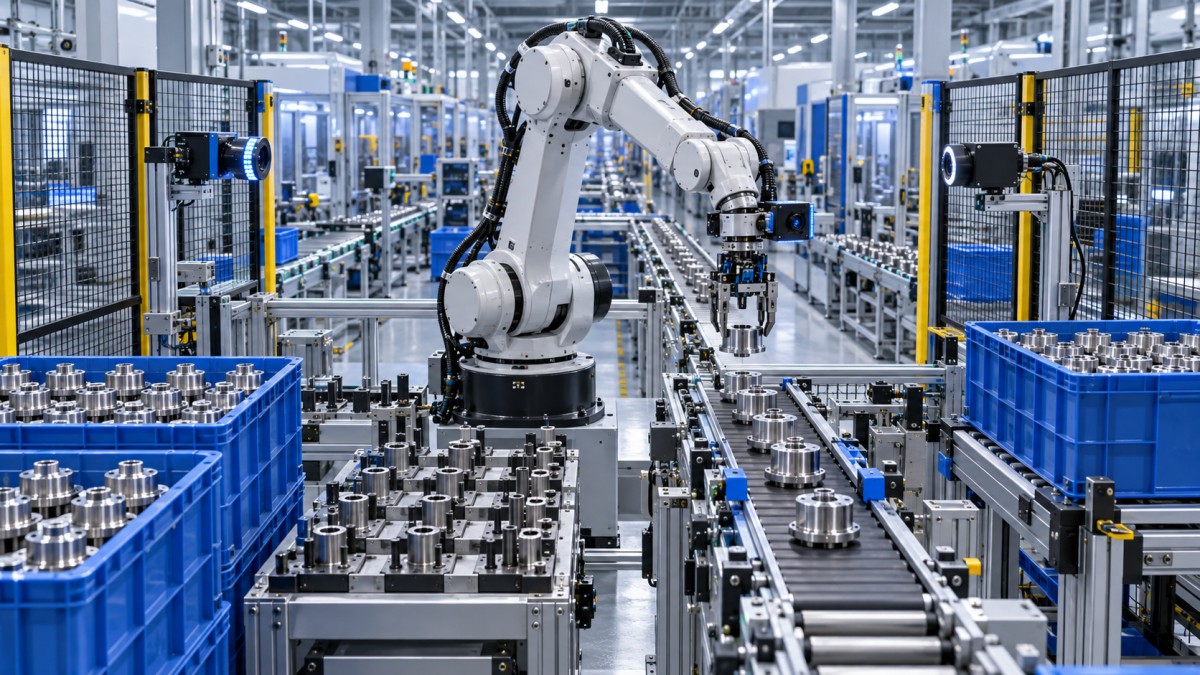
Robot suppliers commonly provide nominal speed and payload specifications, but nominal motion speed is not production cycle time. The actual cycle must include approach and retreat paths, gripper actuation, sensor confirmation, machine interlocks, vision processing, safety zones, conveyor synchronization, and the occasional need to retry a pick or placement. Where a robot services a CNC machine, press, test station, or packaging machine, the equipment around the robot often sets the maximum sustainable output.
Decision-makers should ask for a cycle-time study based on representative parts and the proposed layout. The study should identify assumptions: part orientation, fixture condition, line speed, number of robot axes, payload including tooling, and whether the stated time reflects a simulation, a laboratory test, or a run on a comparable installed cell. These sources are not equivalent.
A few seconds may appear insignificant until multiplied across a high-volume schedule. Yet chasing theoretical speed can also create an expensive mistake. Higher acceleration may require stiffer tooling, more robust guarding, tighter part control, or reduced payload margins. The right target is a stable cycle that meets the required throughput with sufficient recovery margin, not the most aggressive motion profile demonstrated under ideal conditions.
Uptime Is Often the Deciding Variable
In a high-volume line, availability can outweigh a modest difference in robot purchase price. An automation cell that is unavailable during a production peak may require manual fallback, overtime, expedited maintenance, or delayed shipments. Those costs rarely appear in the original robot quote, but they are central to the real cost of industrial robots over their operating life.
Availability should be examined at the cell level. Robot reliability matters, but so do grippers, feeders, sensors, cameras, cables, pneumatics, conveyors, fixtures, safety devices, and control-network interfaces. A vision-guided picking application, for example, may be constrained less by the robot than by changing surface finishes, inconsistent lighting, or poorly managed part presentation.
Procurement specifications should therefore ask suppliers to separate planned maintenance from unplanned stoppage and to state how faults are detected, recovered, and recorded. Mean Time Between Failures can be informative, but it should never be read as a promise of line availability. The operating environment matters: abrasive dust, weld spatter, washdown conditions, temperature variation, electromagnetic interference, and frequent high-speed motion all influence the service burden of the complete installation.
A serious acceptance plan also defines what counts as a cycle, a stoppage, a quality failure, and a successful recovery. Without those definitions, an integrator and a plant may both claim that the system is performing well while measuring different things.
Labor Savings Must Be Treated Honestly
Labor is often the largest item in a robot payback model, and it is also the easiest to overstate. The proper question is not how many people touch the process today. It is how many paid hours can realistically be removed, redeployed to a constrained activity, or avoided as production expands. If an operator must remain at the station to replenish components, resolve faults, inspect output, and perform changeovers, the labor displacement may be partial rather than complete.
This does not make the project unattractive. Partial labor redeployment can still be valuable, particularly where turnover, repetitive-task fatigue, shift coverage, ergonomic risk, or recruiting difficulty is persistent. It simply means that the business case should distinguish between direct cash savings, capacity released for other work, and risk reduction. Blending these categories into a single unsupported labor number creates a fragile approval model.
Training is part of this equation. Plants that designate owners for routine recovery, preventive maintenance, program adjustment, and spare-parts control generally reduce their dependence on emergency external support. The cost of developing those capabilities belongs in the initial plan, but so does the avoided cost of repeated troubleshooting later.
Quality Gains Can Be More Valuable Than Faster Output
Automation may pay back through quality even when direct labor savings are modest. Consistent dispensing paths, controlled weld trajectories, repeatable handling, measured placement, and machine-vision inspection can reduce variation in operations where manual execution is difficult to standardize. In regulated, aerospace, medical, or high-consequence manufacturing environments, traceability and process discipline may carry value beyond the cost of a rejected part.
Still, quality benefits should be tied to an existing baseline. Before automation, measure the current reject categories, rework causes, inspection escapes, and process variation. After commissioning, use the same definitions. A claim that robotics will “improve quality” is not enough for capital planning; the question is which defect mechanism will be reduced and how the reduction will be observed.
This is particularly important when adding sensors or vision. Resolution alone does not establish inspection performance. Lens selection, lighting geometry, contrast, part position, software logic, calibration, and false-reject handling all affect usable results. The sensor, robot, fixture, and quality process must be evaluated as one system.
Integration Risk Is Not an Administrative Detail
Many delayed payback projects are not caused by the robot itself. They are caused by underestimated integration. A robot arm may be selected correctly while the line lacks adequate part presentation, safe access for maintenance, network architecture, floor space, utility capacity, or a clear method for handling exceptions. The result is additional engineering after installation, when change is most expensive.
Before comparing vendors, establish a specification that describes the operating environment, part range, takt requirement, expected shift pattern, payload including end-of-arm tooling, required repeatability, quality checks, safety approach, data interfaces, and acceptance criteria. For a multi-site organization, it is also worth clarifying programming standards, spare-parts strategy, local service coverage, documentation language, and long-term controller support.
TechStat Vanguard approaches this issue from a simple premise: engineering claims should be traceable to operating parameters. In robotics and automation, that means looking beyond broad statements about intelligence or flexibility and examining repeatability, recovery behavior, component exposure, maintenance data, fault tolerance, and the evidence behind claimed throughput. Parameters do not lie, but they must be collected in conditions that resemble the intended application.
A Better Decision Gate Before Full Deployment
For complex or high-value installations, a staged decision can reduce uncertainty. Start with a line study that maps current cycle time, labor content, downtime causes, quality loss, and variation in incoming material. Then build the automation concept around the real bottleneck rather than the most visible manual task. A proof-of-concept may be appropriate where gripping, vision, surface finish, or process interaction remains uncertain, but it should test the difficult conditions rather than a simplified demonstration.
The final approval should include a sensitivity review. What happens if actual throughput is lower than planned? If one shift is removed from the schedule? If the system needs more human support than expected? If scrap reduction does not materialize? A project that remains acceptable under reasonable downside assumptions is far more defensible than one that only works at perfect utilization.
The cost of industrial robots pays back when the installed system delivers sustained, measurable economic benefit—not when the robot is delivered, and not when a simulation reaches its fastest cycle. High-volume production creates the opportunity for rapid payback because fixed automation costs can be spread over many units. It also magnifies every hidden weakness in uptime, integration, maintenance, and quality control. The most reliable procurement decisions are built from observed process data, explicit acceptance criteria, and a model that gives equal weight to engineering reality and financial return.
Search News
Hot Articles
- Carbon Fiber StructuresHow to Specify Aerospace Carbon Fiber Assemblies for Lightweight, Load-Bearing PartsJul 11, 2026
- Machine VisionXiaomi, Alibaba DAMO Academy Drive Open-Source Robotics Model Ecosystem, Lowering Algorithm Development Barriers for Overseas SMEs Adopting Chinese Robotics SolutionsMar 30, 2026
- Cobots & ArmsShanxi 'AI+' Conference Showcases Embodied Intelligence with Multinational Buyer Engagement: Key Industry ImplicationsMar 30, 2026
Popular Tags
Recommended News
 Jul 11, 2026How to Specify Aerospace Carbon Fiber Assemblies for Lightweight, Load-Bearing PartsAerospace carbon fiber assemblies: learn how to specify laminate design, load data, joining methods, and inspection controls for lighter, reliable load-bearing aerospace parts.Elena Rostova (UAV Systems Researcher)
 Mar 30, 2026Xiaomi, Alibaba DAMO Academy Drive Open-Source Robotics Model Ecosystem, Lowering Algorithm Development Barriers for Overseas SMEs Adopting Chinese Robotics SolutionsXiaomi & Alibaba DAMO Academy's open-source robotics models lower algorithm barriers for global SMEs. Boost efficiency in manufacturing, logistics & smart retail with ROS 2 compatible solutions.TSV Data Lab
 Mar 30, 2026Shanxi 'AI+' Conference Showcases Embodied Intelligence with Multinational Buyer Engagement: Key Industry ImplicationsShanxi 'AI+' Conference highlights embodied intelligence with Tesla, Ubtech & Jiantao showcasing multimodal robotics. 40+ global buyers validated tech on-site, creating new B2B channels for industrial automation & AI solutions.Chen Wei (Automation Lead Engineer)
 Mar 30, 2026Zhongguancun Unveils 6G Integrated Sensing-Computing-Intelligence Platform to Empower Embodied Robots for Global Industrial ApplicationsZhongguancun's new 6G platform revolutionizes industrial robotics with <10ms latency, empowering global automotive, logistics & port automation. Discover how this tech boosts China's smart manufacturing exports.TSV Data Lab
 Mar 30, 2026Mech-Mind Tianjin Embodied Intelligence R&D and Production Base Goes Live, Cutting Delivery Time by 20%–30% for Global Customized AMR+Vision SolutionsMech-Mind's Tianjin AMR+Vision production base cuts delivery time by 20%-30% for欧美 & Latin American markets. Discover how this PLd-certified facility accelerates customized robotics solutions for smart manufacturing and logistics.Chen Wei (Automation Lead Engineer)
 Mar 30, 2026Boao Forum Reveals 'Co-evolution of Big and Small Brains' Trend in Humanoid Robots, China's Embodied Intelligence Accelerates Adaptation to Overseas Manufacturing Service ScenariosDiscover how China's humanoid robots, featuring 'Co-evolution of Big and Small Brains,' are revolutionizing global manufacturing. Learn about Embodied Tian Gong 3.0's ISO compliance and overseas deployment at Boao Forum 2026.Chen Wei (Automation Lead Engineer)
 Mar 30, 2026China Railway Industrial Secures Patent for Embodied Robotics in Material Handling, Boosting High-Precision Delivery Capabilities for Overseas Infrastructure and Manufacturing ProjectsChina Railway Industrial's new patent for embodied robotics in material handling boosts high-precision delivery for global infrastructure & manufacturing. Discover how this innovation enhances logistics accuracy in automotive, rail transit & EPC projects.Chen Wei (Automation Lead Engineer)
 Oct 10, 2026How to Select a Machine Performance Monitoring Platform for OEE and Downtime ReductionMachine performance monitoring platform selection guide: validate machine states, OEE data, downtime reasons, integrations, and scalability to reduce losses with confidence.TSV Data Lab
 Oct 08, 2026How to Machine Inconel 625 Blades Without Heat Cracks or Edge ChippingInconel 625 blade machining guide: prevent heat cracks, edge chipping, chatter, and work hardening with proven tooling, cooling, fixturing, and inspection strategies.Dr. Marcus Vance
 Oct 07, 2026How to Evaluate an HMI Panel Distributor for Industrial Automation ProjectsHMI panel distributor evaluation guide: verify technical compatibility, traceability, supply reliability, lifecycle support, and total cost for automation projects.Victor Lin (Chief Software Architect)
 Oct 06, 2026Navigation Fault Tolerance Standards for AMRs: What Safety Teams Must VerifyNavigation fault tolerance standards: learn what AMR safety teams must verify, from localization loss and sensor faults to stopping distance, safe restart, and site-specific validation.Chen Wei (Automation Lead Engineer)
 Oct 05, 2026Calculating Edge Computing Total Cost of Ownership Across Distributed SitesEdge computing ownership cost explained: calculate deployment, energy, connectivity, security, remote support, and refresh costs across distributed sites.TSV Data Lab
 Oct 04, 2026CAD/CAM Benchmarking in the GCC: What Manufacturers Should Ask a ConsultantCAD CAM benchmark consultant GCC guide: learn the key questions manufacturers should ask to validate post-processors, workflows, machine performance, and production risk.Victor Lin (Chief Software Architect)
 Oct 03, 2026Selecting Automotive Radar Sensor Modules for ADAS Range, Resolution, and IntegrationAutomotive radar sensor module selection guide for ADAS: compare range, resolution, field of view, latency, and integration to build safer, reliable vehicle systems.TSV Data Lab
 Oct 02, 2026How to Qualify Machined Parts Suppliers for Hard Tech ProgramsHard tech supply chain machined parts demand rigorous supplier qualification. Learn how to assess capability, traceability, quality controls, and delivery resilience.Dr. Marcus Vance
 Oct 01, 2026How to Select an Outdoor Security Radar Sensor for Perimeter Detection?Outdoor security radar sensor selection guide: compare range, accuracy, false-alarm control, integration, and field testing for reliable perimeter detection.TSV Data Lab
 Sep 30, 2026How to Evaluate Solid-State LiDAR Hardware for Outdoor Autonomous VehiclesSolid state LiDAR hardware evaluation guide for outdoor autonomous vehicles—compare range, point-cloud quality, environmental resilience, integration, and safety.TSV Data Lab
 Sep 29, 2026ISO 9283 Repeatability: How to Evaluate Cobot Positioning PerformanceISO 9283 cobot repeatability explained: learn how payload, reach, approach direction, and test conditions affect positioning performance and cell capability.Chen Wei (Automation Lead Engineer)
 Oct 10, 2026When does the cost of industrial robots pay back in high-volume production?Cost of industrial robots: discover how high-volume manufacturers calculate payback through uptime, cycle time, labor, quality, and integration before investing.Chen Wei (Automation Lead Engineer)
 Oct 09, 2026What does a manufacturing robot really cost beyond the purchase price?Manufacturing robot cost goes far beyond the purchase price. Explore integration, tooling, safety, uptime, and total ownership factors for smarter automation investments.Chen Wei (Automation Lead Engineer)
 Oct 08, 2026AGV vs. AMR: Which Is Better for Frequently Changing Routes?Which is better for changing routes? Compare AGVs and AMRs for flexible navigation, docking precision, traffic control, and faster facility reconfiguration.Chen Wei (Automation Lead Engineer)
 Oct 07, 2026How Much Does an Automated Guided Vehicle Cost in 2026?How much does an automated guided vehicle cost in 2026? Explore AGV price ranges, hidden deployment costs, and smart buying factors for stronger ROI.Chen Wei (Automation Lead Engineer)
 Oct 06, 2026Are Collaborative Robots Safe Enough to Operate Without Fencing?Are collaborative robots safe enough to work without fencing? Explore risk assessment, safeguarding options, and practical guidance for safer, productive cobot cells.Chen Wei (Automation Lead Engineer)
 Oct 05, 2026What Causes Machine Vision Systems to Miss Small Defects?What causes machine vision systems to miss small defects? Discover how lighting, optics, motion, and AI thresholds affect detection—and prevent costly escapes.TSV Data Lab