Is a Parachute Recovery System Required for Commercial Drones?
Publication Date
author
Is a parachute recovery system required for commercial drones? Not automatically. A recovery parachute is rarely a universal legal requirement attached to every commercial UAV, but it can become a practical requirement of a specific operation, authorization pathway, client safety plan, insurer, or internal engineering standard.
That distinction matters. Many procurement discussions begin with a simple yes-or-no question and end with an unsuitable payload penalty, an unproven deployment concept, or a compliance assumption that does not survive review. The better question is: does this aircraft, flying this mission over this ground environment, need an independently verifiable means of reducing impact risk after a critical failure?
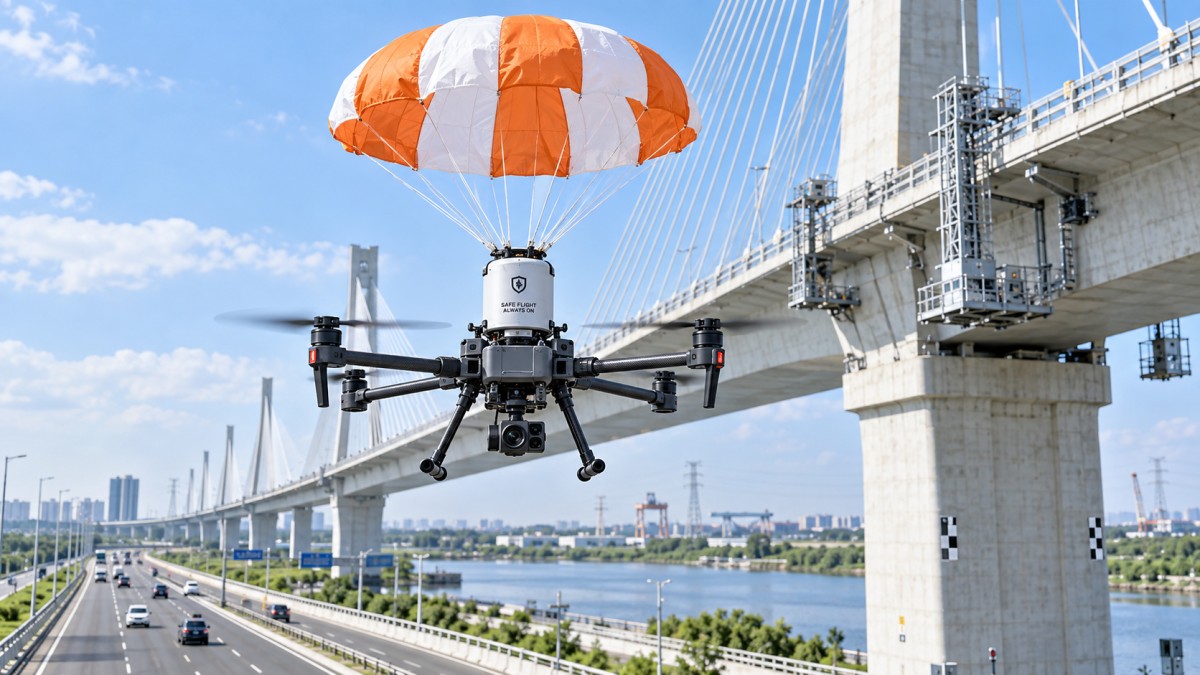
For operators flying over isolated farmland, a parachute may add cost and maintenance without materially improving an already low-risk ground profile. For a multirotor conducting bridge inspection beside moving traffic, surveying a construction site near workers, or operating beyond visual line of sight (BVLOS), the same system may be central to the safety case. Its value is not the canopy itself. Its value is the measured reduction in residual risk.
A parachute is usually an operational decision before it is a hardware decision
Commercial drone rules vary by jurisdiction, aircraft category, and intended operation. A regulator may not prescribe “install a parachute” in ordinary operating rules, yet may expect the operator to demonstrate that a proposed flight does not create unacceptable risk to people, property, or other airspace users. That expectation becomes sharper when a mission moves beyond routine conditions: operations near uninvolved people, flights over populated areas, higher-mass aircraft, BVLOS missions, or special approvals and waivers.
In the United States, for example, operators must consider the applicable Federal Aviation Administration framework and the exact operating conditions being requested or conducted. In Europe, the applicable national authority and the European aviation framework may lead to a risk-based assessment for certain operations. Neither environment should be reduced to a generic online claim that parachutes are “required” or “not required.” The controlling question is the approved operating concept and the documentation supporting it.
A strong safety case does not treat the parachute as a shortcut around every other problem. It considers the entire chain: aircraft reliability, command-and-control link integrity, navigation behavior, flight termination logic, launch area, emergency landing options, people on the ground, and post-deployment consequences. A parachute can reduce descent energy; it cannot guarantee a safe landing location.
When a recovery system is most likely to be justified
The clearest use case is a mission where a loss of propulsion or flight-control authority could put uninvolved people beneath or near the aircraft. This does not only mean a dense urban setting. A utility inspection can pass above roadside work zones. A mapping route can cross a public footpath. A roofing survey may take place next to a school, warehouse entrance, or parking area where the ground scene changes minute by minute.
Mission planners should also look beyond the intended flight path. Wind drift during canopy descent may move the aircraft well away from the point of failure. A system that deploys successfully over an open field may produce a poor outcome if it deploys at low altitude beside traffic, power lines, water, rotating machinery, or a crowded access road. The recovery footprint belongs in the pre-flight plan.
There is another, less obvious trigger: contractual risk. Large infrastructure, energy, mining, and logistics organizations often have their own aviation or contractor safety requirements. An operator may be legally able to perform the flight without a parachute, while still being unable to win the work or obtain site access without one. In that situation, the decision is commercial, but it must still be technically defensible.
The engineering numbers that deserve more attention than marketing claims
“Fast deployment” and “safe landing” are not specifications. A parachute recovery system should be evaluated as an integrated subsystem with known limits. The most important question is whether it can deploy early enough, reliably enough, and predictably enough for the flight envelope that matters.
Start with total takeoff mass, including battery, sensor, mounting hardware, parachute assembly, and any protective enclosure. A system selected from a nominal aircraft-weight range may be unsuitable once a LiDAR unit, gas sensor, or oblique camera has been installed. Then review the published or tested descent performance for that actual configuration, not merely for a bare airframe.
Deployment altitude is equally important. A recovery device has a sequence: failure detection, trigger decision, release or ejection, canopy extraction, inflation, and stabilization. If the aircraft fails at very low altitude, there may be insufficient vertical distance for the system to produce the descent profile assumed in the safety analysis. Operators sometimes overlook this because their routine cruise altitude looks generous. Takeoff, landing, terrain-following segments, and close-proximity inspection passes are where altitude margins can disappear.
Other parameters should be visible in the procurement file:
- Trigger architecture: manual, automatic, or both; and whether the trigger is independent of the primary flight controller.
- Activation logic: how the system distinguishes a true emergency from a brief sensor fault, aggressive maneuver, or temporary communications interruption.
- Propeller shutdown behavior: whether rotors stop before canopy deployment and how that decision affects entanglement risk.
- Environmental limits: wind, rain, dust, vibration, temperature, and electromagnetic conditions relevant to the intended mission.
- Packing, inspection, and replacement intervals: a recovery device that is never repacked or function-tested is not a credible mitigation.
- Interface effects: added drag, shifted center of gravity, altered GPS or radio placement, and changed payload capacity.
For multirotors, a poorly integrated module can affect handling more than teams expect. A few hundred grams may be operationally minor on a large platform but significant on a compact inspection drone. It can shorten endurance, reduce wind margin, or force a battery change that introduces its own thermal and reliability considerations. The right comparison is not parachute versus no parachute in isolation. It is mission capability and risk exposure before and after integration.
A recovery parachute does not replace aircraft reliability
This is where engineering discipline matters. If a platform has intermittent GNSS behavior, weak connector retention, uncertain battery health controls, or poorly characterized electromagnetic susceptibility, adding a parachute may merely mask a deeper qualification gap. The recovery system is intended for low-probability, high-consequence events. It should not become the primary answer to predictable failures.
The most credible operators build layered controls. They inspect propulsion and airframe condition, set conservative battery reserves, verify firmware compatibility, establish geofenced routes and emergency procedures, maintain ground separation, and use a recovery system where the remaining risk warrants it. In other words, the parachute sits near the end of the safety chain, not at the beginning.
The same applies to testing. A bench check of an electronic trigger is useful, but it does not prove field performance. Integration testing should consider the installed payload, aircraft orientation at activation, realistic vibration, and the failure modes identified in the operation’s risk assessment. Test planning must be lawful, controlled, and appropriate to the location. It is not sensible to validate a recovery system for the first time above an active project site.
How to make a defensible go-or-no-go decision
A practical decision starts with a mission profile rather than a supplier catalogue. Map the route, operating altitude, expected wind, crew positions, public access points, and likely emergency descent areas. Identify who could be affected if the UAV loses power at different points in the mission. Then quantify what can be verified: takeoff mass, operating speed, descent behavior, reaction time, available altitude, and drift exposure.
Next, separate mandatory requirements from preferred safeguards. Review the regulations and authorizations applicable to the place of operation. Check the customer’s safety documentation and insurance conditions. If a parachute is being cited as a requirement, ask for the exact source: an operating approval condition, a contract clause, an insurer requirement, or an internal policy. This avoids a familiar procurement mistake—buying a system to satisfy a rule that was never actually applicable.
Finally, demand evidence in a form engineers can use. A supplier should be able to explain compatibility boundaries, maintenance instructions, trigger dependencies, and known limitations without relying on vague assurances. Independent test information, where available and relevant, is more useful than broad claims of compliance. The documentation should also make clear whether the system is intended for a particular platform configuration or whether additional integration validation is needed.
Why procurement teams should treat recovery systems as traceable safety components
A parachute module is often purchased late in a drone program, after the aircraft and sensor payload have already been chosen. That is backwards for higher-risk commercial missions. Once it affects aircraft mass, balance, endurance, approval documentation, and maintenance routines, it belongs in the original system specification.
This is also a supply-chain issue. A safety-critical accessory needs configuration control: which unit was installed, which firmware or trigger revision it uses, what inspection status it has, and whether the correct packing materials and replacement parts remain available. An inexpensive module with unclear traceability can create more operational uncertainty than it removes.
At TechStat Vanguard, the useful approach is to strip this decision back to engineering truth. Instead of asking whether a recovery system is “best-in-class,” examine the actual tolerances: the mass budget, the minimum effective deployment height, the trigger path, the descent characteristics, the integration burden, and the evidence behind each claim. Parameters do not eliminate judgment, but they give that judgment a firmer place to stand.
So, is a parachute recovery system required for commercial drones? Sometimes by a defined operational condition; often by a prudent risk assessment; and occasionally not at all. The correct answer is mission-specific. If the consequences of a fall cannot be adequately controlled through route design, ground separation, aircraft reliability, and operating procedures, a properly validated recovery system may be necessary. If it is selected, it should be treated as part of the aircraft’s safety architecture—not as an accessory added to make a proposal look safer.
Search News
Hot Articles
- Carbon Fiber StructuresHow to Specify Aerospace Carbon Fiber Assemblies for Lightweight, Load-Bearing PartsJul 11, 2026
- Machine VisionXiaomi, Alibaba DAMO Academy Drive Open-Source Robotics Model Ecosystem, Lowering Algorithm Development Barriers for Overseas SMEs Adopting Chinese Robotics SolutionsMar 30, 2026
- Cobots & ArmsShanxi 'AI+' Conference Showcases Embodied Intelligence with Multinational Buyer Engagement: Key Industry ImplicationsMar 30, 2026
Popular Tags
Recommended News
 Jul 11, 2026How to Specify Aerospace Carbon Fiber Assemblies for Lightweight, Load-Bearing PartsAerospace carbon fiber assemblies: learn how to specify laminate design, load data, joining methods, and inspection controls for lighter, reliable load-bearing aerospace parts.Elena Rostova (UAV Systems Researcher)
 Mar 30, 2026Xiaomi, Alibaba DAMO Academy Drive Open-Source Robotics Model Ecosystem, Lowering Algorithm Development Barriers for Overseas SMEs Adopting Chinese Robotics SolutionsXiaomi & Alibaba DAMO Academy's open-source robotics models lower algorithm barriers for global SMEs. Boost efficiency in manufacturing, logistics & smart retail with ROS 2 compatible solutions.TSV Data Lab
 Mar 30, 2026Shanxi 'AI+' Conference Showcases Embodied Intelligence with Multinational Buyer Engagement: Key Industry ImplicationsShanxi 'AI+' Conference highlights embodied intelligence with Tesla, Ubtech & Jiantao showcasing multimodal robotics. 40+ global buyers validated tech on-site, creating new B2B channels for industrial automation & AI solutions.Chen Wei (Automation Lead Engineer)
 Mar 30, 2026Zhongguancun Unveils 6G Integrated Sensing-Computing-Intelligence Platform to Empower Embodied Robots for Global Industrial ApplicationsZhongguancun's new 6G platform revolutionizes industrial robotics with <10ms latency, empowering global automotive, logistics & port automation. Discover how this tech boosts China's smart manufacturing exports.TSV Data Lab
 Mar 30, 2026Mech-Mind Tianjin Embodied Intelligence R&D and Production Base Goes Live, Cutting Delivery Time by 20%–30% for Global Customized AMR+Vision SolutionsMech-Mind's Tianjin AMR+Vision production base cuts delivery time by 20%-30% for欧美 & Latin American markets. Discover how this PLd-certified facility accelerates customized robotics solutions for smart manufacturing and logistics.Chen Wei (Automation Lead Engineer)
 Mar 30, 2026Boao Forum Reveals 'Co-evolution of Big and Small Brains' Trend in Humanoid Robots, China's Embodied Intelligence Accelerates Adaptation to Overseas Manufacturing Service ScenariosDiscover how China's humanoid robots, featuring 'Co-evolution of Big and Small Brains,' are revolutionizing global manufacturing. Learn about Embodied Tian Gong 3.0's ISO compliance and overseas deployment at Boao Forum 2026.Chen Wei (Automation Lead Engineer)
 Mar 30, 2026China Railway Industrial Secures Patent for Embodied Robotics in Material Handling, Boosting High-Precision Delivery Capabilities for Overseas Infrastructure and Manufacturing ProjectsChina Railway Industrial's new patent for embodied robotics in material handling boosts high-precision delivery for global infrastructure & manufacturing. Discover how this innovation enhances logistics accuracy in automotive, rail transit & EPC projects.Chen Wei (Automation Lead Engineer)
 Oct 10, 2026How to Select a Machine Performance Monitoring Platform for OEE and Downtime ReductionMachine performance monitoring platform selection guide: validate machine states, OEE data, downtime reasons, integrations, and scalability to reduce losses with confidence.TSV Data Lab
 Oct 08, 2026How to Machine Inconel 625 Blades Without Heat Cracks or Edge ChippingInconel 625 blade machining guide: prevent heat cracks, edge chipping, chatter, and work hardening with proven tooling, cooling, fixturing, and inspection strategies.Dr. Marcus Vance
 Oct 07, 2026How to Evaluate an HMI Panel Distributor for Industrial Automation ProjectsHMI panel distributor evaluation guide: verify technical compatibility, traceability, supply reliability, lifecycle support, and total cost for automation projects.Victor Lin (Chief Software Architect)
 Oct 06, 2026Navigation Fault Tolerance Standards for AMRs: What Safety Teams Must VerifyNavigation fault tolerance standards: learn what AMR safety teams must verify, from localization loss and sensor faults to stopping distance, safe restart, and site-specific validation.Chen Wei (Automation Lead Engineer)
 Oct 05, 2026Calculating Edge Computing Total Cost of Ownership Across Distributed SitesEdge computing ownership cost explained: calculate deployment, energy, connectivity, security, remote support, and refresh costs across distributed sites.TSV Data Lab
 Oct 04, 2026CAD/CAM Benchmarking in the GCC: What Manufacturers Should Ask a ConsultantCAD CAM benchmark consultant GCC guide: learn the key questions manufacturers should ask to validate post-processors, workflows, machine performance, and production risk.Victor Lin (Chief Software Architect)
 Oct 03, 2026Selecting Automotive Radar Sensor Modules for ADAS Range, Resolution, and IntegrationAutomotive radar sensor module selection guide for ADAS: compare range, resolution, field of view, latency, and integration to build safer, reliable vehicle systems.TSV Data Lab
 Oct 02, 2026How to Qualify Machined Parts Suppliers for Hard Tech ProgramsHard tech supply chain machined parts demand rigorous supplier qualification. Learn how to assess capability, traceability, quality controls, and delivery resilience.Dr. Marcus Vance
 Oct 01, 2026How to Select an Outdoor Security Radar Sensor for Perimeter Detection?Outdoor security radar sensor selection guide: compare range, accuracy, false-alarm control, integration, and field testing for reliable perimeter detection.TSV Data Lab
 Sep 30, 2026How to Evaluate Solid-State LiDAR Hardware for Outdoor Autonomous VehiclesSolid state LiDAR hardware evaluation guide for outdoor autonomous vehicles—compare range, point-cloud quality, environmental resilience, integration, and safety.TSV Data Lab
 Sep 29, 2026ISO 9283 Repeatability: How to Evaluate Cobot Positioning PerformanceISO 9283 cobot repeatability explained: learn how payload, reach, approach direction, and test conditions affect positioning performance and cell capability.Chen Wei (Automation Lead Engineer)
 Oct 10, 2026When does the cost of industrial robots pay back in high-volume production?Cost of industrial robots: discover how high-volume manufacturers calculate payback through uptime, cycle time, labor, quality, and integration before investing.Chen Wei (Automation Lead Engineer)
 Oct 09, 2026What does a manufacturing robot really cost beyond the purchase price?Manufacturing robot cost goes far beyond the purchase price. Explore integration, tooling, safety, uptime, and total ownership factors for smarter automation investments.Chen Wei (Automation Lead Engineer)
 Oct 08, 2026AGV vs. AMR: Which Is Better for Frequently Changing Routes?Which is better for changing routes? Compare AGVs and AMRs for flexible navigation, docking precision, traffic control, and faster facility reconfiguration.Chen Wei (Automation Lead Engineer)
 Oct 07, 2026How Much Does an Automated Guided Vehicle Cost in 2026?How much does an automated guided vehicle cost in 2026? Explore AGV price ranges, hidden deployment costs, and smart buying factors for stronger ROI.Chen Wei (Automation Lead Engineer)
 Oct 06, 2026Are Collaborative Robots Safe Enough to Operate Without Fencing?Are collaborative robots safe enough to work without fencing? Explore risk assessment, safeguarding options, and practical guidance for safer, productive cobot cells.Chen Wei (Automation Lead Engineer)
 Oct 05, 2026What Causes Machine Vision Systems to Miss Small Defects?What causes machine vision systems to miss small defects? Discover how lighting, optics, motion, and AI thresholds affect detection—and prevent costly escapes.TSV Data Lab