Edge computing power consumption at idle can still be expensive
Publication Date
author
Many teams underestimate edge computing power consumption because idle states look harmless on spec sheets. In reality, always-on nodes, industrial iot gateway latency demands, and edge ai inference speed fps requirements can turn “low-load” deployments into persistent operating costs. This article examines why idle draw still matters, how it affects total edge economics, and what engineers, operators, buyers, and decision-makers should benchmark before scaling.
Why idle power in edge computing deserves closer engineering review
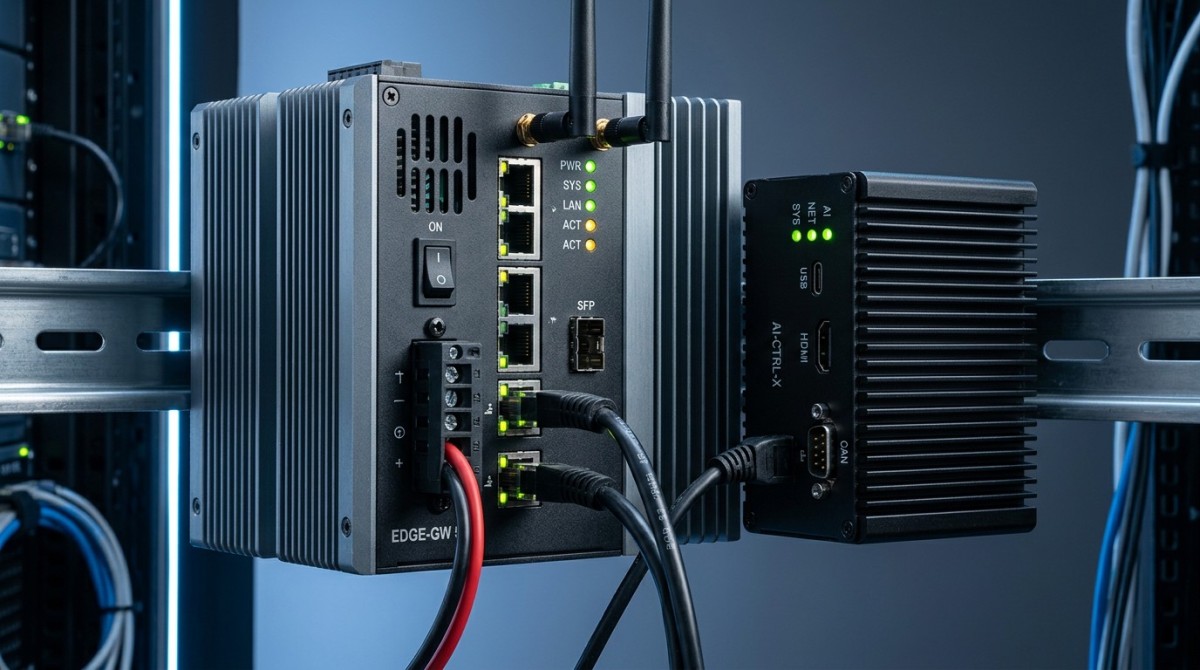
In edge deployments, idle rarely means off. A gateway, vision box, AI controller, or rugged mini-PC may wait for bursts of traffic, but it still keeps CPUs, memory, storage, network interfaces, thermal control, and power conversion stages active. Over 24 hours a day and 7 days a week, that baseline draw can become a material operating expense, especially when a site scales from 10 nodes to 100 or more.
This matters across manufacturing, logistics, utilities, aerospace ground systems, and smart facilities. Operators often focus on peak throughput, yet procurement teams later discover that idle edge computing power consumption shapes monthly energy bills, enclosure sizing, UPS runtime, and thermal management. For decision-makers, the issue is not only watts. It is the compounding effect on total cost of ownership across a 3-year to 5-year deployment window.
At TechStat Vanguard, the practical question is simple: what does the system consume in realistic field states, not just under headline benchmark conditions? Parameters do not lie. A node that advertises strong edge AI inference speed fps may still waste power during low-utilization periods if firmware, accelerators, or network stacks do not enter efficient standby behavior between workloads.
For information researchers, this topic helps separate marketing language from engineering truth. For users and operators, it explains why cabinet temperatures stay elevated overnight. For buyers, it supports more accurate RFQ comparisons. For enterprise leaders, it improves budgeting accuracy before scaling pilots into multi-site infrastructure.
What “idle” usually includes in real deployments
A true field idle state often includes system heartbeat traffic, sensor polling, watchdog functions, encrypted tunneling, storage buffering, and remote management. In industrial environments, nodes may also maintain deterministic communications, timestamp synchronization, or camera readiness. These are not faults. They are design requirements, but they consume power continuously.
- Processor and memory remain partially active to preserve low wake-up latency, commonly in sub-second ranges.
- Network ports, PoE modules, 4G or 5G links, and VPN services may run continuously for monitoring and cybersecurity policy.
- Cooling fans or heaters in outdoor cabinets may operate regardless of compute load when ambient conditions shift between 0°C and 40°C or beyond.
That is why spec sheets showing only TDP, peak board power, or synthetic workload energy are incomplete. Procurement teams need idle, average, and burst-state measurements under realistic peripheral configurations.
Where idle draw becomes expensive in multi-site edge deployments
A single low-power edge node may not seem costly. The economics change when fleets are distributed across plants, warehouses, substations, inspection cells, or unmanned sites. Fifty devices idling at a modest baseline can equal the annual energy cost of a much larger central system, especially when each unit also drives local cooling, DC power conversion losses, and battery backup overhead.
This is particularly visible in applications that require instant response but intermittent processing. Examples include machine vision stations waiting for triggers, industrial IoT gateways buffering sparse telemetry, UAV ground support units in standby, and remote security analytics nodes active only during event windows. In all of these, the business case depends on low latency, but the power bill is dominated by waiting time rather than processing time.
The table below summarizes how common deployment patterns change the importance of idle power. It is not a universal benchmark, but it is a practical planning aid for comparing architectures before procurement.
The key takeaway is that low average utilization does not automatically mean low total energy use. In many edge systems, idle time occupies 50%–90% of the operating calendar. That is why site planners should model annual energy by state distribution, not by peak wattage alone.
Three cost layers teams often miss
The first layer is direct electricity. The second is supporting infrastructure such as UPS sizing, solar-storage capacity, and thermal handling. The third is operational friction: more heat in enclosures can shorten fan life, increase dust loading, and trigger derating in harsh environments. Those secondary effects frequently appear 6–18 months after commissioning, when replacement and service budgets are already locked.
A practical fleet-level example
If a site runs 40 edge nodes and each node’s real idle draw is 12 W higher than expected, that is an extra 480 W continuously. Over a full year of 8,760 hours, the operational impact becomes visible even before cooling losses are included. For procurement teams, this is exactly why measured idle power should appear in bid comparisons alongside compute capability and interface counts.
Which parameters should engineers and buyers benchmark before scaling?
A useful benchmark framework should connect power states to application behavior. Looking only at processor class or advertised TOPS is not enough. Edge platforms must be judged by how efficiently they transition between idle, light load, and burst inference while preserving industrial iot gateway latency targets and stable edge AI inference speed fps where needed.
For engineering teams, the most important step is to request test conditions. Was idle measured with all network interfaces enabled? Was storage installed? Were cameras, fieldbus modules, or accelerators powered? Without that context, one watt figure cannot be compared fairly with another. TSV’s methodology emphasizes boundary conditions because tolerance in testing defines trust in the result.
The following table provides a practical shortlist of parameters worth including in a technical review, pilot acceptance plan, or procurement checklist.
A strong procurement file should include at least 5 core checks: idle watts, duty-cycle average watts, latency under realistic traffic, thermal behavior, and power mode recovery. Without those, “efficient” remains a marketing word rather than an engineering statement.
Questions to put into an RFQ or technical clarification round
- What peripherals were active during idle power measurement, and was the network fully connected?
- Can the supplier provide 24-hour power logs under a representative workload instead of only peak power figures?
- How does the system maintain industrial iot gateway latency when low-power modes are enabled?
- If an NPU or GPU is present, what is its standby behavior when edge AI inference speed fps demand drops between events?
These questions reduce supplier ambiguity and shorten qualification cycles. They also align technical review with practical budgeting, which is exactly where many edge projects succeed or fail.
How to choose between always-on performance and lower operating cost
The right choice depends on response time, reliability requirements, environmental conditions, and fleet size. In some applications, keeping a node fully awake is justified because every millisecond matters. In others, aggressive state management can reduce energy use without harming quality of service. The decision should be made at application level, not by default hardware preference.
For example, a high-speed inspection line may require constant readiness to sustain camera synchronization and deterministic processing. A remote telemetry gateway with periodic uploads every 5 minutes or 15 minutes can usually tolerate deeper low-power behavior. Similarly, an outdoor deployment powered by battery or solar has a different optimization target from an indoor cabinet connected to stable AC power.
A practical selection framework should balance three dimensions: compute headroom, standby efficiency, and transition predictability. Oversizing for rare peak events often leads to elevated idle edge computing power consumption. Undersizing creates dropped frames, latency spikes, and thermal stress during bursts. The goal is not the largest processor. It is the best-fit power-performance envelope.
Decision rules for four common buyer profiles
Information researchers
Focus on test conditions, not headline values. Build a comparison sheet with 3 columns minimum: idle state definition, average duty-cycle power, and recovery latency. This immediately exposes weak or incomplete vendor documentation.
Operators and users
Ask whether lower-power modes change startup behavior, fan acoustics, cabinet heat, or maintenance intervals. A 10 W reduction can be more valuable if it lowers internal temperature enough to improve reliability in dusty or sealed environments.
Procurement teams
Compare total delivered configuration, not bare boards. Include storage, modem, interfaces, mounting, and software agents. The most common comparison error is evaluating power on a stripped configuration but paying for a field-ready configuration.
Enterprise decision-makers
Model deployment in 3 stages: pilot, site rollout, and fleet expansion. What looks minor in a 5-unit trial may become a budget issue at 200 units. Planning with a 12-month and 36-month view makes the operating cost impact visible before contracts are finalized.
Common misconceptions, compliance context, and implementation advice
One common misconception is that low CPU utilization means low system power. In reality, peripherals, memory, NICs, accelerators, and power supply losses can dominate the idle baseline. Another is that fanless always means efficient. Fanless design may reduce maintenance, but thermal behavior still depends on enclosure, ambient conditions, and sustained standby heat.
A second misconception is that edge AI platforms should be judged mainly by TOPS or fps. Those values matter, but only within the intended duty cycle. A system that reaches target edge AI inference speed fps during a demo may still be economically weak if it remains power-hungry for the other 20 or 22 hours of the day. This is especially relevant in distributed industrial settings where always-on behavior is the norm.
On compliance and engineering governance, buyers should request documentation that is consistent with the application: electrical safety documentation, environmental ratings, EMC-related considerations, and protocol compatibility where relevant. The exact standard set varies by geography and industry, but the purchasing principle is consistent: verify that measured power behavior aligns with the certified or declared operating configuration.
A 4-step implementation path before large-scale rollout
- Define 2–3 realistic operating states, such as idle-connected, low-load streaming, and burst inference.
- Measure each state over a meaningful time window, often 8 hours to 24 hours, not just a short lab snapshot.
- Validate latency, fps, and thermal behavior at common ambient checkpoints such as 25°C and 40°C.
- Convert findings into a fleet-level cost model before issuing final purchase orders.
This process is modest in effort but high in value. It reduces requalification, avoids hidden infrastructure upgrades, and gives procurement teams a defensible basis for vendor comparison.
FAQ: what buyers and engineers ask most often
Is idle power still important if the device has high peak performance?
Yes. In many edge environments, the device spends most of its calendar time in standby or low activity. If the active-duty ratio is only 10%–30%, idle behavior can dominate annual energy use and enclosure heat load. Peak performance matters, but not at the expense of inefficient baseline operation.
How should industrial IoT gateway latency be evaluated with power-saving enabled?
Measure latency in the actual power mode intended for production. Include network stack, protocol conversions, security services, and sensor polling. A lab result taken with power saving disabled may not reflect field performance.
What is the biggest procurement mistake?
Comparing incomplete configurations. Buyers often receive one power figure for a minimal setup and another vendor quote for a field-ready setup. Standardize the bill of materials, software services, and test conditions first, then compare.
When is a higher idle draw acceptable?
When the application demands deterministic response, constant sensor readiness, strict buffer continuity, or uninterrupted local analytics. Even then, the additional watts should be justified by measurable process value, not vague claims.
Why work with a data-driven benchmarking partner before procurement?
TechStat Vanguard was built for exactly this kind of decision problem: where engineering truth is buried under broad claims and incomplete specifications. In edge computing, the gap between brochure language and field behavior is often widest around power states, thermal conditions, interface activation, and realistic workload timing. That gap creates procurement risk.
Our value is not generic promotion. It is rigorous comparison logic. We help teams define measurable acceptance criteria for edge computing power consumption, industrial iot gateway latency, environmental readiness, and edge AI inference speed fps under application-specific duty cycles. This reduces trial-and-error cost and shortens supplier qualification rounds.
If you are preparing a pilot or scaling beyond one site, the most useful discussion usually starts with 6 items: target workload, idle-connected behavior, latency threshold, thermal envelope, deployment quantity, and timeline. With that input, a technical review can move quickly from vague product claims to practical selection logic.
Contact TSV if you need support with parameter confirmation, edge platform selection, configuration comparison, delivery-cycle planning, compliance-oriented documentation review, sample evaluation criteria, or quote-side technical clarification. For engineering teams, that means cleaner spec sheets. For procurement, it means fairer comparisons. For decision-makers, it means scaling with fewer hidden operating costs.
Search News
Hot Articles
- Carbon Fiber StructuresHow to Specify Aerospace Carbon Fiber Assemblies for Lightweight, Load-Bearing PartsJul 11, 2026
- Machine VisionXiaomi, Alibaba DAMO Academy Drive Open-Source Robotics Model Ecosystem, Lowering Algorithm Development Barriers for Overseas SMEs Adopting Chinese Robotics SolutionsMar 30, 2026
- Cobots & ArmsShanxi 'AI+' Conference Showcases Embodied Intelligence with Multinational Buyer Engagement: Key Industry ImplicationsMar 30, 2026
Popular Tags
Recommended News
 Jul 11, 2026How to Specify Aerospace Carbon Fiber Assemblies for Lightweight, Load-Bearing PartsAerospace carbon fiber assemblies: learn how to specify laminate design, load data, joining methods, and inspection controls for lighter, reliable load-bearing aerospace parts.Elena Rostova (UAV Systems Researcher)
 Mar 30, 2026Xiaomi, Alibaba DAMO Academy Drive Open-Source Robotics Model Ecosystem, Lowering Algorithm Development Barriers for Overseas SMEs Adopting Chinese Robotics SolutionsXiaomi & Alibaba DAMO Academy's open-source robotics models lower algorithm barriers for global SMEs. Boost efficiency in manufacturing, logistics & smart retail with ROS 2 compatible solutions.TSV Data Lab
 Mar 30, 2026Shanxi 'AI+' Conference Showcases Embodied Intelligence with Multinational Buyer Engagement: Key Industry ImplicationsShanxi 'AI+' Conference highlights embodied intelligence with Tesla, Ubtech & Jiantao showcasing multimodal robotics. 40+ global buyers validated tech on-site, creating new B2B channels for industrial automation & AI solutions.Chen Wei (Automation Lead Engineer)
 Mar 30, 2026Zhongguancun Unveils 6G Integrated Sensing-Computing-Intelligence Platform to Empower Embodied Robots for Global Industrial ApplicationsZhongguancun's new 6G platform revolutionizes industrial robotics with <10ms latency, empowering global automotive, logistics & port automation. Discover how this tech boosts China's smart manufacturing exports.TSV Data Lab
 Mar 30, 2026Mech-Mind Tianjin Embodied Intelligence R&D and Production Base Goes Live, Cutting Delivery Time by 20%–30% for Global Customized AMR+Vision SolutionsMech-Mind's Tianjin AMR+Vision production base cuts delivery time by 20%-30% for欧美 & Latin American markets. Discover how this PLd-certified facility accelerates customized robotics solutions for smart manufacturing and logistics.Chen Wei (Automation Lead Engineer)
 Mar 30, 2026Boao Forum Reveals 'Co-evolution of Big and Small Brains' Trend in Humanoid Robots, China's Embodied Intelligence Accelerates Adaptation to Overseas Manufacturing Service ScenariosDiscover how China's humanoid robots, featuring 'Co-evolution of Big and Small Brains,' are revolutionizing global manufacturing. Learn about Embodied Tian Gong 3.0's ISO compliance and overseas deployment at Boao Forum 2026.Chen Wei (Automation Lead Engineer)
 Mar 30, 2026China Railway Industrial Secures Patent for Embodied Robotics in Material Handling, Boosting High-Precision Delivery Capabilities for Overseas Infrastructure and Manufacturing ProjectsChina Railway Industrial's new patent for embodied robotics in material handling boosts high-precision delivery for global infrastructure & manufacturing. Discover how this innovation enhances logistics accuracy in automotive, rail transit & EPC projects.Chen Wei (Automation Lead Engineer)
 Oct 21, 2026China’s Industrial Robot Exports Near RMB 10 Billion in First Nine Months of 2026China’s industrial robot exports neared RMB 10 billion in January–September 2026, with value rising faster than volume. Explore the data and what it could mean for suppliers.Chen Wei (Automation Lead Engineer)
 Oct 21, 2026Low-Latency Industrial Data Processing: Pricing and Key Cost DriversExplore industrial data latency price drivers, from edge hardware to integration and support. Learn how to compare quotes, verify performance, and avoid unnecessary costs.TSV Data Lab
 Oct 20, 2026KUKA Launches iiQKA.AI Vision to Simplify Industrial Image ProcessingKUKA iiQKA.AI Vision simplifies industrial image processing with controller-based 2D and 3D vision. Explore drag-and-drop setup for vision-guided automation.TSV Data Lab
 Oct 20, 2026Smart Industrial Edge Devices: Key Criteria for Legacy PLC IntegrationChoose smart industrial edge devices for legacy PLC integration. Discover key criteria for compatibility, data quality, security, and reliable collection without disrupting control.TSV Data Lab
 Oct 19, 2026Choosing a Radar Sensor by Application: Range, Resolution, and Field of ViewSimplify radar sensor application based product selection. Compare range, resolution, and field of view to avoid blind spots and choose with confidence. Explore the guide.TSV Data Lab
 Oct 18, 2026Comparing Material Options for Procurement: Specs, Costs, and Supply RisksExplore procurement oriented technical content on material options, specs, costs, and supply risks. Compare alternatives to cut hidden expenses and make confident sourcing decisions.Dr. Marcus Vance
 Oct 17, 20265-Axis CNC Positioning Accuracy: How to Interpret ISO 230-2 Test ResultsAssess 5 axis CNC machining positioning accuracy with ISO 230-2. Learn to interpret repeatability, reversal error, and test conditions to compare suppliers and make confident acceptance decisions.Dr. Marcus Vance
 Oct 16, 2026Choosing a Rugged Edge AI Box Supplier: Thermal Tests and Lifecycle SupportChoose a rugged edge AI box supplier with proven thermal performance and reliable lifecycle support. Discover the tests and commitments to verify before you buy.TSV Data Lab
 Oct 15, 2026R&D Cost Reduction Services: How to Evaluate Fees, Savings, and ROIEvaluate R&D cost reduction services with confidence. Compare fees, verify savings, and calculate ROI without compromising performance. Discover how to choose a provider that delivers real value.Chen Wei (Automation Lead Engineer)
 Oct 20, 2026How Do You Measure Industrial IoT Gateway Latency Under Load?Measure industrial IoT gateway latency under load with reliable timestamps, realistic traffic, and tail-latency analysis. Discover how to expose bottlenecks and choose the right gateway.TSV Data Lab
 Oct 19, 2026How Do You Verify That Precision Machined Parts Meet Tolerances?Master precision machining tolerance verification with the right tools, datum setups, and acceptance rules. Learn how to validate parts confidently and reduce costly inspection errors.Dr. Marcus Vance
 Oct 18, 2026What Should an AS9100 Machining Supplier Checklist Include?Build an AS9100 machining supplier checklist that verifies capability, traceability, inspection, and outsourced processes. Discover what to check before approving your next aerospace supplier.Dr. Marcus Vance
 Oct 17, 2026How Should You Interpret Industrial Robot Repeatability Specs?Decode industrial robot repeatability specifications, understand ISO 9283 test conditions, and avoid costly selection mistakes. Learn how to verify performance for your process.Chen Wei (Automation Lead Engineer)
 Oct 16, 2026How Can You Fairly Compare MTBF Across Industrial Servo Motors?Make a fair industrial servo motor MTBF comparison with matched operating profiles, failure criteria, and confidence bounds. Discover how to assess reliability beyond advertised numbers.Chen Wei (Automation Lead Engineer)
 Oct 15, 2026How Should You Compare TechStat Vanguard 5-Axis CNC Tolerances?TechStat Vanguard 5-axis CNC tolerance comparison: learn how to verify part accuracy, assess inspection evidence, and choose suppliers that reliably meet your drawing requirements.Dr. Marcus Vance
 Oct 14, 2026Drone Frame Composites: Carbon Fiber vs. Fiberglass for Weight and StiffnessExplore drone structural materials composites: compare carbon fiber and fiberglass for weight, stiffness, cost, and antenna compatibility. Find the right material for your drone frame.Elena Rostova (UAV Systems Researcher)
 Oct 13, 2026Smart Cameras vs. PC-Based Machine Vision: Which Fits High-Speed Inspection?This industrial product comparison for machine vision weighs smart cameras vs. PC-based systems on latency, throughput, and cost. Discover your best fit for high-speed inspection.TSV Data Lab