Why Two Trampoline Park Price Offers Can Differ So Much
Publication Date
author
A trampoline park price quote can vary far more than most buyers expect—and for business evaluators, the gap is rarely random. Behind two seemingly similar offers are major differences in safety standards, equipment specifications, material durability, installation scope, and long-term operating costs. This article breaks down why trampoline park price proposals differ so much, helping decision-makers compare offers with greater precision and avoid costly procurement mistakes.
For procurement teams, developers, investors, and commercial operators, a trampoline park price should never be treated as a simple per-square-meter number. In practice, two suppliers may quote for the same 800–1,500 square meter venue, yet the total offer can differ by 20%–60% once engineering details, compliance requirements, and after-sales terms are fully unpacked.
This is exactly where data-driven comparison matters. A low headline price can hide thinner steel tubing, lower bounce-cycle durability, reduced safety padding density, fewer installation services, or limited spare-parts support. A higher quote, by contrast, may reflect better lifecycle value rather than inflated markup.
Why a Trampoline Park Price Is Never Just About Equipment Quantity
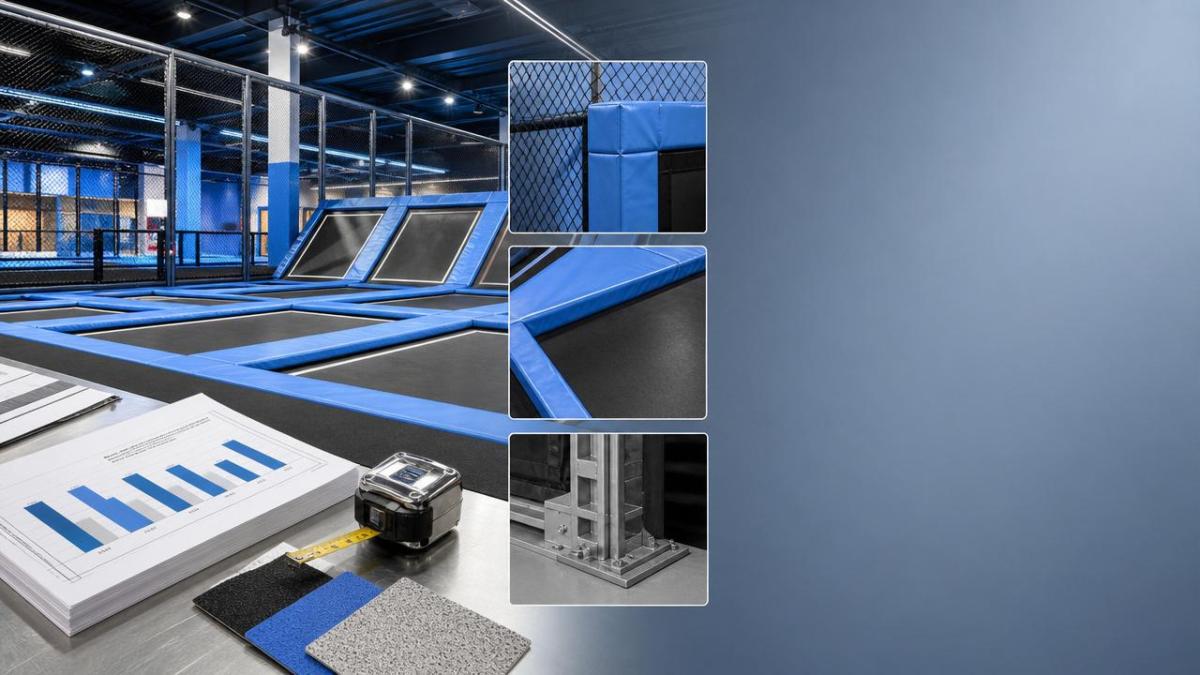
When business evaluators review a trampoline park price proposal, the first mistake is assuming that two layouts with similar visual drawings represent equivalent commercial value. They often do not. A proposal with 18 play modules may still be materially different from another with the same module count because structural design, foam density, spring grade, netting quality, and safety zone calculations all affect the final cost.
Base scope versus real delivery scope
Some suppliers quote only the core trampoline frames and jumping mats. Others include full delivery scope: design adaptation, local code review, transportation, on-site assembly, soft play integration, signage, staff training, and opening inspection support. On paper, the first quote looks cheaper. In the procurement cycle, however, missing scope can add 10%–25% in downstream costs.
Common exclusions that change the quote
- Freight, customs, and local unloading charges
- Installation labor and site supervision for 7–21 days
- Impact flooring, wall padding, and guard net systems
- Electrical preparation for lighting or interactive zones
- Maintenance kits and first-year spare parts
For this reason, a trampoline park price comparison should begin with scope normalization. Buyers should ask every supplier to separate equipment cost, logistics cost, installation cost, and optional features into independent line items. That single step can prevent distorted bid comparisons.
Layout complexity influences engineering cost
A simple rectangular park with standard jumping zones is easier to manufacture and install than a mixed-format venue combining dodgeball courts, slam dunk lanes, ninja elements, climbing walls, foam pits, toddler zones, and interactive projection games. More complexity means more steel junctions, more customized pads, more anchoring points, and more installation hours.
In practical terms, a straightforward family entertainment layout may require 2D planning and standard module fabrication. A premium attraction format can require 3D site adaptation, custom heights, and structural coordination with HVAC, sprinkler, and ceiling clearance constraints. That difference alone can widen a trampoline park price offer by tens of thousands of dollars.
The table below shows how two “similar” park offers can differ once procurement teams examine scope and engineering detail instead of headline numbers.
The key takeaway is simple: a lower initial trampoline park price may reflect a narrower scope rather than a more efficient supplier. For evaluation teams, the real benchmark is total delivered value, not first-page quote size.
Safety Standards and Material Specifications Drive Major Price Gaps
In indoor amusement procurement, safety engineering is one of the biggest reasons two trampoline park price offers can differ so much. This category is highly sensitive to component quality. Small material differences at the sourcing stage can create major cost variation over a 3–7 year operating cycle.
Steel structure, mat quality, and padding density
A commercial trampoline system typically depends on steel frame thickness, welding quality, anti-corrosion treatment, spring or elastic system durability, and the wear resistance of the jump surface. Higher-grade galvanized or powder-coated steel costs more than untreated alternatives, but it performs better in humid indoor environments and under repeated dynamic loads.
Similarly, protective pads can differ in foam density, outer cover abrasion resistance, and seam reinforcement. A low-cost offer may reduce thickness or use lower-spec vinyl covering. That saves money at the procurement stage but may lead to faster surface cracking, compression loss, or replacement frequency inside 12–24 months.
Typical material variables buyers should verify
- Steel tube thickness range, such as 2.0–3.0 mm
- Padding thickness, often 30–70 mm depending on zone risk
- Mat weave strength and expected bounce-cycle lifespan
- Corrosion protection method for frames and brackets
- UV, tear, and abrasion resistance of PVC or vinyl covers
Compliance expectations differ by market
A trampoline park price for one region may not translate directly to another because local safety expectations vary. Some buyers require documentation for flame-retardant materials, structural calculations, impact attenuation, or installation records. Others focus heavily on operator manuals, warning signage, and maintenance traceability.
Suppliers that provide better engineering documentation often quote higher because they have invested more in quality control, testing routines, and technical file preparation. For commercial operators seeking insurance approval or smoother licensing, that premium can be justified.
The table below highlights how specification-level differences often reshape the final trampoline park price far more than buyers initially expect.
For evaluators, the message is not that the higher quote is always better. It is that every price gap should be traceable to measurable specification differences. If the supplier cannot clearly define those differences, the quote should be treated with caution.
Installation, Site Conditions, and Project Execution Change the Final Number
Another major reason trampoline park price offers vary is that the venue itself is rarely standard. Ceiling height, column spacing, floor flatness, loading access, sprinkler locations, and local labor conditions all influence execution complexity. Two buyers ordering the same concept may receive different quotes simply because one site is far more difficult to build out.
Site adaptation costs are often underestimated
For example, a site with 6.5 meters of clear height is operationally different from one with 4.8 meters once climbing features or elevated obstacle elements are involved. Likewise, a venue with multiple columns may require custom cutouts, irregular frame sections, and adjusted safety clearances. These changes affect fabrication lead time and installation planning.
Site conditions can also influence whether the supplier uses a standard anchor strategy or requires additional reinforcement review. If local regulations require separate structural confirmation, that can add both engineering hours and approval time, often extending project schedules by 2–4 weeks.
Execution variables that affect price
- Venue measurement accuracy and redraw requirements
- Container access, unloading constraints, and lift equipment needs
- Night work or compressed installation windows
- Local subcontractor rates and travel support for technical teams
- Testing, handover, and reopening deadlines tied to lease terms
Lead time reliability has commercial value
A lower trampoline park price can become expensive if lead time slips by 4–8 weeks and delays opening. For a commercial entertainment venue, every delayed week may mean missed revenue, continued rent exposure, and postponed marketing campaigns. That is why quote evaluation should include not only cost but also production capacity, packaging discipline, installation scheduling, and spare-parts readiness.
From a B2B perspective, schedule risk is a cost category. A supplier that commits to a 35–50 day production cycle with clear installation sequencing may offer stronger operational value than one that quotes lower but gives only vague timing.
How to Compare Two Trampoline Park Price Offers Like a Procurement Professional
A disciplined comparison process turns quote analysis from guesswork into structured decision-making. For business evaluators, the goal is not to chase the lowest number but to identify the offer with the best risk-adjusted return over the equipment lifecycle.
Use a four-layer evaluation model
A practical model is to score every trampoline park price proposal across four layers: technical specification, commercial scope, execution capability, and lifecycle support. Each layer can be weighted at 20%–30% depending on the project stage and investor priorities.
Recommended evaluation checklist
- Are the material and safety specifications fully itemized?
- Does the quote separate mandatory scope from optional upgrades?
- What is the expected maintenance and replacement cycle for wear parts?
- How many days are allocated for installation, testing, and handover?
- What after-sales response window is promised for missing or damaged parts?
- Is there enough documentation for internal approval, insurance, or landlord review?
Below is a practical procurement matrix that helps normalize two offers before final negotiation.
Using a matrix like this helps teams move from “Which quote is cheaper?” to “Which quote is commercially safer?” That shift is especially important for multi-site operators, franchise developers, and financial reviewers working under capex controls.
Watch for three common buying mistakes
First, do not compare quotations based only on visual renderings. Second, do not assume all commercial trampoline materials perform the same over time. Third, do not overlook service responsiveness. A supplier that takes 10 days to respond to an operational parts issue may create more business loss than the initial savings justified.
In many cases, the best trampoline park price is not the lowest bid but the one with the clearest scope, the most transparent component definitions, and the most realistic execution plan. That is the mindset procurement professionals should apply during supplier review.
A Data-First View of Price, Risk, and Long-Term Value
For decision-makers aligned with a technical, evidence-based approach, every trampoline park price should be read as a compressed signal of engineering assumptions. The quote reflects more than a product package. It reflects the supplier’s material logic, safety discipline, manufacturing control, project maturity, and post-installation commitment.
That is why strong commercial evaluation requires specification clarity, not marketing language. Buyers should request measurable details, compare total project scope line by line, and assess the likely operating cost over at least 36 months. The difference between a low-cost order and a high-value procurement decision often becomes visible only after that structured review.
If you are assessing multiple trampoline park price offers for a new venue, expansion project, or investor review, the most effective next step is to build a normalized comparison sheet and validate every material, service, and schedule assumption before commitment. To explore a more data-driven evaluation framework or discuss solution details, contact us to get a tailored procurement review and learn more about practical comparison methods.
Search News
Hot Articles
- Carbon Fiber StructuresHow to Specify Aerospace Carbon Fiber Assemblies for Lightweight, Load-Bearing PartsJul 11, 2026
- Machine VisionXiaomi, Alibaba DAMO Academy Drive Open-Source Robotics Model Ecosystem, Lowering Algorithm Development Barriers for Overseas SMEs Adopting Chinese Robotics SolutionsMar 30, 2026
- Cobots & ArmsShanxi 'AI+' Conference Showcases Embodied Intelligence with Multinational Buyer Engagement: Key Industry ImplicationsMar 30, 2026
Popular Tags
Recommended News
 Jul 11, 2026How to Specify Aerospace Carbon Fiber Assemblies for Lightweight, Load-Bearing PartsAerospace carbon fiber assemblies: learn how to specify laminate design, load data, joining methods, and inspection controls for lighter, reliable load-bearing aerospace parts.Elena Rostova (UAV Systems Researcher)
 Mar 30, 2026Xiaomi, Alibaba DAMO Academy Drive Open-Source Robotics Model Ecosystem, Lowering Algorithm Development Barriers for Overseas SMEs Adopting Chinese Robotics SolutionsXiaomi & Alibaba DAMO Academy's open-source robotics models lower algorithm barriers for global SMEs. Boost efficiency in manufacturing, logistics & smart retail with ROS 2 compatible solutions.TSV Data Lab
 Mar 30, 2026Shanxi 'AI+' Conference Showcases Embodied Intelligence with Multinational Buyer Engagement: Key Industry ImplicationsShanxi 'AI+' Conference highlights embodied intelligence with Tesla, Ubtech & Jiantao showcasing multimodal robotics. 40+ global buyers validated tech on-site, creating new B2B channels for industrial automation & AI solutions.Chen Wei (Automation Lead Engineer)
 Mar 30, 2026Zhongguancun Unveils 6G Integrated Sensing-Computing-Intelligence Platform to Empower Embodied Robots for Global Industrial ApplicationsZhongguancun's new 6G platform revolutionizes industrial robotics with <10ms latency, empowering global automotive, logistics & port automation. Discover how this tech boosts China's smart manufacturing exports.TSV Data Lab
 Mar 30, 2026Mech-Mind Tianjin Embodied Intelligence R&D and Production Base Goes Live, Cutting Delivery Time by 20%–30% for Global Customized AMR+Vision SolutionsMech-Mind's Tianjin AMR+Vision production base cuts delivery time by 20%-30% for欧美 & Latin American markets. Discover how this PLd-certified facility accelerates customized robotics solutions for smart manufacturing and logistics.Chen Wei (Automation Lead Engineer)
 Mar 30, 2026Boao Forum Reveals 'Co-evolution of Big and Small Brains' Trend in Humanoid Robots, China's Embodied Intelligence Accelerates Adaptation to Overseas Manufacturing Service ScenariosDiscover how China's humanoid robots, featuring 'Co-evolution of Big and Small Brains,' are revolutionizing global manufacturing. Learn about Embodied Tian Gong 3.0's ISO compliance and overseas deployment at Boao Forum 2026.Chen Wei (Automation Lead Engineer)
 Mar 30, 2026China Railway Industrial Secures Patent for Embodied Robotics in Material Handling, Boosting High-Precision Delivery Capabilities for Overseas Infrastructure and Manufacturing ProjectsChina Railway Industrial's new patent for embodied robotics in material handling boosts high-precision delivery for global infrastructure & manufacturing. Discover how this innovation enhances logistics accuracy in automotive, rail transit & EPC projects.Chen Wei (Automation Lead Engineer)
 Sep 28, 2026Spindle Runout Measurement in Germany: DIN Standards, Methods, and Acceptance LimitsSpindle runout measurement Germany: explore DIN standards, proven methods, acceptance limits, and audit-ready practices for reliable machining quality.Dr. Marcus Vance
 Sep 27, 2026How to Select Wall-Mount Edge Devices for Space-Constrained Factory NetworksWall mount edge devices for space-constrained factories: evaluate workload, thermal design, power resilience, cable access, and network reliability for smarter deployments.TSV Data Lab
 Sep 26, 2026Machining Tolerance Analysis: How to Set Limits That Meet Function and Cost TargetsMachining tolerance analysis: learn how to set functional limits, control tolerance stacks, reduce inspection risk, and balance precision with production cost.Dr. Marcus Vance
 Sep 25, 2026How to Evaluate an Industrial Infrastructure Data Platform for Multi-Site OperationsIndustrial infrastructure data platform evaluation guide for multi-site operations: compare data quality, edge resilience, interoperability, governance, and scalable proof-of-value criteria.Victor Lin (Chief Software Architect)
 Sep 24, 2026How to Select Machine Vision Optics for Accurate Inspection at Different Working DistancesMachine vision optics selection guide for accurate inspection at every working distance. Compare FOV, pixel scale, DOF, distortion, lighting, and telecentric options.TSV Data Lab
 Sep 23, 2026How to Evaluate a Machine Vision System Integrator for High-Speed Inspection LinesChoose a machine vision system integrator with proven expertise in high-speed inspection, reliable reject timing, robust optics, and measurable acceptance criteria.TSV Data Lab
 Sep 28, 2026When is a SCADA API the right choice for connecting plant systems?SCADA API guide: learn when governed plant data integration improves traceability, security, and scalability—without compromising real-time control.Victor Lin (Chief Software Architect)
 Sep 27, 2026How SCADA data integration improves traceability across production linesSCADA data integration connects production-line data to improve traceability, accelerate quality investigations, and strengthen safety decisions.Victor Lin (Chief Software Architect)
 Sep 26, 2026What to define before starting SCADA integration planningSCADA integration planning starts with clear scope, control boundaries, data models, cybersecurity, and testing. Discover the definitions that reduce risk and costly rework.Victor Lin (Chief Software Architect)
 Sep 25, 2026How a smart factory with Industrial IoT reduces production blind spotsDiscover how a smart factory with Industrial IoT turns real-time machine, quality, and workflow data into actionable insights that reduce production blind spots and delivery risks.Victor Lin (Chief Software Architect)
 Sep 24, 2026When does Industrial IoT make smart manufacturing easier to scale?Smart manufacturing Industrial IoT scales when trusted data, interoperable systems, and secure workflows turn connected assets into measurable gains.TSV Data Lab
 Sep 23, 2026What drives ultra-precision machining cost at 1-micron tolerance?Ultra precision machining cost per part at 1 micron tolerance depends on process, material, metrology, and yield. Learn how to compare quotes confidently.Dr. Marcus Vance
 Sep 22, 2026Drone Engine-T550CC Applications: Build the UAV Power System Around the MissionAn application guide for Drone Engine-T550CC integration, covering payload planning, airframe matching, cooling, fuel, vibration, test procedures, documentation, and service preparation.Elena Rostova (UAV Systems Researcher)
 Sep 22, 2026How to Evaluate Industrial Edge Computing Vendors for Factory DeploymentIndustrial edge computing vendor evaluation guide for factories: compare latency, protocol fit, reliability, security, and lifecycle support before deployment.TSV Data Lab
 Sep 21, 2026Drone Payload Integration: Matching Power, Data, and Center of Gravity for Reliable FlightsDrone payload integration made practical: balance power, data, center of gravity, and endurance to build safer, more reliable mission-ready flights.Elena Rostova (UAV Systems Researcher)
 Sep 20, 2026Autonomous Navigation Pricing: Cost Drivers and Budget Benchmarks for AMR ProjectsAutonomous navigation price explained: compare AMR cost drivers, software, sensors, integration, safety, and lifecycle budgets to build a scalable project plan.Chen Wei (Automation Lead Engineer)
 Sep 19, 2026How to Scope Automation Integration Services for Multi-System Factory ProjectsAutomation integration services: learn how to scope multi-system factory projects with clear workflows, interface contracts, safety boundaries, and acceptance criteria.Victor Lin (Chief Software Architect)