What Trampoline Park Price Quotes Often Leave Out
Publication Date
author
A trampoline park price quote may look straightforward, but procurement teams know the real cost picture is rarely that simple. Beyond the headline number, critical factors like engineering standards, material specifications, installation scope, compliance testing, maintenance exposure, and long-term operating risk can significantly affect total investment. This article examines what many trampoline park price quotes often leave out, helping buyers make clearer, data-backed purchasing decisions.
Why does a trampoline park price quote often look lower than the final project cost?
The short answer is scope compression. A supplier may present a competitive trampoline park price based on a narrow base package, while many real-world cost items sit outside the quote unless the buyer asks for detailed inclusions. For procurement teams, this is not necessarily a sign of bad faith; it is often a result of inconsistent assumptions between buyer and seller.
A base quotation may include trampoline beds, steel framing, and soft padding, but exclude freight, local taxes, floor preparation, HVAC adjustments, fire compliance upgrades, electrical work, branded theming, digital access control, or supervised installation. In some cases, the trampoline park price covers only standard modules, while custom court geometry, ceiling adaptation, and local code documentation are priced later as variations.
This matters because buyers are not purchasing a pile of components; they are procuring a safe, insurable, revenue-generating entertainment environment. The difference between equipment cost and operationally ready cost can be substantial. A low headline trampoline park price may therefore become expensive if the quote lacks technical transparency.
What should procurement teams ask to understand the real scope behind a trampoline park price?
The most useful first step is to request a line-by-line scope matrix. Instead of asking only, “What is your trampoline park price?” ask, “What exactly is included, excluded, assumed, and optional?” That single change usually exposes the cost structure much faster.
Buyers should verify at least six scope categories. First, equipment supply: frame steel grade, trampoline fabric specification, spring performance range, padding density, netting, fasteners, and wear components. Second, design services: layout engineering, structural calculations, stamped drawings where required, and site coordination. Third, logistics: packaging, international shipping, insurance, customs, inland delivery, and unloading responsibility. Fourth, installation: supervision only, full installation, local labor requirements, tools, and commissioning tests. Fifth, compliance: safety standards, third-party testing, documentation, and certification support. Sixth, after-sales support: spare parts, training, warranty response, and maintenance manuals.
If a supplier cannot clearly define those categories, the trampoline park price is not yet decision-ready. In TSV-style procurement logic, unclear scope means unquantified risk, and unquantified risk usually becomes budget overrun later.
Which technical specifications are commonly missing from a trampoline park price quote?
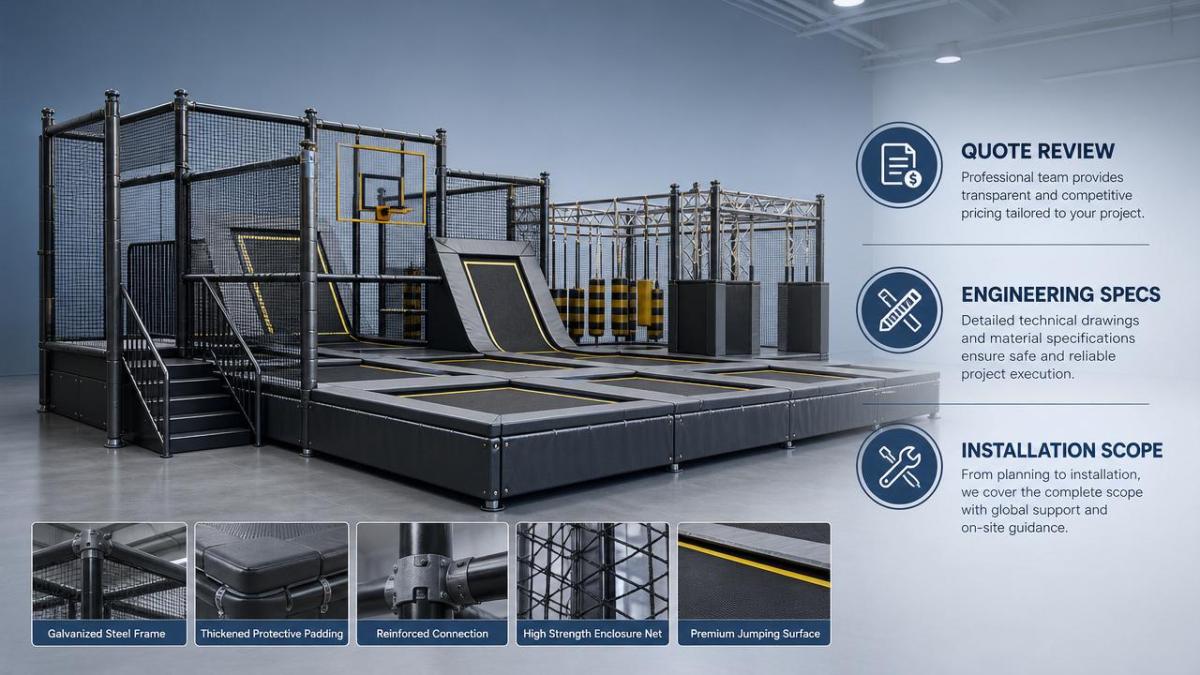
This is where many buyers make the biggest mistake: they compare quotes by area and appearance rather than engineering detail. A trampoline park price can vary significantly because one system uses higher-grade steel, better anti-corrosion treatment, thicker padding, and more durable jump surfaces, while another uses visually similar but lower-performance materials.
Commonly omitted technical items include steel wall thickness, welding quality standards, powder coating or galvanization method, foam density, PVC cover wear resistance, spring cycle life, UV performance for certain zones, anchor requirements, and load assumptions for high-use areas. Some quotes also fail to specify tolerance levels for frame fabrication or the replacement interval of consumable parts under defined traffic conditions.
Procurement professionals should also ask about usage intensity assumptions. Is the quoted trampoline park price based on light family traffic, school group use, or high-volume commercial operation? Equipment selected for occasional use may underperform in a busy urban venue. Without a declared duty-cycle assumption, price comparison is misleading.
Another overlooked point is modular compatibility. If the operator plans future expansion, the initial system should support later additions without reworking structural zones. A lower trampoline park price today may create a costly dead end if modules cannot integrate later.
How do compliance, safety, and insurance requirements affect trampoline park price?
They affect it more than many first-time buyers expect. Safety compliance is not an accessory cost; it is central to whether a facility can open, remain insured, and avoid avoidable liability. A trampoline park price that excludes compliance support may look attractive at procurement stage but create delays when regulators, landlords, or insurers request documents that were never prepared.
Depending on jurisdiction, buyers may need conformity with amusement device standards, fire-retardant material documentation, impact attenuation data, load calculations, and installation records. In some markets, insurers also care about operating procedures, staff training documentation, inspection routines, and maintenance traceability. If the supplier only provides generic marketing brochures instead of test-backed technical files, the burden shifts to the buyer.
This is why a serious procurement review should ask whether the trampoline park price includes test certificates, drawing packages, operations guidance, and post-install inspection support. If not, separate engineering or compliance consulting may be needed, adding both cost and schedule pressure.
What hidden installation and site-preparation costs are usually left out?
Site conditions are one of the biggest reasons final investment deviates from the original trampoline park price. A quote prepared from a simple floor plan may not reflect real constraints such as slab flatness, ceiling obstructions, column interference, loading dock limitations, or restricted working hours inside a mall or mixed-use property.
Typical omitted items include demolition of old interiors, floor leveling, reinforcement for anchor zones, relocation of sprinklers, lighting changes, acoustic treatment, emergency signage, fencing interfaces, ticketing entry gates, CCTV positioning, and mechanical ventilation adjustments. If the supplier installs only the activity equipment, the buyer may still need separate contractors for surrounding works.
Logistics can also expand the effective trampoline park price. International freight volatility, oversized cargo handling, port storage charges, customs clearance delays, and remote-site inland transport all affect landed cost. For buyers sourcing across borders, Incoterms must be reviewed carefully. A quote that seems cheaper ex-works can become more expensive than a delivered-duty-paid option after all downstream charges are added.
How can buyers compare trampoline park price quotes without being misled by low bids?
The best method is not to compare one total number against another. Instead, compare normalized cost categories. Procurement teams should build a side-by-side matrix so that each trampoline park price is evaluated on identical assumptions: equipment specification, compliance package, shipping basis, installation method, warranty duration, spare parts provision, and maintenance exposure.
A practical evaluation table can look like this:
This type of matrix turns a sales comparison into a procurement comparison. It also aligns with a data-first purchasing approach: parameters before promises.
Does the lowest trampoline park price usually lead to the best return on investment?
Not necessarily. In commercial leisure facilities, return on investment depends on uptime, safety record, customer experience, repair burden, and asset longevity. A low trampoline park price may help the initial capital budget, but if the park needs frequent pad replacement, recurrent closure for repairs, or major retrofits to meet local requirements, the operating model weakens.
Buyers should think in total cost of ownership rather than purchase cost alone. That includes replacement parts consumption, technician visits, inspection routines, staff training, accident exposure, insurance impact, and expected service life. Even visual factors matter commercially: a facility that wears badly after one year may reduce customer trust and social media appeal, affecting revenue.
A better question than “Who has the lowest trampoline park price?” is “Which supplier gives the most reliable operating value over three to seven years?” Procurement teams that shift to this frame often make better decisions, especially for multi-site operators and investors scaling standardized concepts.
What are the most common mistakes buyers make when reviewing trampoline park price offers?
One common mistake is comparing concept renders instead of engineering documentation. Attractive visuals do not prove structural quality, wear performance, or code readiness. Another is failing to align quotes to one reference design, which makes every supplier price a different scope. A third is underestimating post-install operating cost, especially in high-traffic venues.
Buyers also often overlook local adaptation cost. A trampoline park price from an overseas manufacturer may not account for local permit pathways, translation of technical documents, or labor certification requirements. In addition, some procurement teams accept broad warranty language without clarifying exclusions for consumables, misuse, humidity, corrosion, or intensive use.
Finally, some decisions rely too heavily on seller reputation without verifying measurable data. In TSV terms, that is a risky shortcut. The more safety-critical and mechanically repetitive the environment, the more buyers should ask for evidence: test results, fatigue assumptions, service records, and reference project performance under similar throughput conditions.
Before requesting a final trampoline park price, what should buyers confirm first?
A procurement-ready request should define the intended user profile, traffic assumptions, site dimensions, ceiling constraints, target opening date, local compliance obligations, preferred delivery model, and budget logic. It should also clarify whether the project is focused on family entertainment, sports training, mall activation, or mixed attraction operations, because design priorities change accordingly.
To get a reliable trampoline park price, buyers should provide a complete brief and request a complete response. That response should include technical specifications, optional modules, exclusions, warranty boundaries, estimated maintenance demand, delivery timeline, and a clear change-order method. If future expansion is possible, that should be discussed at quotation stage, not after installation.
If you need to move from broad market inquiry to a decision-grade proposal, start by asking suppliers these practical questions: What exact standards does the system meet? Which materials and wear parts are used? What is included in installation and compliance support? What assumptions shape the quoted trampoline park price? What recurring maintenance should be budgeted annually? And what project risks remain with the buyer rather than the supplier? Those answers will do more for procurement quality than any headline number alone.
Search News
Hot Articles
- Carbon Fiber StructuresHow to Specify Aerospace Carbon Fiber Assemblies for Lightweight, Load-Bearing PartsJul 11, 2026
- Machine VisionXiaomi, Alibaba DAMO Academy Drive Open-Source Robotics Model Ecosystem, Lowering Algorithm Development Barriers for Overseas SMEs Adopting Chinese Robotics SolutionsMar 30, 2026
- Cobots & ArmsShanxi 'AI+' Conference Showcases Embodied Intelligence with Multinational Buyer Engagement: Key Industry ImplicationsMar 30, 2026
Popular Tags
Recommended News
 Jul 11, 2026How to Specify Aerospace Carbon Fiber Assemblies for Lightweight, Load-Bearing PartsAerospace carbon fiber assemblies: learn how to specify laminate design, load data, joining methods, and inspection controls for lighter, reliable load-bearing aerospace parts.Elena Rostova (UAV Systems Researcher)
 Mar 30, 2026Xiaomi, Alibaba DAMO Academy Drive Open-Source Robotics Model Ecosystem, Lowering Algorithm Development Barriers for Overseas SMEs Adopting Chinese Robotics SolutionsXiaomi & Alibaba DAMO Academy's open-source robotics models lower algorithm barriers for global SMEs. Boost efficiency in manufacturing, logistics & smart retail with ROS 2 compatible solutions.TSV Data Lab
 Mar 30, 2026Shanxi 'AI+' Conference Showcases Embodied Intelligence with Multinational Buyer Engagement: Key Industry ImplicationsShanxi 'AI+' Conference highlights embodied intelligence with Tesla, Ubtech & Jiantao showcasing multimodal robotics. 40+ global buyers validated tech on-site, creating new B2B channels for industrial automation & AI solutions.Chen Wei (Automation Lead Engineer)
 Mar 30, 2026Zhongguancun Unveils 6G Integrated Sensing-Computing-Intelligence Platform to Empower Embodied Robots for Global Industrial ApplicationsZhongguancun's new 6G platform revolutionizes industrial robotics with <10ms latency, empowering global automotive, logistics & port automation. Discover how this tech boosts China's smart manufacturing exports.TSV Data Lab
 Mar 30, 2026Mech-Mind Tianjin Embodied Intelligence R&D and Production Base Goes Live, Cutting Delivery Time by 20%–30% for Global Customized AMR+Vision SolutionsMech-Mind's Tianjin AMR+Vision production base cuts delivery time by 20%-30% for欧美 & Latin American markets. Discover how this PLd-certified facility accelerates customized robotics solutions for smart manufacturing and logistics.Chen Wei (Automation Lead Engineer)
 Mar 30, 2026Boao Forum Reveals 'Co-evolution of Big and Small Brains' Trend in Humanoid Robots, China's Embodied Intelligence Accelerates Adaptation to Overseas Manufacturing Service ScenariosDiscover how China's humanoid robots, featuring 'Co-evolution of Big and Small Brains,' are revolutionizing global manufacturing. Learn about Embodied Tian Gong 3.0's ISO compliance and overseas deployment at Boao Forum 2026.Chen Wei (Automation Lead Engineer)
 Mar 30, 2026China Railway Industrial Secures Patent for Embodied Robotics in Material Handling, Boosting High-Precision Delivery Capabilities for Overseas Infrastructure and Manufacturing ProjectsChina Railway Industrial's new patent for embodied robotics in material handling boosts high-precision delivery for global infrastructure & manufacturing. Discover how this innovation enhances logistics accuracy in automotive, rail transit & EPC projects.Chen Wei (Automation Lead Engineer)
 Sep 28, 2026Spindle Runout Measurement in Germany: DIN Standards, Methods, and Acceptance LimitsSpindle runout measurement Germany: explore DIN standards, proven methods, acceptance limits, and audit-ready practices for reliable machining quality.Dr. Marcus Vance
 Sep 27, 2026How to Select Wall-Mount Edge Devices for Space-Constrained Factory NetworksWall mount edge devices for space-constrained factories: evaluate workload, thermal design, power resilience, cable access, and network reliability for smarter deployments.TSV Data Lab
 Sep 26, 2026Machining Tolerance Analysis: How to Set Limits That Meet Function and Cost TargetsMachining tolerance analysis: learn how to set functional limits, control tolerance stacks, reduce inspection risk, and balance precision with production cost.Dr. Marcus Vance
 Sep 25, 2026How to Evaluate an Industrial Infrastructure Data Platform for Multi-Site OperationsIndustrial infrastructure data platform evaluation guide for multi-site operations: compare data quality, edge resilience, interoperability, governance, and scalable proof-of-value criteria.Victor Lin (Chief Software Architect)
 Sep 24, 2026How to Select Machine Vision Optics for Accurate Inspection at Different Working DistancesMachine vision optics selection guide for accurate inspection at every working distance. Compare FOV, pixel scale, DOF, distortion, lighting, and telecentric options.TSV Data Lab
 Sep 23, 2026How to Evaluate a Machine Vision System Integrator for High-Speed Inspection LinesChoose a machine vision system integrator with proven expertise in high-speed inspection, reliable reject timing, robust optics, and measurable acceptance criteria.TSV Data Lab
 Sep 28, 2026When is a SCADA API the right choice for connecting plant systems?SCADA API guide: learn when governed plant data integration improves traceability, security, and scalability—without compromising real-time control.Victor Lin (Chief Software Architect)
 Sep 27, 2026How SCADA data integration improves traceability across production linesSCADA data integration connects production-line data to improve traceability, accelerate quality investigations, and strengthen safety decisions.Victor Lin (Chief Software Architect)
 Sep 26, 2026What to define before starting SCADA integration planningSCADA integration planning starts with clear scope, control boundaries, data models, cybersecurity, and testing. Discover the definitions that reduce risk and costly rework.Victor Lin (Chief Software Architect)
 Sep 25, 2026How a smart factory with Industrial IoT reduces production blind spotsDiscover how a smart factory with Industrial IoT turns real-time machine, quality, and workflow data into actionable insights that reduce production blind spots and delivery risks.Victor Lin (Chief Software Architect)
 Sep 24, 2026When does Industrial IoT make smart manufacturing easier to scale?Smart manufacturing Industrial IoT scales when trusted data, interoperable systems, and secure workflows turn connected assets into measurable gains.TSV Data Lab
 Sep 23, 2026What drives ultra-precision machining cost at 1-micron tolerance?Ultra precision machining cost per part at 1 micron tolerance depends on process, material, metrology, and yield. Learn how to compare quotes confidently.Dr. Marcus Vance
 Sep 22, 2026Drone Engine-T550CC Applications: Build the UAV Power System Around the MissionAn application guide for Drone Engine-T550CC integration, covering payload planning, airframe matching, cooling, fuel, vibration, test procedures, documentation, and service preparation.Elena Rostova (UAV Systems Researcher)
 Sep 22, 2026How to Evaluate Industrial Edge Computing Vendors for Factory DeploymentIndustrial edge computing vendor evaluation guide for factories: compare latency, protocol fit, reliability, security, and lifecycle support before deployment.TSV Data Lab
 Sep 21, 2026Drone Payload Integration: Matching Power, Data, and Center of Gravity for Reliable FlightsDrone payload integration made practical: balance power, data, center of gravity, and endurance to build safer, more reliable mission-ready flights.Elena Rostova (UAV Systems Researcher)
 Sep 20, 2026Autonomous Navigation Pricing: Cost Drivers and Budget Benchmarks for AMR ProjectsAutonomous navigation price explained: compare AMR cost drivers, software, sensors, integration, safety, and lifecycle budgets to build a scalable project plan.Chen Wei (Automation Lead Engineer)
 Sep 19, 2026How to Scope Automation Integration Services for Multi-System Factory ProjectsAutomation integration services: learn how to scope multi-system factory projects with clear workflows, interface contracts, safety boundaries, and acceptance criteria.Victor Lin (Chief Software Architect)