What Delays Trampoline Park Construction More Than Expected
Publication Date
author
Even well-funded trampoline park construction projects can fall behind schedule when hidden variables emerge after planning begins. For project managers and engineering leads, the biggest delays often come not from obvious budget gaps, but from permitting bottlenecks, structural revisions, safety compliance, and vendor coordination failures. Understanding these overlooked risks is essential to keeping timelines realistic, costs controlled, and project execution aligned with operational goals.
Why trampoline park construction delays are becoming more common
A notable shift has taken place in trampoline park construction over the past few years. These projects are no longer treated as simple interior fit-outs with recreational equipment added at the end. Owners, landlords, insurers, and local authorities increasingly view them as complex assembly occupancies with structural, fire, life-safety, and operational risk implications. That change in perception is reshaping timelines.
For project managers, the key signal is this: what used to be approved through a relatively straightforward build-out process now often requires deeper review across architecture, structural engineering, MEP coordination, occupancy classification, and specialty vendor interfaces. In practice, trampoline park construction gets delayed not because teams ignore the basics, but because the number of decision points has expanded.
This trend matters across the broader commercial development landscape. Recreation venues must now perform like engineered environments, not just branded customer spaces. As a result, project schedules are more vulnerable to late-stage redesigns, especially when early assumptions about floor loading, egress, noise control, foam pit design, or sprinkler coverage turn out to be incomplete.
The strongest delay signals now appear before equipment installation
One of the most useful trend observations for trampoline park construction is that the longest delays now often emerge before any major equipment arrives onsite. The critical path is shifting upstream. Instead of installation alone defining the schedule, entitlement review, shell condition verification, and compliance engineering increasingly determine whether the project can move forward on time.
This upstream risk is especially relevant in second-generation retail spaces, warehouses converted to leisure use, and mixed-use commercial sites. Existing buildings may appear suitable, but hidden constraints such as slab reinforcement needs, roof obstructions, outdated fire protection layouts, utility capacity limits, or accessibility upgrades can trigger cascading revisions.
Permitting has become a bigger variable than many teams expect
Among all hidden risks, permitting is often the most underestimated cause of schedule drift in trampoline park construction. The reason is not merely slow municipal response. The bigger issue is that review authorities often ask cross-disciplinary questions that the initial permit set did not fully resolve. A comment on occupant load can affect egress widths; an egress revision can change partition layouts; a layout change can force updates to equipment placement and supervision zones.
This reflects a broader industry pattern: regulators are less willing to accept generic leisure-use documentation. They want project-specific clarity on fall zones, guard details, emergency access, ADA circulation, mechanical ventilation, and fire alarm interfaces. For project leaders, the lesson is clear. Trampoline park construction should be managed as a coordinated compliance program, not just a build sequence.
Structural revisions are now one of the clearest trend drivers
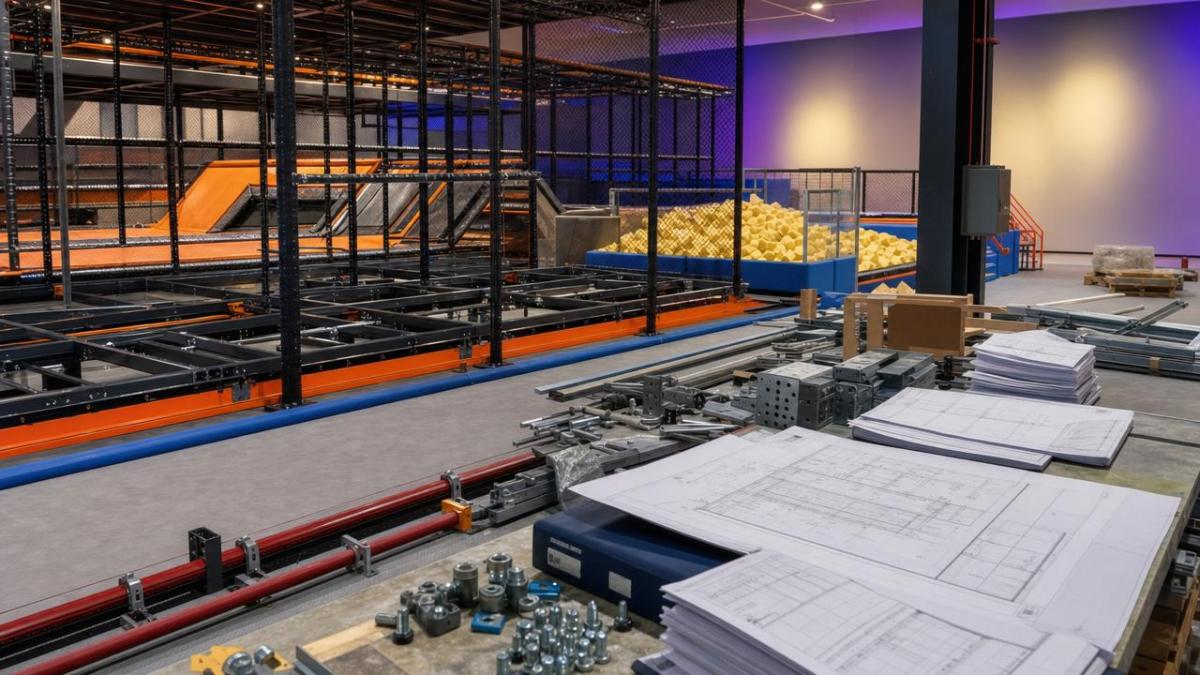
A second major shift is the growing importance of structural due diligence. In many projects, early concepts assume that the existing slab, anchors, and overhead clearances will support the intended trampoline system and associated attractions. But once the equipment supplier, structural engineer, and local reviewer align on actual requirements, the original assumptions often fail.
This is particularly common when a project includes dodgeball courts, performance zones, climbing elements, foam pits, mezzanine observation areas, or suspended features. Each element adds engineering consequences. Anchor locations may conflict with embedded utilities. Slab thickness may be insufficient. Existing columns may interrupt circulation or reduce required clearances. Roof framing may complicate lighting, netting, or HVAC distribution.
From a trend perspective, this means trampoline park construction is increasingly sensitive to verification quality in preconstruction. Teams that rely on leasing drawings, visual walk-throughs, or rough dimensions are much more likely to encounter structural redesign later. In today’s environment, laser-accurate site measurement, slab investigation, and coordination with specialty manufacturers are no longer optional risk controls.
Safety compliance is moving from checklist thinking to systems thinking
Another important change is how safety is evaluated. Historically, some owners approached safety as a post-design layer: install pads, post signage, train staff, and prepare for inspection. That model is weakening. Current expectations are more integrated. Inspectors, insurers, and operating partners want to see safety embedded in circulation, visibility, separation of age groups, queue management, impact attenuation, and emergency response access from the earliest design stage.
For trampoline park construction, this creates schedule pressure because safety comments often reach beyond a single line item. If a reviewer questions supervision sightlines, that can affect wall locations, party room placement, fence lines, and equipment orientation. If an insurer requests clearer separation between active jumping zones and spectators, circulation and exit paths may need rework. These are not minor edits. They can reset procurement and field sequencing.
What project teams should watch most closely
- Whether occupancy classification was confirmed early, not assumed from prior tenant use
- Whether slab, anchoring, and clear-height data were field-verified before equipment layout finalization
- Whether permit drawings reflect actual specialty vendor requirements rather than placeholder concepts
- Whether fire protection, alarms, and egress plans were coordinated with attraction zoning
- Whether operations teams reviewed the design for staffing, supervision, and maintenance practicality
Vendor coordination failures are having a wider impact than before
A less visible but increasingly serious issue in trampoline park construction is fragmented vendor coordination. Many projects rely on a network of specialty participants: trampoline system manufacturers, padding suppliers, netting vendors, scoreboard or lighting integrators, HVAC contractors, flooring teams, fire protection subcontractors, and access-control providers. If these parties submit on different timelines or design from different assumptions, delay risk rises sharply.
This reflects a wider construction trend in experience-based venues. The project is no longer delivered by one general contractor working from a stable design package. Instead, it emerges through interdependent submittals and evolving coordination models. That means schedule control depends heavily on document quality, approval sequencing, and interface ownership. Without a disciplined responsibility matrix, teams lose time to avoidable RFIs, conflicting shop drawings, and late field adjustments.
The market is rewarding earlier technical validation
One of the clearest business lessons from recent trampoline park construction projects is that early technical validation now creates disproportionate value. Not because it guarantees a perfect schedule, but because it prevents low-visibility errors from turning into high-cost delays. This aligns with a broader engineering principle familiar to data-driven organizations: uncertainty is most expensive when discovered late.
For decision-makers, that means treating preconstruction as an evidence-gathering phase rather than a fast-track formality. Existing conditions should be measured, not inferred. Permit assumptions should be stress-tested against local enforcement patterns. Vendor scope boundaries should be documented in detail. If the project includes imported equipment or custom fabrication, logistics and compliance documentation should be reviewed alongside design milestones, not after purchase orders are issued.
How project leaders should respond to these changes
The best response to modern trampoline park construction delays is not simply adding more contingency days to the schedule. A stronger approach is to redesign the decision process itself. Project managers and engineering leads should identify which assumptions are most likely to fail and test them earlier. In most cases, those assumptions involve permitting pathways, structural suitability, safety interpretation, and specialty vendor integration.
A practical response framework includes four actions. First, qualify the site with greater rigor before lease finalization or concept lock. Second, align architect, engineer, operator, and equipment supplier around one coordinated model rather than parallel assumptions. Third, maintain a live risk register that ties each issue to schedule impact, owner, and decision deadline. Fourth, separate “design complete” from “approval ready,” because those are no longer the same thing in many jurisdictions.
A simple judgment checklist for upcoming projects
If your team is planning or actively managing trampoline park construction, the most useful near-term questions are not only about cost and completion date. They are about the quality of assumptions behind the current schedule. Has the building truly been proven fit for this use? Are all authorities likely to interpret the program the same way? Are specialty suppliers contractually aligned on sequence, tolerances, and documentation? Is the operating model reflected in the layout, or only in a future training plan?
These questions matter because the industry direction is clear. Trampoline park construction is becoming more integrated, more regulated, and more dependent on verifiable coordination. Teams that recognize this shift early can protect both timeline and capital efficiency. Teams that continue to treat these builds as ordinary tenant improvements are more likely to absorb schedule erosion through redesign, inspection friction, and avoidable field changes.
Final takeaway for owners, PMs, and engineering leads
What delays trampoline park construction more than expected is rarely one dramatic event. It is usually the accumulation of small technical uncertainties that were left unresolved until they intersected. The strongest trend signal today is that those uncertainties are surfacing earlier in the project lifecycle and carrying larger downstream consequences.
For organizations that want better schedule control, the next step is to examine where assumptions still outweigh verified data. Confirm site constraints, permit logic, structural capacity, safety integration, and vendor interfaces before the project reaches irreversible procurement or field execution. If your business needs to judge how these changes affect a specific trampoline park construction plan, start by identifying which risks are still being estimated rather than engineered.
Search News
Hot Articles
- Carbon Fiber StructuresHow to Specify Aerospace Carbon Fiber Assemblies for Lightweight, Load-Bearing PartsJul 11, 2026
- Machine VisionXiaomi, Alibaba DAMO Academy Drive Open-Source Robotics Model Ecosystem, Lowering Algorithm Development Barriers for Overseas SMEs Adopting Chinese Robotics SolutionsMar 30, 2026
- Cobots & ArmsShanxi 'AI+' Conference Showcases Embodied Intelligence with Multinational Buyer Engagement: Key Industry ImplicationsMar 30, 2026
Popular Tags
Recommended News
 Jul 11, 2026How to Specify Aerospace Carbon Fiber Assemblies for Lightweight, Load-Bearing PartsAerospace carbon fiber assemblies: learn how to specify laminate design, load data, joining methods, and inspection controls for lighter, reliable load-bearing aerospace parts.Elena Rostova (UAV Systems Researcher)
 Mar 30, 2026Xiaomi, Alibaba DAMO Academy Drive Open-Source Robotics Model Ecosystem, Lowering Algorithm Development Barriers for Overseas SMEs Adopting Chinese Robotics SolutionsXiaomi & Alibaba DAMO Academy's open-source robotics models lower algorithm barriers for global SMEs. Boost efficiency in manufacturing, logistics & smart retail with ROS 2 compatible solutions.TSV Data Lab
 Mar 30, 2026Shanxi 'AI+' Conference Showcases Embodied Intelligence with Multinational Buyer Engagement: Key Industry ImplicationsShanxi 'AI+' Conference highlights embodied intelligence with Tesla, Ubtech & Jiantao showcasing multimodal robotics. 40+ global buyers validated tech on-site, creating new B2B channels for industrial automation & AI solutions.Chen Wei (Automation Lead Engineer)
 Mar 30, 2026Zhongguancun Unveils 6G Integrated Sensing-Computing-Intelligence Platform to Empower Embodied Robots for Global Industrial ApplicationsZhongguancun's new 6G platform revolutionizes industrial robotics with <10ms latency, empowering global automotive, logistics & port automation. Discover how this tech boosts China's smart manufacturing exports.TSV Data Lab
 Mar 30, 2026Mech-Mind Tianjin Embodied Intelligence R&D and Production Base Goes Live, Cutting Delivery Time by 20%–30% for Global Customized AMR+Vision SolutionsMech-Mind's Tianjin AMR+Vision production base cuts delivery time by 20%-30% for欧美 & Latin American markets. Discover how this PLd-certified facility accelerates customized robotics solutions for smart manufacturing and logistics.Chen Wei (Automation Lead Engineer)
 Mar 30, 2026Boao Forum Reveals 'Co-evolution of Big and Small Brains' Trend in Humanoid Robots, China's Embodied Intelligence Accelerates Adaptation to Overseas Manufacturing Service ScenariosDiscover how China's humanoid robots, featuring 'Co-evolution of Big and Small Brains,' are revolutionizing global manufacturing. Learn about Embodied Tian Gong 3.0's ISO compliance and overseas deployment at Boao Forum 2026.Chen Wei (Automation Lead Engineer)
 Mar 30, 2026China Railway Industrial Secures Patent for Embodied Robotics in Material Handling, Boosting High-Precision Delivery Capabilities for Overseas Infrastructure and Manufacturing ProjectsChina Railway Industrial's new patent for embodied robotics in material handling boosts high-precision delivery for global infrastructure & manufacturing. Discover how this innovation enhances logistics accuracy in automotive, rail transit & EPC projects.Chen Wei (Automation Lead Engineer)
 Sep 29, 2026ISO 9283 Repeatability: How to Evaluate Cobot Positioning PerformanceISO 9283 cobot repeatability explained: learn how payload, reach, approach direction, and test conditions affect positioning performance and cell capability.Chen Wei (Automation Lead Engineer)
 Sep 28, 2026Spindle Runout Measurement in Germany: DIN Standards, Methods, and Acceptance LimitsSpindle runout measurement Germany: explore DIN standards, proven methods, acceptance limits, and audit-ready practices for reliable machining quality.Dr. Marcus Vance
 Sep 27, 2026How to Select Wall-Mount Edge Devices for Space-Constrained Factory NetworksWall mount edge devices for space-constrained factories: evaluate workload, thermal design, power resilience, cable access, and network reliability for smarter deployments.TSV Data Lab
 Sep 26, 2026Machining Tolerance Analysis: How to Set Limits That Meet Function and Cost TargetsMachining tolerance analysis: learn how to set functional limits, control tolerance stacks, reduce inspection risk, and balance precision with production cost.Dr. Marcus Vance
 Sep 25, 2026How to Evaluate an Industrial Infrastructure Data Platform for Multi-Site OperationsIndustrial infrastructure data platform evaluation guide for multi-site operations: compare data quality, edge resilience, interoperability, governance, and scalable proof-of-value criteria.Victor Lin (Chief Software Architect)
 Sep 24, 2026How to Select Machine Vision Optics for Accurate Inspection at Different Working DistancesMachine vision optics selection guide for accurate inspection at every working distance. Compare FOV, pixel scale, DOF, distortion, lighting, and telecentric options.TSV Data Lab
 Sep 23, 2026How to Evaluate a Machine Vision System Integrator for High-Speed Inspection LinesChoose a machine vision system integrator with proven expertise in high-speed inspection, reliable reject timing, robust optics, and measurable acceptance criteria.TSV Data Lab
 Sep 28, 2026When is a SCADA API the right choice for connecting plant systems?SCADA API guide: learn when governed plant data integration improves traceability, security, and scalability—without compromising real-time control.Victor Lin (Chief Software Architect)
 Sep 27, 2026How SCADA data integration improves traceability across production linesSCADA data integration connects production-line data to improve traceability, accelerate quality investigations, and strengthen safety decisions.Victor Lin (Chief Software Architect)
 Sep 26, 2026What to define before starting SCADA integration planningSCADA integration planning starts with clear scope, control boundaries, data models, cybersecurity, and testing. Discover the definitions that reduce risk and costly rework.Victor Lin (Chief Software Architect)
 Sep 25, 2026How a smart factory with Industrial IoT reduces production blind spotsDiscover how a smart factory with Industrial IoT turns real-time machine, quality, and workflow data into actionable insights that reduce production blind spots and delivery risks.Victor Lin (Chief Software Architect)
 Sep 24, 2026When does Industrial IoT make smart manufacturing easier to scale?Smart manufacturing Industrial IoT scales when trusted data, interoperable systems, and secure workflows turn connected assets into measurable gains.TSV Data Lab
 Sep 23, 2026What drives ultra-precision machining cost at 1-micron tolerance?Ultra precision machining cost per part at 1 micron tolerance depends on process, material, metrology, and yield. Learn how to compare quotes confidently.Dr. Marcus Vance
 Sep 22, 2026Drone Engine-T550CC Applications: Build the UAV Power System Around the MissionAn application guide for Drone Engine-T550CC integration, covering payload planning, airframe matching, cooling, fuel, vibration, test procedures, documentation, and service preparation.Elena Rostova (UAV Systems Researcher)
 Sep 22, 2026How to Evaluate Industrial Edge Computing Vendors for Factory DeploymentIndustrial edge computing vendor evaluation guide for factories: compare latency, protocol fit, reliability, security, and lifecycle support before deployment.TSV Data Lab
 Sep 21, 2026Drone Payload Integration: Matching Power, Data, and Center of Gravity for Reliable FlightsDrone payload integration made practical: balance power, data, center of gravity, and endurance to build safer, more reliable mission-ready flights.Elena Rostova (UAV Systems Researcher)
 Sep 20, 2026Autonomous Navigation Pricing: Cost Drivers and Budget Benchmarks for AMR ProjectsAutonomous navigation price explained: compare AMR cost drivers, software, sensors, integration, safety, and lifecycle budgets to build a scalable project plan.Chen Wei (Automation Lead Engineer)