What Is Included in an Agricultural Spraying Drone Price?
Publication Date
author
What Is Included in an Agricultural Spraying Drone Price?
What is included in an agricultural spraying drone price? The answer extends far beyond the aircraft itself, especially for commercial farms, contractors, and procurement teams.
A practical budget may include spraying payload, navigation hardware, batteries, charging equipment, tanks, nozzles, software, training, maintenance tools, transportation cases, and service support.
The right comparison is therefore not simply drone versus drone. Buyers should compare complete operating systems, annual capacity, regulatory readiness, reliability, and expected lifecycle cost.
The Short Answer: A Drone Price Usually Covers a System, Not Just an Airframe
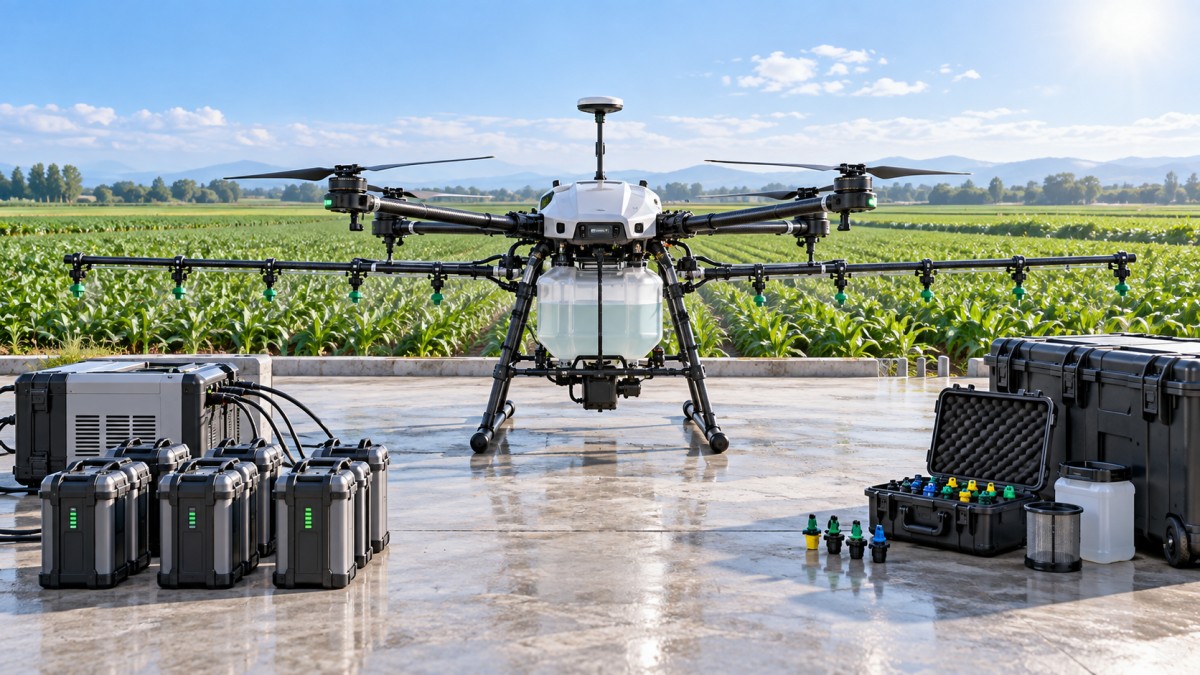
An agricultural spraying drone package generally includes the airframe, propulsion system, flight controller, spray tank, pumps, nozzles, remote controller, and basic batteries.
However, package contents differ widely between suppliers. A lower quoted price may exclude sufficient batteries, intelligent chargers, RTK modules, terrain sensors, spare parts, or operator training.
For this reason, procurement teams should request a detailed bill of materials rather than relying on a single advertised agricultural spraying drone price.
The most useful quotation identifies every included component, its technical specification, quantity, warranty term, replacement cost, and compatibility with future system upgrades.
A complete package can cost more initially but reduce downtime, labor requirements, application errors, and emergency purchases during demanding spraying windows.
Buyers should also distinguish between retail pricing, distributor packages, fleet quotations, and delivered project costs, which may include freight, import duties, insurance, and local compliance support.
The Aircraft Platform and Payload Capacity Drive the Base Price
The airframe is the central cost component. Its price reflects structural materials, motor configuration, propulsion redundancy, weather resistance, flight endurance, and supported liquid payload.
Small agricultural drones may carry limited spray volumes suitable for orchards, test plots, or spot treatments. Larger platforms support broader field coverage and higher daily throughput.
Payload should never be evaluated alone. Buyers should examine usable payload, maximum takeoff weight, empty aircraft mass, spray density assumptions, and safe performance in hot conditions.
A nominal forty-liter tank does not automatically mean forty liters are usable under every mission profile. Terrain, altitude, wind, battery condition, and application rate affect real output.
Frame construction also influences total value. Carbon-fiber structures, sealed electronics, corrosion-resistant fittings, and folding arms can improve durability, transport efficiency, and field serviceability.
Ask suppliers whether the quoted aircraft includes propellers, landing gear, spray plumbing, tank filters, transport protection, firmware updates, and required tools for routine inspections.
Spraying Hardware Determines Application Quality and Operating Cost
The spraying system includes the liquid tank, pump, flow meter, distribution lines, filters, valves, boom assemblies, atomizers, and nozzles used to deliver chemicals.
These components materially affect application uniformity, droplet size, flow accuracy, chemical compatibility, cleaning time, and the drone's suitability for specific crops or formulations.
Basic systems may use conventional pressure nozzles, while more advanced models use centrifugal atomizers or dual systems that support more precise droplet control.
Procurement teams should request verified flow-rate ranges, flow-control accuracy, nozzle replacement intervals, compatible pesticide viscosity, filter mesh specifications, and calibration procedures.
Pump design matters because agricultural chemicals can be abrasive or corrosive. A low-cost pump that fails during peak season can create a larger loss than its replacement price.
Evaluate whether the price includes spare nozzles, spare filters, replacement pump seals, chemical-resistant hoses, cleaning accessories, and a documented flushing process after each operation.
For contractors, application quality is especially important because uneven coverage, overdosing, or drift can damage client relationships and create compliance exposure.
Batteries and Charging Infrastructure Are Often Underquoted
Battery inventory is one of the largest hidden elements in an agricultural spraying drone price because spraying operations require repeated flights throughout short weather windows.
One battery can only support limited airtime under load. Commercial work normally requires multiple battery sets to maintain a continuous rotation between aircraft, charging station, and field crew.
A complete purchase should specify battery capacity, voltage, cycle-life expectation, charging time, thermal management method, storage requirements, and conditions that invalidate warranty coverage.
High-capacity intelligent batteries may cost substantially more than standard packs, but they can provide safer monitoring, better charge balancing, faster turnaround, and useful health diagnostics.
Charging equipment may include grid-powered chargers, portable generators, vehicle-mounted power systems, battery cooling units, or dedicated field charging stations with integrated safety controls.
Ask whether the charger can support the supplied battery fleet at its stated rate. A fast aircraft becomes operationally limited when charging infrastructure cannot keep pace.
Battery replacement planning should be included in total cost of ownership. Cycle count, seasonal storage, temperature exposure, and charging behavior influence replacement timing.
Navigation, Terrain Following, and Obstacle Sensing Change the Price Significantly
Precision navigation features frequently explain major price differences between agricultural drone packages that appear similar in basic payload and flight time.
GNSS positioning is standard, but RTK navigation offers tighter location accuracy. This can improve route repeatability, boundary control, application consistency, and documentation for commercial work.
RTK systems may require a local base station, a network correction subscription, compatible mobile connectivity, or a supplier-supported correction service. These costs should be stated clearly.
Terrain-following sensors help maintain application height over uneven fields, ridges, terraces, orchards, and sloped terrain. Stable height directly affects spray pattern and drift risk.
Depending on the platform, terrain sensing may use radar, LiDAR, stereo vision, ultrasonic sensors, or sensor fusion. Buyers should seek operating limits, not only feature labels.
Obstacle avoidance can reduce collision risk around trees, utility poles, irrigation infrastructure, and field edges. Yet sensor performance may decline in dust, rain, low light, or dense vegetation.
Request measurable specifications such as detection range, minimum obstacle size, sensing field of view, terrain-following accuracy, and behavior when sensor data becomes unreliable.
Control Software and Farm Data Tools Can Be Included or Sold Separately
Modern spraying drones are software-defined agricultural tools. Their value depends partly on mission planning, route generation, application records, fleet management, and update support.
A basic package may include flight planning through a remote controller application. More advanced systems provide desktop planning, cloud synchronization, prescription maps, and multi-aircraft coordination.
For larger operations, software should support field boundaries, exclusion zones, terrain models, route editing, job histories, chemical application records, and exportable operating reports.
Buyers should clarify whether software licenses are perpetual, subscription-based, limited by aircraft count, or dependent on a specific regional distributor or cloud service.
Data ownership also deserves attention. Farms and contractors should understand where field data, mission logs, images, and operator information are stored and who can access them.
Integration matters when the organization already uses farm management software, GIS tools, precision agriculture platforms, or enterprise maintenance systems for equipment tracking.
Software should be judged by field usability, not interface appearance alone. Operators need dependable offline capability, clear warnings, recoverable missions, and simple post-job reporting.
Training, Compliance, and Insurance Are Part of the Real Deployment Budget
Although not always listed in the drone quotation, training and regulatory preparation are essential components of a realistic agricultural spraying drone investment.
Operators may require aviation certification, agricultural chemical handling training, local flight approvals, pesticide application permissions, recordkeeping processes, and emergency response procedures.
Requirements vary by country, state, crop type, payload weight, operating altitude, and whether the service is performed on owned land or for paying clients.
A reputable supplier should explain the boundaries of its support. It may provide product training and documentation, but legal authorization remains the buyer's responsibility.
Training should cover flight safety, preflight inspection, battery handling, chemical mixing, nozzle calibration, route planning, shutdown procedures, emergency landing, cleaning, and basic troubleshooting.
Insurance costs may include aircraft hull coverage, third-party liability, commercial operations coverage, and worker safety protection. These should be budgeted before deployment begins.
For enterprise buyers, documented training and compliance procedures are also important for internal risk management, supplier approval, and incident investigation.
Service Support, Spare Parts, and Warranty Define Lifecycle Value
Service support is frequently the difference between a productive spraying platform and an expensive asset that remains grounded during critical crop treatment periods.
Compare warranty scope carefully. A long warranty is less valuable if it excludes pumps, batteries, crash damage, corrosion, consumables, or labor required for repairs.
Buyers should ask where repairs are performed, whether local technicians are available, how long typical repairs take, and which spare parts are stocked regionally.
Important spare parts may include propellers, motors, ESCs, landing gear, pumps, filters, nozzles, radar modules, arms, tanks, cables, and remote controller components.
For contractors with daily revenue targets, holding selected critical spares can be justified. The cost of one canceled spraying day may exceed the price of basic inventory.
Firmware support is another service consideration. Suppliers should provide a controlled update process, release notes, rollback guidance, and assistance when updates affect fleet operations.
Before signing, request service-level expectations in writing, including response times, repair turnaround, warranty claim procedures, and responsibilities for shipping damaged equipment.
How to Compare Quotes Without Being Misled by a Low Headline Price
The best way to compare suppliers is to normalize quotations into a common operating configuration rather than comparing advertised aircraft prices alone.
Create a comparison sheet with aircraft payload, number of batteries, charging capacity, navigation package, terrain sensors, spraying hardware, software licenses, training, warranty, and delivery terms.
Then calculate expected operating capacity using realistic assumptions. Include refill time, battery swaps, charging cycles, transport time, field size, wind limits, and operator availability.
For example, a cheaper system with fewer batteries may achieve lower daily hectares despite having similar tank capacity. This can reduce contractor revenue and delay treatment schedules.
Buyers should also estimate cost per treated hectare. Include depreciation, labor, power or fuel, battery replacement, maintenance, insurance, training, software, and anticipated downtime.
Do not accept unverified productivity claims without context. Ask for crop type, application rate, field geometry, terrain, temperature, wind conditions, and operator experience behind every figure.
A credible supplier can explain performance limits clearly. Engineering transparency is more useful than generic promises about efficiency, accuracy, or industry-leading spray coverage.
Questions to Ask Before Approving an Agricultural Spraying Drone Purchase
Before purchase approval, ask exactly what is included in the agricultural spraying drone price and request every answer as a line item within the final quotation.
Confirm the number of aircraft, batteries, chargers, tanks, nozzle sets, controllers, RTK devices, transport cases, spare parts kits, and software accounts included.
Ask whether quoted payload and coverage rates are verified under the crop, terrain, chemical, and weather conditions relevant to your expected operation.
Determine whether the supplier provides commissioning, operator training, maintenance training, compliance guidance, local technical support, and access to replacement components during peak season.
Review battery warranty terms, charger power requirements, service locations, expected turnaround times, remote diagnostic capability, and the cost of common repair items.
Finally, assess supplier capability. A reliable partner should provide traceable specifications, technical documentation, test evidence, transparent limitations, and realistic lifecycle cost information.
Conclusion: Buy Operational Capacity, Not a Bare Aircraft
An agricultural spraying drone price should be understood as the cost of creating a reliable aerial application capability, not merely purchasing an airframe with a tank.
The most valuable package matches payload, spraying precision, battery throughput, navigation accuracy, service support, and compliance preparation to the farm's real operating conditions.
For farms and contractors, the correct decision comes from comparing total deployed capability, cost per hectare, downtime risk, and supplier support instead of headline price alone.
A detailed technical quotation enables better procurement decisions. When every component is visible, buyers can identify missing equipment, protect budgets, and choose a platform that performs in the field.
Search News
Hot Articles
- Carbon Fiber StructuresHow to Specify Aerospace Carbon Fiber Assemblies for Lightweight, Load-Bearing PartsJul 11, 2026
- Machine VisionXiaomi, Alibaba DAMO Academy Drive Open-Source Robotics Model Ecosystem, Lowering Algorithm Development Barriers for Overseas SMEs Adopting Chinese Robotics SolutionsMar 30, 2026
- Cobots & ArmsShanxi 'AI+' Conference Showcases Embodied Intelligence with Multinational Buyer Engagement: Key Industry ImplicationsMar 30, 2026
Popular Tags
Recommended News
 Jul 11, 2026How to Specify Aerospace Carbon Fiber Assemblies for Lightweight, Load-Bearing PartsAerospace carbon fiber assemblies: learn how to specify laminate design, load data, joining methods, and inspection controls for lighter, reliable load-bearing aerospace parts.Elena Rostova (UAV Systems Researcher)
 Mar 30, 2026Xiaomi, Alibaba DAMO Academy Drive Open-Source Robotics Model Ecosystem, Lowering Algorithm Development Barriers for Overseas SMEs Adopting Chinese Robotics SolutionsXiaomi & Alibaba DAMO Academy's open-source robotics models lower algorithm barriers for global SMEs. Boost efficiency in manufacturing, logistics & smart retail with ROS 2 compatible solutions.TSV Data Lab
 Mar 30, 2026Shanxi 'AI+' Conference Showcases Embodied Intelligence with Multinational Buyer Engagement: Key Industry ImplicationsShanxi 'AI+' Conference highlights embodied intelligence with Tesla, Ubtech & Jiantao showcasing multimodal robotics. 40+ global buyers validated tech on-site, creating new B2B channels for industrial automation & AI solutions.Chen Wei (Automation Lead Engineer)
 Mar 30, 2026Zhongguancun Unveils 6G Integrated Sensing-Computing-Intelligence Platform to Empower Embodied Robots for Global Industrial ApplicationsZhongguancun's new 6G platform revolutionizes industrial robotics with <10ms latency, empowering global automotive, logistics & port automation. Discover how this tech boosts China's smart manufacturing exports.TSV Data Lab
 Mar 30, 2026Mech-Mind Tianjin Embodied Intelligence R&D and Production Base Goes Live, Cutting Delivery Time by 20%–30% for Global Customized AMR+Vision SolutionsMech-Mind's Tianjin AMR+Vision production base cuts delivery time by 20%-30% for欧美 & Latin American markets. Discover how this PLd-certified facility accelerates customized robotics solutions for smart manufacturing and logistics.Chen Wei (Automation Lead Engineer)
 Mar 30, 2026Boao Forum Reveals 'Co-evolution of Big and Small Brains' Trend in Humanoid Robots, China's Embodied Intelligence Accelerates Adaptation to Overseas Manufacturing Service ScenariosDiscover how China's humanoid robots, featuring 'Co-evolution of Big and Small Brains,' are revolutionizing global manufacturing. Learn about Embodied Tian Gong 3.0's ISO compliance and overseas deployment at Boao Forum 2026.Chen Wei (Automation Lead Engineer)
 Mar 30, 2026China Railway Industrial Secures Patent for Embodied Robotics in Material Handling, Boosting High-Precision Delivery Capabilities for Overseas Infrastructure and Manufacturing ProjectsChina Railway Industrial's new patent for embodied robotics in material handling boosts high-precision delivery for global infrastructure & manufacturing. Discover how this innovation enhances logistics accuracy in automotive, rail transit & EPC projects.Chen Wei (Automation Lead Engineer)
 Oct 06, 2026Navigation Fault Tolerance Standards for AMRs: What Safety Teams Must VerifyNavigation fault tolerance standards: learn what AMR safety teams must verify, from localization loss and sensor faults to stopping distance, safe restart, and site-specific validation.Chen Wei (Automation Lead Engineer)
 Oct 05, 2026Calculating Edge Computing Total Cost of Ownership Across Distributed SitesEdge computing ownership cost explained: calculate deployment, energy, connectivity, security, remote support, and refresh costs across distributed sites.TSV Data Lab
 Oct 04, 2026CAD/CAM Benchmarking in the GCC: What Manufacturers Should Ask a ConsultantCAD CAM benchmark consultant GCC guide: learn the key questions manufacturers should ask to validate post-processors, workflows, machine performance, and production risk.Victor Lin (Chief Software Architect)
 Oct 03, 2026Selecting Automotive Radar Sensor Modules for ADAS Range, Resolution, and IntegrationAutomotive radar sensor module selection guide for ADAS: compare range, resolution, field of view, latency, and integration to build safer, reliable vehicle systems.TSV Data Lab
 Oct 02, 2026How to Qualify Machined Parts Suppliers for Hard Tech ProgramsHard tech supply chain machined parts demand rigorous supplier qualification. Learn how to assess capability, traceability, quality controls, and delivery resilience.Dr. Marcus Vance
 Oct 01, 2026How to Select an Outdoor Security Radar Sensor for Perimeter Detection?Outdoor security radar sensor selection guide: compare range, accuracy, false-alarm control, integration, and field testing for reliable perimeter detection.TSV Data Lab
 Sep 30, 2026How to Evaluate Solid-State LiDAR Hardware for Outdoor Autonomous VehiclesSolid state LiDAR hardware evaluation guide for outdoor autonomous vehicles—compare range, point-cloud quality, environmental resilience, integration, and safety.TSV Data Lab
 Sep 29, 2026ISO 9283 Repeatability: How to Evaluate Cobot Positioning PerformanceISO 9283 cobot repeatability explained: learn how payload, reach, approach direction, and test conditions affect positioning performance and cell capability.Chen Wei (Automation Lead Engineer)
 Oct 05, 2026What Causes Machine Vision Systems to Miss Small Defects?What causes machine vision systems to miss small defects? Discover how lighting, optics, motion, and AI thresholds affect detection—and prevent costly escapes.TSV Data Lab
 Oct 04, 2026How Should You Compare 5-Axis CNC Machine Accuracy Claims?How do I compare 5-axis CNC machine accuracy claims? Learn how to assess standards, thermal stability, TCP accuracy, and real-world test evidence.Dr. Marcus Vance
 Oct 03, 2026Is Edge Computing Necessary for Real-Time Quality Inspection?Is industrial edge computing necessary for real-time quality inspection? Explore how latency, data volume, reliability, and control integration shape the right architecture.TSV Data Lab
 Oct 02, 2026What Documents Prove a Precision Machining Supplier Can Hold Tolerance?What documents prove a precision machining supplier can hold tolerance? Explore certificates, FAI reports, calibration, SPC, and traceability evidence to qualify suppliers with confidence.Dr. Marcus Vance
 Oct 01, 2026Can a Machining Supplier Meet Aerospace Fatigue Testing Requirements?Can a machining supplier meet aerospace fatigue testing requirements? Learn the traceability, process control, and test evidence needed for reliable aerospace parts.Dr. Marcus Vance
 Sep 30, 2026Which Industrial Robot Specifications Matter for High-Precision Assembly?Which industrial robot specifications matter most for high-precision assembly? Explore repeatability, accuracy, stiffness, vibration, calibration, and force control for reliable yields.Chen Wei (Automation Lead Engineer)
 Sep 29, 2026How Do You Verify Servo Motor Torque Under Continuous Load?How do I verify servo motor torque under continuous load? Learn RMS torque checks, torque-speed limits, thermal derating, and real-machine testing.Chen Wei (Automation Lead Engineer)
 Oct 02, 2026ZD330 Software Configuration: Verifying Cut-List Import Before PurchaseZD330 software and machine configuration: verify cut-list imports, data mapping, labels, and workflow before purchase to reduce errors and choose with confidence.Victor Lin (Chief Software Architect)
 Sep 28, 2026Spindle Runout Measurement in Germany: DIN Standards, Methods, and Acceptance LimitsSpindle runout measurement Germany: explore DIN standards, proven methods, acceptance limits, and audit-ready practices for reliable machining quality.Dr. Marcus Vance