Choosing Warehouse Automation Packaging Systems: Throughput and Space
Publication Date
author
Choosing warehouse automation packaging systems starts with a practical question: can the complete line release enough correctly packed orders during the busiest operating window, within the space available? A machine’s advertised cycle rate is only one part of that answer. Product mix, replenishment, rejected packages, downstream congestion, and access for operators can all reduce the capacity a warehouse can use.
For technical evaluators, the strongest candidate is the configuration that meets a defined dispatch requirement under a representative workload, with enough room to operate and recover from interruptions. That may be a compact integrated line, several simpler stations, or a combination of automated and manual processes.
Define throughput in units that reflect the job
Packaging equipment may be rated in cycles, cartons, bags, or individual items per hour. Those figures are not interchangeable. A cycle might form one empty carton, apply one label, or pack several items into a single order. Before comparing suppliers, define the output that matters at the dispatch point, such as correctly packed and labeled orders released per hour.
Use demand during the relevant operating window rather than an average across the entire day. If most orders must be ready before a carrier collection, capacity outside that window may not solve the constraint. Account for breaks, planned cleaning, material replenishment, and other time when the line will not produce saleable output.
A useful planning calculation is:
Required average output during the packing window = orders due in that window ÷ available production hours.
Then assess whether the proposed line can sustain that output while processing the expected order mix. If some orders need multiple parcels, use the corresponding parcel volume to size the equipment stages and downstream handling. Keep the definitions consistent: an order is complete only when all of its required parcels have passed the relevant acceptance point.
Compare this requirement with effective throughput: accepted output over elapsed operating time under stated conditions. A supplier’s demonstrated rate is more useful when the test includes the intended materials, product dimensions, staffing, replenishment method, and exception handling. Ask whether the reported time includes stops, jams, rejected packs, and changeovers. A rate measured only while the machine is cycling cannot establish shift-level output.
Find the constraint across the whole line
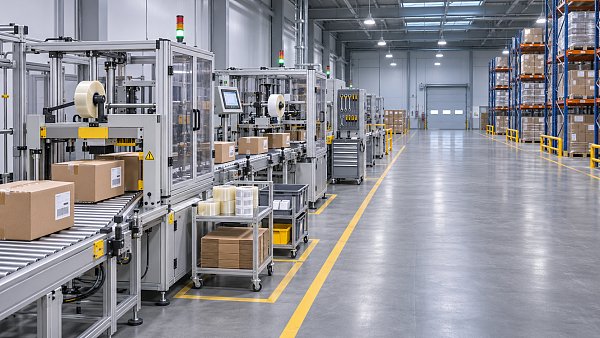
A packaging line is a sequence of dependent processes. Carton erection, product loading, void fill, sealing, weighing, labeling, and transfer to dispatch each have their own capacity and failure modes. The slowest sustained stage will generally limit flow, but the constraint can move as the order mix changes or equipment stops.
For example, a fast sealer adds little usable capacity if operators cannot load irregular items at the same pace. A high-speed bagger may also be held back by a label verification station or a congested takeaway conveyor. Map each step from order presentation to dispatch, including manual work and shared resources, and record its expected rate under the same workload assumptions.
Do not simply add individual machine rates or assume every station runs continuously at its nominal maximum. Require a line-level estimate that identifies where work accumulates, how interruptions affect neighboring stations, and which operations require an operator. If two packaging lines share a printer, replenishment route, or takeaway conveyor, include that shared resource in the capacity assessment.
Variability matters as much as average processing time. A station that handles standard orders quickly but pauses for oversized items can create queues that persist after the difficult order has passed. Separate the expected volume of exceptions from the standard flow and establish where those exceptions will go.
Evaluate the operating footprint, not just the machine dimensions
A supplier drawing may show only the equipment’s physical outline. A workable warehouse layout must also accommodate how people and materials move around it. A smaller machine can consume more usable space if its access doors, material rolls, and discharge points force long or obstructed routes.
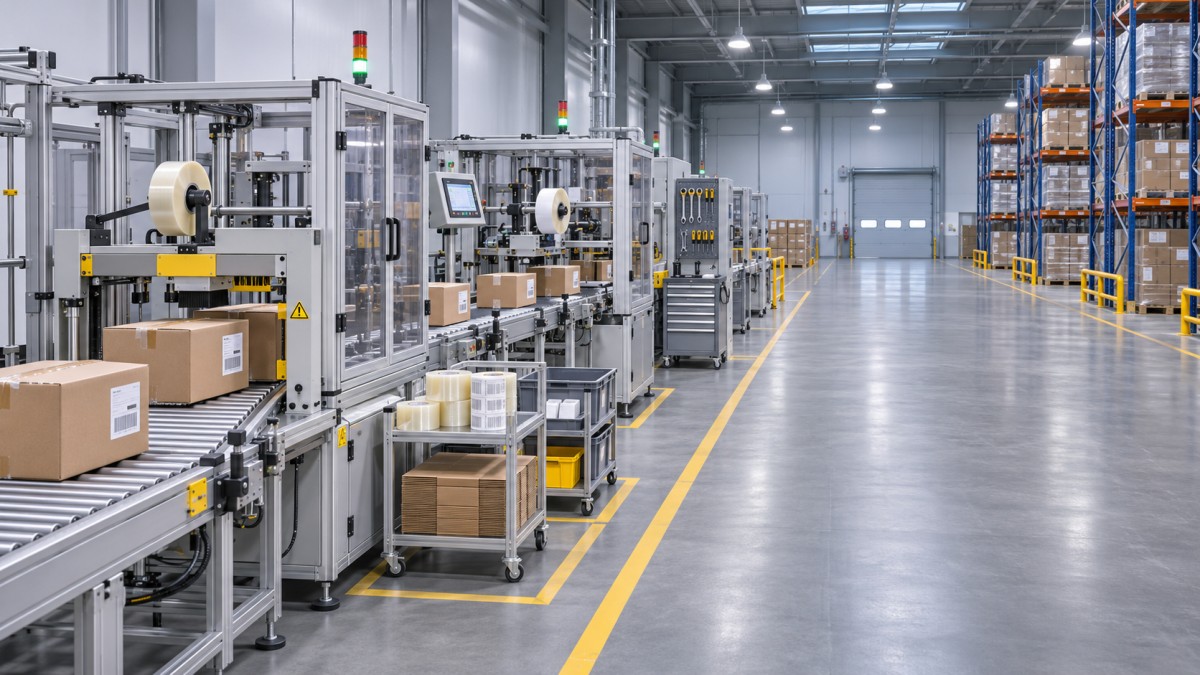
Build the layout around the complete flow: incoming goods or totes, packaging materials, packed orders, rejected items, and waste. Mark equipment envelopes and the areas needed for loading, maintenance, cleaning, and recovery from jams. Include clearances specified by the equipment supplier, as well as site-specific requirements for safe access and traffic separation.
Check the space above and below the equipment as well as the floor plan. Carton magazines, conveyors, guarding, utility drops, and access panels can conflict with columns, low beams, sprinklers, doors, or existing services. A compact arrangement is less attractive if a technician must dismantle adjacent equipment to replace a frequently serviced component.
Compare layouts using the same boundary. One proposal may include accumulation conveyors and material storage while another shows only the central packing machine. Include operator stations, replenishment positions, inbound and outbound queues, and any external equipment needed to achieve the quoted rate. The result is a more meaningful measure of usable output per unit of occupied space.
Size buffers around real interruptions
Buffers temporarily hold work between processes, allowing one stage to continue during a short interruption at another. They can reduce the impact of ordinary variability, but they cannot fix a sustained capacity shortfall. If the downstream process consistently handles less work than arrives, the buffer will eventually fill.
Estimate buffer needs using the rate at which work arrives and the duration of interruptions the operation is designed to absorb. A simple starting point is arrival rate multiplied by interruption duration, expressed in the same units. For example, a buffer between two carton-handling stages should be sized in cartons, not customer orders, if an order can contain several cartons.
That calculation assumes arrivals continue at the stated rate and the buffer starts empty. It also does not account for the time needed to clear accumulated work after restart. The downstream stage needs spare capacity to recover the queue while new work continues to arrive; otherwise, repeated short stops can leave the buffer full for much of the shift.
Physical capacity depends on carton dimensions and conveyor rules, not only on a count of positions. Decide what happens when the buffer fills or empties, including whether upstream equipment stops safely, whether items can be removed manually, and how order identity is preserved during recovery.
Match the configuration to the order profile
The right level of automation depends on how consistently the warehouse presents items for packing and how much the required packaging varies. The following comparisons are starting points for evaluation, not substitutes for testing the actual product mix.
Provide suppliers with a representative distribution of product and order characteristics rather than just minimum and maximum dimensions. Include item weight, rigidity, surface condition, fragility, number of items per order, and packaging constraints. A system that accepts both the smallest and largest items individually may still struggle with the way mixed items arrive together.
Packaging material also affects performance. Carton quality, film behavior, label placement, and void-fill requirements can change the frequency of jams or interventions. If the warehouse intends to use existing materials, include them in the evaluation. If a supplier specifies alternatives, assess how those materials affect storage, replenishment, and downstream handling.
Check integration and recovery before committing to a layout
Mechanical fit is only one integration question. The packaging system needs timely, accurate information about each order and a reliable way to report what happened. Map the required exchanges with the warehouse management system, warehouse control system, scales, printers, and any upstream automation.
Define where package identity is created, how it follows a carton or bag through the line, and what happens if a barcode cannot be read. A duplicate label, missing weight, or lost message can turn a mechanically successful cycle into an order that cannot be dispatched. The design should specify how operators identify and correct those exceptions without losing traceability.
Also examine failure and restart behavior. If a conveyor stops after a label has been printed but before application, can the system determine which package owns that label? After a power interruption, can operators clear the line and reconcile unfinished orders? These scenarios affect both throughput and the space needed for quarantine or manual rework.
Utilities, network connections, controls, guarding, and access to spare parts belong in the same review. Establish which supplier is responsible for each interface and for resolving issues between systems. A line assembled from capable components can still miss its target if no party owns the end-to-end result.
Make supplier proposals comparable
Give each supplier the same demand profile, available production window, product data, packaging materials, layout constraints, and interface requirements. Request a line-level proposal that states its assumptions and identifies the equipment, people, buffers, and external resources needed to meet the target.
The comparison should make it possible to answer these questions:
- What counts as accepted output, where is it measured, and which operating time is included in the rate?
- Which product and order mixes, packaging materials, and staffing levels support the proposed capacity?
- Which queues, maintenance clearances, material stores, and operator areas are included in the layout?
- How are jams, unreadable labels, rejected packs, replenishment, and changeovers handled?
- What happens when upstream supply or downstream dispatch stops, and how is the line restarted?
- What equipment, software interfaces, utilities, consumables, and site work are excluded from the proposal?
Translate the answers into an acceptance plan before purchase. Define a representative workload, the length and conditions of the run, the count of accepted output, and how downtime and exceptions will be recorded. Include the intended packaging materials and operating roles. Where a full test at the supplier’s facility is impractical, agree on which functions and interfaces will be demonstrated there and which line-level results will be measured after installation.
Finally, compare ownership costs over the intended planning period alongside capacity and footprint. Include labor, consumables, maintenance, spare parts, software support, utilities, installation, and the operational cost of expected interruptions. The preferred proposal should meet the required dispatch window with a credible operating layout and a clear route for handling the work that falls outside its standard process.
Search News
Hot Articles
- Carbon Fiber StructuresHow to Specify Aerospace Carbon Fiber Assemblies for Lightweight, Load-Bearing PartsJul 11, 2026
- Machine VisionXiaomi, Alibaba DAMO Academy Drive Open-Source Robotics Model Ecosystem, Lowering Algorithm Development Barriers for Overseas SMEs Adopting Chinese Robotics SolutionsMar 30, 2026
- Cobots & ArmsShanxi 'AI+' Conference Showcases Embodied Intelligence with Multinational Buyer Engagement: Key Industry ImplicationsMar 30, 2026
Popular Tags
Recommended News
 Jul 11, 2026How to Specify Aerospace Carbon Fiber Assemblies for Lightweight, Load-Bearing PartsAerospace carbon fiber assemblies: learn how to specify laminate design, load data, joining methods, and inspection controls for lighter, reliable load-bearing aerospace parts.Elena Rostova (UAV Systems Researcher)
 Mar 30, 2026Xiaomi, Alibaba DAMO Academy Drive Open-Source Robotics Model Ecosystem, Lowering Algorithm Development Barriers for Overseas SMEs Adopting Chinese Robotics SolutionsXiaomi & Alibaba DAMO Academy's open-source robotics models lower algorithm barriers for global SMEs. Boost efficiency in manufacturing, logistics & smart retail with ROS 2 compatible solutions.TSV Data Lab
 Mar 30, 2026Shanxi 'AI+' Conference Showcases Embodied Intelligence with Multinational Buyer Engagement: Key Industry ImplicationsShanxi 'AI+' Conference highlights embodied intelligence with Tesla, Ubtech & Jiantao showcasing multimodal robotics. 40+ global buyers validated tech on-site, creating new B2B channels for industrial automation & AI solutions.Chen Wei (Automation Lead Engineer)
 Mar 30, 2026Zhongguancun Unveils 6G Integrated Sensing-Computing-Intelligence Platform to Empower Embodied Robots for Global Industrial ApplicationsZhongguancun's new 6G platform revolutionizes industrial robotics with <10ms latency, empowering global automotive, logistics & port automation. Discover how this tech boosts China's smart manufacturing exports.TSV Data Lab
 Mar 30, 2026Mech-Mind Tianjin Embodied Intelligence R&D and Production Base Goes Live, Cutting Delivery Time by 20%–30% for Global Customized AMR+Vision SolutionsMech-Mind's Tianjin AMR+Vision production base cuts delivery time by 20%-30% for欧美 & Latin American markets. Discover how this PLd-certified facility accelerates customized robotics solutions for smart manufacturing and logistics.Chen Wei (Automation Lead Engineer)
 Mar 30, 2026Boao Forum Reveals 'Co-evolution of Big and Small Brains' Trend in Humanoid Robots, China's Embodied Intelligence Accelerates Adaptation to Overseas Manufacturing Service ScenariosDiscover how China's humanoid robots, featuring 'Co-evolution of Big and Small Brains,' are revolutionizing global manufacturing. Learn about Embodied Tian Gong 3.0's ISO compliance and overseas deployment at Boao Forum 2026.Chen Wei (Automation Lead Engineer)
 Mar 30, 2026China Railway Industrial Secures Patent for Embodied Robotics in Material Handling, Boosting High-Precision Delivery Capabilities for Overseas Infrastructure and Manufacturing ProjectsChina Railway Industrial's new patent for embodied robotics in material handling boosts high-precision delivery for global infrastructure & manufacturing. Discover how this innovation enhances logistics accuracy in automotive, rail transit & EPC projects.Chen Wei (Automation Lead Engineer)
 Nov 19, 2026Choosing a Palletizing System for Bagged Food: Speed and Bag HandlingChoose the right palletizing system for bagged food. Compare throughput, bag handling, food safety, and robotic vs. conventional options.Chen Wei (Automation Lead Engineer)
 Nov 18, 2026Formnext 2026 Opens as Additive Manufacturing Advances Industrial ApplicationsFormnext 2026 highlights additive manufacturing innovations for industrial applications. Explore what they could mean for production, procurement and suppliers.Dr. Marcus Vance
 Nov 18, 2026Flexible Robotics Integration for High-Mix, Low-Volume ProductionFlexible robotics integration can make high-mix, low-volume production more adaptable. Explore practical ways to reduce changeover risk and plan a reliable robotic cell.Victor Lin (Chief Software Architect)
 Nov 17, 2026Formnext 2026: UK Additive Manufacturing Leads in Research but Faces Production BarriersUK additive manufacturing leads in research but faces barriers to production at scale. Explore the Formnext 2026 insights and what businesses should consider.Dr. Marcus Vance
 Nov 17, 2026Choosing Warehouse Automation Packaging Systems: Throughput and SpaceCompare warehouse automation packaging systems by throughput, footprint, and order mix. Discover how to choose a layout that meets peak demand.Victor Lin (Chief Software Architect)
 Nov 16, 2026China's October Industrial Robot Output Up 26%, 3D Printing Equipment Up 85.9%China's industrial robot output reportedly rose 26% in October, while 3D printing equipment grew 85.9%. Explore what the figures could mean for buyers.Chen Wei (Automation Lead Engineer)
 Nov 16, 2026Commercial Drones in North America: Choosing Payloads for Inspection and MappingCommercial drones North America: compare RGB, thermal and LiDAR payloads for inspection and mapping, and choose a system that delivers reliable data.Elena Rostova (UAV Systems Researcher)
 Nov 15, 2026Aerospace Materials in the UK: Choosing Metals and Composites for AircraftExplore aerospace materials UK teams use for aircraft. Compare metals and composites by weight, fatigue, manufacturing and approval needs to make informed choices.Dr. Marcus Vance
 Nov 14, 2026Ukraine Tests 3D-Printed Protective Structure Against M2 Heavy Machine-Gun FireUkraine’s 3D-printed protective structure reportedly resisted M2 heavy machine-gun fire. Explore the test’s limits and potential procurement implications.Dr. Marcus Vance
 Nov 14, 2026Rugged UAV Metrics: Assessing Wind Resistance, Endurance and IP RatingsCompare rugged UAV metrics for wind resistance, endurance and IP ratings. Learn what evidence to request and choose a platform fit for your mission.Chen Wei (Automation Lead Engineer)
 Nov 13, 2026Physical AI Gains Attention as Robot Investment Moves Beyond HardwarePhysical AI is reshaping robot investment beyond hardware. Explore what the shift toward perception and algorithms could mean for buyers and suppliers.Chen Wei (Automation Lead Engineer)
 Nov 13, 2026Precision Machining Benchmarks: A Guide to Tolerances and Surface FinishExplore this precision machining benchmarks guide to compare tolerances, surface finish, and inspection methods—and specify parts with confidence.Dr. Marcus Vance
 Nov 12, 2026Beijing Issues Three-Year Plan for Embodied AI Robotics IndustryBeijing’s embodied AI robotics plan targets leading humanoid robot makers by 2028. Explore its goals for supply chains, AI models and deployment.Chen Wei (Automation Lead Engineer)
 Nov 12, 2026Choosing an Edge AI Box for Robotics: Compute, Latency and I/OChoose the right edge AI box for robotics with practical guidance on compute, latency, sensor I/O and sustained performance. Explore the selection checklist.Chen Wei (Automation Lead Engineer)
 Nov 11, 2026Beijing Sets 200,000-Unit Annual Capacity Goal in Robotics PlanBeijing's robotics plan targets 200,000 units of annual capacity by 2027. Explore its technology goals, benchmark applications and adoption outlook.Chen Wei (Automation Lead Engineer)
 Nov 11, 2026Aero Engine Blade Machining: 5-Axis CNC Methods and ChallengesExplore aero engine blade machining, from 5-axis toolpaths to thin-wall challenges, surface integrity, and inspection. Learn what makes a process reliable.Dr. Marcus Vance
 Nov 10, 2026FAA Authorizes Skyways’ Long-Distance BVLOS Flights for Shell in Gulf of MexicoFAA authorizes Skyways’ long-distance BVLOS drone flights for Shell in the Gulf of Mexico. Discover what the decision means for offshore pipeline inspection.Elena Rostova (UAV Systems Researcher)