Choosing a Palletizing System for Bagged Food: Speed and Bag Handling
Publication Date
author
Selecting a palletizing system for bagged food requires more than comparing bags per minute. Engineers must assess how bag weight, fill consistency, seal strength, and surface friction affect gripping, transfer, and stack stability at the required throughput.
Food safety, changeover time, and integration with upstream packaging equipment also shape the decision. This guide examines the speed and bag-handling criteria behind a reliable system specification, helping technical evaluators compare robotic and conventional palletizers against actual production requirements.
The best choice is the system that sustains the required output with your actual bags, pallet patterns, and operating interruptions. A supplier’s peak cycle rate alone cannot establish that capability.
What throughput must the palletizer actually sustain?
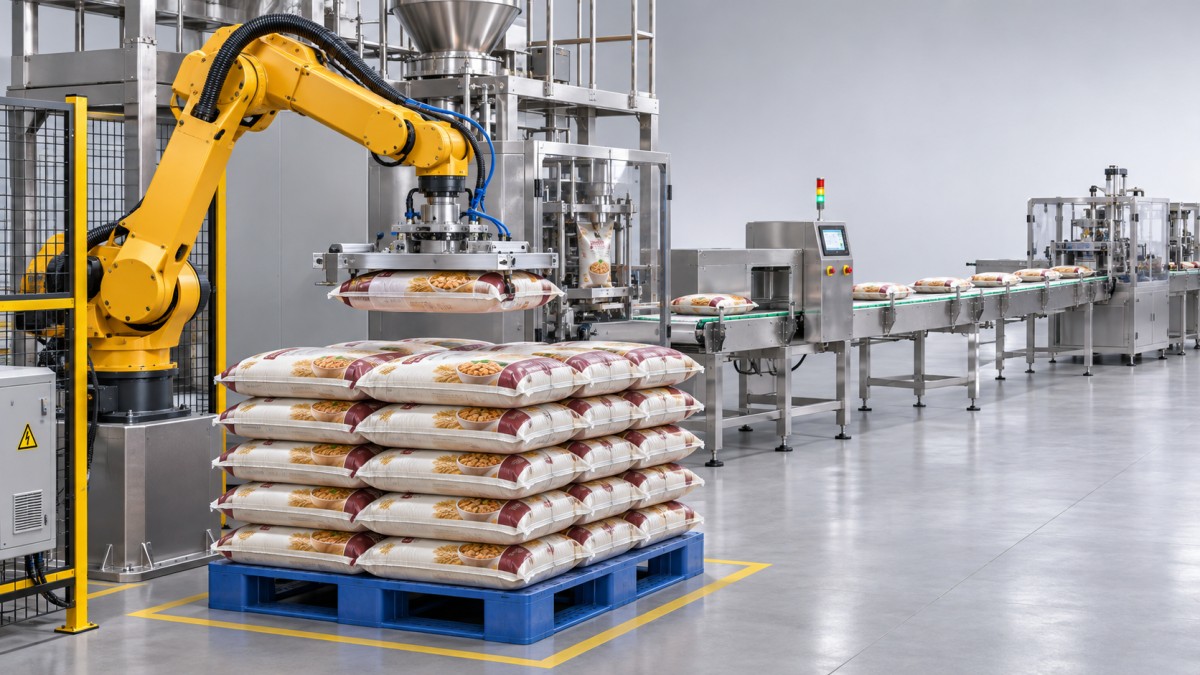
Start with the packaging line’s maximum sustained output, expressed in bags per minute, and distinguish it from the daily average. The palletizer must accommodate the rate presented at its infeed.
Account for planned production time, breaks, cleaning, and expected interruptions when converting a daily target into an operating rate. Avoid applying downtime allowances twice if the upstream rate already includes them.
For example, 24,000 bags over 480 planned minutes require an average of 50 bags per minute during that window. If the palletizing system is available for 90% of that time, its required running rate rises to approximately 56 bags per minute.
That calculation assumes the unavailable time applies to the palletizer and that upstream equipment can deliver enough product when it runs. Confirm those assumptions before using the figure for sizing.
Then examine the complete cycle: bag pickup, transfer, orientation, placement, layer building, pallet exchange, and insertion of slip sheets or empty pallets. Any step can become the limiting operation.
Ask suppliers to state whether their quoted rate includes pallet changes and consumable replenishment. A rate measured during uninterrupted layer placement can overstate production output.
Also specify the required buffer capacity and recovery behavior. After a short downstream stop, a line running above its normal rate may need to clear accumulated bags without causing another stoppage.
Which bag characteristics control handling performance?
Provide representative samples of every bag family, including minimum and maximum weights, dimensions, fill levels, materials, and seal types. Nominal dimensions alone do not describe a deformable package.
Fill consistency affects the bag’s center of gravity and contact surface. A loosely filled bag of flour may spread beneath a gripper, while a tightly filled bag of granular product can behave differently.
Test bag temperature, trapped air, surface contamination, and normal variation from the filling machine. These conditions can change the package profile and grip during production.
Seal strength matters during acceleration, gripping, and placement. Identify areas where the end effector must not clamp, lift, or drag, and verify performance after upstream sealing conditions vary within approved limits.
Surface friction influences both gripping and pallet stability. Slippery film may be easy to slide into position but difficult to hold; a high-friction surface may resist alignment and disturb neighboring bags.
Include bags from the edges of acceptable production variation, not only clean, uniform samples. Document the dimensions and condition of each test batch so results can be reproduced.
Evaluate leakage, deformation, seal damage, and displaced product after handling. Define acceptance limits with quality personnel before testing, including how many bags will be inspected and by what method.
Robotic or conventional: which architecture fits the line?
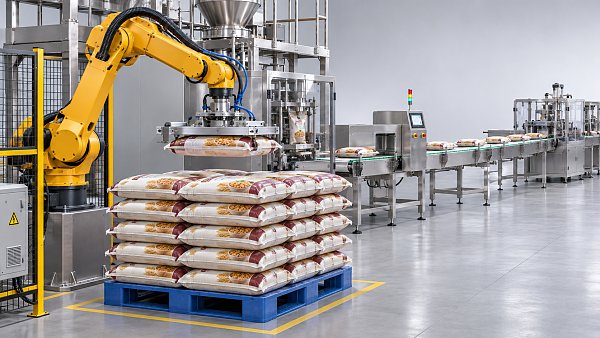
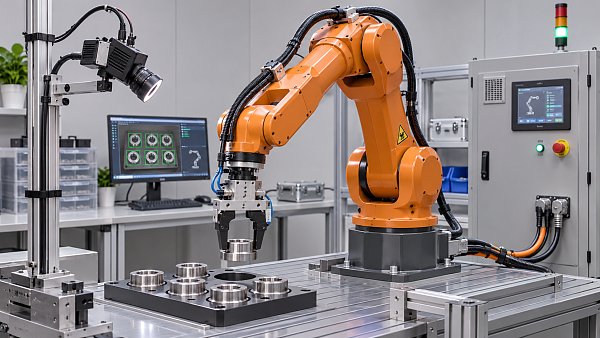
Robotic palletizers use a programmable arm and an end effector to place bags. They are often attractive when product formats, pallet patterns, or production schedules change frequently.
Conventional palletizers typically orient bags and form rows or layers mechanically before placing them on a pallet. They can suit repeatable, high-volume production when bag dimensions and patterns remain stable.
Neither architecture guarantees a particular rate or level of bag protection. Performance depends on the specific machine, bag presentation, pattern, tooling, and supporting equipment.
Compare options against the same operating scenario: identical bags, infeed rate, pallet dimensions, stack height, layer pattern, and pallet exchange requirements. Otherwise, headline rates are difficult to compare.
For a robotic system, examine reach across the full stack, payload including the end effector, acceleration limits, and clearance around conveyors and guarding. The longest reach may coincide with the most demanding placement.
For a conventional system, examine bag orientation, layer-forming pressure, transfer surfaces, and adjustment ranges. Confirm that the machine can handle variation without excessive manual intervention or bag damage.
Multiple production lines add another constraint: shared equipment must handle simultaneous arrivals and practical changeovers. Model the worst credible combination of line rates and bag formats before assuming one machine can serve both.
How should the gripper protect bags at production speed?
The end effector is a major determinant of usable speed. A robot may have ample nominal payload, yet its gripper may struggle with a flexible bag or an unstable product distribution.
Clamp grippers can handle certain bags securely, but jaw pressure and contact geometry require careful tuning. Excessive compression can damage seals, deform contents, or expel product through a weak closure.
Vacuum tooling depends on sufficient contact and sealing. Wrinkled film, porous packaging, dust, and uneven fill can reduce grip; verify vacuum performance on actual packaging at the intended cycle rate.
Support-style tooling, including forks or plates, may reduce pressure on the bag. Check insertion clearance, friction during withdrawal, and whether the bag shifts or catches on adjacent layers.
For any design, assess the entire motion profile rather than the pickup alone. Acceleration, deceleration, rotation, and release can shift contents or cause a bag to slip after an initially secure grip.
Ask how the system detects a missed pick or dropped bag and what happens next. Recovery should prevent misplaced bags from entering the pallet while giving operators a clear restart procedure.
If a tool handles multiple bag sizes, record the adjustment method and limits. A format change that requires replacing heavy tooling may outweigh the apparent flexibility of a programmable robot.
Will the pallet remain stable through storage and transport?
A successful placement is not enough. The completed pallet must remain stable during wrapping, forklift movement, warehouse storage, and the transport conditions expected for the product.
Define pallet dimensions, allowable overhang, maximum stack height, layer count, and gross load. Include pallet quality and dimensional variation because damaged or inconsistent pallets can affect the stack.
Interlocking patterns can improve stability for some bags, but their effectiveness depends on bag shape, fill, friction, and stack compression. Verify the pattern with the actual product and packaging.
Assess whether bag orientation protects seals and labels while maintaining a level surface. Uneven layers can amplify stack lean as height increases, especially with soft or irregular bags.
Specify slip sheets, top sheets, corner protection, and stretch wrapping where required. Their handling time and consumable replenishment must be included in the line-rate calculation.
Use an agreed stability assessment for representative completed pallets. Where applicable, include internal handling and transport trials under defined conditions, and document the acceptance criteria before testing.
What food-safety and cleaning requirements affect the design?
Start by defining the installation environment and the applicable site hygiene requirements. A palletizer handling sealed outer bags has different exposure and cleaning needs from equipment near open product.
Identify surfaces that may collect food dust, damaged product, or water. Request a design that permits inspection and cleaning of conveyors, gripper components, guards, and areas beneath the machine.
Specify the cleaning method, chemicals, temperature, and frequency. Equipment designed for dry cleaning may not be suitable for wet washdown, and electrical protection must match the actual exposure.
Discuss allergen segregation and product changeover procedures with the plant’s food-safety team. The system should support the site’s documented cleaning and verification process without creating inaccessible residue traps.
Include dust control where needed, particularly for powdered products. Assess combustible dust hazards with qualified personnel and apply the requirements relevant to the product, equipment, and jurisdiction.
Also define how leaking or damaged bags are detected, removed, and recorded. A safe, practical rejection procedure reduces contamination risk and prevents unstable bags from entering the pallet.
How should the palletizer connect to the rest of the line?
Map bag orientation, spacing, conveyor height, and arrival rate at the infeed. The palletizer’s rated performance assumes a suitable presentation; upstream variation can disrupt even a well-sized machine.
Agree on control signals for ready, running, fault, blocked, and emergency-stop states. Define which controller owns accumulation, line stopping, and restart sequencing across equipment boundaries.
Check how the system behaves during an empty pallet shortage, wrapper blockage, or robot fault. A controlled stop and predictable recovery can be more valuable than a small improvement in peak speed.
Specify recipe data for bag format, pallet pattern, and stack height, along with user permissions and backup procedures. Confirm whether recipe changes require supplier support or can be managed on site.
Physical integration matters too: reserve space for guarding, maintenance access, pallet movement, consumables, and safe removal of damaged bags. Include forklift and pedestrian routes in the layout review.
What should a supplier prove before acceptance?
Turn the purchase specification into measurable acceptance criteria. Identify each bag type, test quantity, target rate, pallet pattern, permitted interventions, and conditions for counting a successful run.
Require the supplier to report elapsed production time, bags successfully palletized, interruptions, rejected bags, and completed pallets. State whether setup, pallet changes, and recovery time are included.
For example, a test could require a defined number of consecutive pallets at the agreed infeed rate, with no bag damage beyond the specified limit. Select the duration and sample size to expose realistic operating variation.
Run a factory acceptance test with representative materials where practical, then repeat critical checks during site acceptance. The installed conveyor, utilities, operators, and upstream equipment can affect the outcome.
Record both successful and failed trials, including the cause of each interruption and the corrective action. A single short demonstration provides limited evidence of sustained performance.
Request documentation covering maintenance intervals, wear parts, fault diagnostics, training, and spare-parts availability. These details affect recovery time and the system’s ability to maintain output over its service life.
How can evaluators compare total cost and make a decision?
Compare the installed cost of each option, including conveyors, guarding, pallet handling, integration, commissioning, and any building or utility changes. Equipment price alone can conceal significant differences.
Estimate ongoing costs using site-specific assumptions for labor, energy, consumables, maintenance, and downtime. Include changeover frequency and the production time needed to clean or adjust the system.
Examine sensitivity to uncertain inputs. If one option only meets the business case at a very high utilization rate, test whether the expected production schedule supports that assumption.
Choose the architecture that meets the required sustained rate while protecting bags and producing stable pallets across the approved operating range. Require evidence for the difficult formats, not just the easiest sample.
A sound palletizing system for bagged food is ultimately defined by repeatable results: acceptable bags, stable loads, recoverable faults, and a documented operating rate under conditions the plant can reproduce.
Search News
Hot Articles
- Carbon Fiber StructuresHow to Specify Aerospace Carbon Fiber Assemblies for Lightweight, Load-Bearing PartsJul 11, 2026
- Machine VisionXiaomi, Alibaba DAMO Academy Drive Open-Source Robotics Model Ecosystem, Lowering Algorithm Development Barriers for Overseas SMEs Adopting Chinese Robotics SolutionsMar 30, 2026
- Cobots & ArmsShanxi 'AI+' Conference Showcases Embodied Intelligence with Multinational Buyer Engagement: Key Industry ImplicationsMar 30, 2026
Popular Tags
Recommended News
 Jul 11, 2026How to Specify Aerospace Carbon Fiber Assemblies for Lightweight, Load-Bearing PartsAerospace carbon fiber assemblies: learn how to specify laminate design, load data, joining methods, and inspection controls for lighter, reliable load-bearing aerospace parts.Elena Rostova (UAV Systems Researcher)
 Mar 30, 2026Xiaomi, Alibaba DAMO Academy Drive Open-Source Robotics Model Ecosystem, Lowering Algorithm Development Barriers for Overseas SMEs Adopting Chinese Robotics SolutionsXiaomi & Alibaba DAMO Academy's open-source robotics models lower algorithm barriers for global SMEs. Boost efficiency in manufacturing, logistics & smart retail with ROS 2 compatible solutions.TSV Data Lab
 Mar 30, 2026Shanxi 'AI+' Conference Showcases Embodied Intelligence with Multinational Buyer Engagement: Key Industry ImplicationsShanxi 'AI+' Conference highlights embodied intelligence with Tesla, Ubtech & Jiantao showcasing multimodal robotics. 40+ global buyers validated tech on-site, creating new B2B channels for industrial automation & AI solutions.Chen Wei (Automation Lead Engineer)
 Mar 30, 2026Zhongguancun Unveils 6G Integrated Sensing-Computing-Intelligence Platform to Empower Embodied Robots for Global Industrial ApplicationsZhongguancun's new 6G platform revolutionizes industrial robotics with <10ms latency, empowering global automotive, logistics & port automation. Discover how this tech boosts China's smart manufacturing exports.TSV Data Lab
 Mar 30, 2026Mech-Mind Tianjin Embodied Intelligence R&D and Production Base Goes Live, Cutting Delivery Time by 20%–30% for Global Customized AMR+Vision SolutionsMech-Mind's Tianjin AMR+Vision production base cuts delivery time by 20%-30% for欧美 & Latin American markets. Discover how this PLd-certified facility accelerates customized robotics solutions for smart manufacturing and logistics.Chen Wei (Automation Lead Engineer)
 Mar 30, 2026Boao Forum Reveals 'Co-evolution of Big and Small Brains' Trend in Humanoid Robots, China's Embodied Intelligence Accelerates Adaptation to Overseas Manufacturing Service ScenariosDiscover how China's humanoid robots, featuring 'Co-evolution of Big and Small Brains,' are revolutionizing global manufacturing. Learn about Embodied Tian Gong 3.0's ISO compliance and overseas deployment at Boao Forum 2026.Chen Wei (Automation Lead Engineer)
 Mar 30, 2026China Railway Industrial Secures Patent for Embodied Robotics in Material Handling, Boosting High-Precision Delivery Capabilities for Overseas Infrastructure and Manufacturing ProjectsChina Railway Industrial's new patent for embodied robotics in material handling boosts high-precision delivery for global infrastructure & manufacturing. Discover how this innovation enhances logistics accuracy in automotive, rail transit & EPC projects.Chen Wei (Automation Lead Engineer)
 Nov 19, 2026Choosing a Palletizing System for Bagged Food: Speed and Bag HandlingChoose the right palletizing system for bagged food. Compare throughput, bag handling, food safety, and robotic vs. conventional options.Chen Wei (Automation Lead Engineer)
 Nov 18, 2026Formnext 2026 Opens as Additive Manufacturing Advances Industrial ApplicationsFormnext 2026 highlights additive manufacturing innovations for industrial applications. Explore what they could mean for production, procurement and suppliers.Dr. Marcus Vance
 Nov 18, 2026Flexible Robotics Integration for High-Mix, Low-Volume ProductionFlexible robotics integration can make high-mix, low-volume production more adaptable. Explore practical ways to reduce changeover risk and plan a reliable robotic cell.Victor Lin (Chief Software Architect)
 Nov 17, 2026Formnext 2026: UK Additive Manufacturing Leads in Research but Faces Production BarriersUK additive manufacturing leads in research but faces barriers to production at scale. Explore the Formnext 2026 insights and what businesses should consider.Dr. Marcus Vance
 Nov 17, 2026Choosing Warehouse Automation Packaging Systems: Throughput and SpaceCompare warehouse automation packaging systems by throughput, footprint, and order mix. Discover how to choose a layout that meets peak demand.Victor Lin (Chief Software Architect)
 Nov 16, 2026China's October Industrial Robot Output Up 26%, 3D Printing Equipment Up 85.9%China's industrial robot output reportedly rose 26% in October, while 3D printing equipment grew 85.9%. Explore what the figures could mean for buyers.Chen Wei (Automation Lead Engineer)
 Nov 16, 2026Commercial Drones in North America: Choosing Payloads for Inspection and MappingCommercial drones North America: compare RGB, thermal and LiDAR payloads for inspection and mapping, and choose a system that delivers reliable data.Elena Rostova (UAV Systems Researcher)
 Nov 15, 2026Aerospace Materials in the UK: Choosing Metals and Composites for AircraftExplore aerospace materials UK teams use for aircraft. Compare metals and composites by weight, fatigue, manufacturing and approval needs to make informed choices.Dr. Marcus Vance
 Nov 14, 2026Ukraine Tests 3D-Printed Protective Structure Against M2 Heavy Machine-Gun FireUkraine’s 3D-printed protective structure reportedly resisted M2 heavy machine-gun fire. Explore the test’s limits and potential procurement implications.Dr. Marcus Vance
 Nov 14, 2026Rugged UAV Metrics: Assessing Wind Resistance, Endurance and IP RatingsCompare rugged UAV metrics for wind resistance, endurance and IP ratings. Learn what evidence to request and choose a platform fit for your mission.Chen Wei (Automation Lead Engineer)
 Nov 13, 2026Physical AI Gains Attention as Robot Investment Moves Beyond HardwarePhysical AI is reshaping robot investment beyond hardware. Explore what the shift toward perception and algorithms could mean for buyers and suppliers.Chen Wei (Automation Lead Engineer)
 Nov 13, 2026Precision Machining Benchmarks: A Guide to Tolerances and Surface FinishExplore this precision machining benchmarks guide to compare tolerances, surface finish, and inspection methods—and specify parts with confidence.Dr. Marcus Vance
 Nov 12, 2026Beijing Issues Three-Year Plan for Embodied AI Robotics IndustryBeijing’s embodied AI robotics plan targets leading humanoid robot makers by 2028. Explore its goals for supply chains, AI models and deployment.Chen Wei (Automation Lead Engineer)
 Nov 12, 2026Choosing an Edge AI Box for Robotics: Compute, Latency and I/OChoose the right edge AI box for robotics with practical guidance on compute, latency, sensor I/O and sustained performance. Explore the selection checklist.Chen Wei (Automation Lead Engineer)
 Nov 11, 2026Beijing Sets 200,000-Unit Annual Capacity Goal in Robotics PlanBeijing's robotics plan targets 200,000 units of annual capacity by 2027. Explore its technology goals, benchmark applications and adoption outlook.Chen Wei (Automation Lead Engineer)
 Nov 11, 2026Aero Engine Blade Machining: 5-Axis CNC Methods and ChallengesExplore aero engine blade machining, from 5-axis toolpaths to thin-wall challenges, surface integrity, and inspection. Learn what makes a process reliable.Dr. Marcus Vance
 Nov 10, 2026FAA Authorizes Skyways’ Long-Distance BVLOS Flights for Shell in Gulf of MexicoFAA authorizes Skyways’ long-distance BVLOS drone flights for Shell in the Gulf of Mexico. Discover what the decision means for offshore pipeline inspection.Elena Rostova (UAV Systems Researcher)