Drone Delivery System Logistics and the Last 3 km Problem
Publication Date
author
As urban supply chains strain under rising delivery expectations, drone delivery system logistics is emerging as a decisive answer to the last 3 km problem. For enterprise decision-makers, the real question is not hype but operational truth: payload limits, routing efficiency, regulatory constraints, and measurable ROI. This article examines how data-driven UAV logistics can reshape final-mile performance with engineering precision.
For most executives, the central search intent behind “drone delivery system logistics” is practical evaluation. They are not looking for futuristic narratives. They want to know whether drone delivery can solve a specific operational bottleneck in dense cities, industrial parks, medical networks, remote facilities, or high-urgency service corridors. More importantly, they want to understand where the last 3 km problem is economically and technically solvable, and where conventional ground logistics still wins.
That distinction matters. In logistics strategy, the final kilometers are often the most expensive, least predictable, and hardest to optimize. Traffic congestion, labor shortages, fragmented delivery windows, access restrictions, and failed handoffs all inflate cost-to-serve. A well-designed drone delivery system can reduce some of these frictions, but only under tightly defined conditions. The real value lies in selective deployment, not universal replacement.
Why the last 3 km problem is the real decision point in drone delivery system logistics
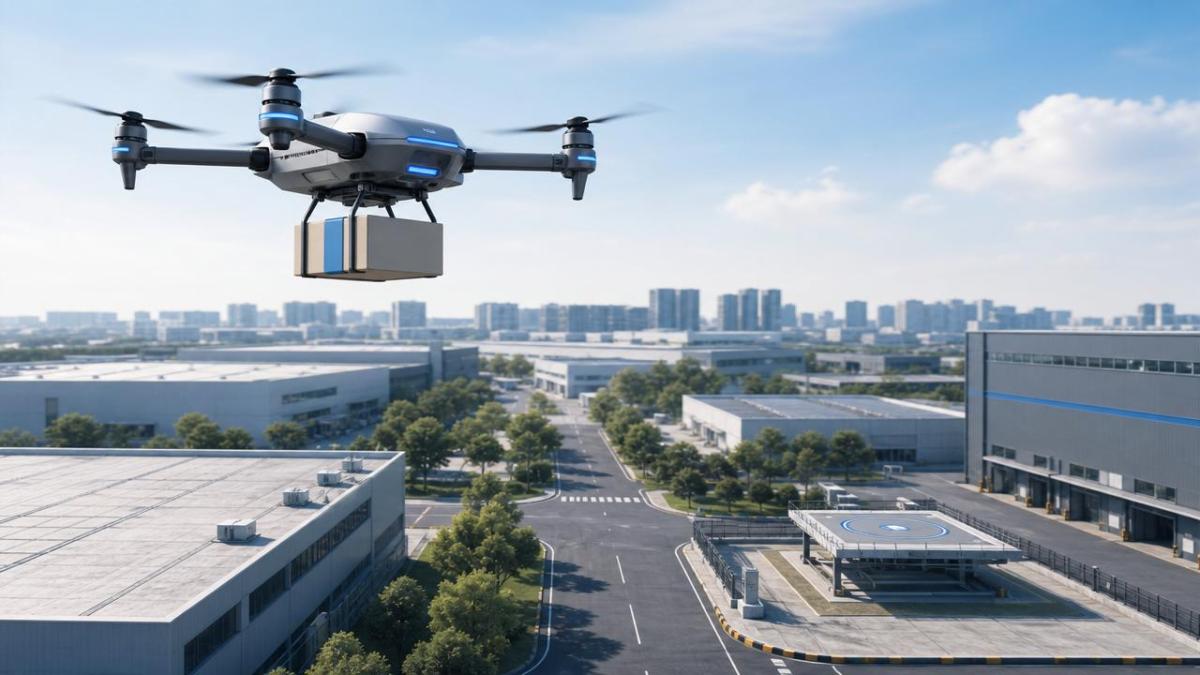
The last 3 km is where delivery promises meet physical reality. In many networks, line-haul transport is already efficient. Warehouses are automated, route planning software is mature, and regional fulfillment is increasingly optimized. Yet the final approach to the customer, clinic, job site, vessel, campus, or field operation remains costly because every stop introduces variability.
For enterprise decision-makers, the issue is not whether drones can fly. The issue is whether they can reduce variability better than vans, riders, or fixed courier routes. Drone delivery system logistics becomes attractive when the mission profile includes small payloads, high urgency, repeated corridors, difficult road access, or premium service economics. Examples include medical samples, critical spare parts, offshore maintenance items, high-value electronics, and urgent documents within controlled geographies.
In other words, the last 3 km problem is less about distance and more about service friction. A three-kilometer route across a congested urban district may take 25 minutes by road and six minutes by air. A three-kilometer route inside a secure industrial zone may require gates, manual verification, and internal traffic management. A drone system can bypass many of these ground-side delays if landing, handoff, and compliance are engineered properly.
However, if the delivery profile involves bulky parcels, highly variable addresses, poor landing options, or low delivery urgency, drones may add complexity without enough return. That is why serious adoption begins with mission segmentation, not with aircraft procurement.
What enterprise buyers should evaluate before believing the ROI story
Executives typically care about five questions first: what service problem is being solved, what technical envelope defines success, what infrastructure is required, what regulatory pathway exists, and what financial model supports scale. Any proposal that cannot answer these with measurable assumptions is still a pilot concept, not an operational logistics strategy.
The first filter is payload-to-distance fit. Most commercial delivery drones operate within constrained payload bands. If the business case depends on carrying 5 to 10 kg over long distances in dense urban conditions, the economics and safety architecture become harder. If the target payload is 1 to 3 kg with a narrow set of urgent SKUs, the feasibility improves considerably. Managers should ask for payload curves at realistic environmental conditions, not headline figures achieved under ideal laboratory assumptions.
The second filter is throughput. One drone flight is not a logistics system. Enterprises need to understand hourly sortie rates, battery swap time, charging constraints, turnaround procedures, fleet redundancy, and dispatch orchestration. In boardroom terms, the question is simple: how many successful deliveries per day per site can this system sustain at defined service levels?
The third filter is integration cost. Drone logistics does not operate in isolation. It must connect with order management systems, warehouse release processes, dispatch software, geofencing logic, customer notification tools, and proof-of-delivery records. Many pilots appear efficient only because the hidden labor is absorbed manually behind the scenes. True ROI analysis must include these workflow costs.
The fourth filter is exception handling. Weather delays, denied landing zones, communication failures, payload imbalance, battery degradation, and customer unavailability can all disrupt the mission. A mature drone delivery system logistics model is not judged by best-case performance but by how safely and economically it handles failure conditions.
The fifth filter is utilization. The fleet economics are highly sensitive to how often the drone system flies useful missions. A platform that solves a narrow need once per day is often a cost center. A platform embedded in recurring medical, industrial, campus, or inter-facility routes can achieve meaningful asset productivity.
Where drone delivery delivers real value today
Not every sector should move early, but several use cases already show credible operational value. Healthcare is one of the strongest. Transporting blood, vaccines, diagnostic samples, and urgent pharmaceuticals between hospitals, labs, and clinics benefits from high speed, low payload, and high urgency. The cost of delay is often far higher than the transport cost itself, which improves the business case.
Industrial and energy operations are another strong category. Large facilities, mining sites, refineries, offshore support chains, and utility networks often need rapid transport of sensors, repair parts, inspection tools, and documentation. In these environments, the “last 3 km” may be geographically short but operationally slow due to access control, terrain, or internal transport constraints.
Campus logistics is also promising. Universities, medical campuses, smart manufacturing parks, and defense-adjacent industrial zones have semi-controlled airspace, predictable routes, and repeatable demand patterns. These conditions reduce the complexity that limits open consumer delivery models.
By contrast, broad urban e-commerce delivery remains harder than popular narratives suggest. The address density looks attractive, but airspace complexity, noise sensitivity, rooftop and curbside handoff challenges, public safety concerns, and uneven regulatory permissions create significant friction. This does not mean urban delivery is impossible. It means enterprises should separate publicity potential from deployment economics.
The engineering realities that determine success or failure
Tech-driven decision-makers should insist on operational metrics, not slogans. In drone delivery system logistics, the performance envelope is shaped by battery energy density, propulsion efficiency, payload balance, navigation resilience, communication reliability, wind tolerance, landing precision, and maintenance intervals. These are not secondary details. They are the system.
Battery performance is one of the most misunderstood constraints. Advertised range rarely reflects real operating conditions. Temperature, wind, reserve margins, payload mass, and repeated cycling all affect available flight time. A fleet that appears viable on paper may lose schedule reliability quickly if charging time and battery degradation are underestimated.
Navigation and sensing robustness are equally critical. Dense urban settings introduce GNSS multipath effects, obstacles, electromagnetic interference, and dynamic airspace conflicts. Industrial environments can add metallic clutter, heat signatures, RF congestion, and restricted corridors. Buyers should ask how the system performs when positioning confidence drops, communications are interrupted, or autonomous landing conditions become partially degraded.
Another technical factor is delivery interface design. The aircraft may perform perfectly, yet the mission can still fail at the handoff point. Winch systems, landing pads, parcel lockers, tethered drop mechanisms, and human-assisted reception each create different safety and timing tradeoffs. Operationally, the interface between drone and destination is often where hidden cost appears.
Maintenance also shapes economics more than many pilot programs admit. Rotor wear, motor reliability, battery health, software updates, sensor calibration, and structural fatigue all influence lifecycle cost. Enterprise users should request maintenance assumptions in flight-hour terms and compare them against the planned sortie volume. Without that discipline, per-delivery cost forecasts are often misleading.
How regulation and airspace management shape the business case
Regulation is not just a legal issue; it is a throughput issue. Even a technically strong system can fail commercially if approvals restrict route flexibility, flight frequency, visual line-of-sight conditions, or operating hours. For this reason, airspace permissions should be treated as a core input to network design, not a late-stage compliance task.
The key regulatory variable is whether operations can move beyond tightly supervised pilots into repeatable commercial missions. Requirements around beyond visual line of sight operations, detect-and-avoid capability, remote identification, operator certification, and urban overflight permissions differ widely across jurisdictions. A strategy that works in one region may not transfer cleanly to another.
Decision-makers should also examine community acceptance. Noise signatures, privacy concerns, visual clutter, and perceived risk can slow rollout even where regulators are cooperative. This matters particularly for enterprise brands operating in public-facing urban areas. A technically sound drone delivery system can still create reputational risk if stakeholder communication and deployment design are poorly handled.
The most pragmatic path is usually corridor-based scaling. Start with controlled or semi-controlled routes, build reliability data, document safety performance, standardize procedures, and then expand gradually. This approach aligns better with both regulators and internal capital committees because it converts abstract promise into measurable operational evidence.
A practical ROI framework for enterprise adoption
The strongest way to assess drone delivery system logistics is to compare it against the current cost of failure, delay, and unpredictability in the final 3 km. Direct transport cost matters, but indirect value often matters more. Faster restoration of equipment uptime, lower stockout risk, improved medical response time, reduced labor dependency, and stronger service differentiation can justify deployment where simple per-mile comparisons cannot.
A useful ROI model should include capital expenditure, software integration, charging or battery-swap infrastructure, maintenance labor, operator supervision, insurance, training, compliance costs, and asset redundancy. Against that, managers should estimate time saved per mission, reduction in failed deliveries, premium service revenue, inventory compression, and reduced emergency courier spending.
Executives should also stress-test the model against realistic utilization levels. What happens if weather reduces flight availability by 20 percent? What if maintenance intervals are shorter than expected? What if only a subset of delivery points are actually drone-compatible? High-quality evaluation does not seek the most optimistic case. It seeks the most decision-relevant one.
In many cases, the best financial entry point is hybrid deployment. Drones handle urgent, lightweight, high-value, or access-constrained deliveries, while vans and riders continue serving standard routes. This avoids forcing the technology into unsuitable missions and allows the enterprise to learn where air logistics has structural advantage.
What a smart implementation roadmap looks like
For enterprise leaders, the right first step is not “buy drones.” It is to map delivery missions by urgency, payload, route repeatability, regulatory exposure, and cost of delay. This usually reveals a small number of high-value corridors where drone delivery is materially better than road-based alternatives.
Next comes data-led pilot design. The pilot should have clear success metrics: average mission time, on-time delivery rate, weather-adjusted availability, manual intervention rate, cost per successful delivery, and safety incident frequency. If these metrics are not defined up front, the pilot may generate excitement but not decision-grade evidence.
Then comes integration and scale discipline. A pilot that depends on exceptional staffing, manual scheduling, or one-off approvals is not scale-ready. The goal should be to standardize dispatch logic, landing workflows, compliance documentation, and fleet health monitoring from the beginning. That creates a path from trial to networked operations.
Finally, supplier evaluation must go beyond aircraft specifications. Enterprises should assess software stack maturity, redundancy architecture, support responsiveness, maintenance model, certification status, cybersecurity posture, and ability to provide operational telemetry. In hard-tech procurement, the platform is only as credible as the data it can produce under real conditions.
Conclusion: drone delivery is not a universal answer, but it can be a decisive one
Drone delivery system logistics is most valuable when it is treated as a precision tool for a defined operational problem. It is not a blanket replacement for final-mile transport, and it should not be evaluated through marketing claims or futuristic assumptions. For enterprise decision-makers, the true question is where the last 3 km creates enough delay, cost, or risk that an aerial workflow produces measurable advantage.
The strongest adoption cases share the same pattern: lightweight and urgent payloads, repeatable routes, difficult ground access, manageable regulatory conditions, and a clear business cost associated with delay. In those environments, drones can cut response times, reduce service variability, and create a more resilient logistics layer.
The winning mindset is engineering-first. Define the mission envelope, test the economics under realistic constraints, verify integration requirements, and demand operational data. When evaluated this way, drone delivery becomes more than a trend story. It becomes a strategic logistics instrument for solving the final 3 km with measurable precision.
Search News
Hot Articles
- Carbon Fiber StructuresHow to Specify Aerospace Carbon Fiber Assemblies for Lightweight, Load-Bearing PartsJul 11, 2026
- Machine VisionXiaomi, Alibaba DAMO Academy Drive Open-Source Robotics Model Ecosystem, Lowering Algorithm Development Barriers for Overseas SMEs Adopting Chinese Robotics SolutionsMar 30, 2026
- Cobots & ArmsShanxi 'AI+' Conference Showcases Embodied Intelligence with Multinational Buyer Engagement: Key Industry ImplicationsMar 30, 2026
Popular Tags
Recommended News
 Jul 11, 2026How to Specify Aerospace Carbon Fiber Assemblies for Lightweight, Load-Bearing PartsAerospace carbon fiber assemblies: learn how to specify laminate design, load data, joining methods, and inspection controls for lighter, reliable load-bearing aerospace parts.Elena Rostova (UAV Systems Researcher)
 Mar 30, 2026Xiaomi, Alibaba DAMO Academy Drive Open-Source Robotics Model Ecosystem, Lowering Algorithm Development Barriers for Overseas SMEs Adopting Chinese Robotics SolutionsXiaomi & Alibaba DAMO Academy's open-source robotics models lower algorithm barriers for global SMEs. Boost efficiency in manufacturing, logistics & smart retail with ROS 2 compatible solutions.TSV Data Lab
 Mar 30, 2026Shanxi 'AI+' Conference Showcases Embodied Intelligence with Multinational Buyer Engagement: Key Industry ImplicationsShanxi 'AI+' Conference highlights embodied intelligence with Tesla, Ubtech & Jiantao showcasing multimodal robotics. 40+ global buyers validated tech on-site, creating new B2B channels for industrial automation & AI solutions.Chen Wei (Automation Lead Engineer)
 Mar 30, 2026Zhongguancun Unveils 6G Integrated Sensing-Computing-Intelligence Platform to Empower Embodied Robots for Global Industrial ApplicationsZhongguancun's new 6G platform revolutionizes industrial robotics with <10ms latency, empowering global automotive, logistics & port automation. Discover how this tech boosts China's smart manufacturing exports.TSV Data Lab
 Mar 30, 2026Mech-Mind Tianjin Embodied Intelligence R&D and Production Base Goes Live, Cutting Delivery Time by 20%–30% for Global Customized AMR+Vision SolutionsMech-Mind's Tianjin AMR+Vision production base cuts delivery time by 20%-30% for欧美 & Latin American markets. Discover how this PLd-certified facility accelerates customized robotics solutions for smart manufacturing and logistics.Chen Wei (Automation Lead Engineer)
 Mar 30, 2026Boao Forum Reveals 'Co-evolution of Big and Small Brains' Trend in Humanoid Robots, China's Embodied Intelligence Accelerates Adaptation to Overseas Manufacturing Service ScenariosDiscover how China's humanoid robots, featuring 'Co-evolution of Big and Small Brains,' are revolutionizing global manufacturing. Learn about Embodied Tian Gong 3.0's ISO compliance and overseas deployment at Boao Forum 2026.Chen Wei (Automation Lead Engineer)
 Mar 30, 2026China Railway Industrial Secures Patent for Embodied Robotics in Material Handling, Boosting High-Precision Delivery Capabilities for Overseas Infrastructure and Manufacturing ProjectsChina Railway Industrial's new patent for embodied robotics in material handling boosts high-precision delivery for global infrastructure & manufacturing. Discover how this innovation enhances logistics accuracy in automotive, rail transit & EPC projects.Chen Wei (Automation Lead Engineer)
 Sep 28, 2026Spindle Runout Measurement in Germany: DIN Standards, Methods, and Acceptance LimitsSpindle runout measurement Germany: explore DIN standards, proven methods, acceptance limits, and audit-ready practices for reliable machining quality.Dr. Marcus Vance
 Sep 27, 2026How to Select Wall-Mount Edge Devices for Space-Constrained Factory NetworksWall mount edge devices for space-constrained factories: evaluate workload, thermal design, power resilience, cable access, and network reliability for smarter deployments.TSV Data Lab
 Sep 26, 2026Machining Tolerance Analysis: How to Set Limits That Meet Function and Cost TargetsMachining tolerance analysis: learn how to set functional limits, control tolerance stacks, reduce inspection risk, and balance precision with production cost.Dr. Marcus Vance
 Sep 25, 2026How to Evaluate an Industrial Infrastructure Data Platform for Multi-Site OperationsIndustrial infrastructure data platform evaluation guide for multi-site operations: compare data quality, edge resilience, interoperability, governance, and scalable proof-of-value criteria.Victor Lin (Chief Software Architect)
 Sep 24, 2026How to Select Machine Vision Optics for Accurate Inspection at Different Working DistancesMachine vision optics selection guide for accurate inspection at every working distance. Compare FOV, pixel scale, DOF, distortion, lighting, and telecentric options.TSV Data Lab
 Sep 23, 2026How to Evaluate a Machine Vision System Integrator for High-Speed Inspection LinesChoose a machine vision system integrator with proven expertise in high-speed inspection, reliable reject timing, robust optics, and measurable acceptance criteria.TSV Data Lab
 Sep 28, 2026When is a SCADA API the right choice for connecting plant systems?SCADA API guide: learn when governed plant data integration improves traceability, security, and scalability—without compromising real-time control.Victor Lin (Chief Software Architect)
 Sep 27, 2026How SCADA data integration improves traceability across production linesSCADA data integration connects production-line data to improve traceability, accelerate quality investigations, and strengthen safety decisions.Victor Lin (Chief Software Architect)
 Sep 26, 2026What to define before starting SCADA integration planningSCADA integration planning starts with clear scope, control boundaries, data models, cybersecurity, and testing. Discover the definitions that reduce risk and costly rework.Victor Lin (Chief Software Architect)
 Sep 25, 2026How a smart factory with Industrial IoT reduces production blind spotsDiscover how a smart factory with Industrial IoT turns real-time machine, quality, and workflow data into actionable insights that reduce production blind spots and delivery risks.Victor Lin (Chief Software Architect)
 Sep 24, 2026When does Industrial IoT make smart manufacturing easier to scale?Smart manufacturing Industrial IoT scales when trusted data, interoperable systems, and secure workflows turn connected assets into measurable gains.TSV Data Lab
 Sep 23, 2026What drives ultra-precision machining cost at 1-micron tolerance?Ultra precision machining cost per part at 1 micron tolerance depends on process, material, metrology, and yield. Learn how to compare quotes confidently.Dr. Marcus Vance
 Sep 22, 2026Drone Engine-T550CC Applications: Build the UAV Power System Around the MissionAn application guide for Drone Engine-T550CC integration, covering payload planning, airframe matching, cooling, fuel, vibration, test procedures, documentation, and service preparation.Elena Rostova (UAV Systems Researcher)
 Sep 22, 2026How to Evaluate Industrial Edge Computing Vendors for Factory DeploymentIndustrial edge computing vendor evaluation guide for factories: compare latency, protocol fit, reliability, security, and lifecycle support before deployment.TSV Data Lab
 Sep 21, 2026Drone Payload Integration: Matching Power, Data, and Center of Gravity for Reliable FlightsDrone payload integration made practical: balance power, data, center of gravity, and endurance to build safer, more reliable mission-ready flights.Elena Rostova (UAV Systems Researcher)
 Sep 20, 2026Autonomous Navigation Pricing: Cost Drivers and Budget Benchmarks for AMR ProjectsAutonomous navigation price explained: compare AMR cost drivers, software, sensors, integration, safety, and lifecycle budgets to build a scalable project plan.Chen Wei (Automation Lead Engineer)
 Sep 19, 2026How to Scope Automation Integration Services for Multi-System Factory ProjectsAutomation integration services: learn how to scope multi-system factory projects with clear workflows, interface contracts, safety boundaries, and acceptance criteria.Victor Lin (Chief Software Architect)