Do trampoline park accessories increase revenue or clutter?
Publication Date
author
For operators and investors, trampoline park accessories can be either a smart profit lever or an expensive source of clutter. The real answer depends on how each add-on affects guest flow, safety, maintenance, and per-visitor spending. This article cuts through assumptions and examines whether trampoline park accessories truly improve revenue performance—or simply add complexity without measurable return.
What counts as trampoline park accessories, and why do decision-makers care so much?
In practical business terms, trampoline park accessories include all the add-ons that sit around the core jumping surface and influence the customer experience, staffing model, and monetization strategy. That can mean foam pits, dodgeball gear, slam dunk hoops, climbing walls, ninja-course elements, safety pads, grip socks, lockers, party room upgrades, branded merchandise, digital scoreboards, photo booths, redemption counters, and seasonal event props.
Executives care because these items are rarely neutral. Every accessory changes at least one operating variable: spend per guest, dwell time, injury exposure, cleaning workload, throughput, or brand perception. A well-chosen accessory can create a new revenue stream or justify premium ticket pricing. A poorly chosen one can slow traffic, increase staff intervention, and consume valuable floor area without improving conversion.
For enterprise decision-makers, the issue is not whether trampoline park accessories are “good” or “bad.” The issue is whether each accessory has a measurable operating role. If an accessory does not improve revenue, retention, capacity use, or customer satisfaction, it is probably clutter—even if guests say it looks fun.
Do trampoline park accessories actually increase revenue, or is that mostly sales talk?
Yes, trampoline park accessories can increase revenue, but only when they are tied to a clear monetization path. In most parks, accessory-driven revenue comes from five channels: higher admission pricing, upsell packages, birthday and group event enhancement, retail attachment, and repeat visitation.
For example, a standard jump area may attract price-sensitive walk-ins, while a park with battle beams, interactive walls, or ninja-style zones can justify a premium experience tier. Likewise, party hosts are often willing to pay more for private room décor, branded gift bundles, or add-on activities that make an event feel complete rather than generic.
However, the increase is not automatic. A hoop or climbing feature does not generate revenue merely because it exists. The accessory must either raise ticket value, improve utilization during off-peak hours, create a visible upsell moment, or strengthen differentiation in a competitive market. If the item adds cost without changing customer buying behavior, then the revenue promise is weak.
This is where a data-driven mindset matters. Instead of asking, “Will customers like it?” ask, “Will this accessory increase average revenue per visitor, improve booking conversion, or reduce churn?” That distinction separates profitable investment from decorative spending.
Which trampoline park accessories usually perform best from a business perspective?
The best-performing trampoline park accessories are usually not the most visually impressive ones. They are the ones that align with predictable guest behavior and simple operational control. In many facilities, strong performers fall into three categories: mandatory-use accessories, premium experience enhancers, and event-oriented add-ons.
Mandatory-use accessories such as grip socks are often the most reliable because attach rates are naturally high. They generate recurring retail revenue with limited floor-space impact. Premium experience enhancers such as interactive gaming walls, air bags, or obstacle modules can work well when they support higher pricing or social media appeal. Event-oriented add-ons such as party kits, themed décor, trophy packs, and private lounge upgrades are especially effective because group buyers tend to respond well to packaged convenience.
Another high-value category is operational accessories that improve customer flow rather than direct sales. Lockers, digital waivers, queue displays, and wristband systems may not feel exciting, but they can reduce friction, increase capacity efficiency, and protect the guest experience during busy periods. In a family entertainment setting, efficiency often supports revenue as much as attraction design.
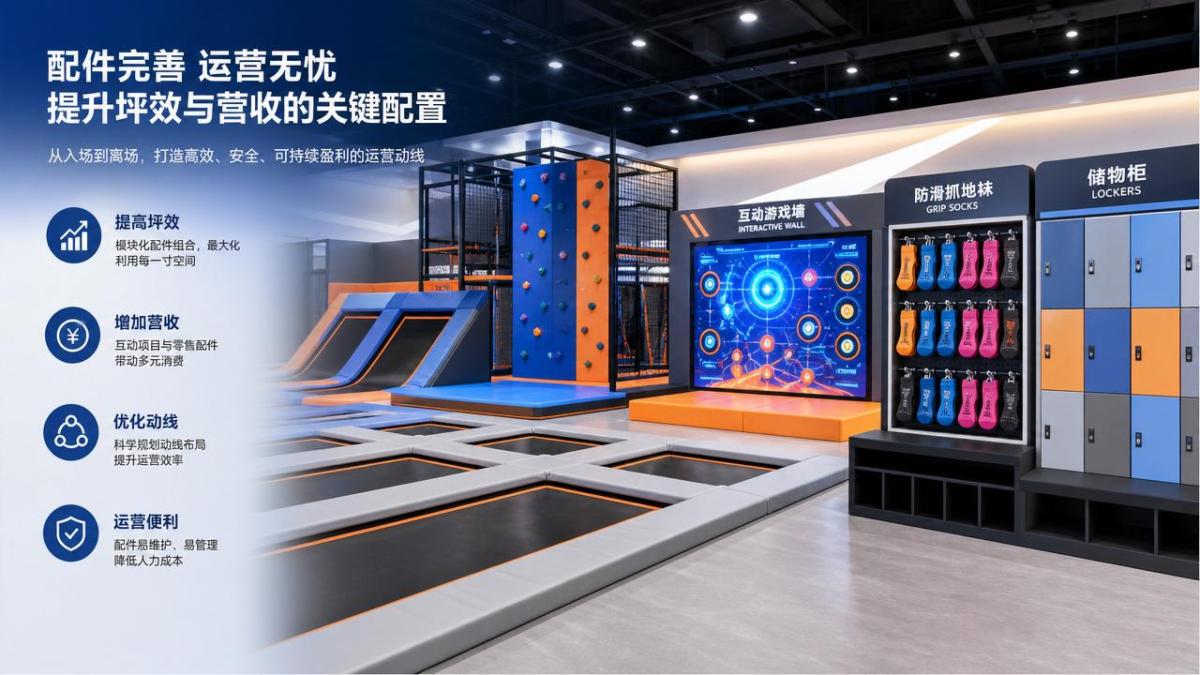
By contrast, some trampoline park accessories look impressive in vendor catalogs but struggle in real-world economics. If an item requires constant staff supervision, causes bottlenecks, or appeals only to a narrow age group, its commercial value may be lower than expected. Operators should favor accessories that combine broad usage, easy maintenance, and monetization clarity.
How can a company tell whether accessories are adding profit or just creating clutter?
The most useful test is to measure each accessory against a small set of operating indicators before and after installation. Clutter is not just a visual problem; it is an economic problem. An accessory becomes clutter when it consumes space, labor, capital, or management attention without producing a corresponding gain.
Decision-makers should track at least the following metrics:
- Average revenue per visitor
- Utilization rate by zone
- Birthday and group package conversion
- Incremental labor hours required
- Maintenance cost and downtime
- Incident frequency or safety interventions
- Guest satisfaction and repeat visit indicators
A useful rule is this: if a new accessory does not improve at least two measurable business outcomes within a reasonable evaluation period, it deserves review. Some items will earn their keep through direct sales. Others support strategic goals such as family retention, social sharing, or improved traffic dispersion. But none should escape measurement.
Quick evaluation table for trampoline park accessories
What are the biggest mistakes operators make when buying trampoline park accessories?
The first mistake is buying for novelty instead of demand. Something can appear impressive during a trade show demo and still fail in a local market. If your guests mainly come for birthdays, family outings, and short sessions, then practical accessories that support convenience and package value may outperform specialized challenge elements.
The second mistake is ignoring safety and maintenance economics. Many trampoline park accessories carry hidden costs: extra padding, inspection schedules, replacement cycles, cleaning time, insurance implications, and staff training. If those costs are not modeled up front, the accessory may destroy margin even when usage looks healthy.
The third mistake is poor layout integration. Accessories that interrupt circulation or create spectator congestion can reduce the effective capacity of the whole venue. In indoor entertainment businesses, floor space is not free. Every square meter should either generate income, improve throughput, or elevate the guest journey in a measurable way.
The fourth mistake is treating all demographics the same. Accessories that work for children under ten may have little value for teens, and what excites teens may not help weekday family traffic. A portfolio approach is usually stronger than copying another park’s layout without considering local customer mix.
Finally, some operators overinvest in physical accessories while underinvesting in the systems that support monetization. A photo point means little without a frictionless purchase flow. Party décor is less valuable without trained hosts and strong booking scripts. Accessories succeed when the commercial process around them is equally strong.
Should investors and multi-site operators evaluate accessories differently from single-venue owners?
Absolutely. A single-site owner may prioritize fast wins and local differentiation, while investors and multi-site operators should care more about repeatability, standardization, and lifecycle economics. An accessory that performs well in one flagship location may not scale efficiently across a broader portfolio.
For enterprise buyers, the right question is not just “Does this work?” but “Can this work consistently across multiple demand profiles, staffing conditions, and maintenance environments?” That changes the evaluation framework. Standard spare parts, vendor reliability, replacement lead times, training requirements, and compliance documentation become more important.
Multi-site groups should also test trampoline park accessories in phases. Start with a pilot, define baseline KPIs, compare performance by market, and only then roll out network-wide. This method reduces capital waste and creates stronger procurement leverage. It also aligns with TSV-style decision logic: prioritize measurable evidence over marketing claims.
Investors, meanwhile, should look at accessories through an asset-value lens. Do they strengthen brand positioning? Do they support pricing resilience? Do they make revenue less seasonal? Do they improve the attractiveness of the business for expansion or franchising? Accessories that help answer yes to those questions may justify capital, even if their direct payback is not immediate.
How should a company prioritize trampoline park accessories before making a purchase decision?
A practical prioritization model is to score each accessory across four dimensions: revenue impact, operational simplicity, safety burden, and strategic fit. Revenue impact asks whether the item raises ticket price, increases spend, or improves booking conversion. Operational simplicity considers staffing, cleaning, durability, and downtime. Safety burden measures supervision needs and compliance risk. Strategic fit checks whether the accessory supports your target customer and brand position.
This approach often leads to a different conclusion than instinct. For instance, a branded sock program may score higher than a dramatic obstacle feature because it is scalable, recurring, easy to manage, and margin-rich. A party package add-on may outperform a large attraction if your venue depends heavily on celebrations and school groups.
It also helps to divide trampoline park accessories into three spending tiers:
- Core essentials: safety pads, socks, lockers, signage, waiver systems
- Commercial enhancers: party upgrades, merchandise, photo products, digital games
- Strategic differentiators: premium attractions, themed zones, interactive competition features
The right order is usually essentials first, enhancers second, differentiators third. That sequence protects the operating foundation before adding complexity. It is especially important in a business where safety, cleanliness, and guest flow influence reviews as much as entertainment variety.
So, do trampoline park accessories increase revenue or clutter?
They do both, depending on discipline. Trampoline park accessories increase revenue when they are selected with clear business logic, integrated into pricing and sales processes, and measured against operational data. They become clutter when they are purchased for appearance, copied from competitors without context, or added without considering space efficiency, maintenance, and customer mix.
For business decision-makers, the most reliable stance is neither enthusiasm nor skepticism. It is structured evaluation. Ask which accessories generate repeatable value, which ones improve the guest journey enough to change buying behavior, and which ones merely add cost and distraction. The strongest portfolios usually combine simple high-margin items, event-focused upsells, and a limited number of signature features that truly differentiate the venue.
If you need to confirm a specific trampoline park accessories plan, the first questions to discuss should be: Which guest segment is this for? What revenue mechanism supports it? What floor space does it consume? What are the maintenance and safety implications? How will success be measured in 30, 90, and 180 days? Those questions turn a broad idea into a decision-ready investment case.
Search News
Hot Articles
- Carbon Fiber StructuresHow to Specify Aerospace Carbon Fiber Assemblies for Lightweight, Load-Bearing PartsJul 11, 2026
- Machine VisionXiaomi, Alibaba DAMO Academy Drive Open-Source Robotics Model Ecosystem, Lowering Algorithm Development Barriers for Overseas SMEs Adopting Chinese Robotics SolutionsMar 30, 2026
- Cobots & ArmsShanxi 'AI+' Conference Showcases Embodied Intelligence with Multinational Buyer Engagement: Key Industry ImplicationsMar 30, 2026
Popular Tags
Recommended News
 Jul 11, 2026How to Specify Aerospace Carbon Fiber Assemblies for Lightweight, Load-Bearing PartsAerospace carbon fiber assemblies: learn how to specify laminate design, load data, joining methods, and inspection controls for lighter, reliable load-bearing aerospace parts.Elena Rostova (UAV Systems Researcher)
 Mar 30, 2026Xiaomi, Alibaba DAMO Academy Drive Open-Source Robotics Model Ecosystem, Lowering Algorithm Development Barriers for Overseas SMEs Adopting Chinese Robotics SolutionsXiaomi & Alibaba DAMO Academy's open-source robotics models lower algorithm barriers for global SMEs. Boost efficiency in manufacturing, logistics & smart retail with ROS 2 compatible solutions.TSV Data Lab
 Mar 30, 2026Shanxi 'AI+' Conference Showcases Embodied Intelligence with Multinational Buyer Engagement: Key Industry ImplicationsShanxi 'AI+' Conference highlights embodied intelligence with Tesla, Ubtech & Jiantao showcasing multimodal robotics. 40+ global buyers validated tech on-site, creating new B2B channels for industrial automation & AI solutions.Chen Wei (Automation Lead Engineer)
 Mar 30, 2026Zhongguancun Unveils 6G Integrated Sensing-Computing-Intelligence Platform to Empower Embodied Robots for Global Industrial ApplicationsZhongguancun's new 6G platform revolutionizes industrial robotics with <10ms latency, empowering global automotive, logistics & port automation. Discover how this tech boosts China's smart manufacturing exports.TSV Data Lab
 Mar 30, 2026Mech-Mind Tianjin Embodied Intelligence R&D and Production Base Goes Live, Cutting Delivery Time by 20%–30% for Global Customized AMR+Vision SolutionsMech-Mind's Tianjin AMR+Vision production base cuts delivery time by 20%-30% for欧美 & Latin American markets. Discover how this PLd-certified facility accelerates customized robotics solutions for smart manufacturing and logistics.Chen Wei (Automation Lead Engineer)
 Mar 30, 2026Boao Forum Reveals 'Co-evolution of Big and Small Brains' Trend in Humanoid Robots, China's Embodied Intelligence Accelerates Adaptation to Overseas Manufacturing Service ScenariosDiscover how China's humanoid robots, featuring 'Co-evolution of Big and Small Brains,' are revolutionizing global manufacturing. Learn about Embodied Tian Gong 3.0's ISO compliance and overseas deployment at Boao Forum 2026.Chen Wei (Automation Lead Engineer)
 Mar 30, 2026China Railway Industrial Secures Patent for Embodied Robotics in Material Handling, Boosting High-Precision Delivery Capabilities for Overseas Infrastructure and Manufacturing ProjectsChina Railway Industrial's new patent for embodied robotics in material handling boosts high-precision delivery for global infrastructure & manufacturing. Discover how this innovation enhances logistics accuracy in automotive, rail transit & EPC projects.Chen Wei (Automation Lead Engineer)
 Sep 28, 2026Spindle Runout Measurement in Germany: DIN Standards, Methods, and Acceptance LimitsSpindle runout measurement Germany: explore DIN standards, proven methods, acceptance limits, and audit-ready practices for reliable machining quality.Dr. Marcus Vance
 Sep 27, 2026How to Select Wall-Mount Edge Devices for Space-Constrained Factory NetworksWall mount edge devices for space-constrained factories: evaluate workload, thermal design, power resilience, cable access, and network reliability for smarter deployments.TSV Data Lab
 Sep 26, 2026Machining Tolerance Analysis: How to Set Limits That Meet Function and Cost TargetsMachining tolerance analysis: learn how to set functional limits, control tolerance stacks, reduce inspection risk, and balance precision with production cost.Dr. Marcus Vance
 Sep 25, 2026How to Evaluate an Industrial Infrastructure Data Platform for Multi-Site OperationsIndustrial infrastructure data platform evaluation guide for multi-site operations: compare data quality, edge resilience, interoperability, governance, and scalable proof-of-value criteria.Victor Lin (Chief Software Architect)
 Sep 24, 2026How to Select Machine Vision Optics for Accurate Inspection at Different Working DistancesMachine vision optics selection guide for accurate inspection at every working distance. Compare FOV, pixel scale, DOF, distortion, lighting, and telecentric options.TSV Data Lab
 Sep 23, 2026How to Evaluate a Machine Vision System Integrator for High-Speed Inspection LinesChoose a machine vision system integrator with proven expertise in high-speed inspection, reliable reject timing, robust optics, and measurable acceptance criteria.TSV Data Lab
 Sep 28, 2026When is a SCADA API the right choice for connecting plant systems?SCADA API guide: learn when governed plant data integration improves traceability, security, and scalability—without compromising real-time control.Victor Lin (Chief Software Architect)
 Sep 27, 2026How SCADA data integration improves traceability across production linesSCADA data integration connects production-line data to improve traceability, accelerate quality investigations, and strengthen safety decisions.Victor Lin (Chief Software Architect)
 Sep 26, 2026What to define before starting SCADA integration planningSCADA integration planning starts with clear scope, control boundaries, data models, cybersecurity, and testing. Discover the definitions that reduce risk and costly rework.Victor Lin (Chief Software Architect)
 Sep 25, 2026How a smart factory with Industrial IoT reduces production blind spotsDiscover how a smart factory with Industrial IoT turns real-time machine, quality, and workflow data into actionable insights that reduce production blind spots and delivery risks.Victor Lin (Chief Software Architect)
 Sep 24, 2026When does Industrial IoT make smart manufacturing easier to scale?Smart manufacturing Industrial IoT scales when trusted data, interoperable systems, and secure workflows turn connected assets into measurable gains.TSV Data Lab
 Sep 23, 2026What drives ultra-precision machining cost at 1-micron tolerance?Ultra precision machining cost per part at 1 micron tolerance depends on process, material, metrology, and yield. Learn how to compare quotes confidently.Dr. Marcus Vance
 Sep 22, 2026Drone Engine-T550CC Applications: Build the UAV Power System Around the MissionAn application guide for Drone Engine-T550CC integration, covering payload planning, airframe matching, cooling, fuel, vibration, test procedures, documentation, and service preparation.Elena Rostova (UAV Systems Researcher)
 Sep 22, 2026How to Evaluate Industrial Edge Computing Vendors for Factory DeploymentIndustrial edge computing vendor evaluation guide for factories: compare latency, protocol fit, reliability, security, and lifecycle support before deployment.TSV Data Lab
 Sep 21, 2026Drone Payload Integration: Matching Power, Data, and Center of Gravity for Reliable FlightsDrone payload integration made practical: balance power, data, center of gravity, and endurance to build safer, more reliable mission-ready flights.Elena Rostova (UAV Systems Researcher)
 Sep 20, 2026Autonomous Navigation Pricing: Cost Drivers and Budget Benchmarks for AMR ProjectsAutonomous navigation price explained: compare AMR cost drivers, software, sensors, integration, safety, and lifecycle budgets to build a scalable project plan.Chen Wei (Automation Lead Engineer)
 Sep 19, 2026How to Scope Automation Integration Services for Multi-System Factory ProjectsAutomation integration services: learn how to scope multi-system factory projects with clear workflows, interface contracts, safety boundaries, and acceptance criteria.Victor Lin (Chief Software Architect)