Trampoline park maintenance gaps that lead to shutdowns
Publication Date
author
Behind every trampoline park shutdown is rarely a single failure—it is usually the result of overlooked trampoline park maintenance gaps that quietly escalate into safety violations, equipment fatigue, and regulatory risk. For quality control and safety managers, identifying these blind spots early is essential to preventing injuries, failed inspections, and costly downtime. This article examines the maintenance weaknesses most likely to trigger closures and how to correct them with data-driven discipline.
Why shutdown risk is rising across trampoline park operations
A clear shift is taking place in the indoor recreation sector: regulators, insurers, landlords, and customers are becoming less tolerant of preventable safety failures. For quality control teams, this means trampoline park maintenance can no longer be treated as a back-of-house routine task. It has become a frontline risk-control function tied directly to operating continuity, insurance renewals, incident response, and brand credibility.
What has changed is not only the equipment itself, but the standard of proof expected from operators. In the past, many parks relied on visual checks, technician experience, and reactive repairs after wear became obvious. Today, that approach leaves dangerous gaps. A damaged spring bed, loosened frame fastener, compressed foam pit, or undocumented repair may be interpreted not as normal wear, but as evidence of poor control.
This is especially important for multi-attraction sites that combine main courts, dodgeball zones, air bags, ninja structures, climbing features, and soft play. Each added attraction increases interface risk. The more diverse the activity mix, the more difficult it becomes to maintain a consistent inspection standard. As a result, trampoline park maintenance is increasingly judged by system quality, not by isolated repairs.
The strongest warning signals are no longer hidden
Shutdowns usually follow a recognizable pattern. Small defects remain open too long, documentation falls behind reality, temporary fixes become semi-permanent, and safety managers lose confidence in the true condition of the site. By the time an incident occurs or an inspector arrives, the problem is no longer a single torn pad or worn net. It is a management failure visible through multiple unresolved signs.
For safety managers, the takeaway is straightforward: if inspection frequency, defect classification, spare-part control, and repair verification have not evolved with these changes, the site is likely operating with blind spots.
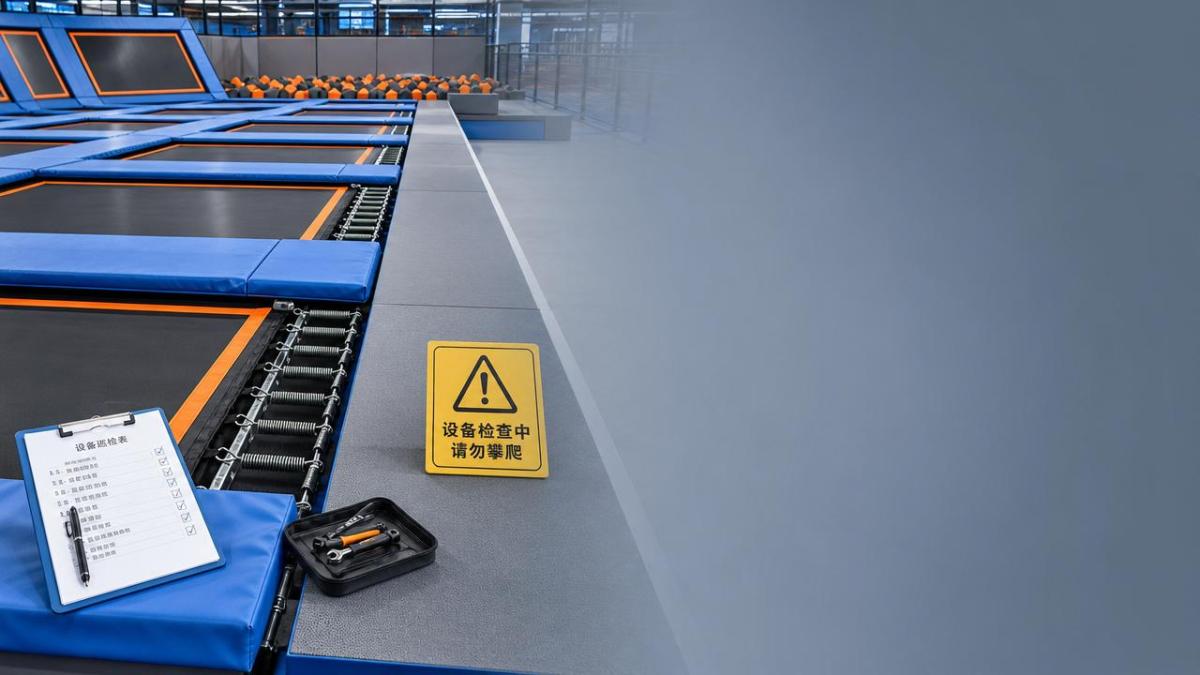
The maintenance gaps most likely to lead to shutdowns
The most serious trampoline park maintenance failures are rarely dramatic at first. They are ordinary problems that stay unresolved because no one owns the threshold for escalation. Several categories repeatedly appear in closure events and near-miss investigations.
1. Surface wear is monitored visually but not functionally
Pads, bed materials, stitching, and protective covers are often checked for visible tears, but not for loss of shock performance, edge separation, compression set, or shifting under repeated load. A pad that still looks acceptable may no longer provide the intended protection. Functional degradation without replacement criteria is a major gap.
2. Structural hardware is inspected inconsistently
Frames, brackets, anchors, weld areas, and fasteners are common sources of hidden risk. In many parks, hardware checks are performed during major repairs but not during routine weekly verification. This creates long periods where loosening, corrosion, distortion, or micro-cracking progresses unnoticed. For regulators, structural uncertainty often justifies immediate use restrictions.
3. Foam pits and landing zones are treated as low-risk areas
A recurring mistake in trampoline park maintenance is underestimating landing systems. Foam cubes degrade, compact, migrate, and trap contamination. Underlayers may become exposed or uneven. Air bags may lose pressure consistency or show seam fatigue. Because these systems absorb impact rather than create it, deterioration is often discovered late—sometimes only after an injury or complaint.
4. Temporary repairs remain in service too long
Tape, patching, tied netting, improvised foam replacement, and non-original fasteners are strong warning signs during audits. Temporary controls are not the core issue; failure to time-limit them is. When parks do not define maximum temporary repair windows, short-term containment becomes normalized degradation.
5. Records exist, but traceability is weak
Many facilities keep checklists, yet cannot prove which defect was found, who approved continued use, what repair standard was applied, and whether the asset was re-inspected before reopening. In practice, poor documentation can be as damaging as poor maintenance. If evidence trails are fragmented, safety claims lose credibility.
Why these gaps are becoming more common, not less
The maintenance challenge is growing because operating models are changing faster than maintenance systems. Many parks now run extended hours, rotate staff frequently, and depend on mixed-skill teams. Attractions are expected to stay available during weekends, holidays, and event peaks. That commercial pressure reduces downtime tolerance, which in turn encourages delayed shutdown decisions for borderline equipment.
At the same time, equipment is aging. First-generation installations in some markets are now beyond their easiest maintenance phase. Wear patterns become less predictable as repeated repairs alter original loading conditions. Spare-part lead times may also be longer, especially when proprietary components or imported systems are involved. Under those conditions, trampoline park maintenance shifts from routine upkeep to lifecycle risk management.
Another factor is the rising expectation of defensible safety governance. Landlords, franchise owners, and investors increasingly want evidence that safety decisions are based on thresholds, not intuition. This reflects a broader cross-industry trend: maintenance is moving from reactive craftsmanship toward auditable, data-backed control.
Which roles feel the impact first
Not every stakeholder experiences maintenance gaps in the same way. For quality and safety leaders, understanding impact by function helps prioritize corrective action.
How leading operators are changing their maintenance judgment
A notable trend is the shift from calendar-only inspection routines to risk-based maintenance decision models. Instead of asking whether the daily checklist was completed, better operators ask whether inspection intervals reflect actual usage intensity, incident history, component age, and attraction type. This is a more mature way to manage trampoline park maintenance because it aligns effort with risk concentration.
Three practical changes stand out. First, defect grading is becoming more precise. Parks are separating cosmetic issues from performance-affecting degradation and from immediate closure conditions. Second, post-repair verification is receiving more attention. A repair is no longer considered finished when the part is replaced; it is finished when independent re-inspection confirms restored safety function. Third, operators are mapping repeated defects by location and component type. That reveals patterns that simple checklists hide.
This approach fits the broader TSV mindset of engineering truth through data. Parameters matter more than assumptions. If a zone shows unusually high pad displacement, repeated seam failure, or frequent hardware loosening, the response should be based on evidence and threshold review rather than routine habit.
What safety managers should measure now
For teams trying to close trampoline park maintenance gaps before they become shutdown triggers, the most useful metrics are not always complex. The goal is to establish operational visibility. Focus on measures that reveal delay, recurrence, and control weakness.
- Open defect age by severity level
- Repeat defect rate by attraction zone
- Percentage of temporary repairs still active after target deadline
- Inspection completion rate versus planned frequency
- Time from defect identification to closure authorization
- Spare-part stock availability for critical components
These indicators help answer a more strategic question: is the site becoming safer, or only more familiar with its recurring problems? That distinction is crucial. Stable operations can still be drifting toward failure if the same weak points keep returning.
A practical response framework for the next 90 days
If current controls feel fragmented, the most effective response is not a full rewrite of every SOP at once. Start with a phased correction plan that targets the most closure-sensitive points in trampoline park maintenance.
The bigger direction: maintenance is becoming a governance issue
The wider industry direction is clear. Trampoline park maintenance is no longer judged only by technical upkeep. It is increasingly evaluated as part of organizational governance. Can the site prove that safety-critical assets are identified, risk-ranked, inspected at the right interval, repaired to an approved standard, and returned to service with documented authorization? Parks that cannot answer yes to all five questions are more exposed to shutdowns than they may realize.
For quality control and safety managers, this shift creates both pressure and opportunity. The pressure comes from lower tolerance for undocumented risk. The opportunity comes from using better maintenance intelligence to justify budgets, strengthen supplier discipline, and prevent crisis-driven closures. In that sense, maintenance is no longer just a cost center. It is an operating license protector.
What to confirm before the next inspection or peak season
Before the next audit, holiday surge, or insurer review, management teams should confirm a few direct questions: Which components fail most often? Which temporary repairs are still active? Where does documentation not match field reality? Which attractions have the weakest re-inspection discipline? And if a closure decision is needed today, who has the authority to make it without delay?
Those questions turn trampoline park maintenance from a checklist exercise into a decision system. That is the key trend to watch. The parks most likely to avoid shutdowns will not be the ones that merely inspect more often. They will be the ones that interpret wear, documentation, and repair data early enough to act before regulators, injuries, or downtime force the decision for them.
Search News
Hot Articles
- Carbon Fiber StructuresHow to Specify Aerospace Carbon Fiber Assemblies for Lightweight, Load-Bearing PartsJul 11, 2026
- Machine VisionXiaomi, Alibaba DAMO Academy Drive Open-Source Robotics Model Ecosystem, Lowering Algorithm Development Barriers for Overseas SMEs Adopting Chinese Robotics SolutionsMar 30, 2026
- Cobots & ArmsShanxi 'AI+' Conference Showcases Embodied Intelligence with Multinational Buyer Engagement: Key Industry ImplicationsMar 30, 2026
Popular Tags
Recommended News
 Jul 11, 2026How to Specify Aerospace Carbon Fiber Assemblies for Lightweight, Load-Bearing PartsAerospace carbon fiber assemblies: learn how to specify laminate design, load data, joining methods, and inspection controls for lighter, reliable load-bearing aerospace parts.Elena Rostova (UAV Systems Researcher)
 Mar 30, 2026Xiaomi, Alibaba DAMO Academy Drive Open-Source Robotics Model Ecosystem, Lowering Algorithm Development Barriers for Overseas SMEs Adopting Chinese Robotics SolutionsXiaomi & Alibaba DAMO Academy's open-source robotics models lower algorithm barriers for global SMEs. Boost efficiency in manufacturing, logistics & smart retail with ROS 2 compatible solutions.TSV Data Lab
 Mar 30, 2026Shanxi 'AI+' Conference Showcases Embodied Intelligence with Multinational Buyer Engagement: Key Industry ImplicationsShanxi 'AI+' Conference highlights embodied intelligence with Tesla, Ubtech & Jiantao showcasing multimodal robotics. 40+ global buyers validated tech on-site, creating new B2B channels for industrial automation & AI solutions.Chen Wei (Automation Lead Engineer)
 Mar 30, 2026Zhongguancun Unveils 6G Integrated Sensing-Computing-Intelligence Platform to Empower Embodied Robots for Global Industrial ApplicationsZhongguancun's new 6G platform revolutionizes industrial robotics with <10ms latency, empowering global automotive, logistics & port automation. Discover how this tech boosts China's smart manufacturing exports.TSV Data Lab
 Mar 30, 2026Mech-Mind Tianjin Embodied Intelligence R&D and Production Base Goes Live, Cutting Delivery Time by 20%–30% for Global Customized AMR+Vision SolutionsMech-Mind's Tianjin AMR+Vision production base cuts delivery time by 20%-30% for欧美 & Latin American markets. Discover how this PLd-certified facility accelerates customized robotics solutions for smart manufacturing and logistics.Chen Wei (Automation Lead Engineer)
 Mar 30, 2026Boao Forum Reveals 'Co-evolution of Big and Small Brains' Trend in Humanoid Robots, China's Embodied Intelligence Accelerates Adaptation to Overseas Manufacturing Service ScenariosDiscover how China's humanoid robots, featuring 'Co-evolution of Big and Small Brains,' are revolutionizing global manufacturing. Learn about Embodied Tian Gong 3.0's ISO compliance and overseas deployment at Boao Forum 2026.Chen Wei (Automation Lead Engineer)
 Mar 30, 2026China Railway Industrial Secures Patent for Embodied Robotics in Material Handling, Boosting High-Precision Delivery Capabilities for Overseas Infrastructure and Manufacturing ProjectsChina Railway Industrial's new patent for embodied robotics in material handling boosts high-precision delivery for global infrastructure & manufacturing. Discover how this innovation enhances logistics accuracy in automotive, rail transit & EPC projects.Chen Wei (Automation Lead Engineer)
 Sep 28, 2026Spindle Runout Measurement in Germany: DIN Standards, Methods, and Acceptance LimitsSpindle runout measurement Germany: explore DIN standards, proven methods, acceptance limits, and audit-ready practices for reliable machining quality.Dr. Marcus Vance
 Sep 27, 2026How to Select Wall-Mount Edge Devices for Space-Constrained Factory NetworksWall mount edge devices for space-constrained factories: evaluate workload, thermal design, power resilience, cable access, and network reliability for smarter deployments.TSV Data Lab
 Sep 26, 2026Machining Tolerance Analysis: How to Set Limits That Meet Function and Cost TargetsMachining tolerance analysis: learn how to set functional limits, control tolerance stacks, reduce inspection risk, and balance precision with production cost.Dr. Marcus Vance
 Sep 25, 2026How to Evaluate an Industrial Infrastructure Data Platform for Multi-Site OperationsIndustrial infrastructure data platform evaluation guide for multi-site operations: compare data quality, edge resilience, interoperability, governance, and scalable proof-of-value criteria.Victor Lin (Chief Software Architect)
 Sep 24, 2026How to Select Machine Vision Optics for Accurate Inspection at Different Working DistancesMachine vision optics selection guide for accurate inspection at every working distance. Compare FOV, pixel scale, DOF, distortion, lighting, and telecentric options.TSV Data Lab
 Sep 23, 2026How to Evaluate a Machine Vision System Integrator for High-Speed Inspection LinesChoose a machine vision system integrator with proven expertise in high-speed inspection, reliable reject timing, robust optics, and measurable acceptance criteria.TSV Data Lab
 Sep 28, 2026When is a SCADA API the right choice for connecting plant systems?SCADA API guide: learn when governed plant data integration improves traceability, security, and scalability—without compromising real-time control.Victor Lin (Chief Software Architect)
 Sep 27, 2026How SCADA data integration improves traceability across production linesSCADA data integration connects production-line data to improve traceability, accelerate quality investigations, and strengthen safety decisions.Victor Lin (Chief Software Architect)
 Sep 26, 2026What to define before starting SCADA integration planningSCADA integration planning starts with clear scope, control boundaries, data models, cybersecurity, and testing. Discover the definitions that reduce risk and costly rework.Victor Lin (Chief Software Architect)
 Sep 25, 2026How a smart factory with Industrial IoT reduces production blind spotsDiscover how a smart factory with Industrial IoT turns real-time machine, quality, and workflow data into actionable insights that reduce production blind spots and delivery risks.Victor Lin (Chief Software Architect)
 Sep 24, 2026When does Industrial IoT make smart manufacturing easier to scale?Smart manufacturing Industrial IoT scales when trusted data, interoperable systems, and secure workflows turn connected assets into measurable gains.TSV Data Lab
 Sep 23, 2026What drives ultra-precision machining cost at 1-micron tolerance?Ultra precision machining cost per part at 1 micron tolerance depends on process, material, metrology, and yield. Learn how to compare quotes confidently.Dr. Marcus Vance
 Sep 22, 2026Drone Engine-T550CC Applications: Build the UAV Power System Around the MissionAn application guide for Drone Engine-T550CC integration, covering payload planning, airframe matching, cooling, fuel, vibration, test procedures, documentation, and service preparation.Elena Rostova (UAV Systems Researcher)
 Sep 22, 2026How to Evaluate Industrial Edge Computing Vendors for Factory DeploymentIndustrial edge computing vendor evaluation guide for factories: compare latency, protocol fit, reliability, security, and lifecycle support before deployment.TSV Data Lab
 Sep 21, 2026Drone Payload Integration: Matching Power, Data, and Center of Gravity for Reliable FlightsDrone payload integration made practical: balance power, data, center of gravity, and endurance to build safer, more reliable mission-ready flights.Elena Rostova (UAV Systems Researcher)
 Sep 20, 2026Autonomous Navigation Pricing: Cost Drivers and Budget Benchmarks for AMR ProjectsAutonomous navigation price explained: compare AMR cost drivers, software, sensors, integration, safety, and lifecycle budgets to build a scalable project plan.Chen Wei (Automation Lead Engineer)
 Sep 19, 2026How to Scope Automation Integration Services for Multi-System Factory ProjectsAutomation integration services: learn how to scope multi-system factory projects with clear workflows, interface contracts, safety boundaries, and acceptance criteria.Victor Lin (Chief Software Architect)