Which trampoline park parts wear out faster than expected
Publication Date
author
For after-sales maintenance teams, knowing which trampoline park parts fail early is critical to reducing downtime, warranty disputes, and safety risks. This guide examines the trampoline park parts most likely to wear out faster than expected, helping you identify hidden fatigue points, improve inspection accuracy, and make data-based replacement decisions before small defects turn into costly operational problems.
In most trampoline parks, the parts that wear out faster than expected are not always the largest or most visible ones. Springs, jumping mats at stitch zones, edge pads, foam pit interfaces, net connection points, and high-cycle fasteners often degrade first because they combine repetitive impact, friction, environmental exposure, and inconsistent user loading. For after-sales teams, the practical question is not simply which components fail, but why they fail earlier than the nominal service interval suggests.
A useful maintenance approach starts with load concentration, not just age. Two parts installed on the same day may show very different wear depending on jumper traffic, temperature variation, cleaning chemicals, moisture, UV exposure, and frame alignment. That is why a reliable inspection program for trampoline park parts must focus on real fatigue signatures, usage pattern data, and replacement thresholds that are specific to each attraction zone.
Which trampoline park parts usually wear out first in real operating conditions
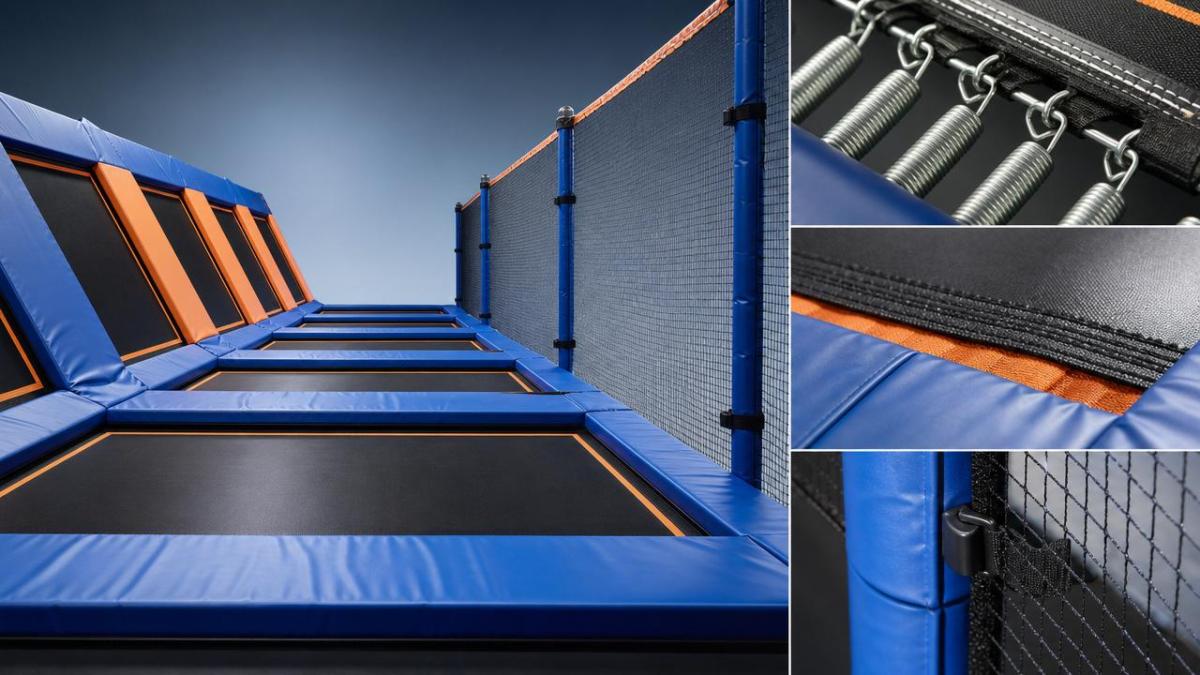
For most indoor parks, the earliest wear tends to appear in six categories: springs, mat stitching, frame pads, enclosure net attachment areas, foam pit transition components, and connection hardware. These parts sit at the intersection of impact energy and motion, which means they absorb repeated stress cycles long before large frame members show visible problems.
Springs are one of the most frequently replaced trampoline park parts because they operate under continuous extension and contraction. Even when they do not break outright, they gradually lose elasticity, develop corrosion, or show hook deformation. A spring that still looks intact can already be causing uneven bounce response, increased load transfer to adjacent springs, and accelerated wear on the mat border.
Jumping mats often fail first at stitched seams, V-ring anchor points, and high-traffic center lanes. The fabric surface may still appear usable while the stitching underneath begins to loosen or fray. In parks with dodgeball courts or main jump arenas, directional movement creates uneven stress patterns that shorten life in very specific zones rather than across the entire mat.
Edge pads and protective covers also wear faster than many teams expect. They are exposed to foot traffic, abrasion, sweat, cleaning agents, and occasional direct shoe contact during entries and exits. Once the outer cover cracks or the foam compresses permanently, the part may still be present but no longer performs its protective function to the required level.
Netting and soft containment systems wear heavily at attachment points rather than in open mesh areas. Repeated flexing at clips, ropes, sleeves, and sewn loops creates local fatigue. This is especially common in attractions with angled walls, performance trampolines, or children’s zones where users tend to push or fall against barriers more frequently.
Why some parts fail earlier than the supplier’s expected lifespan
The biggest reason for unexpected wear is that supplier service-life estimates are usually based on controlled assumptions. Real parks rarely operate under those assumptions. Daily jump counts vary, users land off-center, staff may walk on pads, humidity may fluctuate, and minor frame misalignment can shift load paths. These deviations compound over time.
Load concentration is one of the main hidden drivers. If one trampoline bed sees higher traffic because of park layout, queue flow, or attraction popularity, its springs and mat anchor zones will fatigue much earlier than neighboring units. Without usage-based rotation or targeted inspection, maintenance teams may miss the fact that the issue is operational rather than purely material-related.
Environmental exposure is another major factor. Even in indoor parks, moisture from HVAC imbalance, condensation, drink spills, and cleaning routines can accelerate corrosion or material breakdown. UV exposure from windows or skylights can harden covers and weaken polymer-based parts. In semi-outdoor or high-humidity regions, metal fatigue and fabric degradation can advance much faster than standard schedules predict.
Improper installation also shortens life dramatically. Over-tensioned springs, uneven spring distribution, misaligned frames, poorly seated bolts, and pads installed with excess slack can all create abnormal stress. Many premature failures that appear to be “bad parts” are actually signs of installation geometry problems or inconsistent retrofit practices after earlier repairs.
User behavior should not be underestimated. Double bouncing, concentrated landings near borders, high-frequency wall interactions, and unauthorized stunts produce dynamic loads beyond routine recreational use. If the park’s operational controls are weak, after-sales teams will see recurring wear patterns that no simple replacement cycle can solve.
What maintenance teams should inspect first during routine checks
For after-sales personnel, the best inspections start at fatigue-critical interfaces rather than broad visual scans. Begin with spring hooks, spring coils near the hook transition, and all signs of elongation asymmetry. Compare neighboring springs, because early fatigue is often easier to spot through inconsistency than through absolute appearance alone.
Next, inspect mat stitching and border webbing. Look for loose threads, stitch separation, edge curling, V-ring distortion, and localized fabric thinning. If the mat surface shows polished areas, that can indicate repeated directional loading, which often predicts upcoming seam failure. Use touch as well as sight; stiffness changes and hidden abrasion can be felt before they become obvious visually.
Protective pads should be checked for foam compression set, cover cracking, seam opening, shifting position, and exposed structural gaps. If a pad no longer returns to shape after compression or has become slick, brittle, or displaced, it should be treated as a safety performance issue, not just a cosmetic one.
For net systems and soft barriers, inspect attachment loops, rope channels, clip holes, zipper paths, and overlap joints. These are common points of progressive failure. A net rarely goes from perfect to unusable in one day. Usually the warning signs are localized abrasion, frayed stitching, and elongated connection holes that slowly reduce containment reliability.
Do not overlook fasteners and frame interfaces. Bolts, washers, locking nuts, and bracket holes experience micro-movement under repeated load. Signs such as fretting, powdery metal residue, ovalized holes, coating loss, or recurring loosening indicate a deeper structural wear process. Re-tightening alone is often only a temporary response.
How to distinguish cosmetic wear from replacement-level risk
One of the hardest decisions in trampoline park parts maintenance is determining when visible wear has crossed into performance loss. Cosmetic damage matters, but not all surface marks justify immediate replacement. The practical standard should be whether the part’s mechanical function, protective coverage, or load distribution has measurably degraded.
For springs, replacement-level risk usually includes visible deformation, corrosion pitting, inconsistent extension behavior, cracked hooks, or measurable force imbalance across adjacent units. A spring that has lost rebound consistency can overload the surrounding system even if it has not fractured. In that sense, performance drift is already a failure precursor.
For mats, localized discoloration may be cosmetic, but seam separation, webbing wear, anchor distortion, or soft spots in the fabric are structural concerns. If a mat’s load path is compromised at the border or stitched transitions, the failure can progress quickly once peak traffic returns. Waiting for a full tear is usually too late.
For edge pads, superficial scuffs may be acceptable, but split covers, compressed foam, exposed corners, and migration away from intended coverage zones are functional defects. The core question is whether the pad still absorbs impact and shields the frame and springs as designed. If not, replacement should not be delayed for appearance-based reasons.
A useful rule for after-sales teams is to classify wear into three levels: monitor, schedule, and immediate action. Monitor means no functional loss yet but trendable deterioration exists. Schedule means the part is still operational but should be replaced in the next planned window. Immediate action means safety margin or structural integrity is already compromised.
How to build a smarter replacement strategy instead of reacting to failures
Reactive replacement is expensive because it increases downtime, creates spare-part urgency, and often leads to secondary damage. A better strategy is to rank trampoline park parts by wear rate, safety criticality, replacement lead time, and failure interaction. Parts that fail often and influence other parts should receive tighter inspection intervals and higher on-site stock priority.
Usage-based maintenance is especially effective in trampoline environments. Instead of replacing all components by calendar age, track each attraction’s traffic intensity, peak-hour density, age group profile, and maintenance history. A main court bed used continuously for high-energy jumping should not share the same replacement cycle as a lightly used corner lane.
Trend logging is essential. Record every observed issue by part type, location, defect mode, and date. Over several months, patterns emerge. You may find that one vendor’s pad covers crack earlier under a certain cleaning chemical, or that one zone’s springs always fatigue sooner because of frame settlement. Those findings help shift maintenance from routine guesswork to engineering-based decisions.
It is also worth standardizing acceptance criteria after repair. When one team replaces springs, pads, or hardware, the post-repair geometry should be checked against a consistent baseline. Uneven tension or mixed-condition components can create premature wear in new parts. In many parks, repeat issues are caused not by bad inventory but by inconsistent restoration of the original load balance.
Spare-part planning should reflect actual field failure modes. High-turn items such as springs, pad covers, clips, anchor connectors, and localized mat repair assemblies usually deserve greater stock depth than lower-frequency frame parts. The goal is not to overstock everything, but to shorten recovery time for the parts most likely to interrupt safe operations.
Common hidden fatigue points that are easy to miss
Some of the most important wear points are also the easiest to overlook. One example is the underside of mats near anchor transitions, where abrasion may develop from slight rubbing or alignment error. Because the top surface still looks normal, this damage can remain invisible until seam integrity is already reduced.
Another hidden point is the contact zone between pads and frame edges. If the cover shifts slightly over time, repeated rubbing can wear through from the underside. By the time the top cover shows signs, the internal foam may already be damaged or displaced. Removing and checking pads periodically is more informative than top-down visual inspection alone.
Fastener holes in brackets and frame joints are another overlooked area. Micro-motion can slowly enlarge holes or polish contact surfaces even when the hardware remains tight. This can change the way impact loads distribute through the structure and eventually accelerate wear in nearby springs, mats, or support elements.
Transition zones between trampoline beds and adjacent attractions deserve special attention too. Foam pits, airbag landings, angled walls, and run-up lanes create mixed loading conditions that standard rectangular court inspections may not fully address. These interfaces often contain unique attachment details and nonuniform wear signatures.
What procurement and after-sales teams should ask suppliers about wear-critical parts
If you are sourcing replacement trampoline park parts, ask suppliers for more than generic durability claims. Maintenance teams need detail on material grade, coating type, stitch construction, foam density retention, corrosion resistance, and expected behavior under repeated impact cycles. The most useful supplier data helps predict field wear, not just confirm basic compliance.
For springs, ask about wire diameter tolerance, heat treatment consistency, surface protection, and cycle-test methodology. For mats, request information on fabric weight, weave structure, stitching pattern, reinforcement layout, and anchor interface design. For pads, focus on cover material, seam construction, foam compression performance, and resistance to cleaning chemicals.
It is also valuable to ask whether the supplier has defect mode data from real installations. A strong supplier should be able to discuss where parts usually fail first, what operational conditions shorten lifespan, and which inspection cues indicate replacement timing. That kind of field-informed transparency is far more useful than broad marketing claims about premium quality.
Finally, align part selection with your actual park profile. A component optimized for low-volume family use may not hold up in a high-throughput urban venue. The best sourcing decisions happen when procurement, operations, and after-sales teams share wear data and choose parts based on verified service conditions.
Conclusion: the fastest-wearing parts are usually the ones under repeated concentrated stress
When maintenance teams ask which trampoline park parts wear out faster than expected, the answer is usually the components exposed to repeated concentrated stress, friction, environmental attack, and small alignment errors. Springs, mat seams, edge pads, net attachment points, foam pit transitions, and high-cycle hardware should be at the center of any serious inspection plan.
The key takeaway is that premature wear is rarely random. It leaves patterns. When after-sales teams inspect the right zones, classify defects by functional risk, and track recurring failure modes, they can replace parts before safety margins collapse or downtime spreads across multiple attractions. That approach reduces emergency repairs, supports clearer warranty discussions, and improves overall park reliability.
In short, the best maintenance results come from understanding not only which parts fail, but how and why they fail in your specific operating environment. Once that data-driven view is in place, replacement decisions become faster, safer, and far more cost-effective.
Search News
Hot Articles
- Carbon Fiber StructuresHow to Specify Aerospace Carbon Fiber Assemblies for Lightweight, Load-Bearing PartsJul 11, 2026
- Machine VisionXiaomi, Alibaba DAMO Academy Drive Open-Source Robotics Model Ecosystem, Lowering Algorithm Development Barriers for Overseas SMEs Adopting Chinese Robotics SolutionsMar 30, 2026
- Cobots & ArmsShanxi 'AI+' Conference Showcases Embodied Intelligence with Multinational Buyer Engagement: Key Industry ImplicationsMar 30, 2026
Popular Tags
Recommended News
 Jul 11, 2026How to Specify Aerospace Carbon Fiber Assemblies for Lightweight, Load-Bearing PartsAerospace carbon fiber assemblies: learn how to specify laminate design, load data, joining methods, and inspection controls for lighter, reliable load-bearing aerospace parts.Elena Rostova (UAV Systems Researcher)
 Mar 30, 2026Xiaomi, Alibaba DAMO Academy Drive Open-Source Robotics Model Ecosystem, Lowering Algorithm Development Barriers for Overseas SMEs Adopting Chinese Robotics SolutionsXiaomi & Alibaba DAMO Academy's open-source robotics models lower algorithm barriers for global SMEs. Boost efficiency in manufacturing, logistics & smart retail with ROS 2 compatible solutions.TSV Data Lab
 Mar 30, 2026Shanxi 'AI+' Conference Showcases Embodied Intelligence with Multinational Buyer Engagement: Key Industry ImplicationsShanxi 'AI+' Conference highlights embodied intelligence with Tesla, Ubtech & Jiantao showcasing multimodal robotics. 40+ global buyers validated tech on-site, creating new B2B channels for industrial automation & AI solutions.Chen Wei (Automation Lead Engineer)
 Mar 30, 2026Zhongguancun Unveils 6G Integrated Sensing-Computing-Intelligence Platform to Empower Embodied Robots for Global Industrial ApplicationsZhongguancun's new 6G platform revolutionizes industrial robotics with <10ms latency, empowering global automotive, logistics & port automation. Discover how this tech boosts China's smart manufacturing exports.TSV Data Lab
 Mar 30, 2026Mech-Mind Tianjin Embodied Intelligence R&D and Production Base Goes Live, Cutting Delivery Time by 20%–30% for Global Customized AMR+Vision SolutionsMech-Mind's Tianjin AMR+Vision production base cuts delivery time by 20%-30% for欧美 & Latin American markets. Discover how this PLd-certified facility accelerates customized robotics solutions for smart manufacturing and logistics.Chen Wei (Automation Lead Engineer)
 Mar 30, 2026Boao Forum Reveals 'Co-evolution of Big and Small Brains' Trend in Humanoid Robots, China's Embodied Intelligence Accelerates Adaptation to Overseas Manufacturing Service ScenariosDiscover how China's humanoid robots, featuring 'Co-evolution of Big and Small Brains,' are revolutionizing global manufacturing. Learn about Embodied Tian Gong 3.0's ISO compliance and overseas deployment at Boao Forum 2026.Chen Wei (Automation Lead Engineer)
 Mar 30, 2026China Railway Industrial Secures Patent for Embodied Robotics in Material Handling, Boosting High-Precision Delivery Capabilities for Overseas Infrastructure and Manufacturing ProjectsChina Railway Industrial's new patent for embodied robotics in material handling boosts high-precision delivery for global infrastructure & manufacturing. Discover how this innovation enhances logistics accuracy in automotive, rail transit & EPC projects.Chen Wei (Automation Lead Engineer)
 Sep 28, 2026Spindle Runout Measurement in Germany: DIN Standards, Methods, and Acceptance LimitsSpindle runout measurement Germany: explore DIN standards, proven methods, acceptance limits, and audit-ready practices for reliable machining quality.Dr. Marcus Vance
 Sep 27, 2026How to Select Wall-Mount Edge Devices for Space-Constrained Factory NetworksWall mount edge devices for space-constrained factories: evaluate workload, thermal design, power resilience, cable access, and network reliability for smarter deployments.TSV Data Lab
 Sep 26, 2026Machining Tolerance Analysis: How to Set Limits That Meet Function and Cost TargetsMachining tolerance analysis: learn how to set functional limits, control tolerance stacks, reduce inspection risk, and balance precision with production cost.Dr. Marcus Vance
 Sep 25, 2026How to Evaluate an Industrial Infrastructure Data Platform for Multi-Site OperationsIndustrial infrastructure data platform evaluation guide for multi-site operations: compare data quality, edge resilience, interoperability, governance, and scalable proof-of-value criteria.Victor Lin (Chief Software Architect)
 Sep 24, 2026How to Select Machine Vision Optics for Accurate Inspection at Different Working DistancesMachine vision optics selection guide for accurate inspection at every working distance. Compare FOV, pixel scale, DOF, distortion, lighting, and telecentric options.TSV Data Lab
 Sep 23, 2026How to Evaluate a Machine Vision System Integrator for High-Speed Inspection LinesChoose a machine vision system integrator with proven expertise in high-speed inspection, reliable reject timing, robust optics, and measurable acceptance criteria.TSV Data Lab
 Sep 28, 2026When is a SCADA API the right choice for connecting plant systems?SCADA API guide: learn when governed plant data integration improves traceability, security, and scalability—without compromising real-time control.Victor Lin (Chief Software Architect)
 Sep 27, 2026How SCADA data integration improves traceability across production linesSCADA data integration connects production-line data to improve traceability, accelerate quality investigations, and strengthen safety decisions.Victor Lin (Chief Software Architect)
 Sep 26, 2026What to define before starting SCADA integration planningSCADA integration planning starts with clear scope, control boundaries, data models, cybersecurity, and testing. Discover the definitions that reduce risk and costly rework.Victor Lin (Chief Software Architect)
 Sep 25, 2026How a smart factory with Industrial IoT reduces production blind spotsDiscover how a smart factory with Industrial IoT turns real-time machine, quality, and workflow data into actionable insights that reduce production blind spots and delivery risks.Victor Lin (Chief Software Architect)
 Sep 24, 2026When does Industrial IoT make smart manufacturing easier to scale?Smart manufacturing Industrial IoT scales when trusted data, interoperable systems, and secure workflows turn connected assets into measurable gains.TSV Data Lab
 Sep 23, 2026What drives ultra-precision machining cost at 1-micron tolerance?Ultra precision machining cost per part at 1 micron tolerance depends on process, material, metrology, and yield. Learn how to compare quotes confidently.Dr. Marcus Vance
 Sep 22, 2026Drone Engine-T550CC Applications: Build the UAV Power System Around the MissionAn application guide for Drone Engine-T550CC integration, covering payload planning, airframe matching, cooling, fuel, vibration, test procedures, documentation, and service preparation.Elena Rostova (UAV Systems Researcher)
 Sep 22, 2026How to Evaluate Industrial Edge Computing Vendors for Factory DeploymentIndustrial edge computing vendor evaluation guide for factories: compare latency, protocol fit, reliability, security, and lifecycle support before deployment.TSV Data Lab
 Sep 21, 2026Drone Payload Integration: Matching Power, Data, and Center of Gravity for Reliable FlightsDrone payload integration made practical: balance power, data, center of gravity, and endurance to build safer, more reliable mission-ready flights.Elena Rostova (UAV Systems Researcher)
 Sep 20, 2026Autonomous Navigation Pricing: Cost Drivers and Budget Benchmarks for AMR ProjectsAutonomous navigation price explained: compare AMR cost drivers, software, sensors, integration, safety, and lifecycle budgets to build a scalable project plan.Chen Wei (Automation Lead Engineer)
 Sep 19, 2026How to Scope Automation Integration Services for Multi-System Factory ProjectsAutomation integration services: learn how to scope multi-system factory projects with clear workflows, interface contracts, safety boundaries, and acceptance criteria.Victor Lin (Chief Software Architect)