Which Trampoline Park Parts Wear Out Faster Than Expected?
Publication Date
author
For after-sales maintenance teams, knowing which trampoline park parts fail sooner than expected is critical to reducing downtime, controlling repair costs, and keeping every attraction safe. This guide breaks down the most wear-prone trampoline park parts, the hidden factors that accelerate damage, and the inspection priorities that help you spot problems before they disrupt daily operations.
Understanding wear patterns in trampoline park parts
In any active indoor amusement facility, not all trampoline park parts age at the same rate. Some components are designed to absorb repeated impact, while others support alignment, containment, or structural stability. The challenge for after-sales teams is that actual wear in the field often differs from catalog life expectancy. A part that looks durable on paper may degrade quickly under high foot traffic, poor cleaning routines, moisture exposure, or uneven user behavior.
This matters because maintenance success is not only about replacing failed parts. It is about understanding the failure sequence. In many parks, the first visible problem is not the root cause. A torn pad may result from frame misalignment. A stretched bed may be linked to spring imbalance. A loose net anchor may come from vibration and repeated loading at a neighboring bay. For that reason, evaluating trampoline park parts requires a systems view rather than isolated part checks.
For maintenance professionals, the most practical approach is to classify components by wear speed, safety impact, and downtime risk. This creates a service model that is closer to engineering reality: inspect what fails first, verify what causes secondary damage, and replace parts before visible wear becomes an incident.
Why the industry pays close attention to early-wear components
Trampoline parks operate in a demanding environment. Repeated dynamic loading, sharp directional changes, sweat, spilled drinks, cleaning chemicals, and seasonal humidity all affect service life. Unlike low-cycle recreational equipment, commercial trampoline systems face thousands of impact events every day. That usage profile turns small material weaknesses into recurring maintenance issues.
From an operational standpoint, the cost of worn trampoline park parts goes beyond the replacement invoice. Unplanned closures reduce revenue, create staffing inefficiencies, and may interrupt scheduled group bookings. Safety concerns carry an even greater impact. A component that seems cosmetic, such as edge padding, can become a serious hazard if it exposes steel members or creates unstable landing zones.
This is why modern after-sales service increasingly follows a data-based mindset. In line with the broader industrial principle that measurable parameters matter more than marketing claims, maintenance teams benefit from tracking cycle counts, failure intervals, wear hotspots, and repeat defect locations. That level of discipline transforms service work from reactive repair into preventive asset management.
The trampoline park parts that usually wear out faster than expected
Although every facility has a different layout, several trampoline park parts consistently show earlier-than-expected wear. These parts deserve shorter inspection intervals and stronger stocking plans.
1. Jumping mats or beds
The jumping surface takes the highest direct load. Stitching lines, attachment loops, and high-impact center zones often degrade before the fabric body completely fails. Early signs include loss of rebound consistency, edge fraying, loose stitching, and visible polishing where repeated foot contact reduces surface texture. In dodgeball zones and main court lanes, wear can accelerate because users land harder and move more aggressively.
2. Springs and spring hooks
Springs are among the most underestimated trampoline park parts. They may not always break suddenly, but they often stretch, lose tension, corrode, or wear unevenly. Once spring force becomes inconsistent across the bed, bounce quality changes and neighboring components experience abnormal load distribution. Hooks and attachment points are also vulnerable, especially where coating damage exposes metal to humidity.
3. Safety pads and frame padding
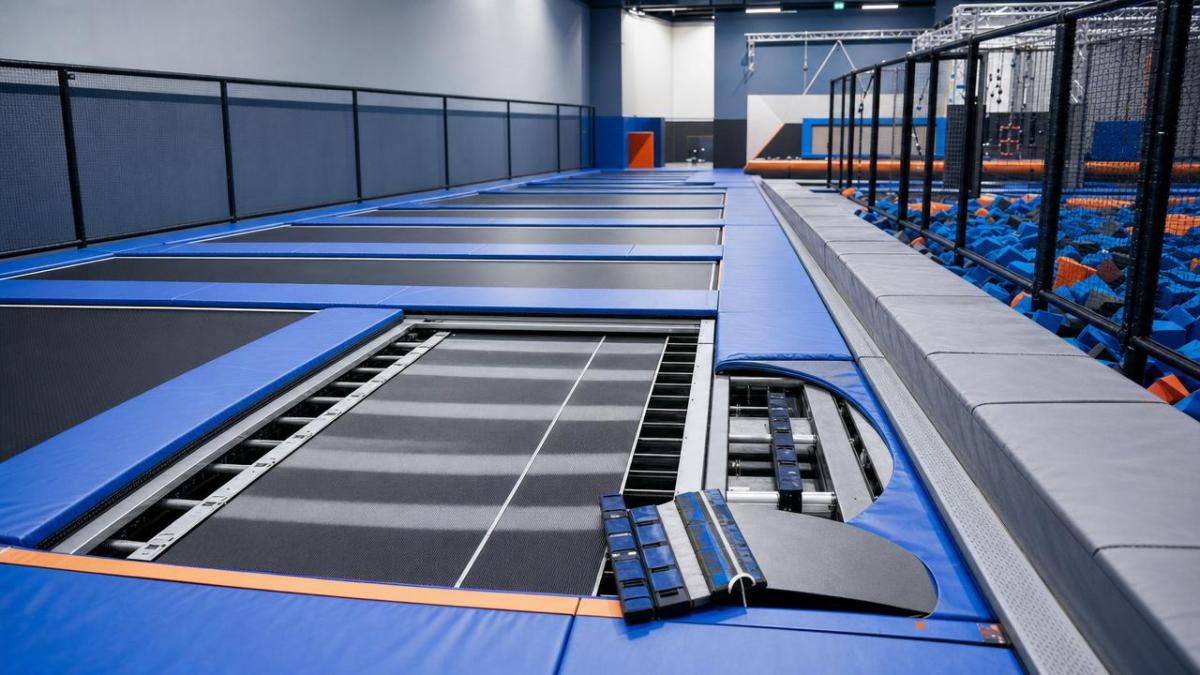
Pads frequently wear faster than operators expect because they face direct foot traffic, sliding contact, and repeated compression. Vinyl covers crack, foam cores collapse, seams split, and fastening points loosen. Pads near entry points and angled wall sections often fail first. Because they are highly visible, teams sometimes focus only on surface tears, but foam density loss is equally important since it reduces impact absorption.
4. Protective netting and soft containment barriers
Netting around performance zones, basketball lanes, and elevated features can suffer from abrasion, UV exposure from windows, and repeated stretching. The problem is not just tears. Mesh distortion, loose tie points, and weakened border stitching can allow excessive deflection before a visible rupture appears. Soft barriers also lose shape over time, reducing their ability to guide users safely.
5. Foam pit blocks and pit liners
Foam cubes compress, crumble, and absorb moisture or contaminants. In high-use foam pits, degradation can be gradual and easy to overlook because the pit still appears full. However, cube collapse reduces energy absorption, and liner wear at the pit base or sidewalls can create exposure risks. Facilities that host older children or adult jumpers often see faster cube fatigue than expected.
6. Frame connection hardware
Bolts, brackets, weld-adjacent zones, and anchor points are not always the first parts to show visible wear, but they are frequent sources of progressive failure. Vibration can loosen hardware. Minor misalignment can enlarge holes or stress connectors. Rust near joints can spread beneath coatings. These trampoline park parts are critical because a small hardware issue often drives secondary damage in mats, pads, and springs.
Wear overview table for maintenance planning
The table below summarizes common trampoline park parts by wear tendency, likely failure mode, and service priority. It is a useful reference for after-sales scheduling and spare parts forecasting.
Hidden factors that accelerate damage
Many premature failures are driven by conditions that are not obvious during a quick walk-through. One major factor is uneven load concentration. Certain bays become favorites because they sit near entrances, near staff supervision, or under better lighting. As a result, the same trampoline park parts absorb a disproportionate number of cycles.
Cleaning practices also matter. Harsh chemicals can dry out vinyl, weaken stitching, or leave surfaces brittle. Moisture trapped under pads or inside foam elements encourages mold, odor, and material breakdown. In coastal or humid climates, corrosion risk rises sharply for springs, hooks, and hardware.
Another hidden issue is deferred minor repair. A small pad tear, a single weak spring, or one loose bracket often appears manageable. But commercial dynamic systems rarely fail in isolation. The longer the defect remains, the more force shifts to adjacent trampoline park parts. This chain effect is why early intervention usually costs less than waiting for a clearly visible failure.
Where wear appears first in typical park zones
Wear intensity varies by attraction type. Main jump courts tend to show mat and spring fatigue first. Dodgeball areas often develop side pad damage and net stress because of lateral movement. Basketball lanes create concentrated impact under goal approaches. Ninja or performance zones combine soft element wear with frame and anchor stress due to climbing, hanging, and off-axis loads.
For after-sales maintenance teams, mapping defects by zone is more useful than tracking only part names. A parts list tells you what exists; a wear map tells you where failure is forming. Over time, this method supports more accurate preventive replacement cycles and better spare inventory decisions.
Practical inspection priorities for after-sales teams
A strong inspection routine should combine daily visual checks, weekly tactile verification, and scheduled technical reviews. Daily checks should focus on obvious damage: torn pads, exposed metal, loose net ties, missing foam cubes, and unusual bounce behavior. Weekly checks should go deeper by testing pad compression, spring consistency, fastener tightness, and bed attachment condition.
Monthly or quarterly reviews should document measurable trends. Examples include counting failed springs by zone, recording repeated seam repairs on the same bed, and comparing pad replacement frequency by attraction type. This is where a data-driven service culture creates value. When maintenance records show exactly which trampoline park parts fail early, teams can justify revised inspection intervals, smarter stocking, and manufacturer feedback based on evidence rather than guesswork.
It is also advisable to separate cosmetic wear from performance-critical degradation. A superficial scuff may not require urgent action, but a loss of pad foam resilience or asymmetrical bed tension does. The best maintenance teams train staff to recognize not just what looks damaged, but what changes the energy absorption, load path, or containment function of the system.
How better parts management reduces downtime and cost
Managing trampoline park parts effectively is not only a replacement task; it is a lifecycle strategy. Facilities that maintain a failure history for each attraction can forecast high-turn items, avoid emergency shipping, and schedule replacements during low-traffic hours. That lowers both labor disruption and closure risk.
The most valuable spare inventory usually includes wear-intensive items rather than low-failure structural members. Springs, hooks, selected pad assemblies, net fixings, foam cubes, and hardware kits often provide the highest maintenance return. Standardizing part identification, storage conditions, and replacement logs also prevents installation mistakes that can shorten the life of newly fitted components.
When possible, teams should also compare expected service life with actual field performance. If one group of trampoline park parts consistently fails before target life, the issue may involve material quality, installation method, environmental exposure, or user behavior. That feedback loop is essential for continuous improvement.
Final takeaway for safer, more predictable maintenance
The trampoline park parts that wear out faster than expected are usually the ones exposed to repeated impact, abrasion, compression, and load transfer: mats, springs, safety pads, netting, foam pit elements, and connection hardware. For after-sales maintenance teams, the key is not simply knowing these parts exist. It is knowing how they fail, where they fail first, and what secondary damage follows if action is delayed.
A practical maintenance program should combine zone-based inspection, trend tracking, and disciplined replacement planning. By treating trampoline park parts as measurable service assets rather than generic consumables, teams can reduce downtime, extend component life, and maintain a safer environment for every user. If your facility is reviewing inspection standards, spare stock priorities, or recurring failure patterns, start with the early-wear components first. That is where the fastest gains in safety, uptime, and maintenance efficiency are usually found.
Search News
Hot Articles
- Carbon Fiber StructuresHow to Specify Aerospace Carbon Fiber Assemblies for Lightweight, Load-Bearing PartsJul 11, 2026
- Machine VisionXiaomi, Alibaba DAMO Academy Drive Open-Source Robotics Model Ecosystem, Lowering Algorithm Development Barriers for Overseas SMEs Adopting Chinese Robotics SolutionsMar 30, 2026
- Cobots & ArmsShanxi 'AI+' Conference Showcases Embodied Intelligence with Multinational Buyer Engagement: Key Industry ImplicationsMar 30, 2026
Popular Tags
Recommended News
 Jul 11, 2026How to Specify Aerospace Carbon Fiber Assemblies for Lightweight, Load-Bearing PartsAerospace carbon fiber assemblies: learn how to specify laminate design, load data, joining methods, and inspection controls for lighter, reliable load-bearing aerospace parts.Elena Rostova (UAV Systems Researcher)
 Mar 30, 2026Xiaomi, Alibaba DAMO Academy Drive Open-Source Robotics Model Ecosystem, Lowering Algorithm Development Barriers for Overseas SMEs Adopting Chinese Robotics SolutionsXiaomi & Alibaba DAMO Academy's open-source robotics models lower algorithm barriers for global SMEs. Boost efficiency in manufacturing, logistics & smart retail with ROS 2 compatible solutions.TSV Data Lab
 Mar 30, 2026Shanxi 'AI+' Conference Showcases Embodied Intelligence with Multinational Buyer Engagement: Key Industry ImplicationsShanxi 'AI+' Conference highlights embodied intelligence with Tesla, Ubtech & Jiantao showcasing multimodal robotics. 40+ global buyers validated tech on-site, creating new B2B channels for industrial automation & AI solutions.Chen Wei (Automation Lead Engineer)
 Mar 30, 2026Zhongguancun Unveils 6G Integrated Sensing-Computing-Intelligence Platform to Empower Embodied Robots for Global Industrial ApplicationsZhongguancun's new 6G platform revolutionizes industrial robotics with <10ms latency, empowering global automotive, logistics & port automation. Discover how this tech boosts China's smart manufacturing exports.TSV Data Lab
 Mar 30, 2026Mech-Mind Tianjin Embodied Intelligence R&D and Production Base Goes Live, Cutting Delivery Time by 20%–30% for Global Customized AMR+Vision SolutionsMech-Mind's Tianjin AMR+Vision production base cuts delivery time by 20%-30% for欧美 & Latin American markets. Discover how this PLd-certified facility accelerates customized robotics solutions for smart manufacturing and logistics.Chen Wei (Automation Lead Engineer)
 Mar 30, 2026Boao Forum Reveals 'Co-evolution of Big and Small Brains' Trend in Humanoid Robots, China's Embodied Intelligence Accelerates Adaptation to Overseas Manufacturing Service ScenariosDiscover how China's humanoid robots, featuring 'Co-evolution of Big and Small Brains,' are revolutionizing global manufacturing. Learn about Embodied Tian Gong 3.0's ISO compliance and overseas deployment at Boao Forum 2026.Chen Wei (Automation Lead Engineer)
 Mar 30, 2026China Railway Industrial Secures Patent for Embodied Robotics in Material Handling, Boosting High-Precision Delivery Capabilities for Overseas Infrastructure and Manufacturing ProjectsChina Railway Industrial's new patent for embodied robotics in material handling boosts high-precision delivery for global infrastructure & manufacturing. Discover how this innovation enhances logistics accuracy in automotive, rail transit & EPC projects.Chen Wei (Automation Lead Engineer)
 Sep 29, 2026ISO 9283 Repeatability: How to Evaluate Cobot Positioning PerformanceISO 9283 cobot repeatability explained: learn how payload, reach, approach direction, and test conditions affect positioning performance and cell capability.Chen Wei (Automation Lead Engineer)
 Sep 29, 2026How Do You Verify Servo Motor Torque Under Continuous Load?How do I verify servo motor torque under continuous load? Learn RMS torque checks, torque-speed limits, thermal derating, and real-machine testing.Chen Wei (Automation Lead Engineer)
 Sep 28, 2026Spindle Runout Measurement in Germany: DIN Standards, Methods, and Acceptance LimitsSpindle runout measurement Germany: explore DIN standards, proven methods, acceptance limits, and audit-ready practices for reliable machining quality.Dr. Marcus Vance
 Sep 27, 2026How to Select Wall-Mount Edge Devices for Space-Constrained Factory NetworksWall mount edge devices for space-constrained factories: evaluate workload, thermal design, power resilience, cable access, and network reliability for smarter deployments.TSV Data Lab
 Sep 26, 2026Machining Tolerance Analysis: How to Set Limits That Meet Function and Cost TargetsMachining tolerance analysis: learn how to set functional limits, control tolerance stacks, reduce inspection risk, and balance precision with production cost.Dr. Marcus Vance
 Sep 25, 2026How to Evaluate an Industrial Infrastructure Data Platform for Multi-Site OperationsIndustrial infrastructure data platform evaluation guide for multi-site operations: compare data quality, edge resilience, interoperability, governance, and scalable proof-of-value criteria.Victor Lin (Chief Software Architect)
 Sep 24, 2026How to Select Machine Vision Optics for Accurate Inspection at Different Working DistancesMachine vision optics selection guide for accurate inspection at every working distance. Compare FOV, pixel scale, DOF, distortion, lighting, and telecentric options.TSV Data Lab
 Sep 23, 2026How to Evaluate a Machine Vision System Integrator for High-Speed Inspection LinesChoose a machine vision system integrator with proven expertise in high-speed inspection, reliable reject timing, robust optics, and measurable acceptance criteria.TSV Data Lab
 Sep 29, 2026How MES and OEE work together to identify production lossesMES and OEE work together to uncover hidden production losses, connect downtime, speed, and quality data, and drive smarter shop-floor improvements.Victor Lin (Chief Software Architect)
 Sep 28, 2026When is a SCADA API the right choice for connecting plant systems?SCADA API guide: learn when governed plant data integration improves traceability, security, and scalability—without compromising real-time control.Victor Lin (Chief Software Architect)
 Sep 27, 2026How SCADA data integration improves traceability across production linesSCADA data integration connects production-line data to improve traceability, accelerate quality investigations, and strengthen safety decisions.Victor Lin (Chief Software Architect)
 Sep 26, 2026What to define before starting SCADA integration planningSCADA integration planning starts with clear scope, control boundaries, data models, cybersecurity, and testing. Discover the definitions that reduce risk and costly rework.Victor Lin (Chief Software Architect)
 Sep 25, 2026How a smart factory with Industrial IoT reduces production blind spotsDiscover how a smart factory with Industrial IoT turns real-time machine, quality, and workflow data into actionable insights that reduce production blind spots and delivery risks.Victor Lin (Chief Software Architect)
 Sep 24, 2026When does Industrial IoT make smart manufacturing easier to scale?Smart manufacturing Industrial IoT scales when trusted data, interoperable systems, and secure workflows turn connected assets into measurable gains.TSV Data Lab
 Sep 23, 2026What drives ultra-precision machining cost at 1-micron tolerance?Ultra precision machining cost per part at 1 micron tolerance depends on process, material, metrology, and yield. Learn how to compare quotes confidently.Dr. Marcus Vance
 Sep 22, 2026Drone Engine-T550CC Applications: Build the UAV Power System Around the MissionAn application guide for Drone Engine-T550CC integration, covering payload planning, airframe matching, cooling, fuel, vibration, test procedures, documentation, and service preparation.Elena Rostova (UAV Systems Researcher)
 Sep 22, 2026How to Evaluate Industrial Edge Computing Vendors for Factory DeploymentIndustrial edge computing vendor evaluation guide for factories: compare latency, protocol fit, reliability, security, and lifecycle support before deployment.TSV Data Lab