Why SCADA system design matters in water treatment
Publication Date
author
In water treatment, system reliability is never accidental—it is designed from the control layer up. A well-planned scada system for water treatment plant operations helps reduce downtime, strengthen compliance, and maintain process visibility.
From intake pumping to dosing, filtration, backwash, sludge handling, and alarm response, control architecture shapes daily performance. That is why SCADA system design matters for safer, more efficient, and future-ready treatment infrastructure.
What does good SCADA system design mean in water treatment?
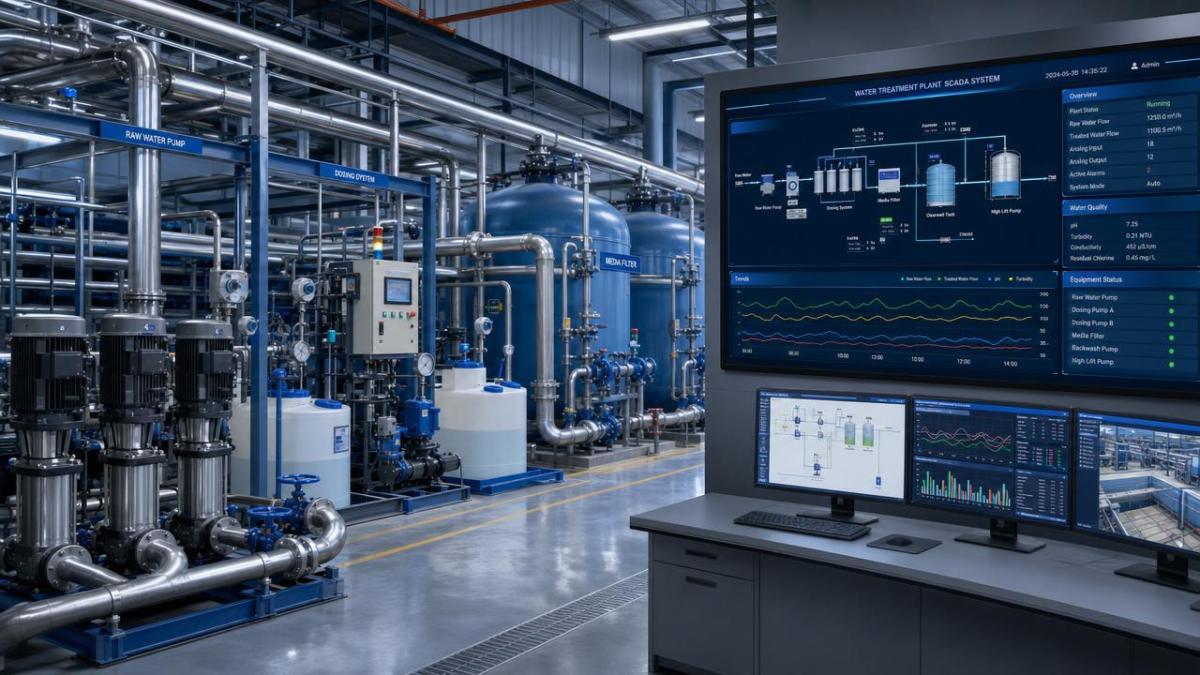
Good design is more than screens and trends. It defines how field devices, PLCs, networks, historians, alarms, and operator workflows work together under real operating pressure.
In a scada system for water treatment plant environments, design starts with process logic. It must reflect chemical dosing windows, pump sequencing, flow balancing, redundancy, and regulatory reporting needs.
A strong design also supports engineering truth. Instead of relying on vague claims, it uses measurable points, reliable communications, and traceable control actions to support stable treatment quality.
Core design elements usually include:
- Clear process mapping from raw water intake to final discharge
- Well-structured tag naming and signal hierarchy
- Alarm priorities based on operational risk
- Reliable historian and reporting strategy
- Cybersecurity and user-access controls
- Scalability for future assets and treatment lines
Why does SCADA system design matter more than software appearance?
Attractive dashboards do not guarantee stable operations. Poor architecture can still hide critical alarms, overload operators, or create data gaps during storms, power events, and maintenance transitions.
A scada system for water treatment plant performance depends on response quality. Operators need the right information, at the right time, with the right priority and context.
When design is weak, common issues appear quickly:
- Nuisance alarms bury real process events
- Pump interlocks become difficult to troubleshoot
- Manual workarounds increase process variability
- Compliance records become incomplete or inconsistent
- Expansion costs rise because the original structure lacks flexibility
By contrast, strong design lowers lifecycle risk. It supports root-cause analysis, improves alarm discipline, and helps teams detect small deviations before they become treatment failures.
Which water treatment processes benefit most from a well-designed SCADA system?
Nearly every process area benefits, but some functions are especially sensitive. These functions depend on timing, sequencing, and verified operating data.
1. Pumping and distribution control
Pump starts, stops, pressure zones, and reservoir levels require dependable automation. A well-built scada system for water treatment plant control improves coordination and reduces energy waste.
2. Chemical dosing
Dosing systems need stable feedback loops and clear override logic. Chlorine, coagulant, pH correction, and polymer control all depend on accurate signals and alarm handling.
3. Filtration and backwash
Filters must track pressure differential, turbidity, runtime, and backwash steps. Good design prevents incomplete sequences, unnecessary wash cycles, and hidden performance decline.
4. Sludge and waste handling
Thickeners, dewatering units, and transfer pumps often reveal design weaknesses. Delayed alarms or poor sequencing can create overflow risks and maintenance burden.
5. Compliance monitoring
Water treatment plants depend on reliable audit trails. A robust scada system for water treatment plant setup captures events, setpoint changes, operator actions, and process trends for reporting.
How can you judge whether a SCADA system for water treatment plant use is well designed?
A practical evaluation should focus on operational clarity, fault tolerance, and future adaptability. The best systems are easy to navigate during both normal production and abnormal events.
Another useful sign is whether process abnormalities can be explained quickly. If repeated faults remain mysterious, design visibility may be insufficient, even when hardware appears modern.
What are the most common design mistakes and risks?
Many failures begin during early specification, not during commissioning. Water treatment projects often suffer when control design is treated as a late-stage software task.
Frequent mistakes include:
- Copying generic templates without matching actual treatment logic
- Ignoring operator workflow during alarm and trend design
- Underestimating network segmentation and cybersecurity requirements
- Failing to define historian needs before startup
- Leaving no room for future process expansion
- Using inconsistent naming across PLC, HMI, and reports
These issues weaken the value of a scada system for water treatment plant operations. They also increase troubleshooting time, training burden, and long-term service costs.
A related risk is over-automation. Not every function needs complexity. Good design balances automatic control with safe manual intervention and clear fallback procedures.
What should be considered for cost, implementation time, and future upgrades?
The cheapest initial option is rarely the lowest lifecycle cost. Design quality affects commissioning effort, maintenance hours, reporting workload, and expansion flexibility for years.
A better planning method is to compare total value across the project timeline:
For future readiness, a scada system for water treatment plant design should support remote diagnostics, secure data exchange, and easier integration with analytics platforms.
That does not mean chasing every new feature. It means choosing structures that preserve engineering clarity while allowing practical modernization over time.
How should a better SCADA design process be approached?
A stronger process begins by documenting treatment objectives before screen design starts. Process stability, alarm response, reporting needs, and maintenance workflows should guide all later choices.
A practical path usually includes:
- Define process narratives for each treatment stage
- Create an alarm philosophy with clear priorities
- Standardize naming, graphics, and trend structure
- Test abnormal scenarios, not only normal sequences
- Review cybersecurity, backup, and recovery procedures
- Reserve capacity for future units and data needs
This approach aligns with TSV’s engineering-first perspective. Measurable design quality creates trust, reduces noise, and delivers durable operational value across industrial infrastructure.
In the end, a reliable scada system for water treatment plant setup is not just a control package. It is a decision framework for uptime, safety, compliance, and long-term plant performance.
If a project is being planned or upgraded, start with the control philosophy, alarm logic, and data requirements. Better SCADA design decisions made early usually return value for the full life of the plant.
Search News
Hot Articles
- Carbon Fiber StructuresHow to Specify Aerospace Carbon Fiber Assemblies for Lightweight, Load-Bearing PartsJul 11, 2026
- Machine VisionXiaomi, Alibaba DAMO Academy Drive Open-Source Robotics Model Ecosystem, Lowering Algorithm Development Barriers for Overseas SMEs Adopting Chinese Robotics SolutionsMar 30, 2026
- Cobots & ArmsShanxi 'AI+' Conference Showcases Embodied Intelligence with Multinational Buyer Engagement: Key Industry ImplicationsMar 30, 2026
Popular Tags
Recommended News
 Jul 11, 2026How to Specify Aerospace Carbon Fiber Assemblies for Lightweight, Load-Bearing PartsAerospace carbon fiber assemblies: learn how to specify laminate design, load data, joining methods, and inspection controls for lighter, reliable load-bearing aerospace parts.Elena Rostova (UAV Systems Researcher)
 Mar 30, 2026Xiaomi, Alibaba DAMO Academy Drive Open-Source Robotics Model Ecosystem, Lowering Algorithm Development Barriers for Overseas SMEs Adopting Chinese Robotics SolutionsXiaomi & Alibaba DAMO Academy's open-source robotics models lower algorithm barriers for global SMEs. Boost efficiency in manufacturing, logistics & smart retail with ROS 2 compatible solutions.TSV Data Lab
 Mar 30, 2026Shanxi 'AI+' Conference Showcases Embodied Intelligence with Multinational Buyer Engagement: Key Industry ImplicationsShanxi 'AI+' Conference highlights embodied intelligence with Tesla, Ubtech & Jiantao showcasing multimodal robotics. 40+ global buyers validated tech on-site, creating new B2B channels for industrial automation & AI solutions.Chen Wei (Automation Lead Engineer)
 Mar 30, 2026Zhongguancun Unveils 6G Integrated Sensing-Computing-Intelligence Platform to Empower Embodied Robots for Global Industrial ApplicationsZhongguancun's new 6G platform revolutionizes industrial robotics with <10ms latency, empowering global automotive, logistics & port automation. Discover how this tech boosts China's smart manufacturing exports.TSV Data Lab
 Mar 30, 2026Mech-Mind Tianjin Embodied Intelligence R&D and Production Base Goes Live, Cutting Delivery Time by 20%–30% for Global Customized AMR+Vision SolutionsMech-Mind's Tianjin AMR+Vision production base cuts delivery time by 20%-30% for欧美 & Latin American markets. Discover how this PLd-certified facility accelerates customized robotics solutions for smart manufacturing and logistics.Chen Wei (Automation Lead Engineer)
 Mar 30, 2026Boao Forum Reveals 'Co-evolution of Big and Small Brains' Trend in Humanoid Robots, China's Embodied Intelligence Accelerates Adaptation to Overseas Manufacturing Service ScenariosDiscover how China's humanoid robots, featuring 'Co-evolution of Big and Small Brains,' are revolutionizing global manufacturing. Learn about Embodied Tian Gong 3.0's ISO compliance and overseas deployment at Boao Forum 2026.Chen Wei (Automation Lead Engineer)
 Mar 30, 2026China Railway Industrial Secures Patent for Embodied Robotics in Material Handling, Boosting High-Precision Delivery Capabilities for Overseas Infrastructure and Manufacturing ProjectsChina Railway Industrial's new patent for embodied robotics in material handling boosts high-precision delivery for global infrastructure & manufacturing. Discover how this innovation enhances logistics accuracy in automotive, rail transit & EPC projects.Chen Wei (Automation Lead Engineer)
 Oct 11, 2026How Procurement-Oriented Content Taxonomy Improves B2B Buying JourneysProcurement-oriented content taxonomy streamlines B2B buying journeys with clearer evidence, supplier comparisons, risk visibility, and faster approvals.TSV Data Lab
 Oct 10, 2026How to Select a Machine Performance Monitoring Platform for OEE and Downtime ReductionMachine performance monitoring platform selection guide: validate machine states, OEE data, downtime reasons, integrations, and scalability to reduce losses with confidence.TSV Data Lab
 Oct 08, 2026How to Machine Inconel 625 Blades Without Heat Cracks or Edge ChippingInconel 625 blade machining guide: prevent heat cracks, edge chipping, chatter, and work hardening with proven tooling, cooling, fixturing, and inspection strategies.Dr. Marcus Vance
 Oct 07, 2026How to Evaluate an HMI Panel Distributor for Industrial Automation ProjectsHMI panel distributor evaluation guide: verify technical compatibility, traceability, supply reliability, lifecycle support, and total cost for automation projects.Victor Lin (Chief Software Architect)
 Oct 06, 2026Navigation Fault Tolerance Standards for AMRs: What Safety Teams Must VerifyNavigation fault tolerance standards: learn what AMR safety teams must verify, from localization loss and sensor faults to stopping distance, safe restart, and site-specific validation.Chen Wei (Automation Lead Engineer)
 Oct 05, 2026Calculating Edge Computing Total Cost of Ownership Across Distributed SitesEdge computing ownership cost explained: calculate deployment, energy, connectivity, security, remote support, and refresh costs across distributed sites.TSV Data Lab
 Oct 04, 2026CAD/CAM Benchmarking in the GCC: What Manufacturers Should Ask a ConsultantCAD CAM benchmark consultant GCC guide: learn the key questions manufacturers should ask to validate post-processors, workflows, machine performance, and production risk.Victor Lin (Chief Software Architect)
 Oct 03, 2026Selecting Automotive Radar Sensor Modules for ADAS Range, Resolution, and IntegrationAutomotive radar sensor module selection guide for ADAS: compare range, resolution, field of view, latency, and integration to build safer, reliable vehicle systems.TSV Data Lab
 Oct 02, 2026How to Qualify Machined Parts Suppliers for Hard Tech ProgramsHard tech supply chain machined parts demand rigorous supplier qualification. Learn how to assess capability, traceability, quality controls, and delivery resilience.Dr. Marcus Vance
 Oct 01, 2026How to Select an Outdoor Security Radar Sensor for Perimeter Detection?Outdoor security radar sensor selection guide: compare range, accuracy, false-alarm control, integration, and field testing for reliable perimeter detection.TSV Data Lab
 Sep 30, 2026How to Evaluate Solid-State LiDAR Hardware for Outdoor Autonomous VehiclesSolid state LiDAR hardware evaluation guide for outdoor autonomous vehicles—compare range, point-cloud quality, environmental resilience, integration, and safety.TSV Data Lab
 Sep 29, 2026ISO 9283 Repeatability: How to Evaluate Cobot Positioning PerformanceISO 9283 cobot repeatability explained: learn how payload, reach, approach direction, and test conditions affect positioning performance and cell capability.Chen Wei (Automation Lead Engineer)
 Oct 10, 2026When does the cost of industrial robots pay back in high-volume production?Cost of industrial robots: discover how high-volume manufacturers calculate payback through uptime, cycle time, labor, quality, and integration before investing.Chen Wei (Automation Lead Engineer)
 Oct 09, 2026What does a manufacturing robot really cost beyond the purchase price?Manufacturing robot cost goes far beyond the purchase price. Explore integration, tooling, safety, uptime, and total ownership factors for smarter automation investments.Chen Wei (Automation Lead Engineer)
 Oct 08, 2026AGV vs. AMR: Which Is Better for Frequently Changing Routes?Which is better for changing routes? Compare AGVs and AMRs for flexible navigation, docking precision, traffic control, and faster facility reconfiguration.Chen Wei (Automation Lead Engineer)
 Oct 07, 2026How Much Does an Automated Guided Vehicle Cost in 2026?How much does an automated guided vehicle cost in 2026? Explore AGV price ranges, hidden deployment costs, and smart buying factors for stronger ROI.Chen Wei (Automation Lead Engineer)
 Oct 06, 2026Are Collaborative Robots Safe Enough to Operate Without Fencing?Are collaborative robots safe enough to work without fencing? Explore risk assessment, safeguarding options, and practical guidance for safer, productive cobot cells.Chen Wei (Automation Lead Engineer)