Industrial IoT security protocols that break legacy integration
Publication Date
author
Industrial IoT security protocols promise stronger protection, but for project leaders managing mixed fleets of old and new systems, they can also expose painful integration gaps. When encryption standards, device authentication, and network segmentation clash with legacy PLCs, SCADA, or edge gateways, security upgrades quickly become operational risks. This article examines where those breakdowns occur and how teams can reduce disruption without compromising engineering rigor.
Why this issue is escalating now rather than later
Across manufacturing, energy, logistics, aerospace supply chains, and process industries, the discussion around industrial IoT security protocols has shifted. A few years ago, many teams treated protocol hardening as a future-state initiative attached to digital transformation roadmaps. Today, it is becoming a near-term delivery constraint. Plants are adding more sensors, remote maintenance links, edge analytics nodes, machine vision systems, and cloud-connected historians. At the same time, many production environments still depend on equipment commissioned 10, 15, or even 25 years ago.
That combination is changing the risk profile. It is no longer enough to say a site has “network security” in general. Project managers are being asked whether specific devices can support certificate-based authentication, secure boot, encrypted telemetry, segmented traffic, and role-based access control without interrupting deterministic control behavior. In other words, industrial IoT security protocols are no longer an IT-only topic. They now influence commissioning schedules, upgrade budgets, supplier qualification, and operational continuity.
The key trend is not simply that security requirements are rising. The more important shift is that security expectations are becoming protocol-level and architecture-level requirements, while legacy integration assumptions remain device-level and interface-level. That mismatch is where many projects break.
The strongest market signals behind the shift
Several converging signals explain why integration friction around industrial IoT security protocols is becoming more visible in project planning.
These signals matter because they convert cybersecurity from a compliance conversation into a system engineering constraint. For engineering-led organizations, that changes how projects are scoped. Teams can no longer assume the new edge platform will simply “talk to” every old machine once protocol wrappers are added.
Where industrial IoT security protocols most often break legacy integration
The failure points are usually not dramatic at first. They appear as slow commissioning, unstable data exchange, inconsistent authentication behavior, or unexplained device resets. Over time, they become schedule overruns and credibility issues between OT, IT, and suppliers.
1. Encryption overhead versus legacy performance limits
Many older PLCs, RTUs, and gateways were not designed for modern encryption workloads. When teams introduce TLS, VPN tunneling, or signed session layers on top of existing traffic, processing latency can rise beyond acceptable limits. In high-frequency polling environments, even small timing shifts may affect HMI responsiveness, alarm handling, or edge buffering.
2. Authentication models that assume newer identity frameworks
Modern industrial IoT security protocols often rely on certificates, managed credentials, or centralized identity services. Legacy devices may support only static passwords, shared accounts, or no native authentication at all. The result is a fragile workaround layer that satisfies audits on paper but creates operational complexity in practice.
3. Network segmentation colliding with old communication assumptions
Zero-trust thinking and segmented industrial networks are gaining ground, but older control systems frequently assume flat, persistent communication paths. Once VLANs, firewalls, or protocol-aware inspection are introduced, undocumented device dependencies surface. Broadcast discovery, time synchronization, engineering workstation access, and vendor diagnostics may fail unexpectedly.
4. Protocol translation that preserves data but loses security meaning
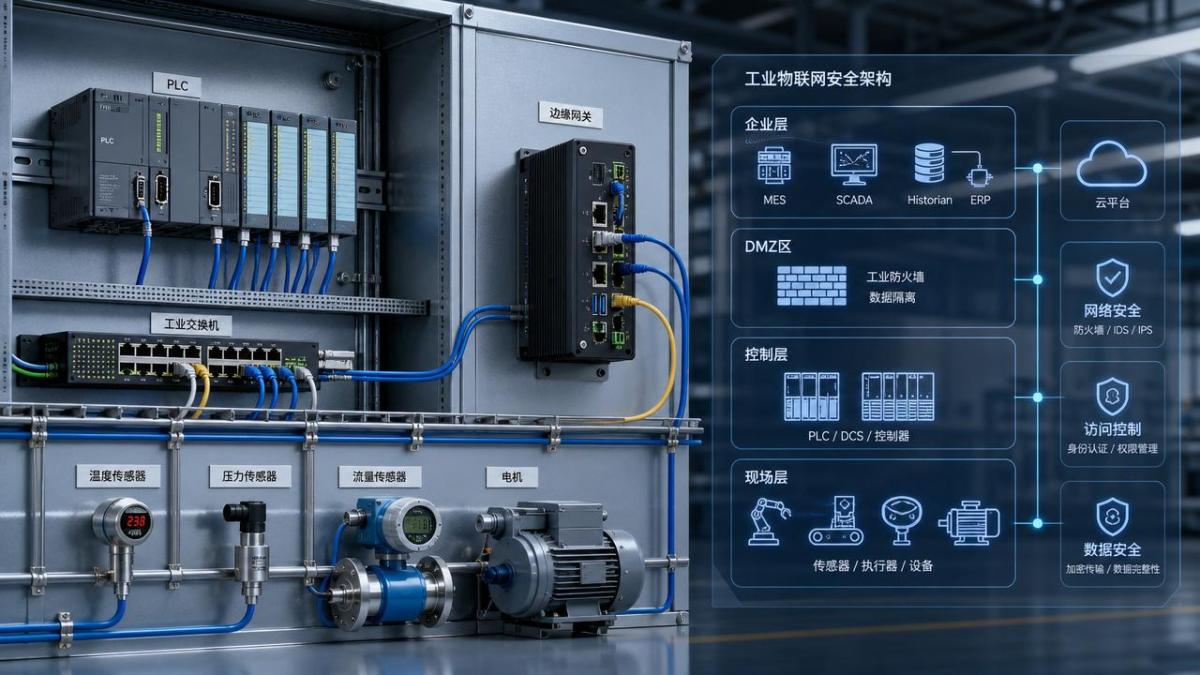
A common integration strategy is to place a secure edge gateway in front of a legacy asset. This can work, but only if decision-makers understand the limits. Translating Modbus, serial traffic, or proprietary machine protocols into MQTT, OPC UA, or API-based flows may preserve telemetry, yet not preserve device trust, write control semantics, or event integrity. The project appears connected, but not truly secured end to end.
5. Patchability and lifecycle support gaps
Some legacy assets cannot accept firmware changes without downtime, recertification, or vendor intervention. That means new industrial IoT security protocols may be technically available in the ecosystem but practically unusable in the installed base. This gap is especially serious in regulated production and safety-sensitive environments.
Why the problem affects project managers more than ever
For project leaders and engineering managers, the main challenge is not deciding whether security matters. It is managing the consequences when security architecture changes project sequencing. A protocol decision now influences FAT and SAT planning, network design reviews, supplier interfaces, downtime windows, and acceptance criteria.
This is why teams that treat security as a late-stage add-on often struggle. If the controls team assumes direct machine visibility, the IT team assumes certificate enforcement, the integrator assumes transparent conversion, and procurement assumes vendor claims are comparable, the project is set up for conflict. Security becomes the point where hidden assumptions are finally exposed.
The trend is moving from protocol adoption to protocol fit assessment
One of the most important industry changes is that leading teams are no longer asking only which industrial IoT security protocols are modern. They are asking which ones fit their installed base, process criticality, and upgrade path. That is a healthier question.
For example, OPC UA with security features may be excellent in one environment, while a gateway-mediated approach is more realistic in another. MQTT with TLS can support scalable telemetry, but not every brownfield asset can sustain the required session behavior. Network access control can improve visibility, but a fragile production line may require staged enforcement rather than immediate lock-down. The trend is toward layered security architecture, not protocol absolutism.
What practical signals deserve close monitoring in the next 12 to 24 months
Project leaders should watch for a few recurring indicators. First, supplier documentation is becoming a stronger differentiator. Vendors that clearly specify supported cipher suites, certificate handling, firmware dependencies, and integration limits are easier to trust than those using broad marketing claims. Second, edge gateway design is becoming more strategic. The gateway is no longer just a data bridge; it increasingly acts as a trust boundary, logging point, and segmentation control.
Third, procurement language is evolving. More RFQs now ask not only whether devices support secure communication, but how that support behaves under real deployment constraints. Fourth, legacy asset inventories are gaining executive attention because modernization roadmaps depend on actual protocol capability, not assumed compatibility.
How to reduce disruption without lowering security standards
The most effective response is not to pause security upgrades. It is to make compatibility assessment more engineering-driven from the beginning. For mixed OT environments, that means documenting real protocol behavior before architecture commitments are finalized.
Build a protocol capability map early
List each critical asset, firmware version, communication method, latency sensitivity, write-control need, and upgrade constraint. Many integration failures happen because teams know the device model but not the security-relevant behavior of that exact deployed version.
Separate telemetry security from control security
Not all traffic carries equal operational risk. In some cases, read-only monitoring can be secured through a modern edge layer while control pathways remain under tighter, more conservative handling. This staged architecture can reduce exposure without forcing unrealistic immediate replacement.
Require testable acceptance criteria
When evaluating industrial IoT security protocols, define measurable checks: handshake reliability, failover response, latency tolerance, certificate renewal behavior, packet loss under load, and recovery after reboot. This fits TSV’s engineering-first mindset: parameters matter more than slogans.
Use segmentation as design, not as a patch
If segmentation is added late, teams often discover hidden dependencies too late. If it is designed early, exceptions can be documented, monitored, and reduced over time rather than becoming permanent blind spots.
A practical decision framework for engineering-led organizations
Final judgment: security maturity now depends on integration realism
The future of industrial IoT security protocols is not just stronger encryption or better device identity. The real direction is more disciplined alignment between security design and operational reality. For project managers, that means the winning organizations will be the ones that stop treating legacy integration as a hidden technical detail and start treating it as a strategic planning variable.
If your organization is deciding how to modernize connected operations, the most useful next step is to confirm a short list of facts: which assets cannot support current security expectations, where gateway-based protection is acceptable, what latency margins exist, which vendor claims are test-backed, and which exceptions are truly temporary. Those answers will reveal whether your industrial IoT security protocols roadmap is operationally credible—or only theoretically secure.
Search News
Hot Articles
- Carbon Fiber StructuresHow to Specify Aerospace Carbon Fiber Assemblies for Lightweight, Load-Bearing PartsJul 11, 2026
- Machine VisionXiaomi, Alibaba DAMO Academy Drive Open-Source Robotics Model Ecosystem, Lowering Algorithm Development Barriers for Overseas SMEs Adopting Chinese Robotics SolutionsMar 30, 2026
- Cobots & ArmsShanxi 'AI+' Conference Showcases Embodied Intelligence with Multinational Buyer Engagement: Key Industry ImplicationsMar 30, 2026
Popular Tags
Recommended News
 Jul 11, 2026How to Specify Aerospace Carbon Fiber Assemblies for Lightweight, Load-Bearing PartsAerospace carbon fiber assemblies: learn how to specify laminate design, load data, joining methods, and inspection controls for lighter, reliable load-bearing aerospace parts.Elena Rostova (UAV Systems Researcher)
 Mar 30, 2026Xiaomi, Alibaba DAMO Academy Drive Open-Source Robotics Model Ecosystem, Lowering Algorithm Development Barriers for Overseas SMEs Adopting Chinese Robotics SolutionsXiaomi & Alibaba DAMO Academy's open-source robotics models lower algorithm barriers for global SMEs. Boost efficiency in manufacturing, logistics & smart retail with ROS 2 compatible solutions.TSV Data Lab
 Mar 30, 2026Shanxi 'AI+' Conference Showcases Embodied Intelligence with Multinational Buyer Engagement: Key Industry ImplicationsShanxi 'AI+' Conference highlights embodied intelligence with Tesla, Ubtech & Jiantao showcasing multimodal robotics. 40+ global buyers validated tech on-site, creating new B2B channels for industrial automation & AI solutions.Chen Wei (Automation Lead Engineer)
 Mar 30, 2026Zhongguancun Unveils 6G Integrated Sensing-Computing-Intelligence Platform to Empower Embodied Robots for Global Industrial ApplicationsZhongguancun's new 6G platform revolutionizes industrial robotics with <10ms latency, empowering global automotive, logistics & port automation. Discover how this tech boosts China's smart manufacturing exports.TSV Data Lab
 Mar 30, 2026Mech-Mind Tianjin Embodied Intelligence R&D and Production Base Goes Live, Cutting Delivery Time by 20%–30% for Global Customized AMR+Vision SolutionsMech-Mind's Tianjin AMR+Vision production base cuts delivery time by 20%-30% for欧美 & Latin American markets. Discover how this PLd-certified facility accelerates customized robotics solutions for smart manufacturing and logistics.Chen Wei (Automation Lead Engineer)
 Mar 30, 2026Boao Forum Reveals 'Co-evolution of Big and Small Brains' Trend in Humanoid Robots, China's Embodied Intelligence Accelerates Adaptation to Overseas Manufacturing Service ScenariosDiscover how China's humanoid robots, featuring 'Co-evolution of Big and Small Brains,' are revolutionizing global manufacturing. Learn about Embodied Tian Gong 3.0's ISO compliance and overseas deployment at Boao Forum 2026.Chen Wei (Automation Lead Engineer)
 Mar 30, 2026China Railway Industrial Secures Patent for Embodied Robotics in Material Handling, Boosting High-Precision Delivery Capabilities for Overseas Infrastructure and Manufacturing ProjectsChina Railway Industrial's new patent for embodied robotics in material handling boosts high-precision delivery for global infrastructure & manufacturing. Discover how this innovation enhances logistics accuracy in automotive, rail transit & EPC projects.Chen Wei (Automation Lead Engineer)
 Sep 29, 2026ISO 9283 Repeatability: How to Evaluate Cobot Positioning PerformanceISO 9283 cobot repeatability explained: learn how payload, reach, approach direction, and test conditions affect positioning performance and cell capability.Chen Wei (Automation Lead Engineer)
 Sep 28, 2026Spindle Runout Measurement in Germany: DIN Standards, Methods, and Acceptance LimitsSpindle runout measurement Germany: explore DIN standards, proven methods, acceptance limits, and audit-ready practices for reliable machining quality.Dr. Marcus Vance
 Sep 27, 2026How to Select Wall-Mount Edge Devices for Space-Constrained Factory NetworksWall mount edge devices for space-constrained factories: evaluate workload, thermal design, power resilience, cable access, and network reliability for smarter deployments.TSV Data Lab
 Sep 26, 2026Machining Tolerance Analysis: How to Set Limits That Meet Function and Cost TargetsMachining tolerance analysis: learn how to set functional limits, control tolerance stacks, reduce inspection risk, and balance precision with production cost.Dr. Marcus Vance
 Sep 25, 2026How to Evaluate an Industrial Infrastructure Data Platform for Multi-Site OperationsIndustrial infrastructure data platform evaluation guide for multi-site operations: compare data quality, edge resilience, interoperability, governance, and scalable proof-of-value criteria.Victor Lin (Chief Software Architect)
 Sep 24, 2026How to Select Machine Vision Optics for Accurate Inspection at Different Working DistancesMachine vision optics selection guide for accurate inspection at every working distance. Compare FOV, pixel scale, DOF, distortion, lighting, and telecentric options.TSV Data Lab
 Sep 23, 2026How to Evaluate a Machine Vision System Integrator for High-Speed Inspection LinesChoose a machine vision system integrator with proven expertise in high-speed inspection, reliable reject timing, robust optics, and measurable acceptance criteria.TSV Data Lab
 Sep 28, 2026When is a SCADA API the right choice for connecting plant systems?SCADA API guide: learn when governed plant data integration improves traceability, security, and scalability—without compromising real-time control.Victor Lin (Chief Software Architect)
 Sep 27, 2026How SCADA data integration improves traceability across production linesSCADA data integration connects production-line data to improve traceability, accelerate quality investigations, and strengthen safety decisions.Victor Lin (Chief Software Architect)
 Sep 26, 2026What to define before starting SCADA integration planningSCADA integration planning starts with clear scope, control boundaries, data models, cybersecurity, and testing. Discover the definitions that reduce risk and costly rework.Victor Lin (Chief Software Architect)
 Sep 25, 2026How a smart factory with Industrial IoT reduces production blind spotsDiscover how a smart factory with Industrial IoT turns real-time machine, quality, and workflow data into actionable insights that reduce production blind spots and delivery risks.Victor Lin (Chief Software Architect)
 Sep 24, 2026When does Industrial IoT make smart manufacturing easier to scale?Smart manufacturing Industrial IoT scales when trusted data, interoperable systems, and secure workflows turn connected assets into measurable gains.TSV Data Lab
 Sep 23, 2026What drives ultra-precision machining cost at 1-micron tolerance?Ultra precision machining cost per part at 1 micron tolerance depends on process, material, metrology, and yield. Learn how to compare quotes confidently.Dr. Marcus Vance
 Sep 22, 2026Drone Engine-T550CC Applications: Build the UAV Power System Around the MissionAn application guide for Drone Engine-T550CC integration, covering payload planning, airframe matching, cooling, fuel, vibration, test procedures, documentation, and service preparation.Elena Rostova (UAV Systems Researcher)
 Sep 22, 2026How to Evaluate Industrial Edge Computing Vendors for Factory DeploymentIndustrial edge computing vendor evaluation guide for factories: compare latency, protocol fit, reliability, security, and lifecycle support before deployment.TSV Data Lab
 Sep 21, 2026Drone Payload Integration: Matching Power, Data, and Center of Gravity for Reliable FlightsDrone payload integration made practical: balance power, data, center of gravity, and endurance to build safer, more reliable mission-ready flights.Elena Rostova (UAV Systems Researcher)
 Sep 20, 2026Autonomous Navigation Pricing: Cost Drivers and Budget Benchmarks for AMR ProjectsAutonomous navigation price explained: compare AMR cost drivers, software, sensors, integration, safety, and lifecycle budgets to build a scalable project plan.Chen Wei (Automation Lead Engineer)