Industrial IoT gateway latency spikes often come from protocol mix
Publication Date
author
Industrial IoT gateway latency spikes are usually not a simple bandwidth problem. In real plants, the biggest cause is often protocol mix: serial polling on one side, event-driven publish/subscribe on another, plus conversion logic, buffering, and bursty traffic in between. That is why an industrial iot gateway latency issue can appear “random” even when link utilization looks safe, and why a lab iot gateway throughput benchmark often fails to predict field performance. If you are evaluating, deploying, or buying a modbus rtu to mqtt gateway, the key question is not just how fast the hardware is, but how the gateway behaves when multiple industrial protocols compete for timing, CPU cycles, and queue priority at the edge.
Why protocol mix is often the real source of latency spikes
Many teams start troubleshooting with Ethernet speed, cellular quality, or cloud response time. Those factors matter, but in mixed industrial environments they are often secondary. The larger issue is timing mismatch between protocols that were never designed to behave the same way.
For example:
- Modbus RTU is typically polled and serial, with strict request-response behavior.
- MQTT is lightweight and event-oriented, but broker interactions, QoS levels, and retained messaging can change timing.
- OPC UA may add richer data models and security overhead.
- CAN, Profinet, EtherNet/IP, or proprietary field protocols each bring different update cycles, packet sizes, and retry behaviors.
When one gateway must translate between these stacks, latency is no longer a single number. It becomes the result of scheduling, serialization, parsing, buffering, retries, packet assembly, encryption, and message prioritization. In short: mixed protocols create timing contention.
This is why a gateway can show low average latency but still suffer severe spikes. The average may look acceptable, while the 95th or 99th percentile becomes operationally dangerous.
What engineers and operators should check first when latency becomes unstable
For technical users, the fastest path to diagnosis is to stop treating latency as one end-to-end black box. Break it into stages:
- Acquisition delay: how long it takes to collect data from field devices.
- Protocol conversion delay: time spent parsing, mapping, transforming, or normalizing payloads.
- Queueing delay: waiting time caused by bursts, store-and-forward behavior, or low-priority scheduling.
- Transport delay: Ethernet, Wi-Fi, 4G/5G, or WAN transmission time.
- Application delay: broker, SCADA, MES, cloud, or database ingestion latency.
In many cases, the spike is already present before data leaves the gateway.
The most common checks include:
- Polling interval mismatch: a fast upstream publish cycle cannot compensate for a slow serial polling loop.
- Burst behavior: multiple devices responding on the same scan cycle create queue buildup.
- CPU saturation: encryption, scripting, filtering, or edge analytics may steal resources from protocol handling.
- Serial bus constraints: baud rate, framing errors, bus length, and device turnaround time directly affect a modbus rtu to mqtt gateway.
- Improper QoS configuration: higher MQTT QoS improves delivery assurance but can add retransmission and acknowledgment delay.
- Oversized payload mapping: packing too many registers or tags into each transaction may create periodic response stalls.
A practical field rule is this: if spikes appear cyclical, suspect polling design; if they appear during alarms, shift changes, or startup, suspect burst handling and queue policy.
Why a lab throughput benchmark often fails in real edge deployments
Buyers and decision-makers often ask for an iot gateway throughput benchmark, and that is reasonable. But throughput alone is a poor predictor of time-sensitive industrial behavior.
A benchmark measured under clean, single-protocol, evenly distributed traffic can hide the exact problems that matter in production:
- mixed serial and Ethernet workloads
- uneven packet arrival patterns
- high tag-count translation jobs
- security overhead under real certificate policies
- simultaneous northbound and southbound traffic
- device retries and intermittent line noise
Two gateways may publish the same headline throughput number, yet behave very differently under mixed load. One may keep latency tightly bounded; the other may show long-tail spikes that disrupt HMI responsiveness, alarm accuracy, historian integrity, or control-adjacent analytics.
For this reason, a useful evaluation should include:
- Peak-to-average traffic tests, not just steady-state load
- Percentile latency such as P95 and P99, not just mean latency
- Mixed protocol conversion tests, not single-stack tests only
- Recovery behavior after packet loss, device timeout, or broker reconnect
- Sustained runtime stability over hours or days, not only short demo windows
For TSV-style technical due diligence, the better question is not “What is the max throughput?” but “At what mixed workload does latency become unstable, and how predictable is failure behavior?”
How protocol translation creates hidden delay in a modbus rtu to mqtt gateway
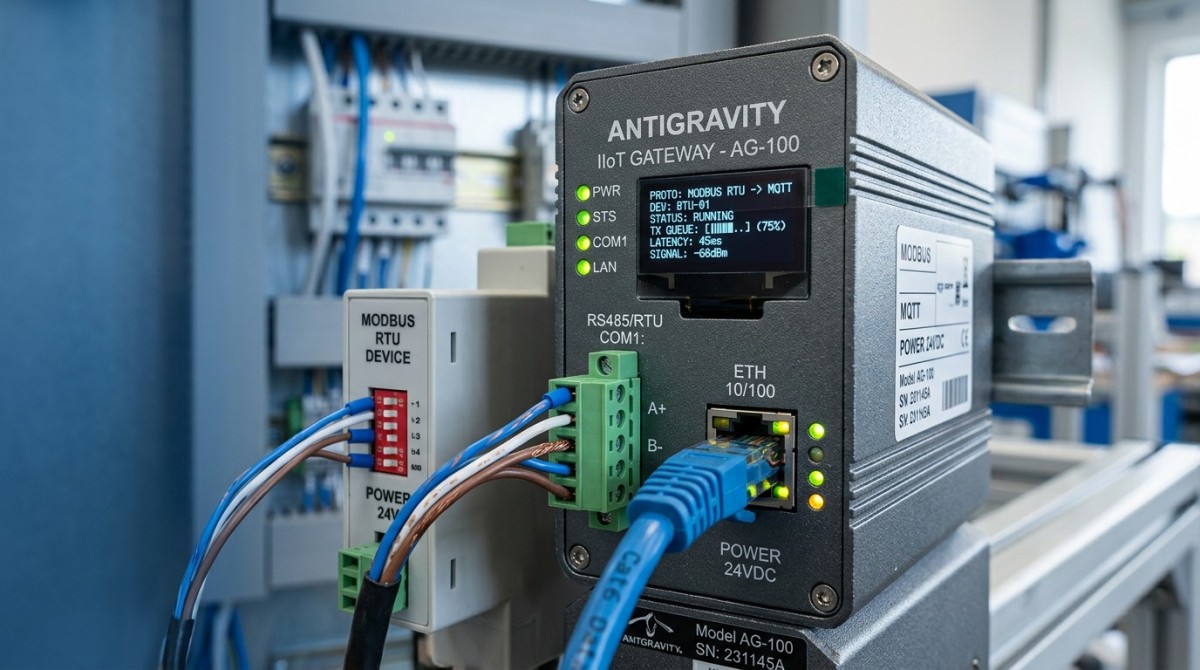
The modbus rtu to mqtt gateway is a common edge architecture, and it is also a common source of misunderstanding. On paper, the translation path looks simple: read registers from serial devices, convert values, publish to MQTT topics. In practice, hidden delay accumulates at several points.
Serial polling is sequential. Even if MQTT can publish quickly, Modbus RTU cannot escape bus timing rules. More devices, more registers, slower baud rates, and more retries all stretch the scan cycle.
Data normalization adds processing cost. Register aggregation, endian conversion, scaling, timestamping, and JSON formatting consume CPU and memory.
Burst publishing can amplify jitter. If the gateway waits for a full polling cycle and then publishes many messages together, MQTT traffic becomes bursty rather than smooth.
Error handling changes timing behavior. One unresponsive slave can delay a full serial round, especially if timeout settings are conservative.
Store-and-forward logic can mask real-time limits. During network interruption, the gateway may buffer successfully, but once connectivity returns, replay traffic can compete with fresh telemetry.
That means a stable design depends on disciplined configuration:
- group registers intelligently instead of over-polling
- separate critical and noncritical tags by update class
- tune serial timeout and retry values based on actual line conditions
- avoid unnecessary payload verbosity for high-frequency data
- test with realistic device counts and message bursts
What procurement teams and enterprise decision-makers should evaluate before purchase
For procurement leaders and CTO-level reviewers, the risk is buying against brochure claims instead of operational truth. A gateway that looks strong in a feature checklist may still create hidden production cost if latency spikes force rework, missed events, or troubleshooting labor.
Focus on these evaluation dimensions:
- Determinism over headline speed: predictable latency bands are often more valuable than higher peak throughput.
- Protocol coexistence capability: ask for evidence of stable operation under the exact protocol mix used in your site.
- Observability: can the gateway expose queue depth, CPU load, dropped messages, retry counts, and timestamped diagnostics?
- Configuration granularity: can polling rates, priorities, buffering rules, and publish behavior be tuned per device or tag group?
- Failure isolation: does one bad device stall the whole gateway, or is degradation contained?
- Lifecycle support: are firmware updates, security patches, and protocol stack maintenance credible over time?
From a business perspective, latency spikes are not only an engineering nuisance. They can affect OEE reporting, traceability reliability, alarm response confidence, and the speed of scaling a multi-site rollout. In highly regulated or precision-driven environments, inconsistent edge timing also weakens trust in data-driven decisions.
Practical design choices that reduce latency spikes in mixed-protocol deployments
If the objective is stable industrial iot gateway latency, architecture matters more than optimism. The following measures usually have the highest return:
- Segment traffic by criticality: do not let low-priority telemetry compete directly with alarm or state-change traffic.
- Reduce unnecessary translation layers: every format conversion adds overhead and possible queue delay.
- Use event-driven publishing where possible: avoid flooding the network with unchanged values.
- Tune polling architecture: align scan groups with process needs instead of using one global interval.
- Benchmark under realistic edge conditions: include bad devices, reconnect events, and burst scenarios.
- Reserve compute headroom: gateways operating near CPU or memory limits will show larger jitter under transient load.
- Instrument timestamps across the path: measure where delay is introduced instead of guessing.
In larger deployments, it may also be better to distribute workloads across more than one gateway rather than centralize every protocol and site function into a single edge node.
How to form a reliable judgment when comparing gateway options
A good comparison framework should combine engineering metrics with deployment reality. Ask vendors or internal teams to demonstrate:
- latency distribution under mixed protocols
- performance of a modbus rtu to mqtt gateway under realistic serial loads
- iot gateway throughput benchmark results with burst traffic, not just steady traffic
- behavior during timeout, reconnect, and buffer replay conditions
- evidence that monitoring tools can pinpoint queue, CPU, and protocol-level bottlenecks
Do not accept generic phrases such as “low latency,” “industrial-grade,” or “high performance” without test conditions. Parameters matter only when tied to workload definition, protocol mix, and percentile behavior.
In summary, industrial IoT gateway latency spikes often come from protocol mix, not raw bandwidth shortage. Mixed polling models, conversion overhead, retries, queueing, and burst publishing can distort the latency profile long before the WAN link becomes the bottleneck. For engineers and operators, the solution is staged measurement and configuration discipline. For procurement teams and enterprise leaders, the right purchase decision depends on deterministic performance under real mixed-protocol conditions, not marketing averages. If you want trustworthy edge data, evaluate the gateway where engineering truth lives: in timing behavior under realistic load.
Search News
Hot Articles
- Carbon Fiber StructuresHow to Specify Aerospace Carbon Fiber Assemblies for Lightweight, Load-Bearing PartsJul 11, 2026
- Machine VisionXiaomi, Alibaba DAMO Academy Drive Open-Source Robotics Model Ecosystem, Lowering Algorithm Development Barriers for Overseas SMEs Adopting Chinese Robotics SolutionsMar 30, 2026
- Cobots & ArmsShanxi 'AI+' Conference Showcases Embodied Intelligence with Multinational Buyer Engagement: Key Industry ImplicationsMar 30, 2026
Popular Tags
Recommended News
 Jul 11, 2026How to Specify Aerospace Carbon Fiber Assemblies for Lightweight, Load-Bearing PartsAerospace carbon fiber assemblies: learn how to specify laminate design, load data, joining methods, and inspection controls for lighter, reliable load-bearing aerospace parts.Elena Rostova (UAV Systems Researcher)
 Mar 30, 2026Xiaomi, Alibaba DAMO Academy Drive Open-Source Robotics Model Ecosystem, Lowering Algorithm Development Barriers for Overseas SMEs Adopting Chinese Robotics SolutionsXiaomi & Alibaba DAMO Academy's open-source robotics models lower algorithm barriers for global SMEs. Boost efficiency in manufacturing, logistics & smart retail with ROS 2 compatible solutions.TSV Data Lab
 Mar 30, 2026Shanxi 'AI+' Conference Showcases Embodied Intelligence with Multinational Buyer Engagement: Key Industry ImplicationsShanxi 'AI+' Conference highlights embodied intelligence with Tesla, Ubtech & Jiantao showcasing multimodal robotics. 40+ global buyers validated tech on-site, creating new B2B channels for industrial automation & AI solutions.Chen Wei (Automation Lead Engineer)
 Mar 30, 2026Zhongguancun Unveils 6G Integrated Sensing-Computing-Intelligence Platform to Empower Embodied Robots for Global Industrial ApplicationsZhongguancun's new 6G platform revolutionizes industrial robotics with <10ms latency, empowering global automotive, logistics & port automation. Discover how this tech boosts China's smart manufacturing exports.TSV Data Lab
 Mar 30, 2026Mech-Mind Tianjin Embodied Intelligence R&D and Production Base Goes Live, Cutting Delivery Time by 20%–30% for Global Customized AMR+Vision SolutionsMech-Mind's Tianjin AMR+Vision production base cuts delivery time by 20%-30% for欧美 & Latin American markets. Discover how this PLd-certified facility accelerates customized robotics solutions for smart manufacturing and logistics.Chen Wei (Automation Lead Engineer)
 Mar 30, 2026Boao Forum Reveals 'Co-evolution of Big and Small Brains' Trend in Humanoid Robots, China's Embodied Intelligence Accelerates Adaptation to Overseas Manufacturing Service ScenariosDiscover how China's humanoid robots, featuring 'Co-evolution of Big and Small Brains,' are revolutionizing global manufacturing. Learn about Embodied Tian Gong 3.0's ISO compliance and overseas deployment at Boao Forum 2026.Chen Wei (Automation Lead Engineer)
 Mar 30, 2026China Railway Industrial Secures Patent for Embodied Robotics in Material Handling, Boosting High-Precision Delivery Capabilities for Overseas Infrastructure and Manufacturing ProjectsChina Railway Industrial's new patent for embodied robotics in material handling boosts high-precision delivery for global infrastructure & manufacturing. Discover how this innovation enhances logistics accuracy in automotive, rail transit & EPC projects.Chen Wei (Automation Lead Engineer)
 Oct 21, 2026China’s Industrial Robot Exports Near RMB 10 Billion in First Nine Months of 2026China’s industrial robot exports neared RMB 10 billion in January–September 2026, with value rising faster than volume. Explore the data and what it could mean for suppliers.Chen Wei (Automation Lead Engineer)
 Oct 21, 2026Low-Latency Industrial Data Processing: Pricing and Key Cost DriversExplore industrial data latency price drivers, from edge hardware to integration and support. Learn how to compare quotes, verify performance, and avoid unnecessary costs.TSV Data Lab
 Oct 20, 2026KUKA Launches iiQKA.AI Vision to Simplify Industrial Image ProcessingKUKA iiQKA.AI Vision simplifies industrial image processing with controller-based 2D and 3D vision. Explore drag-and-drop setup for vision-guided automation.TSV Data Lab
 Oct 20, 2026Smart Industrial Edge Devices: Key Criteria for Legacy PLC IntegrationChoose smart industrial edge devices for legacy PLC integration. Discover key criteria for compatibility, data quality, security, and reliable collection without disrupting control.TSV Data Lab
 Oct 19, 2026Choosing a Radar Sensor by Application: Range, Resolution, and Field of ViewSimplify radar sensor application based product selection. Compare range, resolution, and field of view to avoid blind spots and choose with confidence. Explore the guide.TSV Data Lab
 Oct 18, 2026Comparing Material Options for Procurement: Specs, Costs, and Supply RisksExplore procurement oriented technical content on material options, specs, costs, and supply risks. Compare alternatives to cut hidden expenses and make confident sourcing decisions.Dr. Marcus Vance
 Oct 17, 20265-Axis CNC Positioning Accuracy: How to Interpret ISO 230-2 Test ResultsAssess 5 axis CNC machining positioning accuracy with ISO 230-2. Learn to interpret repeatability, reversal error, and test conditions to compare suppliers and make confident acceptance decisions.Dr. Marcus Vance
 Oct 16, 2026Choosing a Rugged Edge AI Box Supplier: Thermal Tests and Lifecycle SupportChoose a rugged edge AI box supplier with proven thermal performance and reliable lifecycle support. Discover the tests and commitments to verify before you buy.TSV Data Lab
 Oct 15, 2026R&D Cost Reduction Services: How to Evaluate Fees, Savings, and ROIEvaluate R&D cost reduction services with confidence. Compare fees, verify savings, and calculate ROI without compromising performance. Discover how to choose a provider that delivers real value.Chen Wei (Automation Lead Engineer)
 Oct 21, 2026How Should You Balance Cobot Payload Against Reach?Explore cobot payload versus reach to choose the right robot. Learn how tooling, load limits, workspace, and cycle time affect performance—and avoid costly selection mistakes.Chen Wei (Automation Lead Engineer)
 Oct 20, 2026How Do You Measure Industrial IoT Gateway Latency Under Load?Measure industrial IoT gateway latency under load with reliable timestamps, realistic traffic, and tail-latency analysis. Discover how to expose bottlenecks and choose the right gateway.TSV Data Lab
 Oct 19, 2026How Do You Verify That Precision Machined Parts Meet Tolerances?Master precision machining tolerance verification with the right tools, datum setups, and acceptance rules. Learn how to validate parts confidently and reduce costly inspection errors.Dr. Marcus Vance
 Oct 18, 2026What Should an AS9100 Machining Supplier Checklist Include?Build an AS9100 machining supplier checklist that verifies capability, traceability, inspection, and outsourced processes. Discover what to check before approving your next aerospace supplier.Dr. Marcus Vance
 Oct 17, 2026How Should You Interpret Industrial Robot Repeatability Specs?Decode industrial robot repeatability specifications, understand ISO 9283 test conditions, and avoid costly selection mistakes. Learn how to verify performance for your process.Chen Wei (Automation Lead Engineer)
 Oct 16, 2026How Can You Fairly Compare MTBF Across Industrial Servo Motors?Make a fair industrial servo motor MTBF comparison with matched operating profiles, failure criteria, and confidence bounds. Discover how to assess reliability beyond advertised numbers.Chen Wei (Automation Lead Engineer)
 Oct 15, 2026How Should You Compare TechStat Vanguard 5-Axis CNC Tolerances?TechStat Vanguard 5-axis CNC tolerance comparison: learn how to verify part accuracy, assess inspection evidence, and choose suppliers that reliably meet your drawing requirements.Dr. Marcus Vance
 Oct 14, 2026Drone Frame Composites: Carbon Fiber vs. Fiberglass for Weight and StiffnessExplore drone structural materials composites: compare carbon fiber and fiberglass for weight, stiffness, cost, and antenna compatibility. Find the right material for your drone frame.Elena Rostova (UAV Systems Researcher)