Where Cobot Safety Standards Create Unexpected Retrofit Costs
Publication Date
author
For finance approvers, collaborative robots safety standards often look like a compliance line item—until retrofit costs begin to surface across guarding, sensors, controls, and validation. This article examines where hidden expenses typically emerge, why late-stage safety upgrades disrupt ROI assumptions, and how data-driven planning can prevent avoidable capital overruns in cobo deployment decisions.
Why retrofit cost risk is rising faster than many capex models assumed
A clear shift is taking place in automation budgeting. A few years ago, many collaborative robot projects were approved on the assumption that cobots would reduce guarding, simplify commissioning, and accelerate payback compared with traditional industrial robots. That assumption is now being tested. As integrators, insurers, end users, and internal EHS teams apply more rigorous interpretations of collaborative robots safety standards, projects that once looked “light-touch” increasingly require added hardware, engineering time, and verification work.
This matters most to finance approvers because retrofit spending usually appears late, after the original ROI story has already shaped vendor selection and budget approval. The result is not just a higher invoice. It can mean delayed launch, unplanned downtime during modifications, revised depreciation assumptions, and reduced confidence in future automation cases. In other words, the hidden cost is often managerial as much as technical.
The practical trend is simple: collaborative deployment is no longer judged by the robot arm alone. The entire cell is evaluated as a safety system that includes tooling, payload behavior, part presentation, floor traffic, restart logic, vision devices, cable routing, and maintenance access. Once that broader view is applied, the gap between “cobot brochure expectations” and real installed cost becomes visible.
The strongest market signals behind stricter interpretations
Several industry signals explain why collaborative robots safety standards are creating unexpected retrofit costs across sectors. First, cobots are moving into more complex applications. Early use cases centered on light assembly, simple pick-and-place, and benign payloads. Today, deployments increasingly involve polishing, screwdriving, machine tending, palletizing, inspection cells, and mixed human-robot workflows. Complexity raises risk because the arm may be collaborative, but the process may not be.
Second, procurement teams are demanding faster launches. In compressed schedules, safety assessment is often treated as a downstream validation step rather than a design input. That sequencing almost guarantees retrofit exposure. Third, workforce and insurance expectations are changing. Plants want flexibility without ambiguity, and insurers want documented evidence that risk reduction measures align with recognized safety frameworks, not marketing claims.
Fourth, sensor prices have come down, but safety architecture has become more layered. More scanners, interlocks, relays, safety PLCs, and monitored stop functions can improve protection, yet they also expand integration and validation scope. Finance teams therefore face a new pattern: individual components may be affordable, while the system-level retrofit becomes expensive.
Where collaborative robots safety standards most often trigger hidden retrofit spending
For finance leaders, the most useful question is not whether collaborative robots safety standards matter, but where they tend to change the budget after approval. In practice, five cost zones appear repeatedly.
1. Guarding returns through the side door
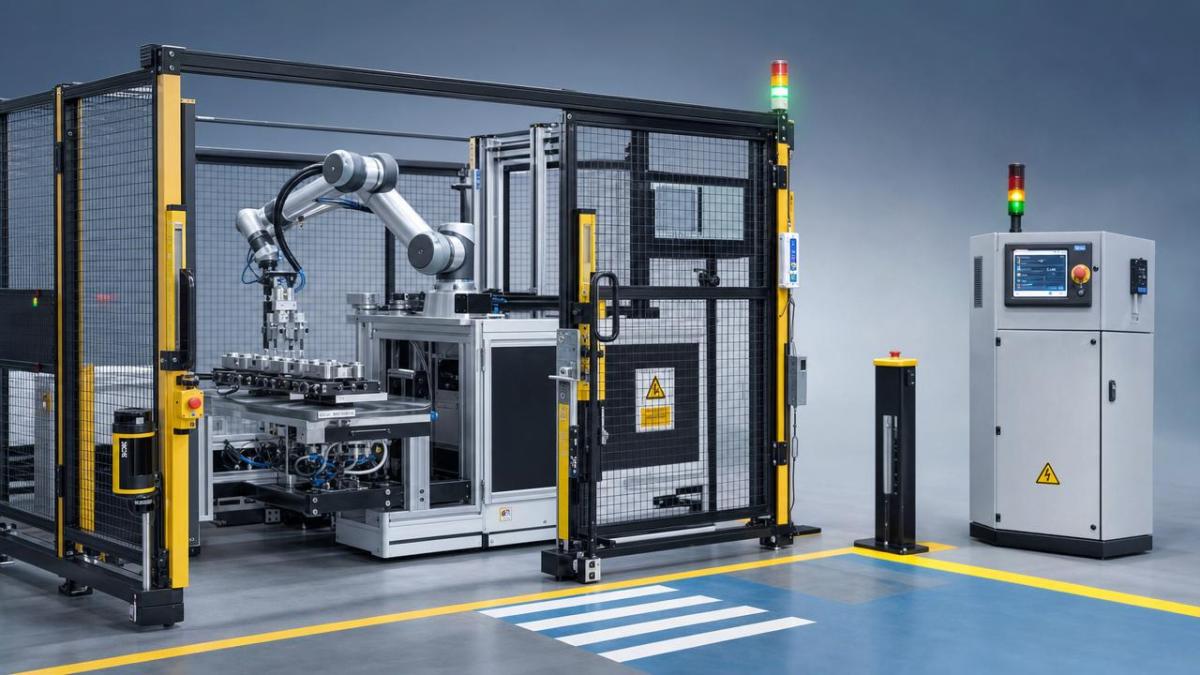
One common misconception is that cobots eliminate guarding. In reality, many applications still require partial fencing, perimeter scanners, interlocked access doors, or restricted approach paths. Even when full cages are avoided, floor markings, partitions, and physical separation may be necessary because of pinch points, payload inertia, tool sharpness, or part ejection risk.
2. End-of-arm tooling changes the risk profile
A robot marketed as collaborative can quickly lose that simplicity when paired with a gripper, spindle, screwdriver, vacuum tool, or heated process head. Tooling often becomes the real hazard source. Retrofits then include protective covers, reduced speeds, safe tool disconnect logic, or different fixture layouts. These are rarely reflected in first-pass vendor quotations.
3. Safety controls become more expensive than expected
Late-stage additions of safety PLCs, relays, emergency stop circuits, muting logic, scanner integration, and restart interlocks can materially change panel design and engineering hours. The hardware line item may still look manageable, but software validation and electrical redesign often drive the true overrun.
4. Validation and documentation expand quietly
Once collaborative robots safety standards are reviewed properly, teams may need fresh risk assessments, force or pressure verification, stop-time measurements, operator training records, lockout updates, and revised standard operating procedures. None of these items are glamorous, but together they consume specialist time and delay production readiness.
5. Existing line constraints force nonstandard modifications
Retrofits are most expensive when the new cobot cell must fit legacy conveyors, machines, traffic aisles, mezzanine support limitations, or pre-existing guarding philosophy. In these cases, the safety concept is shaped by what already exists, not by ideal greenfield design. That is where “minor changes” become custom engineering packages.
Why late-stage safety changes damage ROI more than the invoice suggests
From a finance perspective, retrofit cost is often misread as a one-time capex adjustment. In reality, its impact is amplified because it arrives after project assumptions are locked. If throughput expectations were built on a certain collaborative speed, but a revised safety assessment requires slower motion or more stop events, the operational value case changes along with the budget.
That means collaborative robots safety standards can affect four ROI variables at once: initial capital, launch timing, labor savings realization, and effective output. Even a modest retrofit can shift payback materially if the application runs across multiple shifts or was meant to eliminate a tight labor bottleneck. Finance approvers should therefore evaluate safety changes not only as cost additions, but as cash-flow timing and production-rate risks.
Which stakeholders feel the impact first
The spread of stricter collaborative robots safety standards does not affect every function equally. Knowing where pressure will emerge first helps approvers ask better questions before approving expansion programs.
The shift from “robot cost” to “cell safety architecture” in capital planning
One of the most important market changes is conceptual. Buyers are gradually moving away from viewing cobot investment as an arm-and-software purchase. The more accurate planning unit is the complete production cell, including all safety architecture required by the task. For finance teams, this means benchmarking vendor proposals differently.
A low entry quote can be misleading if it excludes scanner coverage, controls redesign, force testing, operator retraining, floor layout modification, or external validation support. Conversely, a higher initial quote may actually represent lower lifecycle risk if the supplier has already priced in the practical impact of collaborative robots safety standards. The discipline is to compare complete installed scope rather than marketing-friendly equipment price.
What finance approvers should ask before signing off
The best defense against retrofit overruns is earlier questioning, not later negotiation. Before approving a cobot project, finance leaders should confirm whether the safety concept has been developed to application level rather than left at robot-spec level. Useful questions include:
- Has the risk assessment considered the exact end effector, payload, part geometry, and operator interaction pattern?
- What assumptions were used regarding speed, separation distance, and human access during operation?
- Does the quote include guarding, scanners, interlocks, safety controls, and validation labor?
- What existing plant constraints may force custom safety modifications?
- Who owns compliance documentation, acceptance testing, and post-install training?
These questions are especially relevant when multiple sites are planning standardized deployment. A hidden retrofit repeated across ten cells becomes a portfolio-level budget issue, not an isolated engineering annoyance.
A practical decision framework for reducing unexpected retrofit costs
At TechStat Vanguard, the most reliable pattern is data-first scoping. Organizations that handle collaborative robots safety standards well do not treat safety as a final gate. They build a quantified review before purchase order release. That review does not need to be bureaucratic, but it must be specific enough to expose downstream modifications early.
What to watch next as collaborative deployment scales
Looking ahead, the likely direction is not a retreat from cobots, but a more mature cost structure around them. As collaborative robots safety standards continue to shape deployment practice, the market will reward suppliers and end users that can quantify full installed risk early. Expect stronger demand for application-specific benchmarking, clearer integrator scope definitions, and procurement frameworks that separate “robot price” from “validated cell price.”
For finance approvers, the signal to watch is whether proposed savings rely on vague assumptions about reduced guarding or simplified compliance. When that language appears without application-level evidence, retrofit probability is high. When proposals include clear safety architecture, validation boundaries, and commissioning ownership, budget reliability improves.
Final judgment for capital decision-makers
The core change in today’s automation market is that collaborative robots safety standards are no longer a background technical detail. They are a front-end investment variable with direct consequences for capital discipline, launch timing, and realized productivity. The organizations that adapt fastest are not necessarily those buying the cheapest cobots. They are the ones budgeting around the real cell, the real task, and the real compliance burden from day one.
If your business wants to judge how these trends affect an upcoming deployment, focus on three questions: Where could application-specific hazards force added safety hardware? Which scope items are excluded from the current quote but still required for validation? And how would slower cycle time or delayed launch alter the original ROI case? Answer those well, and collaborative robots safety standards become manageable planning inputs instead of expensive surprises.
Search News
Hot Articles
- Carbon Fiber StructuresHow to Specify Aerospace Carbon Fiber Assemblies for Lightweight, Load-Bearing PartsJul 11, 2026
- Machine VisionXiaomi, Alibaba DAMO Academy Drive Open-Source Robotics Model Ecosystem, Lowering Algorithm Development Barriers for Overseas SMEs Adopting Chinese Robotics SolutionsMar 30, 2026
- Cobots & ArmsShanxi 'AI+' Conference Showcases Embodied Intelligence with Multinational Buyer Engagement: Key Industry ImplicationsMar 30, 2026
Popular Tags
Recommended News
 Jul 11, 2026How to Specify Aerospace Carbon Fiber Assemblies for Lightweight, Load-Bearing PartsAerospace carbon fiber assemblies: learn how to specify laminate design, load data, joining methods, and inspection controls for lighter, reliable load-bearing aerospace parts.Elena Rostova (UAV Systems Researcher)
 Mar 30, 2026Xiaomi, Alibaba DAMO Academy Drive Open-Source Robotics Model Ecosystem, Lowering Algorithm Development Barriers for Overseas SMEs Adopting Chinese Robotics SolutionsXiaomi & Alibaba DAMO Academy's open-source robotics models lower algorithm barriers for global SMEs. Boost efficiency in manufacturing, logistics & smart retail with ROS 2 compatible solutions.TSV Data Lab
 Mar 30, 2026Shanxi 'AI+' Conference Showcases Embodied Intelligence with Multinational Buyer Engagement: Key Industry ImplicationsShanxi 'AI+' Conference highlights embodied intelligence with Tesla, Ubtech & Jiantao showcasing multimodal robotics. 40+ global buyers validated tech on-site, creating new B2B channels for industrial automation & AI solutions.Chen Wei (Automation Lead Engineer)
 Mar 30, 2026Zhongguancun Unveils 6G Integrated Sensing-Computing-Intelligence Platform to Empower Embodied Robots for Global Industrial ApplicationsZhongguancun's new 6G platform revolutionizes industrial robotics with <10ms latency, empowering global automotive, logistics & port automation. Discover how this tech boosts China's smart manufacturing exports.TSV Data Lab
 Mar 30, 2026Mech-Mind Tianjin Embodied Intelligence R&D and Production Base Goes Live, Cutting Delivery Time by 20%–30% for Global Customized AMR+Vision SolutionsMech-Mind's Tianjin AMR+Vision production base cuts delivery time by 20%-30% for欧美 & Latin American markets. Discover how this PLd-certified facility accelerates customized robotics solutions for smart manufacturing and logistics.Chen Wei (Automation Lead Engineer)
 Mar 30, 2026Boao Forum Reveals 'Co-evolution of Big and Small Brains' Trend in Humanoid Robots, China's Embodied Intelligence Accelerates Adaptation to Overseas Manufacturing Service ScenariosDiscover how China's humanoid robots, featuring 'Co-evolution of Big and Small Brains,' are revolutionizing global manufacturing. Learn about Embodied Tian Gong 3.0's ISO compliance and overseas deployment at Boao Forum 2026.Chen Wei (Automation Lead Engineer)
 Mar 30, 2026China Railway Industrial Secures Patent for Embodied Robotics in Material Handling, Boosting High-Precision Delivery Capabilities for Overseas Infrastructure and Manufacturing ProjectsChina Railway Industrial's new patent for embodied robotics in material handling boosts high-precision delivery for global infrastructure & manufacturing. Discover how this innovation enhances logistics accuracy in automotive, rail transit & EPC projects.Chen Wei (Automation Lead Engineer)
 Sep 29, 2026ISO 9283 Repeatability: How to Evaluate Cobot Positioning PerformanceISO 9283 cobot repeatability explained: learn how payload, reach, approach direction, and test conditions affect positioning performance and cell capability.Chen Wei (Automation Lead Engineer)
 Sep 28, 2026Spindle Runout Measurement in Germany: DIN Standards, Methods, and Acceptance LimitsSpindle runout measurement Germany: explore DIN standards, proven methods, acceptance limits, and audit-ready practices for reliable machining quality.Dr. Marcus Vance
 Sep 27, 2026How to Select Wall-Mount Edge Devices for Space-Constrained Factory NetworksWall mount edge devices for space-constrained factories: evaluate workload, thermal design, power resilience, cable access, and network reliability for smarter deployments.TSV Data Lab
 Sep 26, 2026Machining Tolerance Analysis: How to Set Limits That Meet Function and Cost TargetsMachining tolerance analysis: learn how to set functional limits, control tolerance stacks, reduce inspection risk, and balance precision with production cost.Dr. Marcus Vance
 Sep 25, 2026How to Evaluate an Industrial Infrastructure Data Platform for Multi-Site OperationsIndustrial infrastructure data platform evaluation guide for multi-site operations: compare data quality, edge resilience, interoperability, governance, and scalable proof-of-value criteria.Victor Lin (Chief Software Architect)
 Sep 24, 2026How to Select Machine Vision Optics for Accurate Inspection at Different Working DistancesMachine vision optics selection guide for accurate inspection at every working distance. Compare FOV, pixel scale, DOF, distortion, lighting, and telecentric options.TSV Data Lab
 Sep 23, 2026How to Evaluate a Machine Vision System Integrator for High-Speed Inspection LinesChoose a machine vision system integrator with proven expertise in high-speed inspection, reliable reject timing, robust optics, and measurable acceptance criteria.TSV Data Lab
 Sep 28, 2026When is a SCADA API the right choice for connecting plant systems?SCADA API guide: learn when governed plant data integration improves traceability, security, and scalability—without compromising real-time control.Victor Lin (Chief Software Architect)
 Sep 27, 2026How SCADA data integration improves traceability across production linesSCADA data integration connects production-line data to improve traceability, accelerate quality investigations, and strengthen safety decisions.Victor Lin (Chief Software Architect)
 Sep 26, 2026What to define before starting SCADA integration planningSCADA integration planning starts with clear scope, control boundaries, data models, cybersecurity, and testing. Discover the definitions that reduce risk and costly rework.Victor Lin (Chief Software Architect)
 Sep 25, 2026How a smart factory with Industrial IoT reduces production blind spotsDiscover how a smart factory with Industrial IoT turns real-time machine, quality, and workflow data into actionable insights that reduce production blind spots and delivery risks.Victor Lin (Chief Software Architect)
 Sep 24, 2026When does Industrial IoT make smart manufacturing easier to scale?Smart manufacturing Industrial IoT scales when trusted data, interoperable systems, and secure workflows turn connected assets into measurable gains.TSV Data Lab
 Sep 23, 2026What drives ultra-precision machining cost at 1-micron tolerance?Ultra precision machining cost per part at 1 micron tolerance depends on process, material, metrology, and yield. Learn how to compare quotes confidently.Dr. Marcus Vance
 Sep 22, 2026Drone Engine-T550CC Applications: Build the UAV Power System Around the MissionAn application guide for Drone Engine-T550CC integration, covering payload planning, airframe matching, cooling, fuel, vibration, test procedures, documentation, and service preparation.Elena Rostova (UAV Systems Researcher)
 Sep 22, 2026How to Evaluate Industrial Edge Computing Vendors for Factory DeploymentIndustrial edge computing vendor evaluation guide for factories: compare latency, protocol fit, reliability, security, and lifecycle support before deployment.TSV Data Lab
 Sep 21, 2026Drone Payload Integration: Matching Power, Data, and Center of Gravity for Reliable FlightsDrone payload integration made practical: balance power, data, center of gravity, and endurance to build safer, more reliable mission-ready flights.Elena Rostova (UAV Systems Researcher)
 Sep 20, 2026Autonomous Navigation Pricing: Cost Drivers and Budget Benchmarks for AMR ProjectsAutonomous navigation price explained: compare AMR cost drivers, software, sensors, integration, safety, and lifecycle budgets to build a scalable project plan.Chen Wei (Automation Lead Engineer)