Collaborative Robot Safety Standards That Impact Cell Layout
Publication Date
author
For project leaders designing or upgrading automation cells, collaborative robots safety standards are not a compliance footnote—they directly shape layout, reach zones, guarding strategy, and risk reduction priorities. This article cuts through generic guidance to show how key standards influence real-world cell architecture, helping engineering and procurement teams make safer, data-driven decisions from concept planning to deployment.
Why cell layout decisions change from one application scenario to another
In practice, collaborative robots safety standards do not produce one universal cell design. A bench-top screwdriving station, a machine-tending cell with part carts, and a palletizing area with mixed pedestrian traffic each create different exposure points, stopping distances, and contact risks. For project managers, the layout question is therefore not simply, “Is this cobot compliant?” It is, “Under this task, with this tool, this payload, this speed, and this operator behavior, what safeguards are required and how will they alter the footprint?”
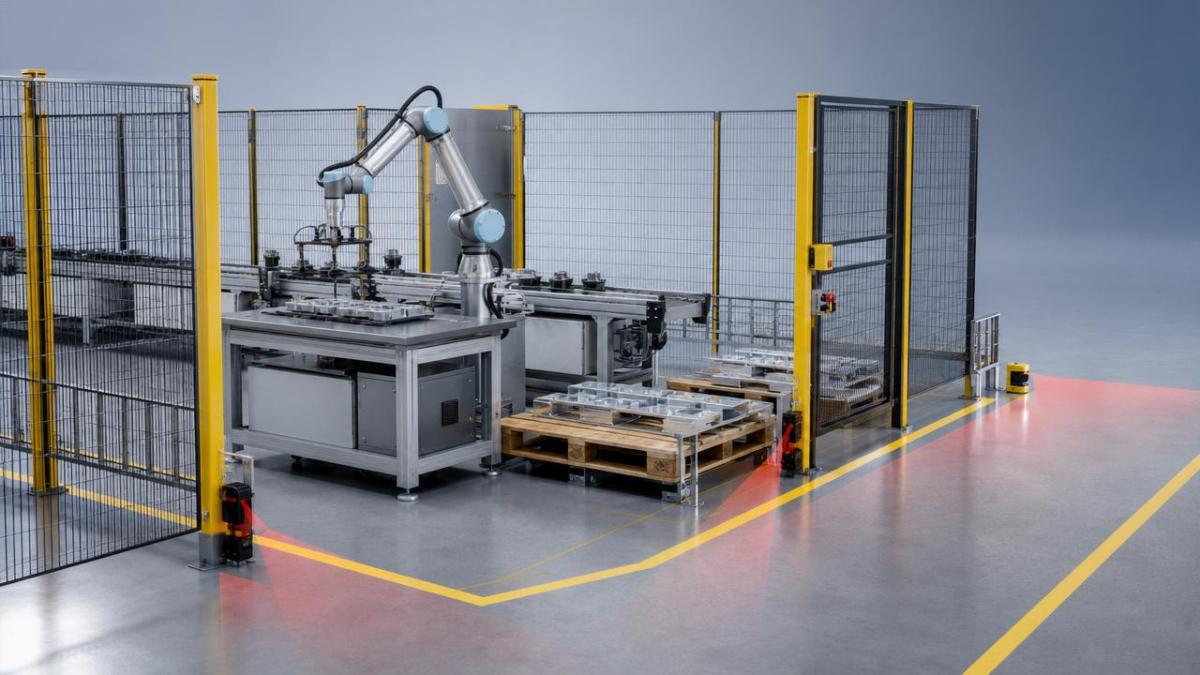
The most influential frameworks usually include ISO 10218, ISO/TS 15066, ISO 13849, IEC 62061, and related machine safety requirements depending on end effector type, peripheral equipment, and regional compliance pathways. These standards affect separation distance, emergency stop design, safety-rated monitored stop logic, power and force limiting validation, pinch-point elimination, and the use of scanners, light curtains, fencing, or interlocked access. As a result, collaborative robots safety standards are deeply tied to capital planning, floor utilization, throughput expectations, and operator acceptance.
For TSV-style engineering evaluation, the right approach is scenario-based: match the task to the applicable hazard profile, then let the standards drive layout decisions instead of forcing the standards to justify a preferred footprint.
The standards that most often reshape layout planning
Before splitting by use case, it helps to understand how major collaborative robots safety standards influence physical design choices. ISO 10218 defines broad robot and integration safety expectations. ISO/TS 15066 adds practical guidance for collaborative operation, including biomechanical considerations for contact limits in power-and-force-limited applications. ISO 13849 and IEC 62061 support the functional safety side: how reliable the safety-related control system must be for stopping, speed limitation, enabling devices, and fault response.
For layout, these standards drive five recurring questions: Can people enter the robot envelope during automatic motion? Is contact expected, incidental, or prohibited? Does the tool create a secondary hazard such as sharp edges, heat, suction, or stored energy? What is the safe access path for loading, clearing jams, and maintenance? And can the safety function achieve the target performance level or SIL under foreseeable fault conditions?
Those questions matter because many cobot projects fail not on robot selection but on late-stage discovery that the gripper, table edge, infeed conveyor, or machine door invalidates the original “open collaborative cell” concept. Collaborative robots safety standards often reveal that the robot itself is only one part of the risk picture.
Scenario comparison: how the same standards lead to different cell architectures
The table below shows why project leaders should avoid copying one cobot cell layout into another application without a fresh risk assessment.
This comparison illustrates a key planning rule: collaborative robots safety standards do not guarantee a fence-free cell. They determine whether open interaction is technically justifiable after considering the full system, not just the robot arm.
Scenario 1: Bench assembly cells where human proximity is constant
Assembly cells are the most common setting where teams expect collaborative operation to work with minimal guarding. That can be true, but only when layout details respect collaborative robots safety standards from the start. In these cells, operators repeatedly cross into part presentation zones, pick bins, and fixture spaces. The safety challenge is less about high energy and more about frequent contact opportunities and pinch points between the robot, fixture, and table edge.
A good layout response includes limiting the robot’s reachable envelope to the task area, keeping fixture heights stable, rounding hard edges, and separating human hand paths from robot acceleration paths. If the process uses power and force limiting, validation should include realistic contact points, not just nominal robot settings. Project leaders should also check whether cycle-time pressure will later push the team to raise speeds beyond the original assessment. If that is likely, reserve space now for scanners or future barriers.
This scenario often suits collaborative deployment, but only if the workstation is designed around predictable operator behavior. Random part placement, cluttered rework trays, and moving carts can quickly erode the assumptions behind the risk assessment.
Scenario 2: Machine tending cells where the machine creates the real hazard
Many procurement teams choose cobots for CNC loading, press tending, or test equipment handling because they want compact automation. However, collaborative robots safety standards often reveal that the robot is not the primary safety driver in these cells. Spindle rotation, chuck jaws, sliding doors, ejected chips, sharp parts, and pneumatic clamps may require controls that change the cell more than the robot does.
In this scenario, project managers should expect hybrid layouts. The robot side may remain relatively open for replenishment, while the machine interface area becomes interlocked or partially enclosed. Safe state coordination between the robot and the machine is critical. If an operator opens a service door, which motion stops, how fast, and under what diagnostic coverage? Functional safety design here often decides whether the cell remains efficient or becomes operationally frustrating.
The practical advice is simple: never approve a machine-tending cobot cell from robot datasheets alone. Review the machine interface, part geometry, jam-clearing routine, and maintenance access path before finalizing footprint or claiming collaborative operation.
Scenario 3: Palletizing and material handling where payload and reach dominate
Palletizing is one of the most misunderstood applications in collaborative robotics. Teams see the cobot label and assume open access is achievable. But collaborative robots safety standards become more restrictive as payload, end-of-arm tooling mass, and reach increase. Even if the arm is collaborative by design, the moving load may create unacceptable impact or crushing risk, especially near pallets, conveyors, and walkways.
For end-of-line cells, layout decisions should prioritize pedestrian separation, forklift interaction, and replenishment timing. Often the best solution is not a fully open collaborative cell but a segmented area with scanners or controlled entry. That may sound less attractive in marketing terms, yet it is usually better for uptime and clearer for operators. Standards-driven layout planning can also prevent future bottlenecks by defining where empty pallets enter, where completed loads exit, and where manual intervention is allowed.
If the business case depends on high throughput, project leaders should be especially cautious. Higher speed and larger loads tend to push the design away from close human-robot coexistence and toward structured separation.
Scenario 4: Inspection, dispensing, and specialty processes where the tool changes the answer
Some of the most expensive layout errors happen in cells where the robot itself is relatively safe but the process tool is not. Vision inspection with bright light, adhesive dispensing with chemicals, ultrasonic operations, heated tools, knives, needles, or vacuum systems can all introduce hazards not solved by using a collaborative arm. Collaborative robots safety standards therefore must be interpreted at system level.
In these applications, project managers should map every operator touchpoint: tool change, purge, nozzle cleaning, calibration, sample collection, and fault recovery. The answer may be a localized enclosure, transparent process shield, keyed maintenance mode, or separate manual station. This is where a lot of “cobot should be open” assumptions collapse. The standard does not care about marketing category; it cares about foreseeable harm.
How different business contexts change the right layout choice
The same application can require different safety architecture depending on business conditions. A high-mix, low-volume plant may accept slower robot speed in exchange for easier operator interaction. A high-volume site may prefer more separation because throughput consistency matters more than open access. A greenfield facility may reserve wider maintenance corridors and future safety scanner locations, while a retrofit project may need compact access management around existing columns, conveyors, and utility drops.
For engineering leaders, this means collaborative robots safety standards should be reviewed alongside staffing model, shift pattern, training maturity, and changeover frequency. Layout is not only a safety output; it is an operating model decision. Cells with frequent product changeovers need especially disciplined reset logic, safe teaching procedures, and clear handoff zones between manual and automatic work.
Common misjudgments that create rework late in the project
- Assuming a collaborative robot means no guarding is needed anywhere in the cell.
- Ignoring end effector hazards, part sharpness, or carried load inertia during concept review.
- Designing for normal production only, without considering jam recovery, maintenance, and cleaning tasks.
- Underestimating functional safety integration with machine tools, conveyors, doors, and scanners.
- Setting an aggressive cycle-time target that later forces unsafe speed increases or expensive redesign.
These misjudgments are costly because they are usually discovered after mechanical design, purchasing, or FAT planning has already advanced. A standards-led layout review early in the project is far cheaper than retrofitting barriers, relocating utilities, or reprogramming safe motion zones after installation.
A practical decision checklist for project managers
When evaluating cell concepts, use collaborative robots safety standards as a decision framework rather than a final audit item. Confirm the intended collaboration mode, expected human access frequency, payload and tooling characteristics, stopping performance, adjacent equipment hazards, and recovery tasks. Ask suppliers to show how the risk assessment changes if speed increases, if a different gripper is added, or if the operator approaches from another direction. Those scenario checks reveal whether the layout is robust or fragile.
For procurement and project governance, require evidence: safe distance calculations, control architecture documentation, performance level validation, and operator path assumptions. That aligns with TSV’s data-first philosophy: parameters, not slogans, should determine whether an open, semi-guarded, or segmented layout is justified.
FAQ: what teams usually ask before locking the layout
Does a cobot always allow people and robots to work side by side without fences?
No. Collaborative robots safety standards evaluate the complete application, including tool, part, speed, reach, and surrounding equipment. Many cells still need partial guarding or controlled access.
Which scenario is most likely to remain truly open?
Usually low-payload bench assembly with predictable operator behavior and limited secondary hazards. Even then, validation of force, pinch points, and reach boundaries is necessary.
What causes the biggest gap between concept and final layout?
Underestimating system-level hazards. Machine doors, loaded parts, and end effectors often drive redesign more than the robot arm itself.
Final takeaway for safer, more efficient deployment
The real value of collaborative robots safety standards is not that they help teams pass a compliance review. Their bigger value is that they help project leaders choose the right cell architecture for the actual production scenario. In bench assembly, the standards may support open collaboration with disciplined reach control. In machine tending, they often favor hybrid guarding. In palletizing, they frequently justify structured separation. In specialty processes, the tool may dictate the layout more than the robot category.
If you are planning a new automation cell, start with the scenario, not the sales label. Map human interaction, carried energy, tool hazards, and recovery tasks early. Then use collaborative robots safety standards to test whether the proposed layout is truly suitable for your operating reality, your throughput target, and your long-term expansion plan.
Search News
Hot Articles
- Carbon Fiber StructuresHow to Specify Aerospace Carbon Fiber Assemblies for Lightweight, Load-Bearing PartsJul 11, 2026
- Machine VisionXiaomi, Alibaba DAMO Academy Drive Open-Source Robotics Model Ecosystem, Lowering Algorithm Development Barriers for Overseas SMEs Adopting Chinese Robotics SolutionsMar 30, 2026
- Cobots & ArmsShanxi 'AI+' Conference Showcases Embodied Intelligence with Multinational Buyer Engagement: Key Industry ImplicationsMar 30, 2026
Popular Tags
Recommended News
 Jul 11, 2026How to Specify Aerospace Carbon Fiber Assemblies for Lightweight, Load-Bearing PartsAerospace carbon fiber assemblies: learn how to specify laminate design, load data, joining methods, and inspection controls for lighter, reliable load-bearing aerospace parts.Elena Rostova (UAV Systems Researcher)
 Mar 30, 2026Xiaomi, Alibaba DAMO Academy Drive Open-Source Robotics Model Ecosystem, Lowering Algorithm Development Barriers for Overseas SMEs Adopting Chinese Robotics SolutionsXiaomi & Alibaba DAMO Academy's open-source robotics models lower algorithm barriers for global SMEs. Boost efficiency in manufacturing, logistics & smart retail with ROS 2 compatible solutions.TSV Data Lab
 Mar 30, 2026Shanxi 'AI+' Conference Showcases Embodied Intelligence with Multinational Buyer Engagement: Key Industry ImplicationsShanxi 'AI+' Conference highlights embodied intelligence with Tesla, Ubtech & Jiantao showcasing multimodal robotics. 40+ global buyers validated tech on-site, creating new B2B channels for industrial automation & AI solutions.Chen Wei (Automation Lead Engineer)
 Mar 30, 2026Zhongguancun Unveils 6G Integrated Sensing-Computing-Intelligence Platform to Empower Embodied Robots for Global Industrial ApplicationsZhongguancun's new 6G platform revolutionizes industrial robotics with <10ms latency, empowering global automotive, logistics & port automation. Discover how this tech boosts China's smart manufacturing exports.TSV Data Lab
 Mar 30, 2026Mech-Mind Tianjin Embodied Intelligence R&D and Production Base Goes Live, Cutting Delivery Time by 20%–30% for Global Customized AMR+Vision SolutionsMech-Mind's Tianjin AMR+Vision production base cuts delivery time by 20%-30% for欧美 & Latin American markets. Discover how this PLd-certified facility accelerates customized robotics solutions for smart manufacturing and logistics.Chen Wei (Automation Lead Engineer)
 Mar 30, 2026Boao Forum Reveals 'Co-evolution of Big and Small Brains' Trend in Humanoid Robots, China's Embodied Intelligence Accelerates Adaptation to Overseas Manufacturing Service ScenariosDiscover how China's humanoid robots, featuring 'Co-evolution of Big and Small Brains,' are revolutionizing global manufacturing. Learn about Embodied Tian Gong 3.0's ISO compliance and overseas deployment at Boao Forum 2026.Chen Wei (Automation Lead Engineer)
 Mar 30, 2026China Railway Industrial Secures Patent for Embodied Robotics in Material Handling, Boosting High-Precision Delivery Capabilities for Overseas Infrastructure and Manufacturing ProjectsChina Railway Industrial's new patent for embodied robotics in material handling boosts high-precision delivery for global infrastructure & manufacturing. Discover how this innovation enhances logistics accuracy in automotive, rail transit & EPC projects.Chen Wei (Automation Lead Engineer)
 Sep 28, 2026Spindle Runout Measurement in Germany: DIN Standards, Methods, and Acceptance LimitsSpindle runout measurement Germany: explore DIN standards, proven methods, acceptance limits, and audit-ready practices for reliable machining quality.Dr. Marcus Vance
 Sep 27, 2026How to Select Wall-Mount Edge Devices for Space-Constrained Factory NetworksWall mount edge devices for space-constrained factories: evaluate workload, thermal design, power resilience, cable access, and network reliability for smarter deployments.TSV Data Lab
 Sep 26, 2026Machining Tolerance Analysis: How to Set Limits That Meet Function and Cost TargetsMachining tolerance analysis: learn how to set functional limits, control tolerance stacks, reduce inspection risk, and balance precision with production cost.Dr. Marcus Vance
 Sep 25, 2026How to Evaluate an Industrial Infrastructure Data Platform for Multi-Site OperationsIndustrial infrastructure data platform evaluation guide for multi-site operations: compare data quality, edge resilience, interoperability, governance, and scalable proof-of-value criteria.Victor Lin (Chief Software Architect)
 Sep 24, 2026How to Select Machine Vision Optics for Accurate Inspection at Different Working DistancesMachine vision optics selection guide for accurate inspection at every working distance. Compare FOV, pixel scale, DOF, distortion, lighting, and telecentric options.TSV Data Lab
 Sep 23, 2026How to Evaluate a Machine Vision System Integrator for High-Speed Inspection LinesChoose a machine vision system integrator with proven expertise in high-speed inspection, reliable reject timing, robust optics, and measurable acceptance criteria.TSV Data Lab
 Sep 28, 2026When is a SCADA API the right choice for connecting plant systems?SCADA API guide: learn when governed plant data integration improves traceability, security, and scalability—without compromising real-time control.Victor Lin (Chief Software Architect)
 Sep 27, 2026How SCADA data integration improves traceability across production linesSCADA data integration connects production-line data to improve traceability, accelerate quality investigations, and strengthen safety decisions.Victor Lin (Chief Software Architect)
 Sep 26, 2026What to define before starting SCADA integration planningSCADA integration planning starts with clear scope, control boundaries, data models, cybersecurity, and testing. Discover the definitions that reduce risk and costly rework.Victor Lin (Chief Software Architect)
 Sep 25, 2026How a smart factory with Industrial IoT reduces production blind spotsDiscover how a smart factory with Industrial IoT turns real-time machine, quality, and workflow data into actionable insights that reduce production blind spots and delivery risks.Victor Lin (Chief Software Architect)
 Sep 24, 2026When does Industrial IoT make smart manufacturing easier to scale?Smart manufacturing Industrial IoT scales when trusted data, interoperable systems, and secure workflows turn connected assets into measurable gains.TSV Data Lab
 Sep 23, 2026What drives ultra-precision machining cost at 1-micron tolerance?Ultra precision machining cost per part at 1 micron tolerance depends on process, material, metrology, and yield. Learn how to compare quotes confidently.Dr. Marcus Vance
 Sep 22, 2026Drone Engine-T550CC Applications: Build the UAV Power System Around the MissionAn application guide for Drone Engine-T550CC integration, covering payload planning, airframe matching, cooling, fuel, vibration, test procedures, documentation, and service preparation.Elena Rostova (UAV Systems Researcher)
 Sep 22, 2026How to Evaluate Industrial Edge Computing Vendors for Factory DeploymentIndustrial edge computing vendor evaluation guide for factories: compare latency, protocol fit, reliability, security, and lifecycle support before deployment.TSV Data Lab
 Sep 21, 2026Drone Payload Integration: Matching Power, Data, and Center of Gravity for Reliable FlightsDrone payload integration made practical: balance power, data, center of gravity, and endurance to build safer, more reliable mission-ready flights.Elena Rostova (UAV Systems Researcher)
 Sep 20, 2026Autonomous Navigation Pricing: Cost Drivers and Budget Benchmarks for AMR ProjectsAutonomous navigation price explained: compare AMR cost drivers, software, sensors, integration, safety, and lifecycle budgets to build a scalable project plan.Chen Wei (Automation Lead Engineer)
 Sep 19, 2026How to Scope Automation Integration Services for Multi-System Factory ProjectsAutomation integration services: learn how to scope multi-system factory projects with clear workflows, interface contracts, safety boundaries, and acceptance criteria.Victor Lin (Chief Software Architect)