How to Evaluate Supplier Qualification Support and Response Time Before Buying?
Publication Date
author
Why qualification support and response time matter before the PO is released
Price and drawing compliance are easy to compare. What usually causes pain later is slower and harder to quantify: how a supplier behaves when qualification documents are incomplete, a first article needs clarification, a material lot traceability question appears, or engineering changes arrive three days before an internal approval gate.
That is where supplier qualification support response time becomes a real procurement variable, not an administrative detail. In industrial sourcing, especially for precision machining, automation systems, sensors, UAV subsystems, and other hard-tech categories, a supplier is not just shipping parts. They are participating in your approval process. If they cannot support documentation, technical review, and corrective action fast enough, your total cost goes up even if their quote looks attractive.
A delayed PPAP package, an unclear CoC, a vague answer on tolerance capability, or a two-day wait for a simple deviation response can stall engineering sign-off, stretch launch timing, and force buyers into expedited freight or emergency secondary sourcing. The purchase decision stops being about unit price and starts being about approval velocity and risk containment.
In practice, the best buyers evaluate support quality before buying, not after the first problem. That means looking beyond certificates on a slide deck and testing whether the supplier can respond with the level of precision your project actually needs.
Do not confuse qualification paperwork with qualification support
A supplier may hold recognized certifications and still be poor at qualification support. The distinction matters. Certification shows that a management system exists. Support shows whether that system is usable under project pressure.
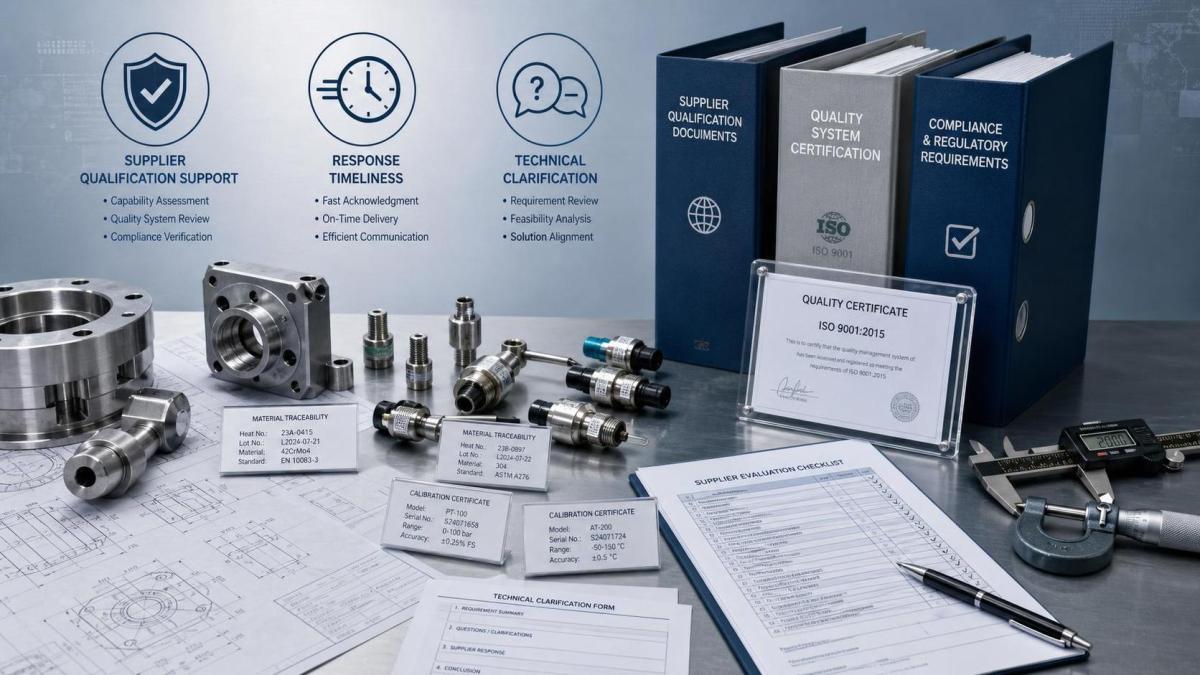
For procurement teams, qualification support usually includes several practical abilities: providing up-to-date quality manuals and process documents, answering technical questionnaires accurately, supplying material and process traceability records, coordinating first article or sample approval, handling nonconformance feedback, and maintaining a stable contact path between sales, quality, and engineering.
This is where many sourcing exercises go wrong. Buyers collect ISO certificates, capability decks, and factory photos, then assume operational readiness. But in real projects, the issue is rarely “Do they have a certificate?” It is more often “Can they explain this drawing note, this test requirement, or this revision delta by tomorrow morning?”
Teams that work with aerospace-grade tolerances, machine vision systems, edge AI hardware, or custom machined parts know this instinctively. A supplier that answers with marketing language instead of parameter-backed clarification is already showing you how the next escalation will go.
What a good response time really looks like
Response time is not just “How fast did they reply to my email?” A fast but empty response has almost no value. What matters is whether the first reply is actionable, technically relevant, and routed to the right function.
A useful way to judge it is to separate three layers:
- Administrative response: confirmation that the request was received and assigned.
- Technical response: meaningful answer from quality, process, or engineering staff.
- Closure response: final document, corrected file, root-cause explanation, or approved action.
Some suppliers are quick at layer one and weak at layers two and three. That creates the illusion of responsiveness while your approval clock keeps running. Before buying, ask for expected turnaround times by request type. A document resend should not be treated the same as a tolerance capability question or a nonconformance review.
If the supplier cannot define internal ownership and normal response windows, that is already a signal. Strong suppliers usually know who owns quality questionnaires, who signs traceability records, who joins technical calls, and how urgent requests are escalated.
A practical pre-award test: make the supplier support something real
The easiest way to evaluate supplier qualification support response time is to stop asking generic questions and create a controlled pre-award workload.
Send a real qualification package, even if limited: drawing excerpt, revision history, required documents, traceability expectations, and one or two clarification points that matter to your project. Then watch what happens. Do they ask sensible follow-up questions? Do they identify missing assumptions? Do they answer through one salesperson only, or can they bring in a quality engineer when needed?
This test does more than an audit checklist. It reveals whether the supplier can function inside your process. For example, in precision machining, a serious supplier should be able to discuss tolerance stack-up implications, inspection method limits, and whether a requirement needs CMM validation or additional fixture control. In sensors or automation hardware, you may need clarity on interface versions, test conditions, EMC-related limitations, or firmware handling during qualification. The point is not to trap them. The point is to see whether they deal in specifics.
At TechStat Vanguard, this is exactly the kind of filtering logic that matters. Engineering truth usually appears in the details suppliers can explain under scrutiny, not in broad claims about being “high quality.” Parameters do not lie, and neither does response behavior under a realistic qualification request.
What to review besides certificates
Formal credentials still matter, but they should be the starting point, not the conclusion. Depending on the category, buyers typically need to verify whether the supplier can provide current versions of certificates, scope statements, calibration control evidence, material traceability, process validation records, and sample inspection outputs. For regulated or high-reliability sectors, the exact standard and scope need to match the purchased process, not just the company name.
Also check whether documents are native, current, and internally consistent. A surprisingly common problem is not fraud but operational disorder: obsolete forms, conflicting revision dates, unsigned reports, inconsistent lot references, or quality documents that do not match the quoted manufacturing route. Those issues are often early warnings of future support delays.
Look at cross-functional access, not just the account manager
One of the biggest hidden risks in supplier qualification is communication bottleneck. If every question must pass through a commercial contact who then relays it internally, response time becomes unstable and technical accuracy often degrades.
Before awarding business, find out whether you can access the right people when needed. That does not mean bypassing the sales team on every routine request. It means confirming that quality, manufacturing, and application engineering can join when the issue demands it. In complex categories, this is essential. A radar sensor integration question, a servo reliability concern, or a machining tolerance dispute should not be filtered into generic language because the supplier’s interface model is too shallow.
Good suppliers usually have a visible internal chain: commercial owner, quality owner, technical owner, and escalation path. Weak suppliers often hide behind one responsive person until the first serious problem appears.
How response time affects cost more than most RFQs admit
This is where procurement and engineering tend to align quickly once a project slips. Slow qualification support creates cost in places the original quote never shows. Internal review meetings multiply. Engineers spend time chasing clarifications. Launch approvals are pushed. Logistics teams plan buffers. In some cases, buyers keep a backup supplier warm, which increases sourcing overhead even if no transfer happens.
For lower-risk commodity buys, these delays may be manageable. For custom assemblies, regulated sectors, or tight launch schedules, they are expensive. A supplier that is 3% cheaper but consistently slow to close documentation gaps can end up costing more than a supplier with a firmer price and cleaner support behavior.
That is why experienced teams increasingly score supplier qualification support response time as part of total procurement risk, not as a side note in vendor onboarding.
Questions worth asking before you commit
A short list of pointed questions can reveal a lot:
- Who owns qualification documents, and who approves technical clarifications?
- What is the normal turnaround for document requests, deviation requests, and root-cause feedback?
- Can you provide a sample qualification package with revision control visible?
- How do you handle urgent engineering changes after quotation but before mass production?
- What information do you need from us to avoid incomplete qualification loops?
The answers do not need to be perfect. They need to be concrete. Vague confidence is less useful than a precise explanation of process limits and expected lead times.
A better way to decide
When buyers evaluate suppliers, the temptation is to rank quote, lead time, and certificate status, then move on. In hard-tech supply chains, that is often too thin. A supplier should also be judged on whether they can sustain technical trust: accurate documents, usable engineering answers, and predictable response under pressure.
This is also why data-driven benchmarking matters. In markets crowded with polished claims, procurement teams need evidence that is closer to engineering reality than to marketing language. The stronger your sourcing process is at testing support capability early, the fewer surprises you carry into qualification, launch, and supplier management later.
Before you release the order, give the supplier a chance to prove how they respond when something real is at stake. Their behavior in that moment usually tells you more than the brochure ever will.
Search News
Hot Articles
- Carbon Fiber StructuresHow to Specify Aerospace Carbon Fiber Assemblies for Lightweight, Load-Bearing PartsJul 11, 2026
- Machine VisionXiaomi, Alibaba DAMO Academy Drive Open-Source Robotics Model Ecosystem, Lowering Algorithm Development Barriers for Overseas SMEs Adopting Chinese Robotics SolutionsMar 30, 2026
- Cobots & ArmsShanxi 'AI+' Conference Showcases Embodied Intelligence with Multinational Buyer Engagement: Key Industry ImplicationsMar 30, 2026
Popular Tags
Recommended News
 Jul 11, 2026How to Specify Aerospace Carbon Fiber Assemblies for Lightweight, Load-Bearing PartsAerospace carbon fiber assemblies: learn how to specify laminate design, load data, joining methods, and inspection controls for lighter, reliable load-bearing aerospace parts.Elena Rostova (UAV Systems Researcher)
 Mar 30, 2026Xiaomi, Alibaba DAMO Academy Drive Open-Source Robotics Model Ecosystem, Lowering Algorithm Development Barriers for Overseas SMEs Adopting Chinese Robotics SolutionsXiaomi & Alibaba DAMO Academy's open-source robotics models lower algorithm barriers for global SMEs. Boost efficiency in manufacturing, logistics & smart retail with ROS 2 compatible solutions.TSV Data Lab
 Mar 30, 2026Shanxi 'AI+' Conference Showcases Embodied Intelligence with Multinational Buyer Engagement: Key Industry ImplicationsShanxi 'AI+' Conference highlights embodied intelligence with Tesla, Ubtech & Jiantao showcasing multimodal robotics. 40+ global buyers validated tech on-site, creating new B2B channels for industrial automation & AI solutions.Chen Wei (Automation Lead Engineer)
 Mar 30, 2026Zhongguancun Unveils 6G Integrated Sensing-Computing-Intelligence Platform to Empower Embodied Robots for Global Industrial ApplicationsZhongguancun's new 6G platform revolutionizes industrial robotics with <10ms latency, empowering global automotive, logistics & port automation. Discover how this tech boosts China's smart manufacturing exports.TSV Data Lab
 Mar 30, 2026Mech-Mind Tianjin Embodied Intelligence R&D and Production Base Goes Live, Cutting Delivery Time by 20%–30% for Global Customized AMR+Vision SolutionsMech-Mind's Tianjin AMR+Vision production base cuts delivery time by 20%-30% for欧美 & Latin American markets. Discover how this PLd-certified facility accelerates customized robotics solutions for smart manufacturing and logistics.Chen Wei (Automation Lead Engineer)
 Mar 30, 2026Boao Forum Reveals 'Co-evolution of Big and Small Brains' Trend in Humanoid Robots, China's Embodied Intelligence Accelerates Adaptation to Overseas Manufacturing Service ScenariosDiscover how China's humanoid robots, featuring 'Co-evolution of Big and Small Brains,' are revolutionizing global manufacturing. Learn about Embodied Tian Gong 3.0's ISO compliance and overseas deployment at Boao Forum 2026.Chen Wei (Automation Lead Engineer)
 Mar 30, 2026China Railway Industrial Secures Patent for Embodied Robotics in Material Handling, Boosting High-Precision Delivery Capabilities for Overseas Infrastructure and Manufacturing ProjectsChina Railway Industrial's new patent for embodied robotics in material handling boosts high-precision delivery for global infrastructure & manufacturing. Discover how this innovation enhances logistics accuracy in automotive, rail transit & EPC projects.Chen Wei (Automation Lead Engineer)
 Oct 07, 2026How to Evaluate an HMI Panel Distributor for Industrial Automation ProjectsHMI panel distributor evaluation guide: verify technical compatibility, traceability, supply reliability, lifecycle support, and total cost for automation projects.Victor Lin (Chief Software Architect)
 Oct 06, 2026Navigation Fault Tolerance Standards for AMRs: What Safety Teams Must VerifyNavigation fault tolerance standards: learn what AMR safety teams must verify, from localization loss and sensor faults to stopping distance, safe restart, and site-specific validation.Chen Wei (Automation Lead Engineer)
 Oct 05, 2026Calculating Edge Computing Total Cost of Ownership Across Distributed SitesEdge computing ownership cost explained: calculate deployment, energy, connectivity, security, remote support, and refresh costs across distributed sites.TSV Data Lab
 Oct 04, 2026CAD/CAM Benchmarking in the GCC: What Manufacturers Should Ask a ConsultantCAD CAM benchmark consultant GCC guide: learn the key questions manufacturers should ask to validate post-processors, workflows, machine performance, and production risk.Victor Lin (Chief Software Architect)
 Oct 03, 2026Selecting Automotive Radar Sensor Modules for ADAS Range, Resolution, and IntegrationAutomotive radar sensor module selection guide for ADAS: compare range, resolution, field of view, latency, and integration to build safer, reliable vehicle systems.TSV Data Lab
 Oct 02, 2026How to Qualify Machined Parts Suppliers for Hard Tech ProgramsHard tech supply chain machined parts demand rigorous supplier qualification. Learn how to assess capability, traceability, quality controls, and delivery resilience.Dr. Marcus Vance
 Oct 01, 2026How to Select an Outdoor Security Radar Sensor for Perimeter Detection?Outdoor security radar sensor selection guide: compare range, accuracy, false-alarm control, integration, and field testing for reliable perimeter detection.TSV Data Lab
 Sep 30, 2026How to Evaluate Solid-State LiDAR Hardware for Outdoor Autonomous VehiclesSolid state LiDAR hardware evaluation guide for outdoor autonomous vehicles—compare range, point-cloud quality, environmental resilience, integration, and safety.TSV Data Lab
 Sep 29, 2026ISO 9283 Repeatability: How to Evaluate Cobot Positioning PerformanceISO 9283 cobot repeatability explained: learn how payload, reach, approach direction, and test conditions affect positioning performance and cell capability.Chen Wei (Automation Lead Engineer)
 Oct 06, 2026Are Collaborative Robots Safe Enough to Operate Without Fencing?Are collaborative robots safe enough to work without fencing? Explore risk assessment, safeguarding options, and practical guidance for safer, productive cobot cells.Chen Wei (Automation Lead Engineer)
 Oct 05, 2026What Causes Machine Vision Systems to Miss Small Defects?What causes machine vision systems to miss small defects? Discover how lighting, optics, motion, and AI thresholds affect detection—and prevent costly escapes.TSV Data Lab
 Oct 04, 2026How Should You Compare 5-Axis CNC Machine Accuracy Claims?How do I compare 5-axis CNC machine accuracy claims? Learn how to assess standards, thermal stability, TCP accuracy, and real-world test evidence.Dr. Marcus Vance
 Oct 03, 2026Is Edge Computing Necessary for Real-Time Quality Inspection?Is industrial edge computing necessary for real-time quality inspection? Explore how latency, data volume, reliability, and control integration shape the right architecture.TSV Data Lab
 Oct 02, 2026What Documents Prove a Precision Machining Supplier Can Hold Tolerance?What documents prove a precision machining supplier can hold tolerance? Explore certificates, FAI reports, calibration, SPC, and traceability evidence to qualify suppliers with confidence.Dr. Marcus Vance
 Oct 01, 2026Can a Machining Supplier Meet Aerospace Fatigue Testing Requirements?Can a machining supplier meet aerospace fatigue testing requirements? Learn the traceability, process control, and test evidence needed for reliable aerospace parts.Dr. Marcus Vance
 Sep 30, 2026Which Industrial Robot Specifications Matter for High-Precision Assembly?Which industrial robot specifications matter most for high-precision assembly? Explore repeatability, accuracy, stiffness, vibration, calibration, and force control for reliable yields.Chen Wei (Automation Lead Engineer)
 Sep 29, 2026How Do You Verify Servo Motor Torque Under Continuous Load?How do I verify servo motor torque under continuous load? Learn RMS torque checks, torque-speed limits, thermal derating, and real-machine testing.Chen Wei (Automation Lead Engineer)