Choosing a Trampoline Park Manufacturer: Safety, Installation and Support
Publication Date
author
Choosing a trampoline park manufacturer requires more than comparing prices and layouts. Procurement teams need evidence that equipment meets applicable safety requirements, installation plans suit the site, and support continues after handover. A low initial quote can become expensive if it excludes engineering, freight, commissioning, replacement parts, or work needed to make the building suitable.
This guide sets out the documents, technical questions, and commercial commitments to examine before selecting a supplier. Its purpose is not to prescribe a universal park design, but to help buyers compare proposals on the same scope and identify risks while they can still be negotiated.
Start with the site and operating model, not the catalog
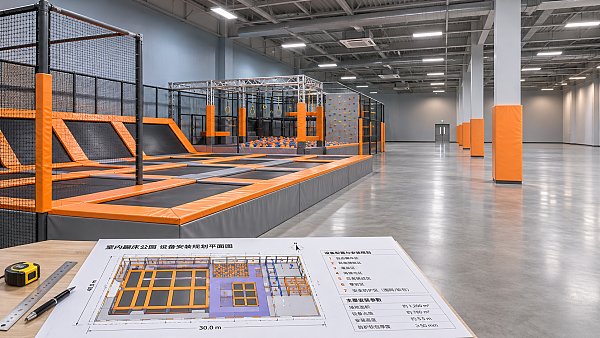
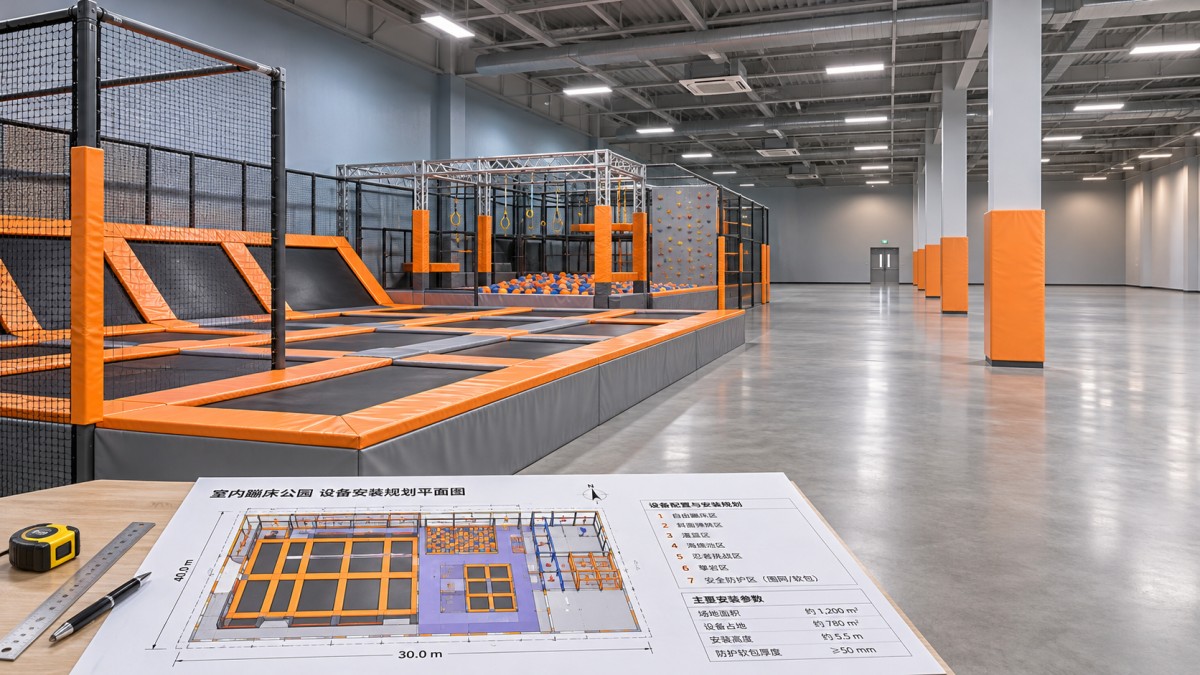
A manufacturer cannot give a dependable proposal without knowing how the park will be used and what the building can accommodate. Before requesting firm prices, assemble a site brief with verified dimensions, available utilities, access constraints, and the intended attraction mix. Have qualified local professionals confirm structural and regulatory assumptions rather than relying solely on a supplier’s preliminary drawing.
- Define the users: State the intended age groups, whether different groups will be separated, and any planned activities such as classes, parties, or competitive training.
- Map the building: Supply current floor plans, ceiling and obstruction heights, columns, exits, sprinkler locations, and any restrictions on drilling or anchoring.
- Set operational expectations: Describe opening hours, expected usage patterns, staffing arrangements, cleaning requirements, and the desired approach to inspections.
- Identify the approval path: Establish which authorities, building professionals, and insurers must review the project, and who will coordinate their requirements.
Ask suppliers to distinguish confirmed dimensions from assumptions. If the venue is still under negotiation, make the quotation conditional on a documented site survey. A layout that fits on a drawing may conflict with a beam, an exit route, or a service access zone in the actual building.
Verify safety claims against the equipment being purchased
“Compliant” is not a complete specification. Standards and legal requirements differ by location and attraction type, and a certificate for one component does not automatically cover an entire park. Ask a prospective trampoline park manufacturer to identify the applicable standards, editions, equipment covered, and limits of each claim.
For example, ASTM F2970 addresses the design, manufacture, installation, operation, maintenance, inspection, and major modification of trampoline courts. In Europe, EN 1176-10 addresses additional specific safety requirements and test methods for fully enclosed play equipment; its applicability depends on the actual equipment and use. Neither reference should be assumed to cover every attraction in a mixed-use venue. Confirm the relevant current editions and local requirements with the authority having jurisdiction and competent advisers.
Sources: ASTM International, ASTM F2970 standard information (https://www.astm.org/f2970); European Committee for Standardization, EN 1176-10 standard information (https://standards.cencenelec.eu/).
Request an evidence package, not a badge
- Ask for a standards matrix: List every attraction and its applicable requirements, identifying the responsible designer, manufacturer, installer, and operator.
- Review design documents: Request drawings showing equipment boundaries, access points, protective padding, enclosure details, clearances, and interfaces with the building.
- Examine supporting evidence: Request relevant test reports, calculations, material specifications, and inspection records. Check the tested configuration, report date, laboratory identity, and any stated limitations.
- Trace changes: Require written assessment and approval when dimensions, components, or attraction layouts change after the initial review.
- Confirm operating obligations: Obtain draft inspection, maintenance, supervision, and incident-response instructions before committing to a design.
A third-party report is useful only when it relates to what will be installed. If a supplier substitutes a different bed, spring, frame section, or enclosure material, ask whether the existing evidence remains applicable. Do not treat a general company certification or a photograph of another park as proof that your configuration satisfies local requirements.
Compare proposals using a normalized scope
Ask each bidder to price the same attraction list and deliverables. If one supplier proposes a different configuration, request a separate alternative rather than letting the change disappear into the base price. The following comparison helps reveal the items most likely to create later change orders.
For international purchases, specify the agreed Incoterms rule and named place in the contract; do not use “shipping included” as a substitute. Incoterms allocate certain delivery, cost, and risk responsibilities, but they do not replace detailed terms on ownership, payment, installation, or warranty. Source: International Chamber of Commerce, Incoterms rules (https://iccwbo.org/business-solutions/incoterms-rules/).
Evaluate total cost over a defined planning period using each bidder’s stated assumptions. Include foreseeable wear parts, inspections, service visits, freight, and downtime exposure where you can estimate them. Keep uncertain figures visible as allowances rather than presenting them as firm prices.
Installation is an engineered interface, not just assembly
A manufacturer may supply the equipment while a local contractor prepares the building and a separate crew installs it. That division can work, but only if the interfaces are documented. Ambiguity over floor condition, anchor locations, or equipment access can delay opening even when the goods arrive on time.
Before equipment ships
- Approve the site-readiness checklist: Include floor condition, verified dimensions, clear access, lighting, power, storage, and working-area requirements.
- Agree on lifting and unloading: Identify the party supplying equipment, labor, permits, and safe unloading space.
- Resolve building interfaces: Have the relevant local professionals review anchoring, structural loads, fire protection, exits, and any required alterations.
- Freeze the installation drawings: Record the approved revision and the process for handling discrepancies discovered on site.
At installation and handover
Require an installation schedule with named responsibilities, inspection points, and a process for recording defects. Ask who supervises the crew, whether subcontractors are used, and who has authority to approve deviations from the drawings. If the manufacturer provides remote supervision, establish what local expertise is required and how unresolved issues will be handled.
Acceptance should be tied to evidence, not merely completion of assembly. The handover package should include as-built drawings, component identification, inspection records, operating limits, maintenance instructions, warranty documents, and training records. Where local rules require independent inspection or approval before opening, make that a separate contractual milestone and identify who arranges it.
Reserve a documented procedure for incomplete items: list the defect, responsible party, corrective action, and target date. Do not allow a punch list to obscure a safety-critical issue or imply permission to operate before required approvals are obtained.
Assess the manufacturer’s support after opening
Trampoline equipment experiences repeated use, and the operator needs a practical way to inspect, maintain, and replace components. A warranty is only one part of that plan. Ask the supplier to explain normal wear items, inspection intervals recommended for the supplied equipment, replacement procedures, and conditions that could invalidate warranty coverage.
Review these commitments before award:
- Parts traceability: Can the supplier identify the correct bed, spring, pad, fastener, or enclosure component from the handover documentation?
- Availability and lead times: Are replacement parts stocked locally, shipped internationally, or made to order? Ask for written estimates and the process for urgent requests, rather than an unsupported availability promise.
- Service coverage: Identify the contact channel, working hours, escalation route, and whether troubleshooting is remote or on site.
- Warranty boundaries: Separate manufacturing defects from consumables, misuse, improper cleaning, unauthorized repairs, and damage caused by site conditions.
- Training: Specify who is trained, the subjects covered, the language of manuals, and whether refresher training is available.
Request a recommended initial spares list with quantities and prices, then evaluate it against the park’s operating plan and storage capacity. Avoid assuming that a generic part is interchangeable: substitutions should be authorized against the equipment specification and applicable safety requirements.
Use contract milestones to control procurement risk
A purchasing agreement should connect payment and acceptance to deliverables that both parties can verify. The appropriate commercial terms depend on the transaction, but the following structure gives a legal or procurement team a basis for negotiation.
- Design approval: Release the agreed milestone after receiving drawings, the attraction schedule, and the documented scope of applicable requirements.
- Pre-shipment confirmation: Define the evidence required for completed equipment, packing lists, identification, and any agreed inspections.
- Delivery and installation: Record delivery condition, site readiness, installation responsibilities, and the treatment of delays outside either party’s control.
- Handover: Link final acceptance to the agreed documentation, training, corrective actions, and required approvals.
Also address change control, insurance, intellectual property in drawings, dispute resolution, and remedies for missed obligations. A retention or performance security may be appropriate, but its form and enforceability should be reviewed under the governing contract law. Have local counsel and technical advisers check that commercial language does not conflict with the approval process.
How to shortlist a trampoline park manufacturer
Score suppliers only after excluding proposals that cannot meet mandatory site, safety, or approval requirements. For the remaining bids, use a weighted assessment agreed internally before opening commercial offers. Include the completeness of technical evidence, suitability of the layout, installation capability, total evaluated cost, and support arrangements.
Ask for references involving comparable equipment and scope, then verify what the supplier actually provided: design, manufacturing, installation, or only selected components. Speak with operators about documentation quality, parts ordering, and how problems were resolved. References inform the decision; they do not replace an assessment of your own project.
A strong final proposal should leave the buyer able to answer three questions clearly: what is being supplied, who is responsible at every interface, and what evidence is required before the park opens? If a bidder cannot answer them in writing, a lower price may be buying uncertainty rather than value.
Frequently asked questions
Should procurement choose the lowest-priced manufacturer?
Not without normalizing the scope. Compare freight, site work, approvals, installation, training, spare parts, and warranty exclusions alongside the equipment price. A higher initial offer may include responsibilities that another bidder assigns to the buyer.
Does a test certificate mean the whole park is approved?
No. A report may apply only to a particular component, design, or test configuration. Check its scope against the proposed installation and obtain the approvals required for the venue in its jurisdiction.
When should replacement parts be ordered?
Discuss the initial spares list before contract award and confirm ordering arrangements before opening. The appropriate stock depends on equipment, supplier lead times, operating patterns, and the consequences of taking an attraction out of service.
Search News
Hot Articles
- Carbon Fiber StructuresHow to Specify Aerospace Carbon Fiber Assemblies for Lightweight, Load-Bearing PartsJul 11, 2026
- Machine VisionXiaomi, Alibaba DAMO Academy Drive Open-Source Robotics Model Ecosystem, Lowering Algorithm Development Barriers for Overseas SMEs Adopting Chinese Robotics SolutionsMar 30, 2026
- Cobots & ArmsShanxi 'AI+' Conference Showcases Embodied Intelligence with Multinational Buyer Engagement: Key Industry ImplicationsMar 30, 2026
Popular Tags
Recommended News
 Jul 11, 2026How to Specify Aerospace Carbon Fiber Assemblies for Lightweight, Load-Bearing PartsAerospace carbon fiber assemblies: learn how to specify laminate design, load data, joining methods, and inspection controls for lighter, reliable load-bearing aerospace parts.Elena Rostova (UAV Systems Researcher)
 Mar 30, 2026Xiaomi, Alibaba DAMO Academy Drive Open-Source Robotics Model Ecosystem, Lowering Algorithm Development Barriers for Overseas SMEs Adopting Chinese Robotics SolutionsXiaomi & Alibaba DAMO Academy's open-source robotics models lower algorithm barriers for global SMEs. Boost efficiency in manufacturing, logistics & smart retail with ROS 2 compatible solutions.TSV Data Lab
 Mar 30, 2026Shanxi 'AI+' Conference Showcases Embodied Intelligence with Multinational Buyer Engagement: Key Industry ImplicationsShanxi 'AI+' Conference highlights embodied intelligence with Tesla, Ubtech & Jiantao showcasing multimodal robotics. 40+ global buyers validated tech on-site, creating new B2B channels for industrial automation & AI solutions.Chen Wei (Automation Lead Engineer)
 Mar 30, 2026Zhongguancun Unveils 6G Integrated Sensing-Computing-Intelligence Platform to Empower Embodied Robots for Global Industrial ApplicationsZhongguancun's new 6G platform revolutionizes industrial robotics with <10ms latency, empowering global automotive, logistics & port automation. Discover how this tech boosts China's smart manufacturing exports.TSV Data Lab
 Mar 30, 2026Mech-Mind Tianjin Embodied Intelligence R&D and Production Base Goes Live, Cutting Delivery Time by 20%–30% for Global Customized AMR+Vision SolutionsMech-Mind's Tianjin AMR+Vision production base cuts delivery time by 20%-30% for欧美 & Latin American markets. Discover how this PLd-certified facility accelerates customized robotics solutions for smart manufacturing and logistics.Chen Wei (Automation Lead Engineer)
 Mar 30, 2026Boao Forum Reveals 'Co-evolution of Big and Small Brains' Trend in Humanoid Robots, China's Embodied Intelligence Accelerates Adaptation to Overseas Manufacturing Service ScenariosDiscover how China's humanoid robots, featuring 'Co-evolution of Big and Small Brains,' are revolutionizing global manufacturing. Learn about Embodied Tian Gong 3.0's ISO compliance and overseas deployment at Boao Forum 2026.Chen Wei (Automation Lead Engineer)
 Mar 30, 2026China Railway Industrial Secures Patent for Embodied Robotics in Material Handling, Boosting High-Precision Delivery Capabilities for Overseas Infrastructure and Manufacturing ProjectsChina Railway Industrial's new patent for embodied robotics in material handling boosts high-precision delivery for global infrastructure & manufacturing. Discover how this innovation enhances logistics accuracy in automotive, rail transit & EPC projects.Chen Wei (Automation Lead Engineer)
 Nov 23, 2026How to Compare 5-Axis CNC Accuracy Claims: Tests and TolerancesHow do I compare 5-axis CNC machine accuracy claims? Learn which tests, tolerances, and acceptance criteria matter before choosing your machine.Dr. Marcus Vance
 Nov 22, 2026Indian Drone Federation Flags Chinese Components in Defence ProcurementIndia defence procurement faces scrutiny as the Drone Federation of India flags Chinese drone components and urges faster supply-chain localisation.Elena Rostova (UAV Systems Researcher)
 Nov 22, 2026Choosing a Cobot Exporter in China: What to Check Before OrderingChoosing a cobot exporter in China? Learn how to verify specifications, safety, landed costs and after-sales support before placing your order.Chen Wei (Automation Lead Engineer)
 Nov 21, 2026Choosing a Trampoline Park Manufacturer: Safety, Installation and SupportChoosing a trampoline park manufacturer? Compare safety evidence, installation plans, costs and ongoing support to reduce risk and buy with confidence.Chen Wei (Automation Lead Engineer)
 Nov 20, 2026Formnext 2026 Awards: Swiss Start-Up sallea Wins for Soluble ToolingFormnext 2026 Awards: Swiss start-up sallea wins for 3D-printed soluble tooling. Discover what buyers and manufacturers should assess before adoption.Dr. Marcus Vance
 Nov 20, 2026Retrofitting Quality Inspection Automation on Existing Production LinesQuality inspection automation retrofit: discover how to assess existing lines, integrate reliable detection and rejection, and build a sound investment case.Victor Lin (Chief Software Architect)
 Nov 19, 2026Choosing a Palletizing System for Bagged Food: Speed and Bag HandlingChoose the right palletizing system for bagged food. Compare throughput, bag handling, food safety, and robotic vs. conventional options.Chen Wei (Automation Lead Engineer)
 Nov 18, 2026Formnext 2026 Opens as Additive Manufacturing Advances Industrial ApplicationsFormnext 2026 highlights additive manufacturing innovations for industrial applications. Explore what they could mean for production, procurement and suppliers.Dr. Marcus Vance
 Nov 18, 2026Flexible Robotics Integration for High-Mix, Low-Volume ProductionFlexible robotics integration can make high-mix, low-volume production more adaptable. Explore practical ways to reduce changeover risk and plan a reliable robotic cell.Victor Lin (Chief Software Architect)
 Nov 17, 2026Formnext 2026: UK Additive Manufacturing Leads in Research but Faces Production BarriersUK additive manufacturing leads in research but faces barriers to production at scale. Explore the Formnext 2026 insights and what businesses should consider.Dr. Marcus Vance
 Nov 17, 2026Choosing Warehouse Automation Packaging Systems: Throughput and SpaceCompare warehouse automation packaging systems by throughput, footprint, and order mix. Discover how to choose a layout that meets peak demand.Victor Lin (Chief Software Architect)
 Nov 16, 2026China's October Industrial Robot Output Up 26%, 3D Printing Equipment Up 85.9%China's industrial robot output reportedly rose 26% in October, while 3D printing equipment grew 85.9%. Explore what the figures could mean for buyers.Chen Wei (Automation Lead Engineer)
 Nov 16, 2026Commercial Drones in North America: Choosing Payloads for Inspection and MappingCommercial drones North America: compare RGB, thermal and LiDAR payloads for inspection and mapping, and choose a system that delivers reliable data.Elena Rostova (UAV Systems Researcher)
 Nov 15, 2026Aerospace Materials in the UK: Choosing Metals and Composites for AircraftExplore aerospace materials UK teams use for aircraft. Compare metals and composites by weight, fatigue, manufacturing and approval needs to make informed choices.Dr. Marcus Vance
 Nov 14, 2026Ukraine Tests 3D-Printed Protective Structure Against M2 Heavy Machine-Gun FireUkraine’s 3D-printed protective structure reportedly resisted M2 heavy machine-gun fire. Explore the test’s limits and potential procurement implications.Dr. Marcus Vance
 Nov 14, 2026Rugged UAV Metrics: Assessing Wind Resistance, Endurance and IP RatingsCompare rugged UAV metrics for wind resistance, endurance and IP ratings. Learn what evidence to request and choose a platform fit for your mission.Chen Wei (Automation Lead Engineer)
 Nov 13, 2026Physical AI Gains Attention as Robot Investment Moves Beyond HardwarePhysical AI is reshaping robot investment beyond hardware. Explore what the shift toward perception and algorithms could mean for buyers and suppliers.Chen Wei (Automation Lead Engineer)