Collaborative robot safety standards keep changing, what shifts?
Publication Date
author
Collaborative robots safety standards are evolving faster than many engineering teams can comfortably track, reshaping how manufacturers assess risk, validate compliance, and deploy cobots on real production floors. For researchers and technical decision-makers, understanding what is actually changing—and why it matters in practice—is essential to reducing qualification uncertainty, avoiding costly redesigns, and aligning safety requirements with measurable engineering performance.
In practice, the question is not whether collaborative robots are safe in principle, but how safety is defined, validated, documented, and maintained across changing applications. A cobot that is acceptable for low-force pick-and-place at 250 mm/s may require a completely different validation pathway when fitted with a sharp end effector, a 12 kg payload, or vision-guided motion near human operators.
For B2B buyers, R&D teams, and plant engineering groups, collaborative robots safety standards now influence more than compliance checklists. They affect cycle time assumptions, guarding architecture, sensor selection, integrator scope, operator training hours, and supplier qualification timelines that often stretch from 4 weeks to 16 weeks depending on system complexity.
Why Collaborative Robot Safety Standards Are Shifting
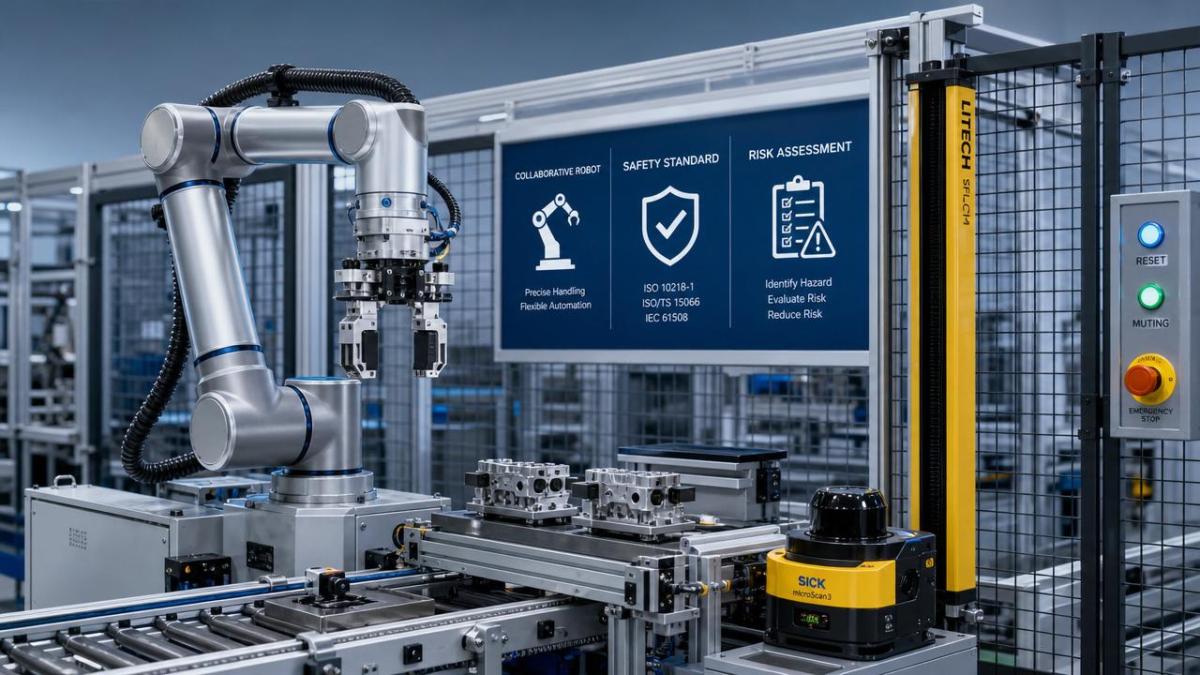
The most important shift is that collaborative robot safety standards are moving from generic product-level interpretation toward application-level validation. Earlier market discussions often treated a cobot as inherently safe because it was lightweight or equipped with force-limited joints. That assumption is no longer sufficient. Safety depends on the robot, the tool, the part, the speed, the workspace layout, and human interaction frequency.
Three forces are driving this change. First, cobot deployments are expanding from laboratory-friendly demonstration cells into mixed-use production lines, machine tending stations, electronics assembly, packaging, inspection, and mobile manipulation. Second, payload classes are increasing, with many systems now operating in ranges from 5 kg to 30 kg rather than only 3 kg to 10 kg. Third, regulators, auditors, and multinational customers are demanding clearer evidence that claimed safe operation has been measured, not assumed.
From robot certification to full-cell risk assessment
A robot arm may conform to relevant design requirements, but the installed system still requires a documented risk assessment. This means manufacturers must evaluate pinch points, trapping zones, tool geometry, workpiece edges, restart behavior, stop categories, and foreseeable misuse. In many facilities, 6 to 12 risk items identified during commissioning are not located on the arm itself, but in the interface between robot, fixture, conveyor, and operator reach zone.
What engineering teams are being asked to prove
- That power and force limiting values are appropriate for the actual contact scenario.
- That safety-rated monitored stop logic works within validated stopping distances.
- That speed and separation monitoring is matched to sensor performance and reaction time.
- That tooling and payload changes do not invalidate the original assessment.
This is where many teams encounter friction. They may have a cobot data sheet, but not the measured stopping distance at 500 mm/s, 1000 mm/s, and maximum payload. They may know the repeatability is ±0.03 mm, yet lack documentation showing how contact force changes when the gripper fingers extend the effective lever arm by 80 mm to 120 mm.
The standards landscape is becoming more interconnected
Collaborative robots safety standards rarely stand alone. Engineering teams increasingly need to interpret them alongside broader machinery safety frameworks, electrical safety requirements, and functional safety concepts. In practical procurement terms, this means the robot supplier, end-effector vendor, safety sensor provider, and integrator can no longer work in isolation if the goal is a defensible compliance file.
The table below shows the main areas where requirements are shifting from simple component selection toward integrated system evidence.
The key takeaway is straightforward: the market is moving away from checkbox compliance and toward measurable system behavior. For technical buyers, this means supplier comparisons should include validation scope, not just robot specifications or list price.
What Has Changed in Real Deployment Terms
When engineers ask what has changed, they often want details that affect project execution. In real deployment terms, collaborative robots safety standards now place more weight on four operational factors: contact severity, stopping performance, sensing reliability, and configuration control after installation. Each factor can alter whether a system remains collaborative, requires additional protective measures, or needs partial segregation.
1. Contact is evaluated more rigorously
Older assumptions often focused only on robot joint torque limiting. Current evaluation is broader. It considers transient versus quasi-static contact, body region sensitivity, contact surface area, and the effect of the carried object. A rounded gripper handling foam trays presents a different risk profile from a parallel gripper moving stamped metal brackets, even if both run at 750 mm/s.
This matters because integrators increasingly need to verify not only nominal robot force control, but also the combined effect of the robot arm, tool shape, payload mass, and path direction. A 2 kg workpiece with sharp edges may drive the need for reduced speed, guarded loading windows, or revised handoff logic.
2. Stopping distance is now a purchasing issue
For many buyers, stopping performance used to be a commissioning detail. It is now a sourcing variable. If two cobots have similar payload and reach but one requires a longer protective separation distance due to slower stop response, the larger safety envelope can reduce workstation density and increase floor-space cost by 10% to 25% in compact production cells.
This is especially important in high-mix manufacturing, where one cell may switch between 3 to 8 part programs in a shift. Every change in speed, tool center point, or payload distribution should be checked against validated stop behavior, not only software settings.
3. Sensors and safety logic face closer scrutiny
Speed and separation monitoring depends on the total chain: detection range, sensor resolution, controller reaction time, robot braking time, and uncertainty margin. If an area scanner has a 40 ms to 80 ms response window, and the robot needs another 120 ms to 250 ms to achieve a safe stop under load, these numbers directly affect allowable speed and minimum distance.
In procurement reviews, engineering teams should ask whether the supplier can provide tested values for loaded and unloaded stop times, not just a generic safety function list. This is consistent with TSV’s data-first approach: measurable performance is more useful than marketing claims.
4. Change management is no longer optional
Many cobot systems evolve after installation. End effectors are swapped, parts become heavier, operators request faster cycle times, or vision systems are added. Under current expectations, these are not minor tweaks. A 15% increase in line speed or a gripper extension change from 60 mm to 140 mm can trigger the need for revalidation.
The practical shift is that collaborative robots safety standards increasingly reward organizations that maintain disciplined configuration control. If no one owns the revision history of tooling, software limits, and validated operating modes, the original compliance case can degrade quickly.
How to Evaluate a Cobot System Against Current Safety Expectations
For technical researchers and sourcing teams, the most efficient approach is to move from product comparison to evidence comparison. Instead of asking only which cobot has the best reach or the lowest upfront cost, ask which supplier can support a complete, auditable safety case within your application constraints.
Five evaluation checkpoints before approval
- Define the interaction model: direct collaboration, monitored coexistence, or segregated operation with occasional human access.
- Document payload mass, center of gravity, tool extension, and part edge conditions for each production mode.
- Verify stop-time and braking data at at least 2 to 3 representative speeds under expected load.
- Check whether safety sensors, logic, and robot functions have compatible response times and fault behavior.
- Establish a revalidation trigger list for software edits, tooling swaps, speed increases, and new SKUs.
The following table is useful during supplier screening because it converts collaborative robots safety standards into operational selection criteria rather than abstract compliance language.
A strong vendor or integrator should be able to explain these items in engineering terms, not only provide marketing brochures. If a supplier cannot clarify how a 20% payload increase affects stopping distance or contact risk, the buyer is absorbing unnecessary qualification risk.
Common sourcing mistakes
Mistake 1: Treating a collaborative label as a universal operating mode
A cobot can operate collaboratively in one task and require protective measures in another. The label does not eliminate the need to evaluate every operating mode, including setup, manual recovery, maintenance, and part changeover.
Mistake 2: Ignoring the carried part
Safety is not only about the arm. A harmless manipulator can become a higher-risk system when carrying glass, knives, machined aluminum with burrs, or hot components above 60°C. The workpiece is part of the safety case.
Mistake 3: Approving speed changes without documented review
What seems like a minor optimization can alter separation distances, braking outcomes, and contact energy. Even a change from 600 mm/s to 900 mm/s should be tied to a formal check rather than informal operator preference.
What Technical Decision-Makers Should Do Next
For engineering researchers, CTOs, and procurement leaders, the most useful response to changing collaborative robots safety standards is to tighten the link between data, design, and supplier evaluation. Safety should be treated as a measurable engineering parameter set, not as a late-stage legal formality.
In practical terms, that means building a decision framework with 4 layers: task definition, risk modeling, validation evidence, and post-installation change control. Teams that do this early often shorten acceptance cycles by several weeks because they avoid repeated redesign of guards, scanners, tooling, and workstation spacing.
A data-first operating model for safer deployment
- Map every human-robot interaction point across normal operation, fault recovery, and maintenance.
- Request measured values for stop time, speed limits, payload effects, and sensor latency.
- Maintain revision records for tooling, software, and process changes from day 1.
- Reassess the system whenever production conditions change beyond defined thresholds.
At TSV, we view collaborative robots safety standards through the same lens we apply across advanced manufacturing: parameters do not lie, and tolerances dictate outcomes. The companies that perform best in global sourcing and deployment are usually not the ones with the loudest claims. They are the ones with the clearest validation data, the most disciplined risk documentation, and the strongest engineering traceability.
If your team is comparing cobot platforms, qualifying integrators, or refining a safety specification for a new automation project, now is the time to convert vague safety assumptions into measurable selection criteria. Contact TSV to get a more structured benchmarking perspective, discuss application-specific evaluation factors, and explore data-driven solutions for safer, faster collaborative robot deployment.
Search News
Hot Articles
- Carbon Fiber StructuresHow to Specify Aerospace Carbon Fiber Assemblies for Lightweight, Load-Bearing PartsJul 11, 2026
- Machine VisionXiaomi, Alibaba DAMO Academy Drive Open-Source Robotics Model Ecosystem, Lowering Algorithm Development Barriers for Overseas SMEs Adopting Chinese Robotics SolutionsMar 30, 2026
- Cobots & ArmsShanxi 'AI+' Conference Showcases Embodied Intelligence with Multinational Buyer Engagement: Key Industry ImplicationsMar 30, 2026
Popular Tags
Recommended News
 Jul 11, 2026How to Specify Aerospace Carbon Fiber Assemblies for Lightweight, Load-Bearing PartsAerospace carbon fiber assemblies: learn how to specify laminate design, load data, joining methods, and inspection controls for lighter, reliable load-bearing aerospace parts.Elena Rostova (UAV Systems Researcher)
 Mar 30, 2026Xiaomi, Alibaba DAMO Academy Drive Open-Source Robotics Model Ecosystem, Lowering Algorithm Development Barriers for Overseas SMEs Adopting Chinese Robotics SolutionsXiaomi & Alibaba DAMO Academy's open-source robotics models lower algorithm barriers for global SMEs. Boost efficiency in manufacturing, logistics & smart retail with ROS 2 compatible solutions.TSV Data Lab
 Mar 30, 2026Shanxi 'AI+' Conference Showcases Embodied Intelligence with Multinational Buyer Engagement: Key Industry ImplicationsShanxi 'AI+' Conference highlights embodied intelligence with Tesla, Ubtech & Jiantao showcasing multimodal robotics. 40+ global buyers validated tech on-site, creating new B2B channels for industrial automation & AI solutions.Chen Wei (Automation Lead Engineer)
 Mar 30, 2026Zhongguancun Unveils 6G Integrated Sensing-Computing-Intelligence Platform to Empower Embodied Robots for Global Industrial ApplicationsZhongguancun's new 6G platform revolutionizes industrial robotics with <10ms latency, empowering global automotive, logistics & port automation. Discover how this tech boosts China's smart manufacturing exports.TSV Data Lab
 Mar 30, 2026Mech-Mind Tianjin Embodied Intelligence R&D and Production Base Goes Live, Cutting Delivery Time by 20%–30% for Global Customized AMR+Vision SolutionsMech-Mind's Tianjin AMR+Vision production base cuts delivery time by 20%-30% for欧美 & Latin American markets. Discover how this PLd-certified facility accelerates customized robotics solutions for smart manufacturing and logistics.Chen Wei (Automation Lead Engineer)
 Mar 30, 2026Boao Forum Reveals 'Co-evolution of Big and Small Brains' Trend in Humanoid Robots, China's Embodied Intelligence Accelerates Adaptation to Overseas Manufacturing Service ScenariosDiscover how China's humanoid robots, featuring 'Co-evolution of Big and Small Brains,' are revolutionizing global manufacturing. Learn about Embodied Tian Gong 3.0's ISO compliance and overseas deployment at Boao Forum 2026.Chen Wei (Automation Lead Engineer)
 Mar 30, 2026China Railway Industrial Secures Patent for Embodied Robotics in Material Handling, Boosting High-Precision Delivery Capabilities for Overseas Infrastructure and Manufacturing ProjectsChina Railway Industrial's new patent for embodied robotics in material handling boosts high-precision delivery for global infrastructure & manufacturing. Discover how this innovation enhances logistics accuracy in automotive, rail transit & EPC projects.Chen Wei (Automation Lead Engineer)
 Sep 29, 2026ISO 9283 Repeatability: How to Evaluate Cobot Positioning PerformanceISO 9283 cobot repeatability explained: learn how payload, reach, approach direction, and test conditions affect positioning performance and cell capability.Chen Wei (Automation Lead Engineer)
 Sep 29, 2026How Do You Verify Servo Motor Torque Under Continuous Load?How do I verify servo motor torque under continuous load? Learn RMS torque checks, torque-speed limits, thermal derating, and real-machine testing.Chen Wei (Automation Lead Engineer)
 Sep 28, 2026Spindle Runout Measurement in Germany: DIN Standards, Methods, and Acceptance LimitsSpindle runout measurement Germany: explore DIN standards, proven methods, acceptance limits, and audit-ready practices for reliable machining quality.Dr. Marcus Vance
 Sep 27, 2026How to Select Wall-Mount Edge Devices for Space-Constrained Factory NetworksWall mount edge devices for space-constrained factories: evaluate workload, thermal design, power resilience, cable access, and network reliability for smarter deployments.TSV Data Lab
 Sep 26, 2026Machining Tolerance Analysis: How to Set Limits That Meet Function and Cost TargetsMachining tolerance analysis: learn how to set functional limits, control tolerance stacks, reduce inspection risk, and balance precision with production cost.Dr. Marcus Vance
 Sep 25, 2026How to Evaluate an Industrial Infrastructure Data Platform for Multi-Site OperationsIndustrial infrastructure data platform evaluation guide for multi-site operations: compare data quality, edge resilience, interoperability, governance, and scalable proof-of-value criteria.Victor Lin (Chief Software Architect)
 Sep 24, 2026How to Select Machine Vision Optics for Accurate Inspection at Different Working DistancesMachine vision optics selection guide for accurate inspection at every working distance. Compare FOV, pixel scale, DOF, distortion, lighting, and telecentric options.TSV Data Lab
 Sep 23, 2026How to Evaluate a Machine Vision System Integrator for High-Speed Inspection LinesChoose a machine vision system integrator with proven expertise in high-speed inspection, reliable reject timing, robust optics, and measurable acceptance criteria.TSV Data Lab
 Sep 29, 2026How MES and OEE work together to identify production lossesMES and OEE work together to uncover hidden production losses, connect downtime, speed, and quality data, and drive smarter shop-floor improvements.Victor Lin (Chief Software Architect)
 Sep 28, 2026When is a SCADA API the right choice for connecting plant systems?SCADA API guide: learn when governed plant data integration improves traceability, security, and scalability—without compromising real-time control.Victor Lin (Chief Software Architect)
 Sep 27, 2026How SCADA data integration improves traceability across production linesSCADA data integration connects production-line data to improve traceability, accelerate quality investigations, and strengthen safety decisions.Victor Lin (Chief Software Architect)
 Sep 26, 2026What to define before starting SCADA integration planningSCADA integration planning starts with clear scope, control boundaries, data models, cybersecurity, and testing. Discover the definitions that reduce risk and costly rework.Victor Lin (Chief Software Architect)
 Sep 25, 2026How a smart factory with Industrial IoT reduces production blind spotsDiscover how a smart factory with Industrial IoT turns real-time machine, quality, and workflow data into actionable insights that reduce production blind spots and delivery risks.Victor Lin (Chief Software Architect)
 Sep 24, 2026When does Industrial IoT make smart manufacturing easier to scale?Smart manufacturing Industrial IoT scales when trusted data, interoperable systems, and secure workflows turn connected assets into measurable gains.TSV Data Lab
 Sep 23, 2026What drives ultra-precision machining cost at 1-micron tolerance?Ultra precision machining cost per part at 1 micron tolerance depends on process, material, metrology, and yield. Learn how to compare quotes confidently.Dr. Marcus Vance
 Sep 22, 2026Drone Engine-T550CC Applications: Build the UAV Power System Around the MissionAn application guide for Drone Engine-T550CC integration, covering payload planning, airframe matching, cooling, fuel, vibration, test procedures, documentation, and service preparation.Elena Rostova (UAV Systems Researcher)
 Sep 22, 2026How to Evaluate Industrial Edge Computing Vendors for Factory DeploymentIndustrial edge computing vendor evaluation guide for factories: compare latency, protocol fit, reliability, security, and lifecycle support before deployment.TSV Data Lab