AGV and AMR for Warehouse Automation: What Scales Well?
Publication Date
author
For enterprise decision-makers evaluating AGV AMR for warehouse automation, scalability is not a buzzword—it is a measurable engineering outcome tied to throughput, fault tolerance, system integration, and lifecycle cost. This article examines what truly scales well, helping leaders cut through market noise and compare automation paths based on operational data, deployment complexity, and long-term supply chain performance.
The core search intent behind “AGV and AMR for warehouse automation: what scales well?” is not simply to understand the difference between AGVs and AMRs. It is to determine which automation approach can support business growth with acceptable risk, realistic integration effort, and measurable return. For enterprise leaders, the real question is: which system will still perform when the warehouse network expands, SKU complexity rises, labor conditions change, and uptime becomes mission-critical?
In practical terms, the short answer is this: neither AGV nor AMR scales well by default. Scalability depends on the fit between vehicle type, process design, software orchestration, facility constraints, and operational variability. AGVs often scale well in stable, repetitive, high-volume flows with controlled routes. AMRs usually scale better in dynamic environments where workflows, layouts, and demand profiles change frequently. The better investment is rarely the more advanced-looking robot. It is the one that preserves throughput under real operating complexity.
What enterprise buyers are actually trying to decide
When companies search for AGV AMR for warehouse automation, they are usually at a decision point: standardize on a transport platform, launch a pilot, replace manual cart movement, or modernize a distribution center without locking themselves into a brittle system. They are not looking for generic definitions. They want a decision framework.
The main concerns are consistent across industries. First, can the system scale from one site to multiple sites without major redesign? Second, does performance hold when fleet size grows from ten units to fifty or more? Third, how much engineering support is required after go-live? Fourth, what happens when layouts change, aisles become congested, or upstream systems send poor-quality data? And finally, what is the true lifecycle cost beyond the initial robot purchase?
These are valid concerns because warehouse automation projects often fail for reasons that are invisible in sales demos. A vehicle may navigate well in a clean pilot area but struggle in mixed traffic. Fleet software may work at low volume but create traffic bottlenecks as robot density increases. Integration may appear straightforward until warehouse management system events, order priorities, battery logic, and exception handling collide in production.
AGV vs AMR: the difference only matters when tied to operational fit
AGVs, or automated guided vehicles, generally follow predefined paths using magnetic tape, QR codes, reflectors, wires, or fixed navigation references. Their strength is predictability. In environments with repeated point-to-point movement, limited route variability, and strict process discipline, AGVs can deliver strong uptime and straightforward control logic.
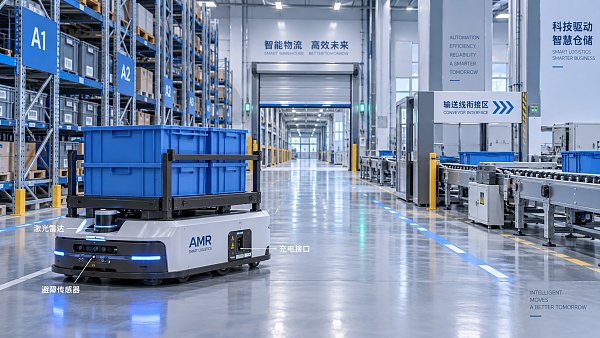
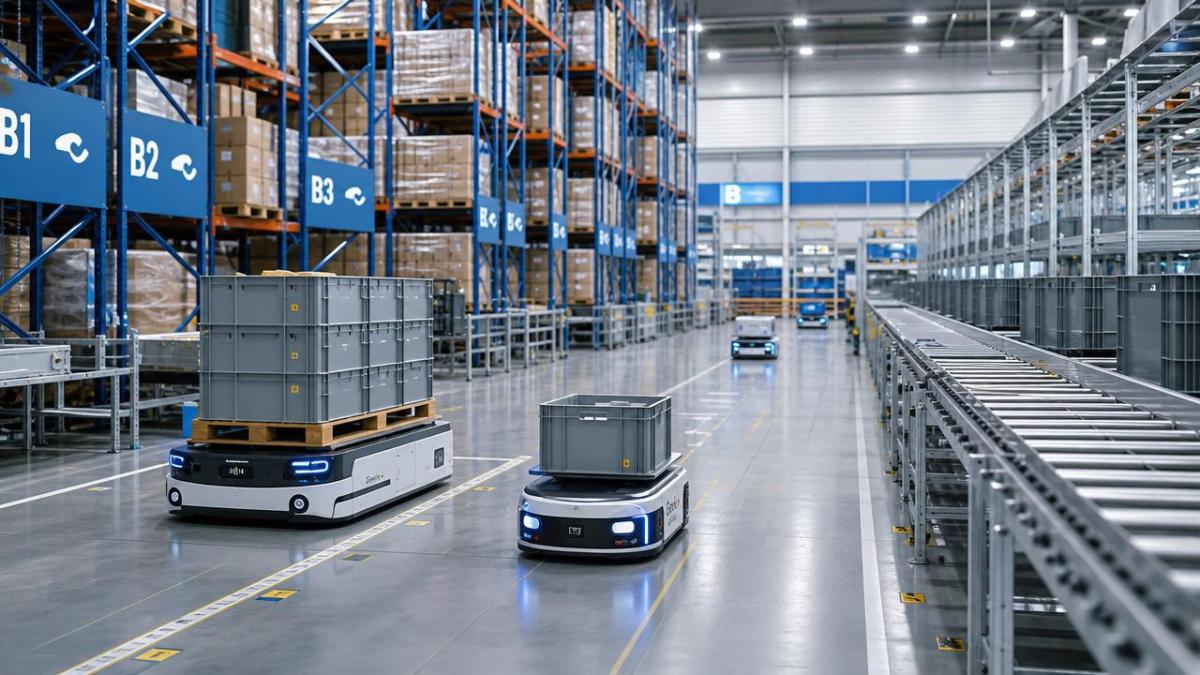
AMRs, or autonomous mobile robots, use onboard sensors and software to localize themselves, plan routes, and adjust to obstacles in real time. Their value is flexibility. In warehouses where traffic patterns shift, pick faces move, and process changes occur regularly, AMRs can reduce the cost and delay of modifying physical guidance infrastructure.
For enterprise decision-makers, this distinction matters only when translated into scaling behavior. AGV systems tend to scale better when the process itself is stable. If route networks, material handoff points, and task sequencing remain largely fixed, fleet expansion can be relatively manageable. AMR systems tend to scale better when the business model is less predictable. If product mix changes, temporary work zones appear, and seasonal peaks force layout adaptation, AMRs usually offer a more resilient path.
However, flexibility alone does not equal scalability. AMRs can create hidden complexity in traffic management, charging strategy, map maintenance, and software tuning. Likewise, AGVs can become expensive to adapt when operational change is frequent. The right comparison is not “which technology is better?” but “which failure mode can the business tolerate more easily?”
What “scales well” really means in warehouse automation
Scalability in warehouse robotics should be evaluated across five dimensions: throughput scaling, operational resilience, integration scaling, site replication, and financial efficiency. If a system only looks strong in one dimension, it may still fail as an enterprise platform.
Throughput scaling means the system can move more material without causing disproportionate congestion, idle time, or dispatch inefficiency. A fleet that performs well with eight robots but loses coordination at twenty does not scale well. Decision-makers should ask for performance data on travel time distribution, queue formation, task completion rate, and throughput under peak load.
Operational resilience means the system continues to function when conditions are imperfect. This includes blocked aisles, delayed pallets, temporary obstacles, Wi-Fi degradation, battery imbalance, and inaccurate location data from adjacent systems. A scalable platform is not one that performs well only under ideal conditions. It is one that degrades gracefully and recovers quickly.
Integration scaling refers to how easily the automation stack connects with warehouse management systems, warehouse control systems, ERP workflows, safety systems, elevators, doors, conveyors, and human workstations. Many pilots succeed because the integration scope is small. Enterprise rollouts fail when each added process requires custom engineering.
Site replication matters for organizations with multiple warehouses. A system that works only in one flagship building may not scale as a business asset. Leaders should evaluate template-based deployment, map portability, software standardization, spare parts strategy, and remote fleet support.
Financial efficiency includes not just capital cost, but labor substitution quality, maintenance burden, battery replacement cycles, software licensing, integration upkeep, and downtime cost. A warehouse automation platform scales well when incremental gains remain attractive as more robots, more zones, and more sites are added.
Where AGVs usually scale better
AGVs often outperform AMRs in facilities where routes are fixed, product movement is repetitive, and variability is intentionally minimized. This includes line-side delivery, pallet shuttling between production and staging, and repetitive transport loops in highly structured environments.
In these cases, AGVs benefit from simpler route governance and predictable motion behavior. Safety validation can also be more straightforward because vehicle paths are known in advance. For operations teams, this often means more stable scheduling and less day-to-day tuning. For finance leaders, it can mean a clearer path to utilization planning.
AGVs may also scale well where compliance, process repeatability, and deterministic flow are more important than layout agility. If the warehouse is designed around standard handling logic and process discipline is strong, adding more AGVs can be less operationally disruptive than managing a large free-navigation AMR fleet.
But there are tradeoffs. AGVs become less attractive when each route change requires physical modification, engineering downtime, or workflow revalidation. If the operation expects frequent slotting changes, temporary storage reconfiguration, or cross-functional floor sharing, the cost of maintaining rigid infrastructure can grow quickly.
Where AMRs usually scale better
AMRs generally scale better in warehouses with changing workflows, labor variability, and mixed traffic. E-commerce fulfillment, multi-SKU distribution, dynamic replenishment, and facilities undergoing continuous layout evolution are common examples.
The key advantage is adaptability. AMRs can often be deployed faster because they require less physical navigation infrastructure. When demand changes, the fleet can be reassigned, maps can be updated, and task logic can be reconfigured without major facility interruption. For businesses managing uncertainty, this reduces the penalty of being wrong about tomorrow’s workflow.
AMRs also fit operations that need phased automation. Instead of redesigning the full warehouse, companies can automate a subset of transport tasks and expand over time. This can reduce capital concentration and support more incremental ROI validation.
Still, AMR scalability is frequently overstated. As fleets grow, software quality becomes decisive. Traffic orchestration, deadlock avoidance, charging optimization, and exception recovery determine whether the fleet remains productive or simply adds mobile congestion. An AMR deployment that scales well is less about the robot itself and more about the maturity of the fleet management layer.
The metrics that matter more than marketing claims
Enterprise buyers should insist on measurable criteria. For AGV AMR for warehouse automation decisions, the most useful metrics are not headline speed or theoretical payload. They are system-level performance indicators tied to business output.
Start with task throughput per hour under normal and peak conditions. Then review fleet utilization, because low utilization may indicate overbuying or poor dispatch logic. Ask for mean time to recover from obstruction, not just obstacle detection capability. Review battery charging efficiency and how charging behavior affects mission availability during peak shifts.
Other critical indicators include navigation fault rate, mission completion accuracy, software update stability, integration incident frequency, and unplanned downtime per 1,000 operating hours. For multi-site programs, include deployment lead time per site and engineering hours required per process change.
These are the data points that reveal whether a warehouse automation solution truly scales. They also align with TSV’s engineering-first philosophy: parameters matter because they determine operational truth. If a vendor cannot provide structured evidence beyond pilot anecdotes, decision-makers should treat scalability claims cautiously.
The hidden bottlenecks that break scaling plans
Most scaling problems in warehouse robotics do not start with navigation. They start with system design gaps. One common bottleneck is poor process mapping. If manual exceptions, pallet quality variation, aisle discipline, and handoff delays are not modeled early, the robot fleet will inherit operational chaos instead of removing it.
Another bottleneck is weak integration architecture. If task generation depends on inconsistent inventory data or delayed warehouse management events, vehicle efficiency will suffer regardless of robot type. In large operations, data latency and event integrity often matter as much as robot performance.
Charging strategy is another overlooked factor. A fleet may appear adequately sized on paper, yet underperform because charging windows overlap with peak mission demand. This creates silent capacity loss. Scalable deployments require battery policy design, not just charger procurement.
Finally, organizational readiness matters. If local teams cannot manage exception workflows, floor marking discipline, software escalation, and preventive maintenance, even a strong platform will struggle to scale. Warehouse automation is not only a technology decision. It is an operating model decision.
How enterprise leaders should evaluate AGV and AMR vendors
A useful vendor evaluation process should move beyond feature comparison and focus on operational proof. Ask each supplier to explain where their system scales poorly, not just where it scales well. Honest constraint mapping is often more valuable than polished claims.
Request evidence from live deployments with similar SKU complexity, shift patterns, aisle geometry, and traffic conditions. Separate pilot performance from mature production performance. A six-robot pilot in a low-interference zone is not a valid proxy for a forty-robot live warehouse.
Evaluate the software stack closely. For both AGVs and AMRs, fleet management quality often determines long-term success. Review API maturity, event handling logic, interoperability with WMS or WCS layers, cybersecurity policy, and remote diagnostics capability. Ask what percentage of workflow changes can be handled through configuration rather than custom coding.
Also review support structure. Scalability depends on spare parts availability, on-site service response, software maintenance cadence, and the vendor’s ability to support replication across regions. For global organizations, local support gaps can turn a technically sound system into a commercial risk.
A practical decision framework: which path is more likely to scale for you?
If your warehouse has stable routes, repetitive transport, low layout volatility, and a strong need for deterministic flow, AGVs may offer the better scaling profile. This is especially true where process control is high and changes are infrequent enough that route rigidity is not a major penalty.
If your operation deals with dynamic slotting, changing order profiles, mixed traffic, and continuous process adjustment, AMRs are more likely to scale effectively. Their value increases when business flexibility is a strategic requirement rather than a convenience.
If the environment includes both stable and variable zones, a hybrid approach may be the most scalable. Some enterprises use AGVs for fixed long-haul transport and AMRs for flexible short-haul or person-to-goods workflows. The goal is not technology purity. The goal is matching motion logic to process reality.
For most enterprise decision-makers, the best next step is a bounded, metrics-driven pilot with clear success criteria. Define target throughput, recovery time, integration effort, and labor impact before deployment. Then test not only steady-state performance, but disruption scenarios. A pilot that ignores edge cases will produce misleading confidence.
Conclusion: scalability is a systems outcome, not a robot category
In the debate around AGV AMR for warehouse automation, the most important insight is simple: scalability is not built into the acronym. It emerges from the fit between technology, workflow stability, software orchestration, and operational discipline.
AGVs often scale well in structured, repeatable, high-control environments. AMRs often scale better in dynamic, evolving warehouses where flexibility has measurable business value. But in both cases, enterprise success depends less on product messaging and more on engineering evidence: throughput under load, fault recovery behavior, integration depth, and lifecycle economics.
Decision-makers who focus on these fundamentals will make better automation choices and avoid expensive misalignment. In warehouse automation, what scales well is not what looks most advanced in a demo. It is what continues to deliver reliable material flow when complexity, volume, and business expectations all increase at once.
Search News
Hot Articles
- Carbon Fiber StructuresHow to Specify Aerospace Carbon Fiber Assemblies for Lightweight, Load-Bearing PartsJul 11, 2026
- Machine VisionXiaomi, Alibaba DAMO Academy Drive Open-Source Robotics Model Ecosystem, Lowering Algorithm Development Barriers for Overseas SMEs Adopting Chinese Robotics SolutionsMar 30, 2026
- Cobots & ArmsShanxi 'AI+' Conference Showcases Embodied Intelligence with Multinational Buyer Engagement: Key Industry ImplicationsMar 30, 2026
Popular Tags
Recommended News
 Jul 11, 2026How to Specify Aerospace Carbon Fiber Assemblies for Lightweight, Load-Bearing PartsAerospace carbon fiber assemblies: learn how to specify laminate design, load data, joining methods, and inspection controls for lighter, reliable load-bearing aerospace parts.Elena Rostova (UAV Systems Researcher)
 Mar 30, 2026Xiaomi, Alibaba DAMO Academy Drive Open-Source Robotics Model Ecosystem, Lowering Algorithm Development Barriers for Overseas SMEs Adopting Chinese Robotics SolutionsXiaomi & Alibaba DAMO Academy's open-source robotics models lower algorithm barriers for global SMEs. Boost efficiency in manufacturing, logistics & smart retail with ROS 2 compatible solutions.TSV Data Lab
 Mar 30, 2026Shanxi 'AI+' Conference Showcases Embodied Intelligence with Multinational Buyer Engagement: Key Industry ImplicationsShanxi 'AI+' Conference highlights embodied intelligence with Tesla, Ubtech & Jiantao showcasing multimodal robotics. 40+ global buyers validated tech on-site, creating new B2B channels for industrial automation & AI solutions.Chen Wei (Automation Lead Engineer)
 Mar 30, 2026Zhongguancun Unveils 6G Integrated Sensing-Computing-Intelligence Platform to Empower Embodied Robots for Global Industrial ApplicationsZhongguancun's new 6G platform revolutionizes industrial robotics with <10ms latency, empowering global automotive, logistics & port automation. Discover how this tech boosts China's smart manufacturing exports.TSV Data Lab
 Mar 30, 2026Mech-Mind Tianjin Embodied Intelligence R&D and Production Base Goes Live, Cutting Delivery Time by 20%–30% for Global Customized AMR+Vision SolutionsMech-Mind's Tianjin AMR+Vision production base cuts delivery time by 20%-30% for欧美 & Latin American markets. Discover how this PLd-certified facility accelerates customized robotics solutions for smart manufacturing and logistics.Chen Wei (Automation Lead Engineer)
 Mar 30, 2026Boao Forum Reveals 'Co-evolution of Big and Small Brains' Trend in Humanoid Robots, China's Embodied Intelligence Accelerates Adaptation to Overseas Manufacturing Service ScenariosDiscover how China's humanoid robots, featuring 'Co-evolution of Big and Small Brains,' are revolutionizing global manufacturing. Learn about Embodied Tian Gong 3.0's ISO compliance and overseas deployment at Boao Forum 2026.Chen Wei (Automation Lead Engineer)
 Mar 30, 2026China Railway Industrial Secures Patent for Embodied Robotics in Material Handling, Boosting High-Precision Delivery Capabilities for Overseas Infrastructure and Manufacturing ProjectsChina Railway Industrial's new patent for embodied robotics in material handling boosts high-precision delivery for global infrastructure & manufacturing. Discover how this innovation enhances logistics accuracy in automotive, rail transit & EPC projects.Chen Wei (Automation Lead Engineer)
 Sep 29, 2026ISO 9283 Repeatability: How to Evaluate Cobot Positioning PerformanceISO 9283 cobot repeatability explained: learn how payload, reach, approach direction, and test conditions affect positioning performance and cell capability.Chen Wei (Automation Lead Engineer)
 Sep 28, 2026Spindle Runout Measurement in Germany: DIN Standards, Methods, and Acceptance LimitsSpindle runout measurement Germany: explore DIN standards, proven methods, acceptance limits, and audit-ready practices for reliable machining quality.Dr. Marcus Vance
 Sep 27, 2026How to Select Wall-Mount Edge Devices for Space-Constrained Factory NetworksWall mount edge devices for space-constrained factories: evaluate workload, thermal design, power resilience, cable access, and network reliability for smarter deployments.TSV Data Lab
 Sep 26, 2026Machining Tolerance Analysis: How to Set Limits That Meet Function and Cost TargetsMachining tolerance analysis: learn how to set functional limits, control tolerance stacks, reduce inspection risk, and balance precision with production cost.Dr. Marcus Vance
 Sep 25, 2026How to Evaluate an Industrial Infrastructure Data Platform for Multi-Site OperationsIndustrial infrastructure data platform evaluation guide for multi-site operations: compare data quality, edge resilience, interoperability, governance, and scalable proof-of-value criteria.Victor Lin (Chief Software Architect)
 Sep 24, 2026How to Select Machine Vision Optics for Accurate Inspection at Different Working DistancesMachine vision optics selection guide for accurate inspection at every working distance. Compare FOV, pixel scale, DOF, distortion, lighting, and telecentric options.TSV Data Lab
 Sep 23, 2026How to Evaluate a Machine Vision System Integrator for High-Speed Inspection LinesChoose a machine vision system integrator with proven expertise in high-speed inspection, reliable reject timing, robust optics, and measurable acceptance criteria.TSV Data Lab
 Sep 28, 2026When is a SCADA API the right choice for connecting plant systems?SCADA API guide: learn when governed plant data integration improves traceability, security, and scalability—without compromising real-time control.Victor Lin (Chief Software Architect)
 Sep 27, 2026How SCADA data integration improves traceability across production linesSCADA data integration connects production-line data to improve traceability, accelerate quality investigations, and strengthen safety decisions.Victor Lin (Chief Software Architect)
 Sep 26, 2026What to define before starting SCADA integration planningSCADA integration planning starts with clear scope, control boundaries, data models, cybersecurity, and testing. Discover the definitions that reduce risk and costly rework.Victor Lin (Chief Software Architect)
 Sep 25, 2026How a smart factory with Industrial IoT reduces production blind spotsDiscover how a smart factory with Industrial IoT turns real-time machine, quality, and workflow data into actionable insights that reduce production blind spots and delivery risks.Victor Lin (Chief Software Architect)
 Sep 24, 2026When does Industrial IoT make smart manufacturing easier to scale?Smart manufacturing Industrial IoT scales when trusted data, interoperable systems, and secure workflows turn connected assets into measurable gains.TSV Data Lab
 Sep 23, 2026What drives ultra-precision machining cost at 1-micron tolerance?Ultra precision machining cost per part at 1 micron tolerance depends on process, material, metrology, and yield. Learn how to compare quotes confidently.Dr. Marcus Vance
 Sep 22, 2026Drone Engine-T550CC Applications: Build the UAV Power System Around the MissionAn application guide for Drone Engine-T550CC integration, covering payload planning, airframe matching, cooling, fuel, vibration, test procedures, documentation, and service preparation.Elena Rostova (UAV Systems Researcher)
 Sep 22, 2026How to Evaluate Industrial Edge Computing Vendors for Factory DeploymentIndustrial edge computing vendor evaluation guide for factories: compare latency, protocol fit, reliability, security, and lifecycle support before deployment.TSV Data Lab
 Sep 21, 2026Drone Payload Integration: Matching Power, Data, and Center of Gravity for Reliable FlightsDrone payload integration made practical: balance power, data, center of gravity, and endurance to build safer, more reliable mission-ready flights.Elena Rostova (UAV Systems Researcher)
 Sep 20, 2026Autonomous Navigation Pricing: Cost Drivers and Budget Benchmarks for AMR ProjectsAutonomous navigation price explained: compare AMR cost drivers, software, sensors, integration, safety, and lifecycle budgets to build a scalable project plan.Chen Wei (Automation Lead Engineer)