Why 3D metal printing for rocket nozzles is gaining ground
Publication Date
author
As propulsion teams push for lighter, hotter, and faster-performing components, 3d metal printing for rocket nozzles is moving from experimental promise to strategic production reality. The real shift is not promotional. It comes from measurable gains in geometry control, part consolidation, thermal management, and production agility. In high-consequence hardware programs, those gains directly affect qualification timelines, total cost, and supply-chain resilience.
For data-driven engineering organizations, the key question is no longer whether additive manufacturing can build a nozzle. The useful question is whether a specific nozzle design, alloy, process window, and inspection route justify the transition from conventional fabrication to 3d metal printing for rocket nozzles.
Why a checklist matters before adopting 3D metal printing for rocket nozzles
Rocket nozzles sit at the intersection of extreme heat flux, pressure loading, fatigue cycling, oxidation risk, and dimensional sensitivity. A visually impressive printed part means little without verified density, repeatable microstructure, and predictable post-processing behavior.
That is why 3d metal printing for rocket nozzles should be evaluated with a structured decision framework. A checklist helps separate genuine engineering value from cases where subtractive machining, brazed assemblies, or cast-and-machine routes still offer better economics or lower qualification risk.
Core checklist for evaluating 3D metal printing for rocket nozzles
- Define the thermal duty first, including chamber pressure, wall temperature, cooling strategy, duty cycle, and erosion environment before discussing process selection.
- Map which features create value, such as internal channels, lattice-supported walls, integrated manifolds, or contour-matched cooling paths impossible with conventional tooling.
- Select the alloy by performance window, comparing copper alloys, nickel superalloys, stainless grades, and refractory candidates against printability and post-build stability.
- Verify achievable density and defect limits using CT, metallography, and coupon testing, not brochure claims about aerospace-grade quality.
- Check whether part consolidation removes welds, braze joints, seals, and interfaces that traditionally create leakage, distortion, or inspection complexity.
- Quantify lead-time compression across design iteration, tooling elimination, spare production, and engineering change response, then compare against qualification overhead.
- Plan post-processing early, including stress relief, HIP, machining stock, support removal, surface finishing, and thread or flange finishing requirements.
- Assess repeatability across builds by tracking machine calibration, powder lot variation, scan strategy, and orientation sensitivity for critical dimensions.
- Require a traceable inspection route that links powder chemistry, build records, heat treatment, NDE data, and final dimensional reports.
- Model total cost using mission-ready hardware metrics, not part price alone, because test failures and requalification loops dominate true program expense.
What makes 3D metal printing for rocket nozzles technically attractive
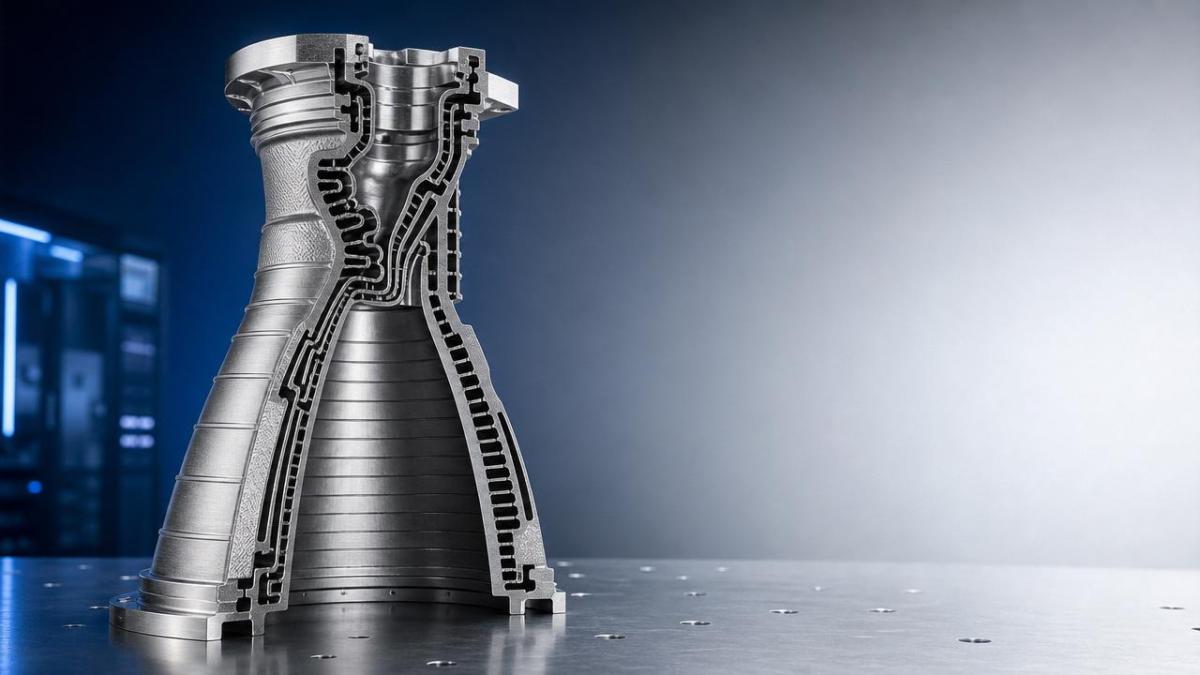
The strongest case for 3d metal printing for rocket nozzles is geometric freedom. Regenerative cooling channels can follow local heat loads more closely. Wall thickness can change gradually. Manifolds can be integrated instead of assembled.
This often reduces joint count and leak paths. It also shortens the path from CFD and thermal simulation to physical hardware. In development-heavy propulsion work, that iteration speed can be as valuable as the final mass reduction.
Application-specific guidance across propulsion scenarios
Small launch and responsive space systems
In smaller engines, production volume is often modest, while design changes are frequent. That makes 3d metal printing for rocket nozzles attractive because tooling cost is harder to amortize through conventional routes.
Printed nozzles can support rapid hot-fire iteration, especially when chamber and nozzle features are partially consolidated. The main watchpoint is ensuring that speed does not outpace process discipline.
Reusable engines and high-cycle duty
Reusable propulsion hardware shifts attention from one-time proof to cycle durability. Here, 3d metal printing for rocket nozzles must be judged on crack initiation behavior, thermal fatigue life, and microstructural consistency after repeated firing.
Integrated cooling features may improve temperature control, but surface roughness and local defects can become fatigue concentrators. Build strategy and finishing quality therefore matter as much as topology innovation.
Prototype-to-production transitions
A printed prototype that works once does not automatically support serial production. The transition phase should test machine-to-machine transfer, powder replenishment rules, dimensional drift, and inspection throughput.
For this reason, 3d metal printing for rocket nozzles should be evaluated as a production system, not just a design method. Stable documentation and parameter control become decisive at this stage.
Commonly overlooked risks in 3D metal printing for rocket nozzles
Surface condition inside cooling passages
Internal roughness is often underestimated. It can help heat transfer in some cases, but it can also raise pressure drop, trap powder residue, and complicate cleaning validation.
Residual stress and distortion
Nozzle geometries with thin walls and long thermal gradients are highly sensitive to stress accumulation. Distortion can shift mating features, alter channel dimensions, and increase machining loss.
Inspection bottlenecks
Complex internal passages create value, but they also make verification harder. If CT capacity, acceptance criteria, or digital traceability are weak, throughput can collapse despite fast printing.
False economics from incomplete costing
A low printed part quote may hide expensive heat treatment, HIP cycles, machining setups, scrap exposure, and extended qualification campaigns. Lifecycle cost must include those realities.
Practical execution steps for a data-driven adoption path
- Start with a nozzle subscale or feature-representative article that includes critical channels, wall sections, and flange transitions.
- Run coupon and witness testing alongside hardware builds to correlate tensile, fatigue, density, and microstructure with actual nozzle geometry.
- Establish acceptance bands for porosity, roughness, distortion, and dimensional scatter before first article review begins.
- Create a closed digital thread linking CAD revision, build orientation, powder lot, machine log, heat treatment, CT scan, and final machining report.
- Compare printed and conventional nozzles using equal mission criteria, including thrust chamber efficiency, mass, leak risk, and turnaround time.
Where independent engineering evidence matters most
For organizations guided by engineering truth, the success of 3d metal printing for rocket nozzles depends on parameter-level transparency. Density values, fatigue curves, dimensional CpK, and CT acceptance thresholds matter more than broad claims about innovation.
This is where a benchmarking mindset is essential. Comparing alloys, machines, post-processing routes, and qualification outcomes on a traceable basis reduces trial-and-error cost and shortens the path to validated hardware.
Conclusion and next-action guidance
3d metal printing for rocket nozzles is gaining ground because it can solve real propulsion problems: constrained geometry, excessive joints, long lead times, and limited iteration speed. Its value is strongest when thermal performance and manufacturability improve together.
The best next step is to evaluate one nozzle family through a strict checklist: mission duty, alloy fit, channel design value, post-processing burden, inspection readiness, and repeatability risk. If the data support those factors, additive manufacturing moves from experimental capability to credible production strategy.
In advanced manufacturing, claims are temporary, but verified parameters endure. That is exactly why 3d metal printing for rocket nozzles continues to gain ground across modern aerospace supply chains.
Search News
Hot Articles
- Carbon Fiber StructuresHow to Specify Aerospace Carbon Fiber Assemblies for Lightweight, Load-Bearing PartsJul 11, 2026
- Machine VisionXiaomi, Alibaba DAMO Academy Drive Open-Source Robotics Model Ecosystem, Lowering Algorithm Development Barriers for Overseas SMEs Adopting Chinese Robotics SolutionsMar 30, 2026
- Cobots & ArmsShanxi 'AI+' Conference Showcases Embodied Intelligence with Multinational Buyer Engagement: Key Industry ImplicationsMar 30, 2026
Popular Tags
Recommended News
 Jul 11, 2026How to Specify Aerospace Carbon Fiber Assemblies for Lightweight, Load-Bearing PartsAerospace carbon fiber assemblies: learn how to specify laminate design, load data, joining methods, and inspection controls for lighter, reliable load-bearing aerospace parts.Elena Rostova (UAV Systems Researcher)
 Mar 30, 2026Xiaomi, Alibaba DAMO Academy Drive Open-Source Robotics Model Ecosystem, Lowering Algorithm Development Barriers for Overseas SMEs Adopting Chinese Robotics SolutionsXiaomi & Alibaba DAMO Academy's open-source robotics models lower algorithm barriers for global SMEs. Boost efficiency in manufacturing, logistics & smart retail with ROS 2 compatible solutions.TSV Data Lab
 Mar 30, 2026Shanxi 'AI+' Conference Showcases Embodied Intelligence with Multinational Buyer Engagement: Key Industry ImplicationsShanxi 'AI+' Conference highlights embodied intelligence with Tesla, Ubtech & Jiantao showcasing multimodal robotics. 40+ global buyers validated tech on-site, creating new B2B channels for industrial automation & AI solutions.Chen Wei (Automation Lead Engineer)
 Mar 30, 2026Zhongguancun Unveils 6G Integrated Sensing-Computing-Intelligence Platform to Empower Embodied Robots for Global Industrial ApplicationsZhongguancun's new 6G platform revolutionizes industrial robotics with <10ms latency, empowering global automotive, logistics & port automation. Discover how this tech boosts China's smart manufacturing exports.TSV Data Lab
 Mar 30, 2026Mech-Mind Tianjin Embodied Intelligence R&D and Production Base Goes Live, Cutting Delivery Time by 20%–30% for Global Customized AMR+Vision SolutionsMech-Mind's Tianjin AMR+Vision production base cuts delivery time by 20%-30% for欧美 & Latin American markets. Discover how this PLd-certified facility accelerates customized robotics solutions for smart manufacturing and logistics.Chen Wei (Automation Lead Engineer)
 Mar 30, 2026Boao Forum Reveals 'Co-evolution of Big and Small Brains' Trend in Humanoid Robots, China's Embodied Intelligence Accelerates Adaptation to Overseas Manufacturing Service ScenariosDiscover how China's humanoid robots, featuring 'Co-evolution of Big and Small Brains,' are revolutionizing global manufacturing. Learn about Embodied Tian Gong 3.0's ISO compliance and overseas deployment at Boao Forum 2026.Chen Wei (Automation Lead Engineer)
 Mar 30, 2026China Railway Industrial Secures Patent for Embodied Robotics in Material Handling, Boosting High-Precision Delivery Capabilities for Overseas Infrastructure and Manufacturing ProjectsChina Railway Industrial's new patent for embodied robotics in material handling boosts high-precision delivery for global infrastructure & manufacturing. Discover how this innovation enhances logistics accuracy in automotive, rail transit & EPC projects.Chen Wei (Automation Lead Engineer)
 Oct 06, 2026Navigation Fault Tolerance Standards for AMRs: What Safety Teams Must VerifyNavigation fault tolerance standards: learn what AMR safety teams must verify, from localization loss and sensor faults to stopping distance, safe restart, and site-specific validation.Chen Wei (Automation Lead Engineer)
 Oct 05, 2026Calculating Edge Computing Total Cost of Ownership Across Distributed SitesEdge computing ownership cost explained: calculate deployment, energy, connectivity, security, remote support, and refresh costs across distributed sites.TSV Data Lab
 Oct 04, 2026CAD/CAM Benchmarking in the GCC: What Manufacturers Should Ask a ConsultantCAD CAM benchmark consultant GCC guide: learn the key questions manufacturers should ask to validate post-processors, workflows, machine performance, and production risk.Victor Lin (Chief Software Architect)
 Oct 03, 2026Selecting Automotive Radar Sensor Modules for ADAS Range, Resolution, and IntegrationAutomotive radar sensor module selection guide for ADAS: compare range, resolution, field of view, latency, and integration to build safer, reliable vehicle systems.TSV Data Lab
 Oct 02, 2026How to Qualify Machined Parts Suppliers for Hard Tech ProgramsHard tech supply chain machined parts demand rigorous supplier qualification. Learn how to assess capability, traceability, quality controls, and delivery resilience.Dr. Marcus Vance
 Oct 01, 2026How to Select an Outdoor Security Radar Sensor for Perimeter Detection?Outdoor security radar sensor selection guide: compare range, accuracy, false-alarm control, integration, and field testing for reliable perimeter detection.TSV Data Lab
 Sep 30, 2026How to Evaluate Solid-State LiDAR Hardware for Outdoor Autonomous VehiclesSolid state LiDAR hardware evaluation guide for outdoor autonomous vehicles—compare range, point-cloud quality, environmental resilience, integration, and safety.TSV Data Lab
 Sep 29, 2026ISO 9283 Repeatability: How to Evaluate Cobot Positioning PerformanceISO 9283 cobot repeatability explained: learn how payload, reach, approach direction, and test conditions affect positioning performance and cell capability.Chen Wei (Automation Lead Engineer)
 Oct 06, 2026Are Collaborative Robots Safe Enough to Operate Without Fencing?Are collaborative robots safe enough to work without fencing? Explore risk assessment, safeguarding options, and practical guidance for safer, productive cobot cells.Chen Wei (Automation Lead Engineer)
 Oct 05, 2026What Causes Machine Vision Systems to Miss Small Defects?What causes machine vision systems to miss small defects? Discover how lighting, optics, motion, and AI thresholds affect detection—and prevent costly escapes.TSV Data Lab
 Oct 04, 2026How Should You Compare 5-Axis CNC Machine Accuracy Claims?How do I compare 5-axis CNC machine accuracy claims? Learn how to assess standards, thermal stability, TCP accuracy, and real-world test evidence.Dr. Marcus Vance
 Oct 03, 2026Is Edge Computing Necessary for Real-Time Quality Inspection?Is industrial edge computing necessary for real-time quality inspection? Explore how latency, data volume, reliability, and control integration shape the right architecture.TSV Data Lab
 Oct 02, 2026What Documents Prove a Precision Machining Supplier Can Hold Tolerance?What documents prove a precision machining supplier can hold tolerance? Explore certificates, FAI reports, calibration, SPC, and traceability evidence to qualify suppliers with confidence.Dr. Marcus Vance
 Oct 01, 2026Can a Machining Supplier Meet Aerospace Fatigue Testing Requirements?Can a machining supplier meet aerospace fatigue testing requirements? Learn the traceability, process control, and test evidence needed for reliable aerospace parts.Dr. Marcus Vance
 Sep 30, 2026Which Industrial Robot Specifications Matter for High-Precision Assembly?Which industrial robot specifications matter most for high-precision assembly? Explore repeatability, accuracy, stiffness, vibration, calibration, and force control for reliable yields.Chen Wei (Automation Lead Engineer)
 Sep 29, 2026How Do You Verify Servo Motor Torque Under Continuous Load?How do I verify servo motor torque under continuous load? Learn RMS torque checks, torque-speed limits, thermal derating, and real-machine testing.Chen Wei (Automation Lead Engineer)
 Oct 02, 2026ZD330 Software Configuration: Verifying Cut-List Import Before PurchaseZD330 software and machine configuration: verify cut-list imports, data mapping, labels, and workflow before purchase to reduce errors and choose with confidence.Victor Lin (Chief Software Architect)