New VDI AGV/AMR White Paper Enforces 99.997% Dynamic Obstacle Avoidance
Publication Date
author
Lead
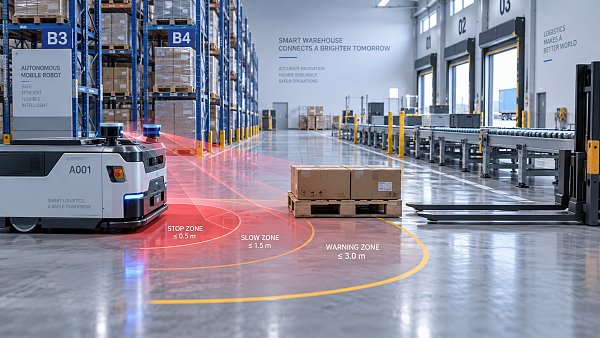
On 22 May 2026, the German Association of Engineers (VDI) formally implemented the revised VDI 2510 standard, mandating a minimum dynamic obstacle avoidance success rate of 99.997% for industrial-grade automated guided vehicles (AGVs) and autonomous mobile robots (AMRs) deployed in complex factory environments. This regulatory shift directly impacts Chinese manufacturers exporting to the EU market, triggering technical reassessments across the supply chain—particularly concerning LiDAR–machine vision (MV) sensor fusion architecture, environmental light resilience, and time-synchronized multi-sensor validation.
Event Overview
The VDI 2510 revision entered into force on 22 May 2026. It specifies that all AGVs/AMRs placed on the EU market must achieve ≥99.997% dynamic obstacle avoidance success under real-world operational conditions—including variable lighting, moving personnel, occlusions, and mixed-floor surface reflectivity. Compliance is evaluated using standardized test sequences defined in Annex C of the document. The metric explicitly depends on three measurable parameters: LiDAR point cloud density (≥1.2 million points/sec at 10 m), MV sub-pixel motion recognition latency (≤12 ms end-to-end), and hardware-level timestamp synchronization accuracy across sensors (≤50 ns jitter).
Industries Affected
Direct Exporters
Chinese OEMs and system integrators supplying AGVs/AMRs to EU-based automotive, logistics, and electronics manufacturers face immediate compliance pressure. Non-compliant units risk rejection during pre-delivery audits or post-market surveillance by notified bodies. Impact manifests as delayed shipments, increased third-party certification costs (e.g., TÜV Rheinland’s new VDI 2510-2026 test protocol), and renegotiation of contractual SLAs covering safety performance guarantees.
Raw Material Suppliers
Suppliers of core components—including 1550 nm LiDAR modules, global-shutter CMOS image sensors, and time-synchronized FPGA carrier boards—are seeing revised technical inquiry patterns. EU procurement teams now routinely request evidence of IEC/EN 62471 photobiological safety ratings for laser emitters and ISO/IEC 81001-5-1 conformance reports for MV inference pipelines. Absence of such documentation reduces quotation win rates by an estimated 30–40%, per recent distributor feedback from Stuttgart and Munich.
Contract Manufacturers & OEMs
Domestic contract manufacturers assembling AGV chassis, drive units, or control cabinets must verify upstream component traceability against VDI 2510’s calibration chain requirements. Firmware updates, thermal derating profiles, and electromagnetic compatibility (EMC) margin testing now require co-signature from both hardware and functional safety engineers—extending NPI cycles by 4–6 weeks on average.
Supply Chain Service Providers
Certification consultancies, test labs, and logistics firms offering CE marking support are adjusting service portfolios. New offerings include VDI 2510-specific test plan development, LiDAR-MV temporal alignment audits, and factory acceptance test (FAT) witnessing aligned with EN 1525:2022 + VDI 2510:2026 dual compliance. Lead times for accredited testing have lengthened to 11–14 weeks, up from 6–8 weeks in Q1 2026.
Key Focus Areas and Recommended Actions
Validate LiDAR Environmental Robustness Under Realistic Lighting Conditions
Manufacturers must conduct independent testing of LiDAR modules under >10,000 lux ambient illumination (simulating skylight + LED factory lighting), measuring point cloud dropout rate and false-negative detection incidence—not just datasheet specs. Relying solely on manufacturer-provided lab data is no longer sufficient for notified body review.
Verify MV Pipeline Certification Against ISO/IEC 81001-5-1
The standard references ISO/IEC 81001-5-1 (Health software and health IT systems risk management) as the benchmark for MV-based decision logic. While originally developed for clinical AI, its requirements on traceable training data provenance, adversarial input resilience, and runtime confidence scoring are now being applied de facto to AMR perception stacks. Teams should initiate gap analysis against Clauses 6.3 (data quality), 7.2 (model validation), and 8.4 (operational monitoring).
Implement Hardware-Level Sensor Time Synchronization
Software-only timestamp alignment (e.g., PTP over Ethernet) fails VDI 2510’s ≤50 ns jitter requirement. Firms must adopt IEEE 1588v2-compliant PHY layers with hardware timestamping or integrate dedicated timing ICs (e.g., Texas Instruments LMK04832) into sensor interface boards. Field validation requires oscilloscope capture of sync pulse skew across all sensor triggers.
Editorial Perspective / Industry Observation
Observably, this is not merely a technical uplift—it reflects a broader regulatory pivot toward *performance-based assurance* rather than prescriptive design rules. Unlike earlier standards (e.g., EN 1525), VDI 2510:2026 treats the robot as a closed-loop cyber-physical system where sensor fusion integrity is inseparable from functional safety. Analysis shows that less than 12% of currently certified Chinese AGV models have published test data meeting the 99.997% threshold under dynamic multi-obstacle scenarios. From an industry perspective, the bottleneck lies less in raw sensor capability and more in integrated system-level verification rigor—especially around temporal causality in perception-action loops. Current more critical gaps involve firmware update rollback safety and edge-case handling in partial sensor degradation modes.
Conclusion
This regulatory milestone signals a maturation phase for the global AMR market: safety expectations are shifting from ‘fail-safe’ to ‘always-correct-in-context’. For Chinese exporters, compliance is not optional—it is the baseline for market access. However, the stricter bar also creates differentiation opportunities for firms investing early in verifiable, audit-ready sensor fusion architectures. A rational interpretation is that VDI 2510:2026 functions less as a barrier and more as a catalyst for engineering discipline—and those who treat it as such stand to gain long-term credibility beyond the EU.
Source Attribution
Official text: VDI 2510 Blatt 2:2026 “Sicherheit von fahrerlosen Transportsystemen – Anforderungen an die dynamische Hinderniserkennung”, published by VDI Verlag GmbH, Berlin (ISBN 978-3-18-525102-6).
Supporting guidance: “VDI 2510 Interpretation Note No. 3/2026”, issued 15 April 2026 by VDI Committee on Automation.
Ongoing observation: Implementation timelines for harmonized standards under EU Machinery Regulation (EU) 2023/1230; potential inclusion of VDI 2510 metrics in future EN ISO 3691-4 revisions.
Search News
Hot Articles
- Carbon Fiber StructuresHow to Specify Aerospace Carbon Fiber Assemblies for Lightweight, Load-Bearing PartsJul 11, 2026
- Machine VisionXiaomi, Alibaba DAMO Academy Drive Open-Source Robotics Model Ecosystem, Lowering Algorithm Development Barriers for Overseas SMEs Adopting Chinese Robotics SolutionsMar 30, 2026
- Cobots & ArmsShanxi 'AI+' Conference Showcases Embodied Intelligence with Multinational Buyer Engagement: Key Industry ImplicationsMar 30, 2026
Popular Tags
Recommended News
 Jul 11, 2026How to Specify Aerospace Carbon Fiber Assemblies for Lightweight, Load-Bearing PartsAerospace carbon fiber assemblies: learn how to specify laminate design, load data, joining methods, and inspection controls for lighter, reliable load-bearing aerospace parts.Elena Rostova (UAV Systems Researcher)
 Mar 30, 2026Xiaomi, Alibaba DAMO Academy Drive Open-Source Robotics Model Ecosystem, Lowering Algorithm Development Barriers for Overseas SMEs Adopting Chinese Robotics SolutionsXiaomi & Alibaba DAMO Academy's open-source robotics models lower algorithm barriers for global SMEs. Boost efficiency in manufacturing, logistics & smart retail with ROS 2 compatible solutions.TSV Data Lab
 Mar 30, 2026Shanxi 'AI+' Conference Showcases Embodied Intelligence with Multinational Buyer Engagement: Key Industry ImplicationsShanxi 'AI+' Conference highlights embodied intelligence with Tesla, Ubtech & Jiantao showcasing multimodal robotics. 40+ global buyers validated tech on-site, creating new B2B channels for industrial automation & AI solutions.Chen Wei (Automation Lead Engineer)
 Mar 30, 2026Zhongguancun Unveils 6G Integrated Sensing-Computing-Intelligence Platform to Empower Embodied Robots for Global Industrial ApplicationsZhongguancun's new 6G platform revolutionizes industrial robotics with <10ms latency, empowering global automotive, logistics & port automation. Discover how this tech boosts China's smart manufacturing exports.TSV Data Lab
 Mar 30, 2026Mech-Mind Tianjin Embodied Intelligence R&D and Production Base Goes Live, Cutting Delivery Time by 20%–30% for Global Customized AMR+Vision SolutionsMech-Mind's Tianjin AMR+Vision production base cuts delivery time by 20%-30% for欧美 & Latin American markets. Discover how this PLd-certified facility accelerates customized robotics solutions for smart manufacturing and logistics.Chen Wei (Automation Lead Engineer)
 Mar 30, 2026Boao Forum Reveals 'Co-evolution of Big and Small Brains' Trend in Humanoid Robots, China's Embodied Intelligence Accelerates Adaptation to Overseas Manufacturing Service ScenariosDiscover how China's humanoid robots, featuring 'Co-evolution of Big and Small Brains,' are revolutionizing global manufacturing. Learn about Embodied Tian Gong 3.0's ISO compliance and overseas deployment at Boao Forum 2026.Chen Wei (Automation Lead Engineer)
 Mar 30, 2026China Railway Industrial Secures Patent for Embodied Robotics in Material Handling, Boosting High-Precision Delivery Capabilities for Overseas Infrastructure and Manufacturing ProjectsChina Railway Industrial's new patent for embodied robotics in material handling boosts high-precision delivery for global infrastructure & manufacturing. Discover how this innovation enhances logistics accuracy in automotive, rail transit & EPC projects.Chen Wei (Automation Lead Engineer)
 Oct 06, 2026Navigation Fault Tolerance Standards for AMRs: What Safety Teams Must VerifyNavigation fault tolerance standards: learn what AMR safety teams must verify, from localization loss and sensor faults to stopping distance, safe restart, and site-specific validation.Chen Wei (Automation Lead Engineer)
 Oct 05, 2026Calculating Edge Computing Total Cost of Ownership Across Distributed SitesEdge computing ownership cost explained: calculate deployment, energy, connectivity, security, remote support, and refresh costs across distributed sites.TSV Data Lab
 Oct 04, 2026CAD/CAM Benchmarking in the GCC: What Manufacturers Should Ask a ConsultantCAD CAM benchmark consultant GCC guide: learn the key questions manufacturers should ask to validate post-processors, workflows, machine performance, and production risk.Victor Lin (Chief Software Architect)
 Oct 03, 2026Selecting Automotive Radar Sensor Modules for ADAS Range, Resolution, and IntegrationAutomotive radar sensor module selection guide for ADAS: compare range, resolution, field of view, latency, and integration to build safer, reliable vehicle systems.TSV Data Lab
 Oct 02, 2026How to Qualify Machined Parts Suppliers for Hard Tech ProgramsHard tech supply chain machined parts demand rigorous supplier qualification. Learn how to assess capability, traceability, quality controls, and delivery resilience.Dr. Marcus Vance
 Oct 01, 2026How to Select an Outdoor Security Radar Sensor for Perimeter Detection?Outdoor security radar sensor selection guide: compare range, accuracy, false-alarm control, integration, and field testing for reliable perimeter detection.TSV Data Lab
 Sep 30, 2026How to Evaluate Solid-State LiDAR Hardware for Outdoor Autonomous VehiclesSolid state LiDAR hardware evaluation guide for outdoor autonomous vehicles—compare range, point-cloud quality, environmental resilience, integration, and safety.TSV Data Lab
 Sep 29, 2026ISO 9283 Repeatability: How to Evaluate Cobot Positioning PerformanceISO 9283 cobot repeatability explained: learn how payload, reach, approach direction, and test conditions affect positioning performance and cell capability.Chen Wei (Automation Lead Engineer)
 Oct 06, 2026Are Collaborative Robots Safe Enough to Operate Without Fencing?Are collaborative robots safe enough to work without fencing? Explore risk assessment, safeguarding options, and practical guidance for safer, productive cobot cells.Chen Wei (Automation Lead Engineer)
 Oct 05, 2026What Causes Machine Vision Systems to Miss Small Defects?What causes machine vision systems to miss small defects? Discover how lighting, optics, motion, and AI thresholds affect detection—and prevent costly escapes.TSV Data Lab
 Oct 04, 2026How Should You Compare 5-Axis CNC Machine Accuracy Claims?How do I compare 5-axis CNC machine accuracy claims? Learn how to assess standards, thermal stability, TCP accuracy, and real-world test evidence.Dr. Marcus Vance
 Oct 03, 2026Is Edge Computing Necessary for Real-Time Quality Inspection?Is industrial edge computing necessary for real-time quality inspection? Explore how latency, data volume, reliability, and control integration shape the right architecture.TSV Data Lab
 Oct 02, 2026What Documents Prove a Precision Machining Supplier Can Hold Tolerance?What documents prove a precision machining supplier can hold tolerance? Explore certificates, FAI reports, calibration, SPC, and traceability evidence to qualify suppliers with confidence.Dr. Marcus Vance
 Oct 01, 2026Can a Machining Supplier Meet Aerospace Fatigue Testing Requirements?Can a machining supplier meet aerospace fatigue testing requirements? Learn the traceability, process control, and test evidence needed for reliable aerospace parts.Dr. Marcus Vance
 Sep 30, 2026Which Industrial Robot Specifications Matter for High-Precision Assembly?Which industrial robot specifications matter most for high-precision assembly? Explore repeatability, accuracy, stiffness, vibration, calibration, and force control for reliable yields.Chen Wei (Automation Lead Engineer)
 Sep 29, 2026How Do You Verify Servo Motor Torque Under Continuous Load?How do I verify servo motor torque under continuous load? Learn RMS torque checks, torque-speed limits, thermal derating, and real-machine testing.Chen Wei (Automation Lead Engineer)
 Oct 02, 2026ZD330 Software Configuration: Verifying Cut-List Import Before PurchaseZD330 software and machine configuration: verify cut-list imports, data mapping, labels, and workflow before purchase to reduce errors and choose with confidence.Victor Lin (Chief Software Architect)