3D printing for aerospace prototypes cuts lead time fast
Publication Date
author
For project schedules shaped by tight validation windows, 3d printing for aerospace prototypes has become a practical acceleration tool.
It supports faster design checks, shorter supplier wait times, and earlier engineering decisions across complex development programs.
Instead of waiting weeks for machined trial parts, teams can review geometry, assembly interfaces, and selected functional features within days.
That timing advantage matters in aerospace, where every delay can affect testing plans, certification preparation, and cost control.
Used correctly, 3d printing for aerospace prototypes does not replace engineering discipline.
It strengthens it by enabling faster evidence, tighter iteration loops, and clearer communication between design, analysis, and production teams.
What 3d Printing for Aerospace Prototypes Means in Practice
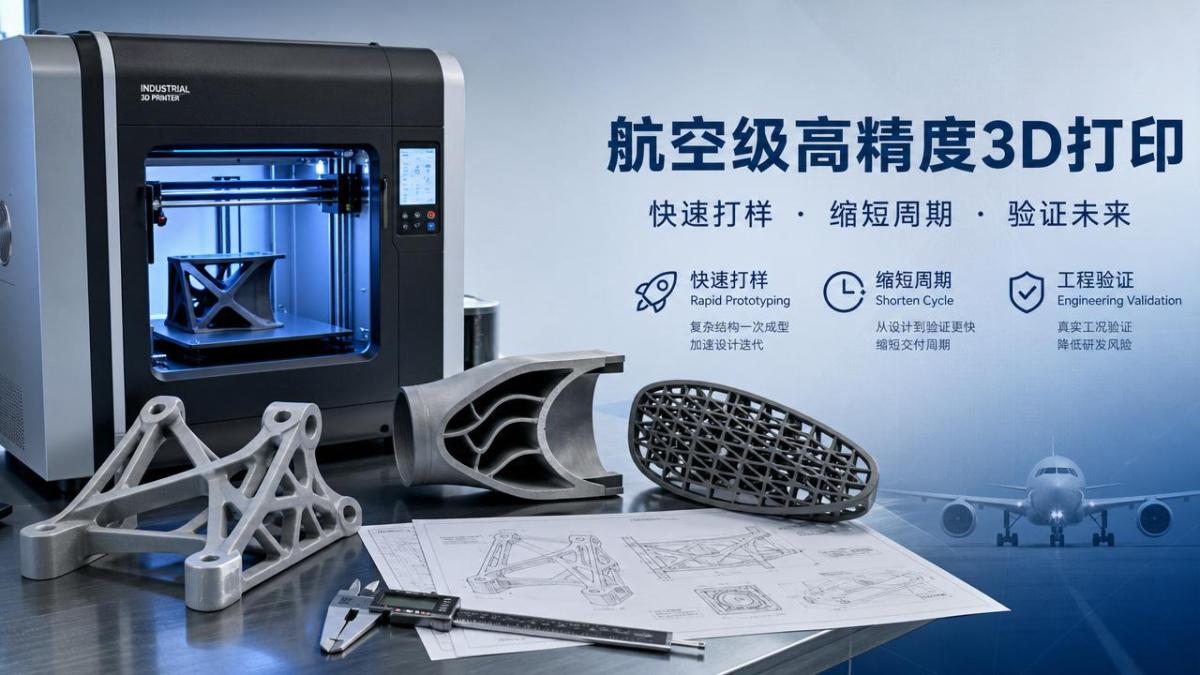
In practical terms, 3d printing for aerospace prototypes is the use of additive manufacturing to create early-stage parts for evaluation.
These parts may support visual review, fit checks, wind tunnel preparation, tooling studies, or selected mechanical testing.
The method is valuable because aerospace designs often include thin walls, internal channels, lattice structures, and weight-sensitive geometries.
Such features can be difficult or slow to prototype using only conventional machining.
Additive workflows usually begin with a CAD model, then proceed through build preparation, material selection, printing, post-processing, and inspection.
The output is not automatically flight hardware.
Its purpose is to generate reliable learning earlier in the development cycle.
Common prototype objectives
- Validate external and internal geometry
- Confirm assembly clearances and fastener access
- Assess routing paths for ducts, wiring, or sensors
- Support aerodynamic or thermal test preparation
- Reduce risk before expensive tooling or machining
Industry Drivers Behind Faster Prototype Adoption
The aerospace sector is under constant pressure to compress development cycles while maintaining traceability and technical rigor.
That pressure is visible across commercial aviation, space systems, defense programs, and unmanned platforms.
Programs now demand more variants, more electronics integration, and more validation data earlier than before.
As a result, 3d printing for aerospace prototypes is increasingly evaluated as a schedule-control method, not only a fabrication option.
This environment aligns closely with TSV’s data-first perspective.
Engineering choices should be based on tolerances, material behavior, process stability, and inspection evidence.
That is exactly where 3d printing for aerospace prototypes creates value when managed with technical discipline.
Lead Time Reduction and Engineering Value
The strongest reason to adopt 3d printing for aerospace prototypes is lead time compression.
However, speed alone is not the full benefit.
The larger advantage is earlier engineering insight, which can prevent cost escalation later.
Key business and technical gains
- Faster concept verification before formal release
- Reduced waiting time for low-volume trial components
- Better visibility into assembly conflicts
- Lower rework risk before hard tooling investment
- Improved collaboration across design, testing, and sourcing functions
A simple bracket or duct may reveal mounting interference before expensive machining begins.
A scaled aerodynamic form may support review decisions that would otherwise wait for external suppliers.
An internal flow path can be visualized physically instead of being debated only on screen.
In each case, faster evidence reduces uncertainty.
That is why 3d printing for aerospace prototypes often improves both schedule confidence and technical alignment.
Typical Aerospace Prototype Scenarios
Not every part should be approached the same way.
The right use case depends on function, material demands, tolerance needs, and test purpose.
These scenarios show why 3d printing for aerospace prototypes has relevance across the wider industrial landscape, not only final aircraft structures.
It touches design validation, tooling, testing, and cross-functional communication.
Process, Material, and Quality Considerations
Fast prototypes still require controlled decisions.
Without clear requirements, speed can produce misleading conclusions.
The selection of process and material should match the intended learning objective.
Critical checkpoints
- Define whether the goal is visual, dimensional, or functional validation
- Specify tolerance needs before quoting or printing
- Check surface finish expectations for mating interfaces
- Confirm thermal and load conditions for test parts
- Plan post-processing and inspection time realistically
For example, polymer parts may be ideal for fit checks and handling studies.
Metal additive prototypes may be more suitable for heat exposure, stiffness review, or selected bench testing.
Even then, properties can vary with orientation, powder condition, and post-build treatment.
That is why parameter transparency matters.
TSV’s manifesto emphasizes that tolerances dictate success, and additive prototype programs should follow the same principle.
Practical Guidance for Implementation
A structured workflow improves the results of 3d printing for aerospace prototypes.
The goal is not to print everything quickly.
The goal is to print the right evidence at the right stage.
- Rank candidate parts by schedule risk and geometry complexity.
- Assign each part a prototype purpose and acceptance criteria.
- Choose process routes based on data, not assumptions.
- Capture lessons from each iteration in a traceable review log.
- Use inspection results to refine both design and supplier selection.
This method helps avoid a common mistake.
Teams often treat additive prototypes as informal models, then over-interpret or under-interpret the results.
Clear documentation keeps the learning useful and comparable.
When linked with inspection data and engineering benchmarks, 3d printing for aerospace prototypes becomes a repeatable development asset.
Next-Step Evaluation Framework
A practical next step is to evaluate where prototype delays currently create the most downstream cost.
That may be design reviews, test setup, fixture availability, or low-volume metal trial parts.
From there, build a short list of components that would benefit most from additive iteration.
Measure lead time, tolerance outcome, post-processing effort, and decision impact for each case.
This evidence-based approach reflects the broader TSV philosophy: remove noise, compare parameters, and make sourcing or engineering choices from verified data.
When applied with that mindset, 3d printing for aerospace prototypes can cut lead time fast while preserving the engineering truth behind every decision.
Search News
Hot Articles
- Carbon Fiber StructuresHow to Specify Aerospace Carbon Fiber Assemblies for Lightweight, Load-Bearing PartsJul 11, 2026
- Machine VisionXiaomi, Alibaba DAMO Academy Drive Open-Source Robotics Model Ecosystem, Lowering Algorithm Development Barriers for Overseas SMEs Adopting Chinese Robotics SolutionsMar 30, 2026
- Cobots & ArmsShanxi 'AI+' Conference Showcases Embodied Intelligence with Multinational Buyer Engagement: Key Industry ImplicationsMar 30, 2026
Popular Tags
Recommended News
 Jul 11, 2026How to Specify Aerospace Carbon Fiber Assemblies for Lightweight, Load-Bearing PartsAerospace carbon fiber assemblies: learn how to specify laminate design, load data, joining methods, and inspection controls for lighter, reliable load-bearing aerospace parts.Elena Rostova (UAV Systems Researcher)
 Mar 30, 2026Xiaomi, Alibaba DAMO Academy Drive Open-Source Robotics Model Ecosystem, Lowering Algorithm Development Barriers for Overseas SMEs Adopting Chinese Robotics SolutionsXiaomi & Alibaba DAMO Academy's open-source robotics models lower algorithm barriers for global SMEs. Boost efficiency in manufacturing, logistics & smart retail with ROS 2 compatible solutions.TSV Data Lab
 Mar 30, 2026Shanxi 'AI+' Conference Showcases Embodied Intelligence with Multinational Buyer Engagement: Key Industry ImplicationsShanxi 'AI+' Conference highlights embodied intelligence with Tesla, Ubtech & Jiantao showcasing multimodal robotics. 40+ global buyers validated tech on-site, creating new B2B channels for industrial automation & AI solutions.Chen Wei (Automation Lead Engineer)
 Mar 30, 2026Zhongguancun Unveils 6G Integrated Sensing-Computing-Intelligence Platform to Empower Embodied Robots for Global Industrial ApplicationsZhongguancun's new 6G platform revolutionizes industrial robotics with <10ms latency, empowering global automotive, logistics & port automation. Discover how this tech boosts China's smart manufacturing exports.TSV Data Lab
 Mar 30, 2026Mech-Mind Tianjin Embodied Intelligence R&D and Production Base Goes Live, Cutting Delivery Time by 20%–30% for Global Customized AMR+Vision SolutionsMech-Mind's Tianjin AMR+Vision production base cuts delivery time by 20%-30% for欧美 & Latin American markets. Discover how this PLd-certified facility accelerates customized robotics solutions for smart manufacturing and logistics.Chen Wei (Automation Lead Engineer)
 Mar 30, 2026Boao Forum Reveals 'Co-evolution of Big and Small Brains' Trend in Humanoid Robots, China's Embodied Intelligence Accelerates Adaptation to Overseas Manufacturing Service ScenariosDiscover how China's humanoid robots, featuring 'Co-evolution of Big and Small Brains,' are revolutionizing global manufacturing. Learn about Embodied Tian Gong 3.0's ISO compliance and overseas deployment at Boao Forum 2026.Chen Wei (Automation Lead Engineer)
 Mar 30, 2026China Railway Industrial Secures Patent for Embodied Robotics in Material Handling, Boosting High-Precision Delivery Capabilities for Overseas Infrastructure and Manufacturing ProjectsChina Railway Industrial's new patent for embodied robotics in material handling boosts high-precision delivery for global infrastructure & manufacturing. Discover how this innovation enhances logistics accuracy in automotive, rail transit & EPC projects.Chen Wei (Automation Lead Engineer)
 Oct 07, 2026How to Evaluate an HMI Panel Distributor for Industrial Automation ProjectsHMI panel distributor evaluation guide: verify technical compatibility, traceability, supply reliability, lifecycle support, and total cost for automation projects.Victor Lin (Chief Software Architect)
 Oct 06, 2026Navigation Fault Tolerance Standards for AMRs: What Safety Teams Must VerifyNavigation fault tolerance standards: learn what AMR safety teams must verify, from localization loss and sensor faults to stopping distance, safe restart, and site-specific validation.Chen Wei (Automation Lead Engineer)
 Oct 05, 2026Calculating Edge Computing Total Cost of Ownership Across Distributed SitesEdge computing ownership cost explained: calculate deployment, energy, connectivity, security, remote support, and refresh costs across distributed sites.TSV Data Lab
 Oct 04, 2026CAD/CAM Benchmarking in the GCC: What Manufacturers Should Ask a ConsultantCAD CAM benchmark consultant GCC guide: learn the key questions manufacturers should ask to validate post-processors, workflows, machine performance, and production risk.Victor Lin (Chief Software Architect)
 Oct 03, 2026Selecting Automotive Radar Sensor Modules for ADAS Range, Resolution, and IntegrationAutomotive radar sensor module selection guide for ADAS: compare range, resolution, field of view, latency, and integration to build safer, reliable vehicle systems.TSV Data Lab
 Oct 02, 2026How to Qualify Machined Parts Suppliers for Hard Tech ProgramsHard tech supply chain machined parts demand rigorous supplier qualification. Learn how to assess capability, traceability, quality controls, and delivery resilience.Dr. Marcus Vance
 Oct 01, 2026How to Select an Outdoor Security Radar Sensor for Perimeter Detection?Outdoor security radar sensor selection guide: compare range, accuracy, false-alarm control, integration, and field testing for reliable perimeter detection.TSV Data Lab
 Sep 30, 2026How to Evaluate Solid-State LiDAR Hardware for Outdoor Autonomous VehiclesSolid state LiDAR hardware evaluation guide for outdoor autonomous vehicles—compare range, point-cloud quality, environmental resilience, integration, and safety.TSV Data Lab
 Sep 29, 2026ISO 9283 Repeatability: How to Evaluate Cobot Positioning PerformanceISO 9283 cobot repeatability explained: learn how payload, reach, approach direction, and test conditions affect positioning performance and cell capability.Chen Wei (Automation Lead Engineer)
 Oct 06, 2026Are Collaborative Robots Safe Enough to Operate Without Fencing?Are collaborative robots safe enough to work without fencing? Explore risk assessment, safeguarding options, and practical guidance for safer, productive cobot cells.Chen Wei (Automation Lead Engineer)
 Oct 05, 2026What Causes Machine Vision Systems to Miss Small Defects?What causes machine vision systems to miss small defects? Discover how lighting, optics, motion, and AI thresholds affect detection—and prevent costly escapes.TSV Data Lab
 Oct 04, 2026How Should You Compare 5-Axis CNC Machine Accuracy Claims?How do I compare 5-axis CNC machine accuracy claims? Learn how to assess standards, thermal stability, TCP accuracy, and real-world test evidence.Dr. Marcus Vance
 Oct 03, 2026Is Edge Computing Necessary for Real-Time Quality Inspection?Is industrial edge computing necessary for real-time quality inspection? Explore how latency, data volume, reliability, and control integration shape the right architecture.TSV Data Lab
 Oct 02, 2026What Documents Prove a Precision Machining Supplier Can Hold Tolerance?What documents prove a precision machining supplier can hold tolerance? Explore certificates, FAI reports, calibration, SPC, and traceability evidence to qualify suppliers with confidence.Dr. Marcus Vance
 Oct 01, 2026Can a Machining Supplier Meet Aerospace Fatigue Testing Requirements?Can a machining supplier meet aerospace fatigue testing requirements? Learn the traceability, process control, and test evidence needed for reliable aerospace parts.Dr. Marcus Vance
 Sep 30, 2026Which Industrial Robot Specifications Matter for High-Precision Assembly?Which industrial robot specifications matter most for high-precision assembly? Explore repeatability, accuracy, stiffness, vibration, calibration, and force control for reliable yields.Chen Wei (Automation Lead Engineer)
 Sep 29, 2026How Do You Verify Servo Motor Torque Under Continuous Load?How do I verify servo motor torque under continuous load? Learn RMS torque checks, torque-speed limits, thermal derating, and real-machine testing.Chen Wei (Automation Lead Engineer)